

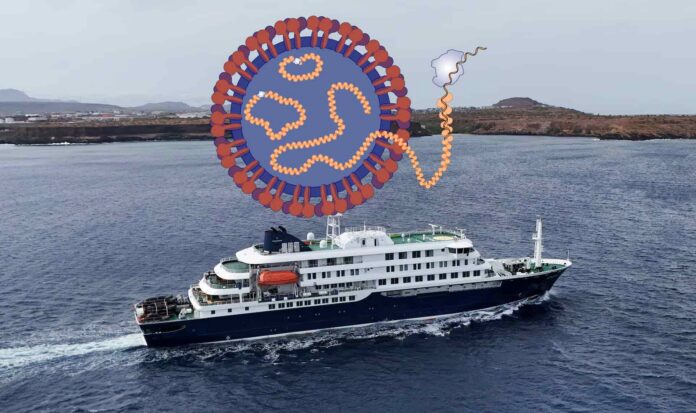
MV Hondius, the Dutch-flagged expedition cruise ship hit by a hantavirus outbreak, is heading towards Spain’s Canary Islands after three people died from the infection. It is expected to arrive around 10 May 2026 after departing from off the coast of Cape Verde, where it had been anchored for several days as a precautionary measure. The vessel, operated by Oceanwide Expeditions and carrying approximately 147 passengers and crew from over 20 nationalities, left Ushuaia in Argentina on 1 April 2026 for a polar expedition that included stops in Antarctica, the Falkland Islands, South Georgia, and remote Atlantic islands.
The outbreak first came to light in early April when passengers began developing flu-like symptoms. The initial case involved a 70-year-old Dutch man who fell ill around 6 April with fever, headache, and mild gastrointestinal issues while the ship was sailing towards Saint Helena. He died on board on 11 April. At the time, the cause could not be determined microbiologically. His body, along with his wife and other passengers, was taken off the vessel during a stop at the British Overseas Territory of Saint Helena on 24 April.
The wife later collapsed at Johannesburg airport in South Africa and died on 26 April. Laboratory tests subsequently confirmed she had contracted hantavirus. A third death, a German national, occurred more recently, bringing the total fatalities to three. At least eight cases have been linked to the ship, with one British passenger remaining in intensive care in South Africa. Five of these cases are laboratory-confirmed, while the rest three are suspected.
Compounding concerns, around 29 to 40 passengers, reports vary slightly between the ship operator’s figure of 29 and the Dutch Foreign Ministry’s estimate of about 40, disembarked at Saint Helena on 24 April without formal contact tracing, as the hantavirus link had not yet been established. This group included the deceased Dutch man’s wife, who flew onward to South Africa. Health authorities have since initiated tracing efforts for these individuals and others who left the vessel earlier.
On 6 May, three more individuals, two crew members (one British and one Dutch) with suspected infections and a close contact of a confirmed case, were medically evacuated from the ship off Cape Verde and flown to specialised hospitals in the Netherlands for urgent care. Cape Verde authorities had refused permission for the vessel to dock, citing public health precautions. The ship then set sail for the Canary Islands, where Spanish authorities plan thorough screening, disinfection, and repatriation of passengers and crew who remain asymptomatic.
When the ship was docked at Cape Verde, local health authorities visited the vessel to assess the condition of the two symptomatic individuals. Cape Verde sent a medical team of two doctors, a nurse and a laboratory specialist to the ship over three trips for the assessment.
The World Health Organisation (WHO) has been closely monitoring the situation since it was notified on 2 May. It describes the public health risk as low and has stated there is no need for travel restrictions or panic. WHO experts, including Dr Maria Van Kerkhove, have noted the possibility of limited human-to-human transmission among close contacts, such as cabin-mates or spouses, which is a rare feature of the Andes strain of hantavirus identified in this outbreak. The organisation is coordinating an international response involving case isolation, medical evacuations, laboratory testing, and epidemiological investigations across multiple countries.
The European Centre for Disease Prevention and Control (ECDC), the EU’s health authority, has said that the risk to Europeans remains “very low.” It has highlighted that while most hantaviruses do not spread directly between people, the Andes strain, which is endemic to parts of South America, has documented rare instances of limited person-to-person transmission through close and prolonged contact.
The Netherlands’ National Institute for Public Health and the Environment (RIVM) and South Africa’s health authorities are assisting with testing and contact tracing. Spanish officials have assured that the arrival in Tenerife will not pose a risk to the public, with operations supported by the EU’s civil protection mechanism.
Hantavirus is a group of rodent-borne viruses that cause serious illness in humans, primarily through inhalation of aerosolised particles from the urine, droppings, or saliva of infected rodents, such as the pygmy rice rat for the Andes strain. In this case, the confirmed Andes virus, prevalent in Argentina and Chile, can, in rare instances, spread between people via close contact, though it is not airborne like respiratory viruses.
Initial symptoms mimic the flu: fever, muscle aches, headache, nausea, and fatigue. The disease can rapidly progress to hantavirus pulmonary syndrome (HPS), involving severe respiratory distress, fluid-filled lungs, and potentially fatal cardiovascular collapse. The fatality rate for HPS can reach 30-40 per cent, making it particularly deadly without prompt hospital care.
There is no specific antiviral treatment or approved vaccine for hantavirus infections, including the Andes strain. Management relies entirely on supportive care, hospitalisation, oxygen therapy, mechanical ventilation if needed, and fluids, to help the body fight the infection. Full recovery, when it occurs, can take weeks to months.
Prevention remains the cornerstone, avoiding contact with rodents and their habitats, especially in endemic areas, sealing homes against pests, and cleaning infested spaces carefully by wearing masks and gloves, wetting droppings with disinfectant before removal, and washing hands thoroughly. On cruise ships or in group settings, strict hygiene, isolation of symptomatic individuals, and rodent-control measures are essential.
Health authorities worldwide continue to stress that while this outbreak is serious, the overall risk outside close contacts remains minimal, and international coordination is underway to ensure safe resolution as the MV Hondius approaches its destination. Passengers still on board are under quarantine protocols in their cabins, with regular monitoring.
