

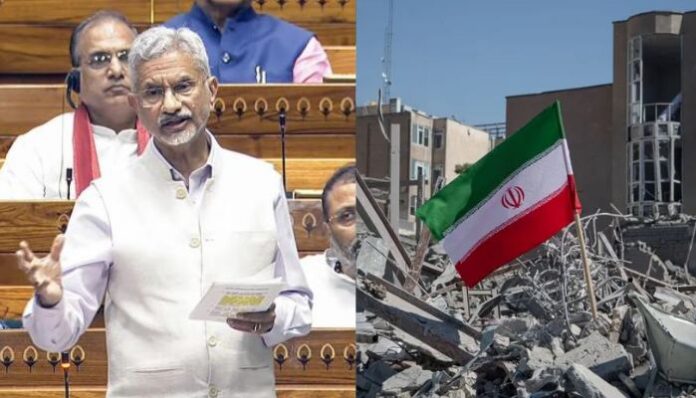
External Affairs Minister S Jaishankar on Monday, 9th March, told the Rajya Sabha that the interests of Indian consumers will be the “overriding priority” of the government as tensions are rising in West Asia. Jaishankar said that the conflict in the region may result in disruptions in global supply chains, which may impact energy supplies, maritime routes, and international trade.
While Jaishankar made these remarks in the Upper House of the Indian Parliament amidst sloganeering by the Opposition parties, the External Affairs Minister said that the Indian government is monitoring the situation in the region and assessing the impact of the situation on the Indian economy.
Stating that the stability of the West Asian region is of great importance for the Indian economy, Jaishankar said, “West Asia must remain stable and peaceful.” He said that the Indian government is in regular touch with the countries in the region and is keeping a close eye on the situation in the region.
“Our government had issued a statement on 20th February expressing deep concern and urging all sides to exercise restraint,” Jaishankar said. “We continue to believe that dialogue and diplomacy should be pursued to de-escalate the tensions.”
Conflict intensifies across West Asia
In his suo motu statement in Parliament, Jaishankar said the latest round of conflict began on 28th February, 2026, and has since expanded across the region.
He said the situation now involves fighting between Israel and the United States on one side and Iran on the other, along with attacks on several Gulf countries. The violence has led to heavy casualties and large-scale damage to infrastructure.
“This round of conflict started on 28th February 2026. It has witnessed not only fighting between Israel and the United States on one side and Iran on the other, but also attacks on several Gulf States,” Jaishankar said. He added that the government had immediately issued a statement expressing concern and urging all parties to avoid further escalation.
“We believed and continue to believe that dialogue and diplomacy should be pursued to de-escalate tensions and address underlying issues,” he said, adding that the sovereignty and territorial integrity of all countries in the region must be respected.
Government monitoring impact on Indians and economy
Jaishankar said the Cabinet Committee on Security (CCS) met on 1st March under the chairmanship of Prime Minister Narendra Modi to assess the situation.
The committee reviewed the airstrikes in Iran and subsequent attacks in several Gulf countries, and discussed their impact on regional security, trade and the safety of Indians living in the region. He said that the region has a large Indian population, and nearly one crore Indians live and work in the Gulf countries. At the same time, several thousand Indians are also in Iran for work and study.
The government has been constantly monitoring the situation and has been issuing advisories for Indians in the region since the tensions in the region began to escalate this year. The Ministry of External Affairs had first advised Indians to avoid non-essential travel to Iran on 5th January, 2026, and later issued stronger advisories asking Indian nationals to leave the country if possible.
Developments in West Asia deep cause for concern for all of us, says EAM Jaishankar in Rajya Sabha.
— Press Trust of India (@PTI_News) March 9, 2026
We continue to believe dialogue and discussion should be used to resolve all issues, says MEA Jaishankar on West Asia conflict.
PM continues to closely monitor developments in… pic.twitter.com/8p17yhyDRZ
Over 67,000 Indians return from the region
Jaishankar informed the House that around 67,000 Indian nationals have returned from the region amid rising tensions.
Indian missions in the region have been working actively to assist citizens, including helping stranded passengers and facilitating cross-border travel.
The minister said Indian diplomats helped passengers move across borders in several cases, including from the UAE to Oman and from Qatar, Kuwait and Bahrain to Saudi Arabia.
Commercial flights and special flights have also been allowed for this purpose. “Almost 67,000 of our nationals have done so,” Jaishankar added that the government was making every possible effort to help Indians who want to leave the region or return home.
Iranian warship allowed to dock in Kochi
External Affairs Minister Jaishankar also addressed the issue related to the docking of an Iranian naval vessel in the country.
He said that “Iran had requested the government to allow three of the Iranian ships operating in the region to dock at Indian ports on 28th February. The request was approved on the 1st March, and one of the ships, IRIS Lavan, had docked at the Kochi port on the 4th March.”
The crew of the ship is currently at Indian naval facilities.
Jaishankar said that the decision to dock the ship was a humane decision and that the Iranian Foreign Minister had thanked them for the gesture.
Opposition protests and walkout
Soon after Jaishankar finished his statement, Parliamentary Affairs Minister Kiren Rijiju criticised the Opposition for not following the rules of the House. However, the Opposition continued with their protests and moved into the well of the House, prompting the Chair to adjourn the House till 3 pm. The members of the INDIA bloc staged a protest near the Makar Dwar in the Parliament.
Congress MP Jairam Ramesh defended the Opposition’s walkout, saying the government allowed only a statement but not a discussion.
“As expected, the external affairs minister made a ‘suo moto statement’ on the situation in the Rajya Sabha on which no questions can be asked or clarifications sought,” Ramesh said.
He added that the Opposition wanted an immediate discussion on the West Asia situation, but since it was not permitted, they decided to walk out after staging protests.
