

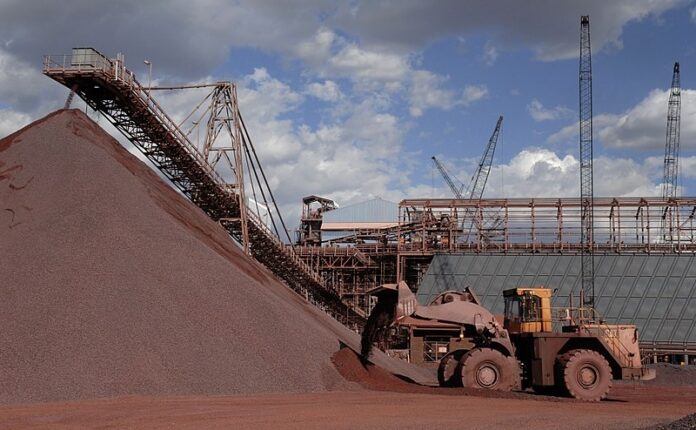
On National Science Day, India’s premier road research body, the CSIR-Central Road Research Institute (CSIR-CRRI), signed a major Research & Development agreement with steel giant ArcelorMittal Nippon Steel (AMNS) India. The pact focuses on exploring the large-scale use of iron ore tailings in road construction, with the goal of converting millions of tonnes of hazardous mining waste into valuable material for the construction of roads. This initiative represents a significant step forward in promoting a circular economy and developing low-carbon infrastructure.
Dr. N. Kalaiselvi, Director General of CSIR and Secretary, DSIR, described the collaboration as a game-changer, stating that the utilisation of iron ore tailings in road construction will help transform mine waste into sustainable “green roads.” She said that India currently generates 18–20 million tonnes of iron ore tailings annually from beneficiation plants in states such as Odisha, Chhattisgarh, and Karnataka. These fine waste materials, often referred to as “slimes,” are typically stored in large tailings dams, which present environmental and safety challenges.
The agreement was formally exchanged between Dr. Ch. Ravi Sekhar, Director of CSIR-CRRI, and Dr. N. Vishwanathan, Head of R&D at AMNS India, in the presence of Dr. Arvind Bodhankar, Chief Sustainability Officer at AMNS India. Under the pact, researchers at CSIR-CRRI will conduct detailed laboratory investigations, material characterisation, and full pavement design studies to determine how iron ore tailings can effectively replace natural aggregates in various road layers.
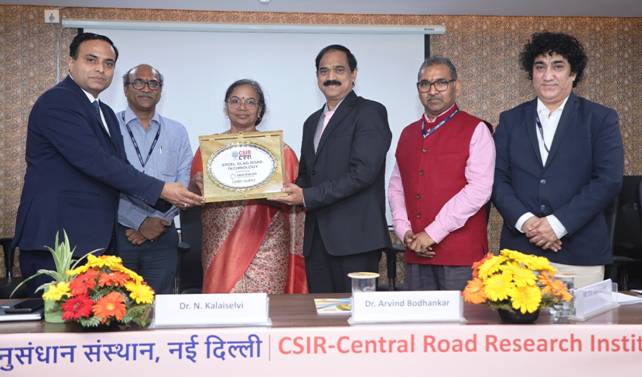
The project is being led by Satish Pandey, Head of the Flexible Pavement Division at CSIR-CRRI and the inventor of India’s successful Steel Slag Road Technology, which has already been implemented across several states.
Iron ore tailings (IOT) are the fine-grained, non-valuable solid residues left after iron ore is crushed, ground, and processed in beneficiation plants to extract usable iron content. They primarily consist of silica (typically 30–65%), alumina, residual iron oxides, and minor amounts of other minerals, with particle sizes generally ranging from a few microns to about 150 µm, giving them a silt-like or sandy texture. In India, these tailings are commonly stored as slimes in massive tailings ponds, where they occupy large areas of land and carry risks of dam failure or water contamination.
Once properly characterised and treated, iron ore tailings can serve as a partial or complete replacement for natural sand and aggregates in road construction. They can be incorporated into subgrade and sub-base layers, cement-stabilised base courses, and even asphalt pavement mixtures.
The implementation process includes laboratory testing to evaluate strength, compaction, durability, and environmental safety, followed by pavement layer design tailored to the material and eventual field trials to confirm performance under actual traffic and weather conditions. This approach builds on CSIR-CRRI’s proven waste-to-wealth technologies, such as steel slag roads and waste plastic geocells, providing a clear pathway for rapid scaling.
Using iron ore tailings in road construction offers several advantages. From an environmental perspective, the technology can divert 18–20 million tonnes of waste from tailings dams each year, thereby reducing land occupation, the risk of water pollution, and the carbon footprint associated with disposal. It also decreases the demand for quarrying virgin stone and sand, helping preserve natural resources and forests.
Economically, the approach can lower road construction costs by substituting expensive natural aggregates with locally available industrial waste. Studies indicate potential savings of up to 20% on fine aggregates while still meeting required strength standards.
In terms of performance and durability, properly processed tailings can enhance compaction, shear strength, and long-term stability in pavement layers. Research shows that they often match or exceed conventional materials in compressive and flexural strength when incorporated at optimal percentages, typically 10–20% in many mixes.
Overall, the initiative supports India’s net-zero ambitions and green infrastructure goals by converting mine waste into a national resource, aligning closely with Sustainable Development Goals and advancing the principles of a circular economy.
Dr. Arvind Bodhankar of AMNS India described the partnership as a perfect example of industry–research collaboration for nation-building, while Dr. Ch. Ravi Sekhar, Director of CRRI, emphasised the institute’s commitment to developing next-generation sustainable road technologies that will position India as a global leader in green pavements.
With laboratory work already underway and field trials planned in the near future, this R&D agreement has the potential to soon transform millions of tonnes of mine waste into thousands of kilometres of durable, eco-friendly roads across the country.
