

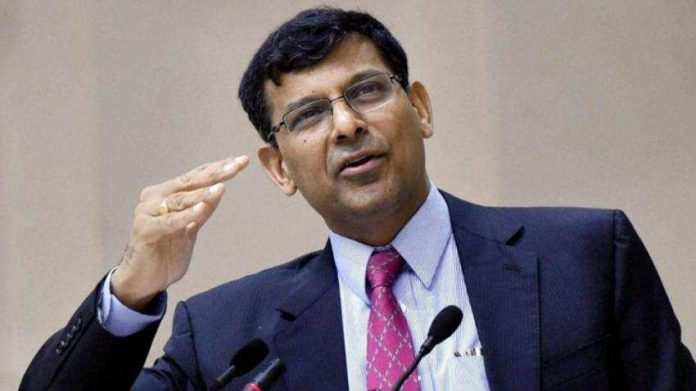
In the run-up to the Lok Sabha elections 2019, then Congress had announced in its manifesto a “Minimum Income Guarantee Scheme”- formally called Nyuntam Aay Yojana (NYAY), to five crore ‘poorest families’ covering 25 crore people by assuring them a guaranteeing minimum income of ₹6,000 per month or ₹72,000 a year. However, the party soon found itself at its wits’ end as questions related to the feasibility of such a costly ‘free money’ scheme started erupting. Former RBI governor, Raghuram Rajan, then came out in the defence of the dole-out scheme asserting that the Congress party consulted him on the workability of NYAY and that fiscal space can be created for its implementation.
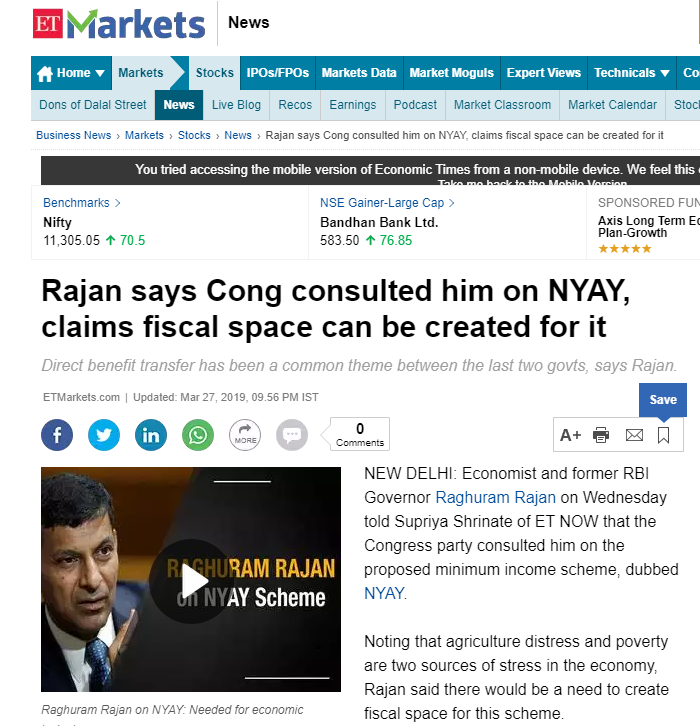
The article which was published on March 27, 2019, the former RBI governor defended NYAY scheme while many economists and financial advisors had put a question mark on the financial viability and feasibility of such a money-guzzling dole-out scheme. Rajan, in an interview, had then hailed NYAY saying that “It is important to create fiscal space for such schemes, which are actually effective”.
Read: ABP, ET, Quint, Outlook and others spread fake news about Raghuram Rajan slamming Piyush Goyal
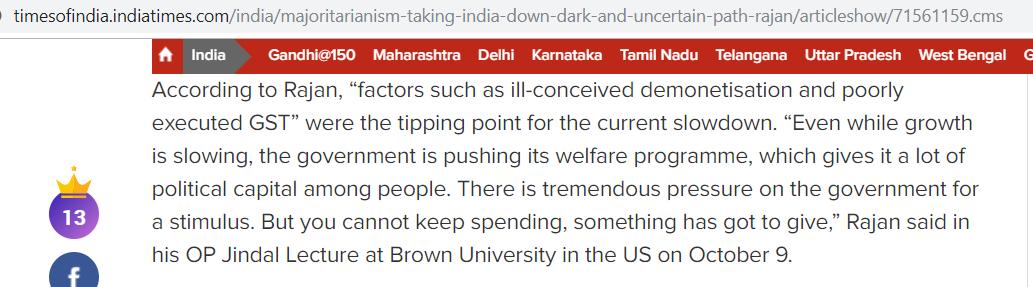
However, barely within 7 months, Rajan seems to have made an abrupt 180-degree turn on his understanding of welfare schemes. In his latest critique of the central government, Rajan held a dim view of the BJP government at the centre’s welfare schemes, claiming that they are aimed to gain political capital among people. Opposing the welfare schemes, he said that the country is in throes of economic slowdown and the country cannot keep spending on welfare schemes.
This assertion is in stark contrast to the views he had expressed about the implementation of Congress’ NYAY scheme. NYAY scheme if implemented would have cost Rs 3.60 lakh crores per year to the public exchequer or 2 per cent of the national income. At Rs 3.60 lakh crores, the outlay under the scheme was projected 3 times India’s fiscal deficit, six times the defence budget and two times the corporate receipts. For Rajan, creating fiscal space for such a huge expenditure was possible but the welfare schemes initiated by the current government to stimulate demand are ill-conceived.
Besides this u-turn, Rajan also made politically motivated remarks against the BJP government while delivering OP Jindal lecture at Watson Institute, Brown University, on October 9. Slamming central government’s alleged majoritarianism, Rajan warned that “It will take the country down the dark and uncertain path”. He also ranted about Demonetisation and the implementation of GST as the primary reasons behind the current slowdown.


