

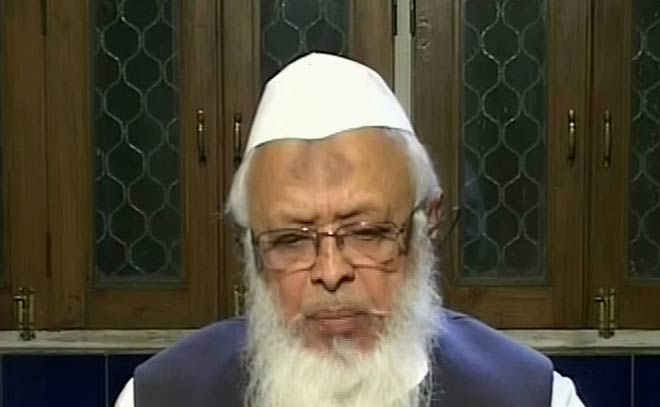
The Jamiat Ulama-e-Hind (JuH), a key Muslim litigant in the Ayodhya title suit which has been indulging in constant rabblerousing since Supreme Court’ historic verdict in the Ram Janmabhoomi case, has today taken a U-turn and said that it will not file a review petition against the Supreme Court’s Ayodhya verdict.
“Jamiat Ulama-i-Hind has passed a resolution that it will not file a review petition against the Supreme Court verdict on Babri Masjid & mosques managed by Archaeological Survey of India (ASI) and Waqf properties,” reported ANI.
Jamiat Ulama-i-Hind has issued a clarification that “Jamiat Ulama-i-Hind has passed a resolution that it will not file review petition against the Supreme Court verdict on Babri Masjid & mosques managed by Archaeological Survey of India (ASI) and Waqf properties.” https://t.co/NZz6vR8Sc4
— ANI (@ANI) November 21, 2019
According to Times Now, Jamiat Ulama-e-Hind (JuH), the key Muslim litigant in the Ayodhya title suit has two factions. One which is led by Arshad Madani and the other led by Mahmood Madani. Reportedly, the faction led by Arshad Madani will be going ahead with filing of a review petition against the SC verdict, while the Mahmood Madani faction, which had organised a meeting yesterday with other Muslim organisations, have decided to step back.
#Breaking | Top Muslim litigant makes a U-turn & decides not to challenge the Supreme Court verdict on Ayodhya dispute.
More details by TIMES NOW’s Wajihulla & Mohit Sharma. pic.twitter.com/DOdgiRNDQ6
— TIMES NOW (@TimesNow) November 21, 2019
Jamiat Ulema-e-Hind split into two groups after the death of the former president of Jamiat Ulema-e-Hind Asad Madani because of the dispute between his brother Arshad Madani and son Mahmood Madani over the leadership of India’s largest Muslim organisation.
Earlier on Sunday, both AIMPLB and Jamiat Ulama-e-Hind president Maulana Arshad Madani had announced that that they will file a review petition against the Supreme Court verdict as it was not based on the ‘evidence and logic’. While announcing the decision, Madani had said that though they are sure the review petition would be thrown out by the Supreme Court, one still should be filed. The Sunni Waqf Board had, however, distanced itself from the decision.
The Supreme Court on 9th November delivered a historic verdict in the Ram Janmabhoomi case. Giving the entire 67 acres to Hindis, the Supreme Court held that an alternate 5-acre land will be given to the Muslims to build their Mosque.
While the Hindus have celebrated this verdict, the Muslim parties, especially the Jamiat Ulama-e-Hind, AIMPLB and Owaisi led AIMIM, have been spewing venom and making fallacious arguments against the SC decision.
The Jamiat Ulama-e-Hind president had earlier said that once a Mosque has been built it will always remain a mosque. He had also rejected the 5-acre land given to the Muslims by the Supreme Court. While earlier, the Muslim litigants want 5 acres within the 67 acres Ram Janmabhoomi, now their demands seem to have shifted to giving Hindus an alternate 5-acre land.


