

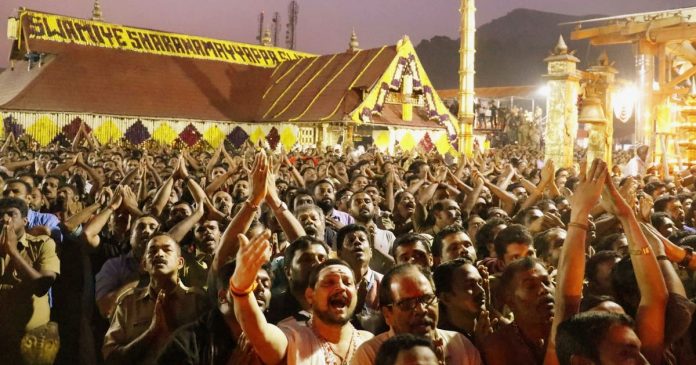
The Supreme Court led by CJI Ranjan Gogoi could not come to a conclusive decision in Sabarimala review petitions and have referred the case to a larger bench by a 3:2 majority.
The Bench to hear the Sabarimala review petitions assembled at 10:30 AM. The review petitions challenged the 2018 verdict that allowed women of menstruating age to enter the Sabarimala temple.
The Supreme Court said that the issue of women’s entry into the Sabarimala temple is not just limited to Sabarimala. It involves the entry of women into Mosques as well. The Supreme Court referenced to larger Bench of issues arising in case of entry of Muslim women into a mosque, female genital mutilation cannot be ruled out.
CJI, justices- Khanvilkar and Malhotra viewed to refer the matter to a larger bench. Justices Chandrachur and Nariman gave dissent view on Sabrimala review pleas. The Supreme Court could not reach a consensus on the review petitions and this, the Sabarimala matter referred to a larger bench by 3:2 J Chandrachud and Nariman dissent Review petitions being kept pending.
The matter has been referred to a larger bench essentially because of the issue of entry of women into Mosques. Issues relating to the conflict between Shirur Math and Dargah to be decided larger Bench including on essential religious practices and other aspects.
Reading out the majority judgment, CJI Gogoi mentioned that issues such as the legality of Female Genital Mutilation in Dawoodi Bohra community, Muslim women mosque entry, right of Parsi women who married outside the community to access towers of silence etc, have been referred to a larger bench. The Sabarimala issue has been tagged along with these other issues and referred to a larger bench. The Supreme Court has decided that Sabarimala review petitions to remain pending until the issue is decided by larger Bench.
Justices Rohinton Nariman and Chandrachud dissented and said that compliance with Supreme Court judgments is not optional.
Justice Nariman, who read out the dissenting opinion, said that the issues of Parsi women and Muslim women were not before the Sabarimala bench and hence the matter could not be tagged with them. The original judgment was based on a bona fide PIL which raised the issue of women being denied entry on the basis of their physiological features, said Justice Nariman.
The Supreme Court had reserved its judgment in the Sabarimala verdict after hearing the review petitions in September this year, challenging the court’s verdict of lifting the ban on women of menstrual age to enter the shrine of Sabarimala-The abode of Lord Ayyappa. The court verdict sparked a series of protest with many asserting that the court cannot interfere in the centuries-old tradition of the Sabarimala temple. There were 65 petitions including 56 review petitions and 4 writ petitions against the judgment passed by the top court.


