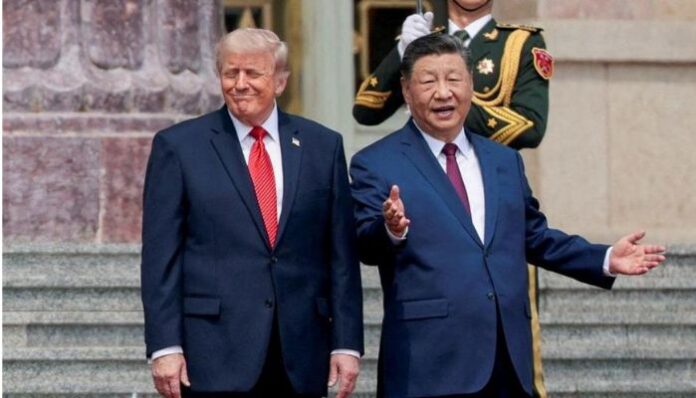
In a first US Presidential visit to China in nearly a decade, President Donald Trump, Secretary of State Marco Rubio and a high-powered American delegation are in Beijing for a two-day visit starting 13th May 2026. President Trump is meeting his Chinese counterpart, Xi Jinping, during a high-stakes meeting. Just weeks after amplifying “hellhole” remarks against China and India, the US President has arrived in Beijing, accompanied by an entourage comprising diplomats, business leaders, and defence officials.
Chinese kids jumping up and down, waving American and Chinese flags, greet Trump and Xi. pic.twitter.com/FiPmM3iegy
— Aditya Raj Kaul (@AdityaRajKaul) May 14, 2026
Donald Trump is accompanied by Marco Rubio, who is the first US Secretary of State on Chinese sanctions to visit Beijing. Rubio was sanctioned in 2020 over his remarks on China’s clampdown on Hong Kong and over Beijing’s use of forced labour by Uyghur Muslims. What facilitated Rubio’s China visit despite sanctions is a linguistic workaround, as China changed the transliteration of his name.
Besides Rubio, US Secretary of War Pete Hegseth, Treasury Secretary Scott Bessent, Trade Representative Jamieson Greer, among others, are part of the American delegation.
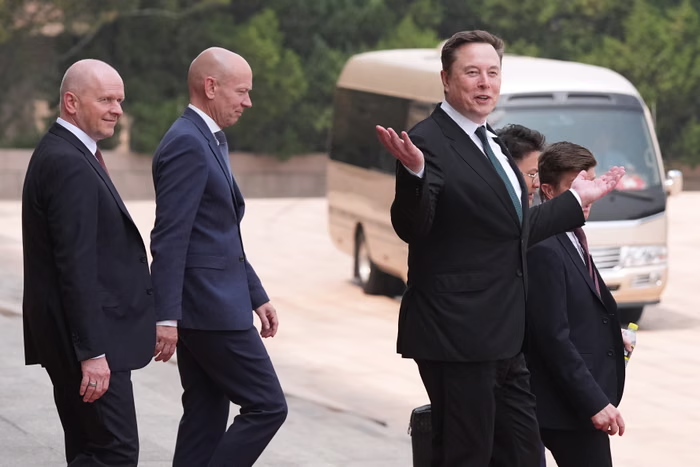
The US President has also brought around 17 CEOs of American companies to Beijing, including Tesla’s Elon Musk, Apple CEO Tim Cook, Jensen Huang of Nvidia, Larry Fink of BlackRock, Stephan Schwerzmann of Blackstone, Kelly Ortberg of Boeing, in addition to representatives from Goldman Sachs, Meta, Citigroup, Visa, Mastercard, Illumina, and others. Several among these have combined net worth exceeding $870 billion.
Amidst trade tensions and hostile rhetoric, what brings Trump to China?
China has emerged as an economic competitor to the US and also a geopolitical rival. The Trump administration has long described China as an economic foe, although Trump enjoys a decent personal relationship with Xi Jinping. Ever since Trump’s inauguration in January 2025, the US President has, through policy and rhetoric, attacked China. In April last year, Trump imposed 125% tariffs on Chinese goods and in October, imposed an additional 100% tariffs. Trump justified the additional tariffs by saying that they were in response to the “extraordinarily aggressive” control measures adopted by China on the export of rare-earth minerals. In response, China warned of ‘necessary action’.
In October 2025, China’s Ministry of Commerce announced sweeping new export controls on rare earth elements, marking a massive escalation in its trade arsenal, and a move that rattled Trump. China’s restrictions cover 12 rare earth elements–adding five critical ones, including Holmium, Europium, and Ytterbium, crucial for semiconductors, defence technologies and permanent magnets. As China weaponised its REEs to gain trade and geopolitical leverage, Trump ranted on his online echo chamber, Truth Social, and accused China of holding the world “captive”.
While a Trump visit to China was on the cards for months, the timing of this visit is particularly interesting. The meeting’s public agenda has long included trade, tariffs, purchase of American goods, cooperation on AI and semiconductors, fentanyl precursors and Taiwan. However, given a fragile truce in West Asia, the Iran War has emerged as a dominant and urgent issue.
Donald Trump’s visit to China with a whole entourage of American industrialists indicates that Washington has, for now, put its pretence of a China containment policy on the back burner. In a classic case of “If fighting is not feasible, form an alliance with your enemy”, the American establishment appears to have realised that China has more economic and geopolitical leverage to offer at this point to the US than the other way round.
Trump wants China to buy more American planes, agricultural products and more
Before heading to Beijing, Trump and his officials said that a key agenda of their visit would be to push China to open its economy more to America. Trump wants China to purchase more American agricultural products and passenger planes, in addition to setting up a board to address trade-related differences, to avoid the recurrence of a tariff war between the two countries, as it happened last year.
China draws a line at Taiwan
During the summit at the Great Hall of the People, China is reported to have made its stance clear on the Taiwan issue and warned Trump that if the issue is ‘mishandled’, China and US could come into conflict. “The Taiwan question is the most important issue in China-US relations,” Xi said at their summit, state broadcaster CCTV said.
Meanwhile, Taiwan quickly issued a statement declaring China a “sole risk” to regional peace and stability. “China is “currently the sole risk to regional peace and stability. Beijing has no right to make any claims on behalf of Taiwan internationally,” the Taiwanese Foreign Ministry said.
America has long backed Taiwan against China while Beijing sees Taiwan as its red line. It remains to be seen if Trump heeds Jinping’s warning to better trade relations or the US and China will ‘come into conflict’ in the near future.
After openly antagonising China, is Trump bolstering Beijing’s position out of desperation?
Donald Trump’s failure to end the Russia-Ukraine war, despite hopes for a reset in the Russia-US ties, Russia’s relations with China are growing stronger. Moreover, with his tariff war and spiteful rhetoric against India, Trump also pushed the RIC, Russia, India and China closer. For long, the US tried to lure India to its side and prop up Delhi as a counterweight to China. However, Trump destroyed the years of American diplomatic manoeuvres with his mindless intransigence.
Trump’s blunders inadvertently bolstered China’s position. What further made things favourable for China was yet another Trump blunder, the Iran war. Donald Trump’s war on Iran was a monumental strategic and geopolitical miscalculation. Much like how Russia’s Vladimir Putin thought that the Ukraine war would end soon with Kyiv’s surrender, Trump thought that taking out Ayatollah Ali Khamenei and inflicting significant damage to Iranian civilian and military infrastructure would be enough to compel the Mullah regime to surrender.
However, three months on, Iran is wounded but stands tall, still ready for both negotiated peace or inevitable war. Trump has landed in such a quagmire that he is now desperately looking for an off-ramp despite claiming to be victorious. It was reported how the American President, in his own arrogant tone, beseeched European countries to deploy warships to clear Iran’s blockade of the Strait of Hormuz. Much to his embarrassment, none of the NATO allies came forward, despite the blockade-caused global energy crisis harming them.
Russia and China are known backers of Iran. From reportedly using Russian tech and Chinese research to jam Starlink during pre-war civil protests in Iran, to defence imports, Iran has deep trade and defence relations with Russia and China. Beijing is also the biggest buyer of Iranian oil.
In fact, some reports said that it was China that pushed a spineless and opportunist Pakistan, which has uniquely become a lackey of both rivals China and the US, to step up and offer mediation between Iran and the US. OpIndia has reported earlier that Pakistan is using its ‘mediator’ role not to secure peace but for its own financial and geopolitical interests.
Amusingly, US Treasury Secretary Scott Bessent had recently urged China to help clear the Iranian blockade of the Strait of Hormuz despite there being a counterblockade by the US Navy. China’s trade relations with Iran are key to the sustenance of the West Asian nation’s war-hit economy. China buys nearly 90% of Iran’s energy exports.
Demonstrating his usual hypocrisy, Donald Trump, who accused India of funding Russia’s ‘war machine’ against Ukraine, for purchasing Russian oil even as China was the biggest buyer, does not want China to stop purchasing Iranian oil and is fine with China funding the Iranian ‘war machine’. Clearly, stances differ on the basis of which country has what leverage.
Both Iran and ‘mediator’ Pakistan share good relations with China, and Beijing has been playing a backdoor role in the negotiations between Tehran and Washington. Iranian Foreign Minister Seyed Abbas Araghchi’s visit to China last week, after the US announced that it was pausing the American efforts to guide vessels out of the Strait of Hormuz, confirmed the significant influence Beijing has over Tehran.
China can and, if required, will play a more direct role in ending the Iran war. However, it is unlikely that Beijing will let the conflict end in such a way that Trump gets to sell it as his ‘victory’. Since the beginning of the Iran war in February, Donald Trump’s domestic ratings have dwindled; he is facing in-party criticism for his West Asia miscalculation, selection of a treacherous Pakistan as ‘mediator’, depletion of military arsenal, and most importantly, the economic impact Trump’s war is having on America and the world.
Trump is desperate for a ‘Win’ after serious miscalculations and the perception that the US was forced into the war by Israel
Inflation, energy price hikes, and the incapacitation of the US President to pursue a tariff war due to a US Supreme Court ruling against his sweeping tariffs have put Trump in a very weak position. The American President’s visit to China at this time only demonstrates that he no longer wants to pursue a ‘counter-China’ foreign policy, but to mend ties. With REEs essential for tech and defence manufacturing, China has an upper hand when Trump and Xi Jinping sit across a table.
Ahead of the midterms, if Trump manages to secure a Chinese purchase commitment for even Boeing or soybeans to reduce the trade deficit, the US President can sell it as a ‘win’ and placate domestic anger stemming from the Iran blunder and the Epstein case. China has already warned Trump on Taiwan, and if the US President softens his stance on this issue, Beijing would not mind handing some concessions like commercial contracts and controlled opening of the Chinese economy for US companies, which Trump can sell as a ‘win’ to cover up the embarrassment of a loss of reputation in Iran.
Recently, Washington Post published an article on a confidential US report on how China is allegedly exploiting the Iran war to maximise leverage over the US across military, economic, diplomatic and other sectors.
The Joint Chiefs of Staff’s intelligence directorate uses a “DIME” framework (diplomatic, informational, military and economic) to analyse China’s response to America’s war against Iran.
While a US counterblockade of the Strait of Hormuz impacted oil supply to China, Beijing is a big beneficiary of the Iran war. Since the joint Israel-US forces attacked Iran in February 2026, China has sold weapons to the same Gulf countries, the US calls its allies, amidst Iranian strikes.
America’s military manoeuvres against Iran also handed China the opportunity to study how the US forces function during a distant operation, what hardware it deploys, its planning and effectiveness, everything. This, the report says, would help China plan its own future operations, especially if the US enters into a conflict with China over Taiwan.
Trump wants China to use its influence to pressure Iran into a peace deal?
While Trump would understandably not directly go and beg China to take an active role in ending the Iran war, the US President desperately wants China to use its influence on Tehran to secure a US-friendly peace deal with Iran, in exchange for, perhaps, a China-friendly understanding on the Taiwan issue and discontinuation of trade hostilities.
It is the European Union’s cold response to Trump’s “come join the war’ requests that have forced an embarrassed US President to attempt to make an ally out of an enemy. China knows this, and knowing that Trump understands that he would be committing an irreversible blunder if he orders ‘death of a civilisation’ in Iran, Beijing might offer limited pressure on Iran after extracting major concessions from the USA. Basically, Trump wants China to hand him an off-ramp in Iran that he could sell as a victory at home, in exchange for a payment in trade and strategic terms.
From claiming ‘total victory’ over Iran to coddling a rival China, Donald Trump, who weaponised trade and tariffs to arm-twist countries into submitting to his whims, is now forced to parade his country’s tech giants before China to secure a face-saver.