

To counter food inflation, the Government of India has announced a cut in import tariffs for lentils, specifically for masoor dal. As per the new regulations, the import duty on lentils from Canada and Australia has been dropped to NIL while the same for lentils of US origin has been dropped to 22% from 30%. However, a 66% tariff on chickpeas is still applicable. Earlier, in 2020, the government had reduced import duty from 33% to 11%.
Notably, Australia has the largest share in India’s lentil imports. According to a report in ABC Australia, the decision to cut import duty will help the farmers in Australia who had a bumper harvest. On the other hand, there are some apprehensions about the step taken by the government to reduce import duty to NILL would increase India’s import of lentils that would harm the local farmers.
No effect on Indian farmers, govt sources
Speaking to OpIndia, government sources known to the matter said the change in import duty would not affect the Indian farmers. The decision is being misinterpreted as there are apprehensions it was done to benefit Australia. In reality, India anyway needs to import lentils to fulfil its requirements. The import duty is not reduced just for Australia but for other countries also.
As Australia has the largest share in India’s lentil imports, it is being seen as connected to Australia. In reality, it would benefit farmers for any country, including Canada, from where India import lentils.
Government data explains lentil demand and supply in India
Data provided by the government sources stated the annual demand of masoor dal in the country is around 21 lakh MT. Last year, India produced 14.50 Lakh MT and this year expected produce is around 15 lakh MT as per the estimates of the Agriculture and Farmers Welfare Ministry.
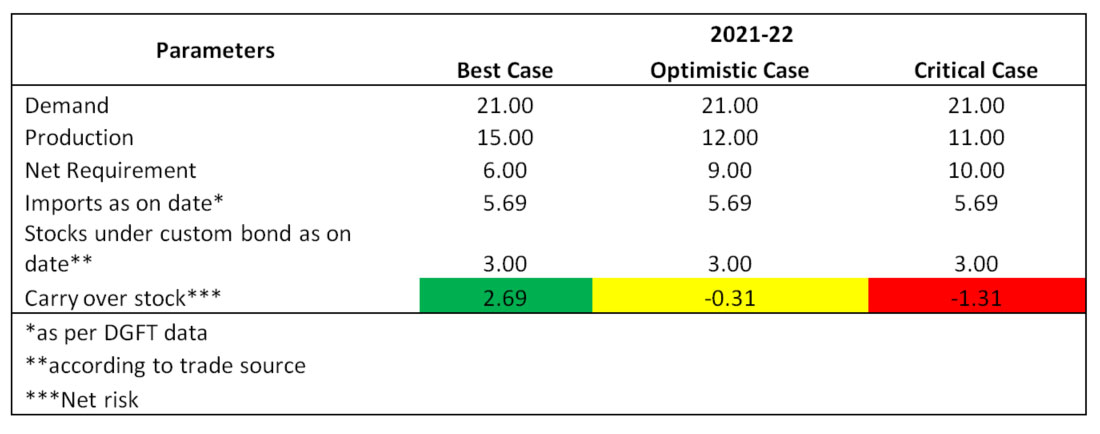
The data collected by the government agencies and trade source, for the year 2021-22, the net requirement of import of masoor will be around 6 lakh MT in the best-case scenario. On the other hand, in the worst-case scenario could be 10 lakh MT at max. To date, India has already imported 5.69 lakh MT of masoor dal. If India produces 15 lakh MT of Masur, carry over stock in hand would be 2.69 lakh MT. In this case, prices are expected to stay in the range of Rs 6,000 to Rs 6,500 per quintal.
In an optimistic case, the price may rise between Rs 6,800 to Rs 7,200 per quintal. However, if a critical case scenario occurs, the price may rise upwards of Rs 7,200 per quintal. In that case, the government of India may consider releasing buffer stock to ease the market price.
The government of India is building a buffer with a target of 1 lakh MT. So far, 71,150 MT of masoor dal has already been contracted, and daily purchases are being made to achieve the target.
As of now, India has a buffer availability of 85,000 MT. Out of the current stock, the Government of Tripura has been allotted 25,000 MT, which would leave 58,000 MT in the stock. The government is working on procuring 29,000 MT of imported stock. Further, the government has decided to release another 20,000 MT of the buffer to open market sale. It would leave a buffer of 67,000 MT.


