

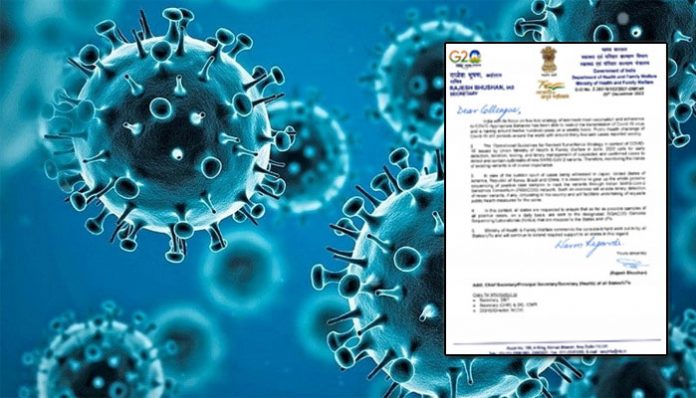
On December 20, the Ministry of Health and Family Welfare issued guidelines amidst rising cases of Covid-19 in several countries worldwide.
In a letter to additional chief secretaries, principal secretaries, and secretaries of health departments of all states, Rajesh Bhushan, secretary Department of Health and Family Welfare of MoHFW, said that in view of the sudden spurt of cases being witnessed in Japan, the United States of America, Republic of Korea, Brazil and China, India should gear up the genome sequencing of positive cases samples.
In view of the recent rising cases of COVID19 in some countries, Union Health Ministry has requested States/UTs to send samples of all #COVID19 positive cases to INSACOG labs to track new variants, if any.
— Ministry of Health (@MoHFW_INDIA) December 20, 2022
Health Ministry and INSACOG are keeping a sharp watch on the situation. pic.twitter.com/ODLTkFwsdH
Bhushan mentioned that by following the five-fold strategy of test-track-treat-vaccination and adherence to COVID Appropriate Behavior, India managed to restrict the transmission of the disease. As of now, there are around 1,200 cases on a weekly basis in the country. However, the spur in the cases has resulted in around 35 lakh cases being reported across the world on a weekly basis.
The letter further pointed out that in the revised surveillance strategy in the context of Covid-19 was issued by MoFHW in June 2022. It emphasised early detection, isolation, testing and timely management of suspected and confirmed cases to detect and contain outbreaks of new SARS-CoV-2 variants. Based on that strategy, Bhushan said that the monitoring of existing variants is of crucial importance.
Bhushan added, “In view of the sudden spurt of cases being witnessed in Japan, the United States of America, the Republic of Korea, Brazil and China, it is essential to gear up the whole genome sequencing of positive case samples to track the variants through Indian SARS-CoV-2 Genomics Consortium (INSACOG) network. Such an exercise will enable timely detection of newer variants, if any, circulating in the country and will facilitate the undertaking of requisite public health measures for the same.”
All states have been instructed to ensure that the samples of all positive cases on a daily basis are sent to the designated INSACOG Genome Sequencing Laboratories (IGSLs) that are mapped to the States and UTs.
The current situation of Covid-19 in India
As per the MoHFW website, there are 3,490 active cases of Covid-19 in the country, out of which Karnataka and Kerala are the most affected states, with 1,275 and 1,448 active cases, respectively. In the last 24 hours, 69 new cases were reported, and 178 patients were discharged. One person succumbed to the disease in the last 24 hours.
The current situation of Covid-19 worldwide
According to World Health Organisation (WHO) data, over 35 lakh cases have been reported worldwide in the last 7 days. In the United States, 4,45,424 cases were reported, and 2,658 people died of Covid in one week. Japan saw a spike of 8,78,241 cases in one week, with 1,456 deaths. The Republic of Korea reported 4,61,472 new cases and 362 deaths. Frace reported 3,81,857 new cases and 747 deaths. Brazil reported 3,24,565, and China reported 1,48,665 new cases and 1,129 and 443 deaths, respectively.


