

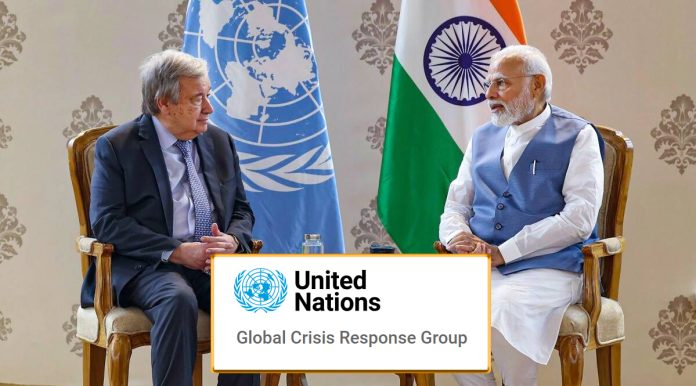
India has joined the Champions Group of the Global Crisis Response Group (GCRG). The decision of India to join the group came after the United Nations Secretary-General Antonio Guterres extended an invitation to Prime Minister Narendra Modi.
The Global Crisis Response Group (GCRG) was set up by the UN Secretary-General in March last year to address urgent and critical global issues related to interlinked crises in food security, energy and finance and to coordinate a global response. GCRG aims to help decision-makers to mobilize solutions and develop strategies to help countries address the interlinked crisis with food, energy and finance.
The GCRG is overseen by the Champions Group and currently, it comprises the heads of governments/states of Bangladesh, Barbados, Denmark, Germany, Indonesia and Senegal.
Sanjay Verma, Secretary (West), Ministry of External Affairs has been designated as Sherpa to the GCRG process. The Sherpas will meet on 7th July virtually and a meeting of the Champions is scheduled to be held on July 21, the Ministry of External Affairs (MEA) said in a press release
The MEA in the press release said, “The decision to join the Group reflects India’s increasing global leadership and committment addressing contemporary global challenges. India’s participation will further boost the efforts of the United Nations in finding result-oriented solutions on developmental issues that impact the world, particularly developing countries.”
The current issues being handled by the GCRG include various aspects under food, energy and finance. It says that commodity prices have fallen due to bumper crops in Australia, Canada, Russia and the United States as well as by the optimism brought upon by the signing of the Black Sea Grain Initiative – a fundamental recommendation by GCRG – to reintegrate grains and sunflower oil from Ukraine into global markets and facilitate unimpeded access to food and fertilizers from Russia.
Under the Black Sea Grain Initiative of the GCRG, a newly established Joint Coordination Centre was established to allow for significant volumes of commercial food exports to depart from three key Ukrainian ports in the Black Sea, and paved the way for the first shipment to leave the port of Odesa on 1 August.
Under energy, the group says that the world needs to double down on renewables to meet net-zero goals, tackle energy poverty, and boost and diversify the global energy mix. The group further states that inflation rates continue to accelerate in developing and least developing countries due to their levels of income and exposure to global financial shocks.


