

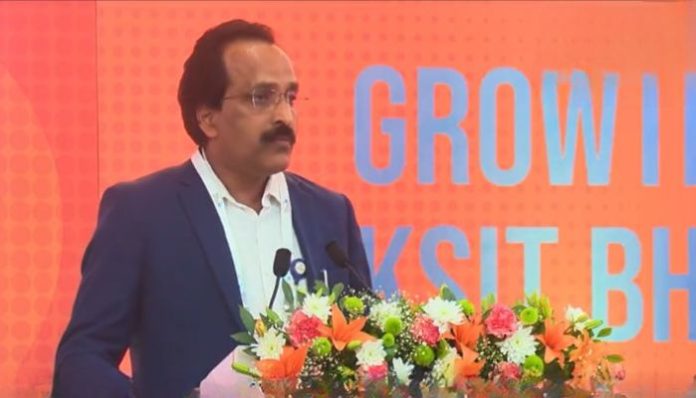
On Thursday (11th January), during the International Space Conference in Gandhinagar, ISRO Chairman S Somanath unveiled India’s ambitious vision for its space program. Drawing inspiration from recent achievements and guided by Prime Minister Narendra Modi, Somanath underscored the country’s dedication to establishing an enduring human presence in space.
ISRO Chairman S Somanath recalled Modi’s support dating back to his tenure as Chief Minister of Gujarat. He said, “The Prime Minister has always been a fervent advocate for our space endeavours.”
S Somanath said, “Let me look at the type of vision that the Prime Minister has given after this success story of the last 6 months. I think he also has been an ardent supporter of space programs ever since he was a CM of this state. What he told us is that we must create continuous activity of humans’ presence in space.”
#WATCH | Gujarat: ISRO Chairman S Somanath addresses International Space Conference 2024 in Gandhinagar.
— ANI (@ANI) January 11, 2024
He says, "Let me look at the type of vision that the Prime Minister has given after this success story of the last 6 months. I think he also has been an ardent supporter of… pic.twitter.com/PNX0MKMYH1
He added, “Though we have a Gaganyaan program, it must continue over a long period leading up to a human landing on the moon and an Indian landing on the moon by 2040. It looks far away, but it’s not far away. It’s so close. And we must build a space station by 2035, a space station that is accessible for Indians to go there and do research.”
While the timeline may appear distant, Somanath assured that it is well within grasp, as plans are actively underway to transform this vision into reality. Additionally, he emphasised the ambitious goal of constructing an Indian space station by 2035, poised to serve as a pivotal platform for Indian researchers to conduct experiments in microgravity conditions.
Somanath’s address follows a string of triumphs and significant declarations from ISRO. Notably, these include the successful deployment of the Aditya-L1 spacecraft, designed for studying the Sun from the first Sun-Earth Lagrangian point (L1), and the launch of the X-ray Polarimeter Satellite (XPoSat), dedicated to analysing cosmic X-rays.
Furthermore, the chairman delved into ISRO’s prospective trajectory, outlining plans such as the upcoming Venus Orbiter Mission, Shukrayaan-1, slated for either December 2024 or 2025. Notably, he detailed the ambitious initiative to launch the initial module of an Indian space station by the year 2028.
In addition, the space agency is gearing up for the Gaganyaan mission, with a sequence of tests scheduled throughout 2024 to guarantee preparedness for the slated launch in 2025.
ISRO’s vision is in harmony with the Prime Minister’s vision to achieve the milestone of landing an Indian on the moon by 2040 – a symbolic goal embodying the nation’s ambitions in space science and technology. Building on a track record of cost-effective and triumphant missions, ISRO remains a crucial force in India’s progress, actively contributing to the realms of education, agriculture, communication, and defence.


