On Tuesday, August 5, devastating flash floods triggered by a cloudburst swept through parts of Uttarakhand, leaving death and destruction in their wake. Among the worst-hit regions was the serene village of Dharali, near Gangotri, where homes, people, and livelihoods were mercilessly washed away. The tragedy, captured in a viral video, evoked grief and sympathy from most quarters, except, disturbingly, from a certain section of India’s Islamist-leaning social media users.
Instead of prayers or solidarity, what emerged from some corners of the internet was a chilling spectacle of celebration. Figures like Ali Sohrab, Karishma Aziz, and their echo chamber of like-minded users responded to the footage not with empathy, but with unvarnished glee. Their posts gleefully dubbed the floods as “कुदरत का बुलडोज़र” (nature’s bulldozer), mocking the natural disaster as a form of divine retribution against the Hindu-majority state.
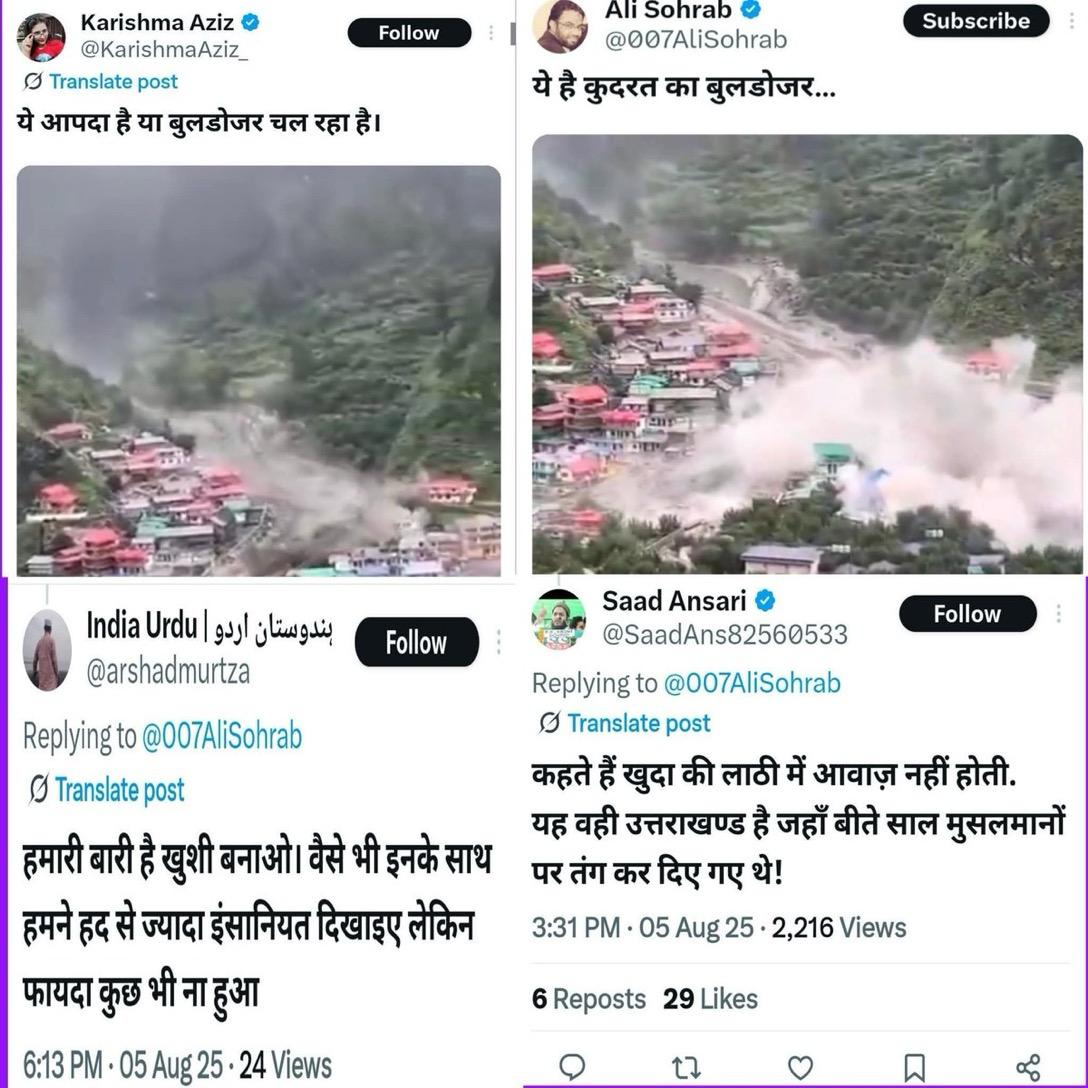
The term “bulldozer” is no accident. Uttarakhand, also known as Devbhoomi (Land of the Gods), has recently become symbolic of a government-led campaign to root out illegal encroachments, many of which involved unauthorized Islamic structures. The Dhami government, with public support, has employed bulldozers to reclaim public land, a move that has drawn ire from Islamist quarters. And now, in an act of grotesque poeticism, the flash floods are being painted by these elements as ‘Allah’s vengeance’ for the bulldozing of illegal mosques.
One tweet mockingly asks, “Ye aapda hai ya bulldozer chal raha hai?” (Is this a disaster or a bulldozer at work?), while another suggests that this is divine punishment for the supposed mistreatment of Muslims in Uttarakhand. A user even rejoiced in how “Khuda ki laathi mein awaaz nahi hoti”, a vile justification of human tragedy as godly wrath. These reactions are not just distasteful, they reveal a deeper, festering moral rot that thrives in ideological echo chambers insulated from humanity.
This moral rot stems from decades of political conditioning that treated Muslims not as equal citizens, but as a pampered political bloc. The Modi-led Centre and the Dhami-led Uttarakhand government have systematically dismantled the UPA-era model of minority appeasement, where encroachments were ignored, conversions were brushed under the carpet, and political correctness ensured silence even in the face of lawlessness. The bulldozer, symbolic of governance without fear or favour, has disrupted this long-standing ecosystem of entitlement.
And it is this disruption, this end of unearned privilege, that has enraged a section of the Muslim community, particularly those with Islamist leanings. To them, equal treatment feels like oppression. Being held to the same legal standards is perceived as persecution. They are not angry because they are being targeted; they are angry because they are no longer above the law.
This explains the venomous reactions to the Uttarakhand floods. The fact that the affected region is popularly known as Devbhoomi—home to sacred Hindu shrines like Kedarnath and Badrinath, only fuels their ideological resentment. So when a cloudburst causes devastation in a Hindu-majority hill state, it is grotesquely recast by Islamists as “divine punishment,” a so-called “nature’s bulldozer” taking revenge for the state’s crackdown on illegal Islamic structures.
This is not political protest. This is a manifestation of hate so visceral that it dehumanises an entire population based on their religion. It’s the same mindset that justified the partition, cheered during communal violence, and continues to sympathize with terrorists and radicals so long as they serve an Islamist cause.
Even more disturbing is the silence from so-called liberal secularists and moderate Muslim voices. If Hindus had celebrated a disaster in a Muslim area, the outrage would have echoed from every media outlet and activist pulpit. But when the hate is directed at Hindus, it is conveniently ignored, if not quietly approved. This selective morality has become a shield for Islamist supremacism masquerading as victimhood.
Make no mistake, this isn’t about religious identity; it’s about ideological poison. These Islamists aren’t opposing state policies on principle. They’re opposing them because those policies dare to treat them equally. Their grievance is not about justice; it is about the loss of their historic immunity from accountability. The bulldozer is not the enemy, equality is.
The tragedy in Uttarakhand should have united people across religious lines in shared sorrow. Instead, it has been weaponised by a segment of bigoted ideologues to push a narrative of retribution and divine punishment. The glee with which they celebrate death is a mirror to their ideological bankruptcy and a warning sign for the rest of the nation.
No one, regardless of their religion or political beliefs, should find joy in the suffering of others. What we are witnessing is not just a digital provocation, it is a spiritual catastrophe. A nation cannot survive if a section of its people are taught to laugh when others bleed.
In times of tragedy, silence is not neutrality. It is complicity. The path to national integrity lies not just in infrastructure and reforms, but in moral clarity. India must call out this sickness firmly, unapologetically, and without compromise. Because when death becomes a joke, and nature’s fury is weaponised as communal vengeance, we are not dealing with political dissent. We are dealing with a toxic ideology that seeks to destroy the very soul of the Indian Republic.