

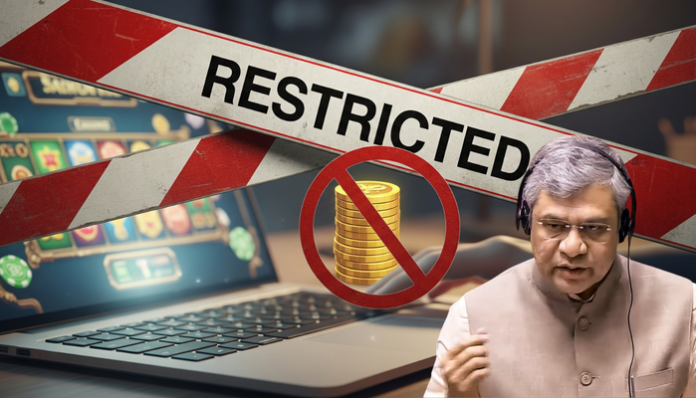
In a move to promote the online gaming industry while also curbing harmful financial practices associated with it, the government introduced the Promotion and Regulation of Online Gaming Bill, 2025, in the Lok Sabha yesterday (August 20). The Bill was passed in the Lower House after I&B Minister Ashwini Vaishnaw introduced it. It will now be tabled in the Upper House, where on being passed, the Bill will become a law.
Amid the rising incidents of gambling, addiction, financial losses and extreme consequences like suicides linked with online gaming, the government has been prompted to take this significant step to regulate the online gaming industry, which is said to be valued at around $3.8 billion currently. The bill intends to clamp down on money-based online games, which allow gambling, including poker, rummy, and other card games.
Misled and lured by false promises of getting massive and quick paybacks, people end up losing their hard-earned money on these online gaming platforms, leading to financial and emotional distress. About 45 crore people lose around ₹20,000 crore annually in online games, including gambling and betting games, as reported by NDTV. After the Bill becomes law, popular money-based online gaming applications such as Dream11, Games24x7, Winzo, GamesKraft, 99Games, KheloFantasy, and My11Circle are likely to be impacted.
The Bill also addresses the financial fraud, money laundering, and terror financing activities undertaken by several online gaming platforms. “The government believes that the harms of addiction, financial loss and even extreme consequences such as suicides associated with online money gaming can be prevented by prevention of such activities,” read a media statement released by the government. “Additionally, online money gaming platforms are often misused for financial fraud, money laundering, terror financing and messaging activity that compromise national security,” it added.
Here is how the Promotion and Regulation of Online Gaming Bill, 2025, aims to promote India’s fast emerging online gaming market while curbing the harmful financial activities linked with it.
Promotion of e-sports
The Bill promotes and recognises e-sports as a legitimate form of competitive sport. The guidelines and standards for conduct in this respect will be framed by the Ministry of Sports.

For the growth of e-sports, the government plans to establish training academies, research centres, and technology platforms. In addition to that, the government will also launch incentive schemes, awareness campaigns, and integrate e-sports into broader sports policy initiatives.
Prohibits harmful financial practices linked with online games
Departing from previous regulatory interpretations, the Bill imposes an absolute ban on online gaming platforms offering or facilitating real-money transactions, regardless of whether the games are skill-based or chance-based. This is intended to bring the online game operators, which have been allowing gambling activities under the garb of skill-based games, within the purview of the bill. Even the promotion of such games on any form of media is prohibited under the Bill. And, banks and payment systems have been barred from processing transactions relating to such games.

Currently operational online money games will be blocked under the Information Technology Act, 2000.
Promotion of social and educational games
The Bill empowers the union government to recognise, categorise, and register online social games. It provides for facilitating online gaming platforms offering age-appropriate social and educational games.

Through the Bill, the government aims to use online games for skill development and digital literacy. It will also promote cultural and educational gaming content aligned with Indian values.
Constitution of an online gaming regulatory authority
The Bill envisages a national online gaming authority to oversee the online gaming platforms. The authority will be tasked to categorise and register online games, determine if a game qualifies as a money game and address complaints and grievances related to online games. Additionally, the authority will issue guidelines, orders and codes of practice to ensure compliance with the laws of the land.
Offences and penalties under the Bill
The government preferred an absolute ban on online platforms offering gambling opportunities instead of the regulation of such platforms for the reason that these platforms often use manipulative design features and addictive algorithms to evade accountability.
As a result, the Bill criminalises facilitation or involvement in online money gaming. Imprisonment up to three years and/or a fine of up to ₹1 crore is prescribed in the Bill for entities involved in online money gaming. Advertisement of such games will attract a penalty of 50 lakh or up to 2 years of imprisonment under the Bill.
Besides, any financial transaction linked with such online money games can attract a fine of up to ₹1 crore, and/or up to 3 years of imprisonment. A repeated offence will be punishable with enhanced penalties, including 3-5 years of imprisonment and a fine of up to ₹2 crore.
Gaming industry representatives write to Amit Shah
Before the introduction of the Bill in the Parliament, the All India Gaming Federation (AIGF) wrote to Union Home Minister Amit Shah, requesting his intervention in the Bill.
The AIGF expressed the apprehension that a blanket ban on money-based online games will severely damage the online gaming sector. Urging for a “progressive regulation” rather than outright prohibition, the federation claimed the Bill, if passed, might push crores of legitimate gamers toward illegal gambling networks and unregulated operators.
Money-based online games have pushed several households into debt and poverty. In some cases, people addicted to gambling activities in online games committed suicide after losing money. The devastating effects of money-based online games compelled the central government to introduce the Bill, even though this would cost the government an estimated revenue loss of about Rs 15,000 crore to Rs 20,000 crore.


