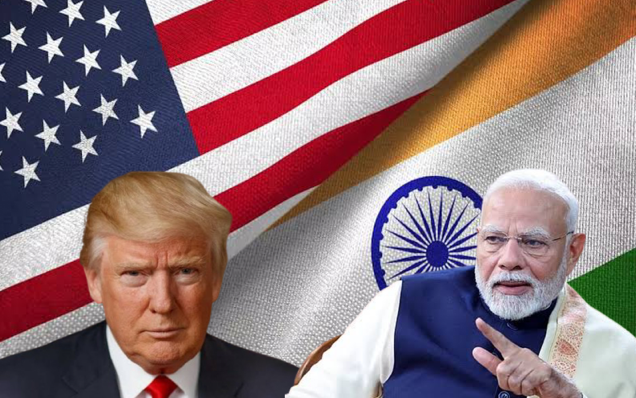
Few bilateral relationships in the 21st century carried as much promise as that between the United States and India. For a time, leaders in both Washington and New Delhi framed their partnership as indispensable, a “natural alliance” between the world’s oldest and largest democracies. Yet today, the relationship is fraying at the edges, poisoned by mistrust, political vanity, and an American president more interested in chasing accolades than respecting India’s sovereignty.
At the heart of this rupture is President Donald Trump’s unhealthy obsession with the Nobel Peace Prize. His repeated boasts of “solving” the India–Pakistan conflict, and his unsubtle hints that Prime Minister Narendra Modi should nominate him for the award, have collided with the immovable wall of India’s historical experience with American duplicity. Trump’s simultaneous embrace of Pakistan’s military establishment, particularly Field Marshal Asim Munir, a man notorious for his anti-Hindu bigotry, has further deepened the impression that Washington is reverting to its Cold War habit of hyphenating India with Pakistan.
What Trump may have thought was clever deal-making has instead been interpreted in New Delhi as yet another American betrayal. A recent report published in the New York Times sheds light on the deteriorating relationship between New Delhi and Washington as Modi pivots to the east, exploring more vibrant markets and slightly more reliable partners in Russia, China, and Japan.
US President Donald Trump has “no plans” to travel to India later this year for the Quad Summit, The New York Times reported on Saturday. The article, titled “The Nobel Prize and a Testy Phone Call: How the Trump-Modi Relationship Unraveled,” outlined how ties between Trump and Prime Minister Narendra Modi soured in recent months
A history India cannot forget
India’s wariness of U.S. mediation is not new. The scars run deep. During the 1971 Bangladesh Liberation War, when India intervened to end genocide in East Pakistan, the United States under Richard Nixon and Henry Kissinger tilted openly toward Islamabad, even dispatching the Seventh Fleet into the Bay of Bengal in a show of intimidation. In the decades that followed, successive administrations armed Pakistan despite its sponsorship of terrorism against India.
The nuclear sanctions of 1998, imposed after India’s Pokhran-II tests while ignoring China’s proliferation to Pakistan, reinforced the perception that Washington’s non-proliferation concerns were selective and politically motivated. Even after the 2008 U.S.–India civil nuclear deal seemed to usher in a new era, American reluctance on technology transfers and its indulgence of Pakistan’s duplicity kept Indian scepticism alive.
Against this historical backdrop, Trump’s repeated claims of having “solved” the India–Pakistan dispute were bound to strike a nerve. For Modi, conceding any role to Washington would not just be politically costly; it would amount to repeating the very mistakes that Indian diplomacy has spent decades resisting.
Operation Sindoor and Trump’s credit theft
The most recent flashpoint came during Operation Sindoor, when Indian forces retaliated firmly after the gruesome Pahalgam terror attack, where Pakistan-sponsored terrorists in Kashmir wreaked havoc, killing tourists with abandon but after checking if they were Hindus. The swift escalation, involving drone strikes and missile exchanges, was eventually halted by a ceasefire painstakingly arranged between New Delhi and Islamabad.
Yet Trump could not resist inserting himself into the drama. On Truth Social, even before India’s foreign secretary had announced the ceasefire terms, Trump declared “FULL AND IMMEDIATE CEASEFIRE” as if it were the fruit of his intervention. To make matters worse, his Secretary of State Marco Rubio suggested that India and Pakistan had agreed to “start talks at a neutral site,” blatantly violating India’s consistent position that there will never be third-party mediation on Kashmir.
In New Delhi, officials were livid. The ceasefire had nothing to do with Washington, and Trump’s insistence on claiming credit was seen not only as dishonest but humiliating. Weeks since a ceasefire was achieved between the two sides, the satellite imageries and vivid account of operations headed by Indian military officials revealed the scale of destruction that was inflicted on Pakistan. At one point, the Navy chief even almost admitted that Karachi Port was spared from destruction, implying it was one of the targets of India’s formidable naval force.
It was Pakistan that came begging for a ceasefire. Yet, Trump tried to turn it as an opportunity to steal credit and burnish his credentials as a candidate most deserving of the Nobel Prize. Munir and Pakistan after having robbed off their dignity and honor during Operation Sindoor, have merrily played along like loyal sycophants, echoing statements that are music to Trump’s ears.
Trump’s Pakistan gamble: Flirting with Munir
Compounding the problem was Trump’s visible tilt toward Pakistan. In recent months, he openly courted Field Marshal Asim Munir, Pakistan’s all-powerful army chief, notorious for his anti-Hindu rhetoric and record of stoking religious extremism. By inviting Munir to Washington and allegedly considering orchestrating a staged “peace handshake” with Modi, Trump revealed either a dangerous ignorance of India’s sensitivities or a deliberate attempt to test Modi’s patience.
For New Delhi, this crossed a red line. India has spent decades fighting the Pakistani deep state, which nurtures groups like Lashkar-e-Taiba and Jaish-e-Mohammed. For Trump to not only engage Munir but also elevate him as a “partner for peace” was nothing short of an insult to the memory of Indian soldiers and civilians who have died at the hands of Pakistan-backed terror.
This revived the old suspicion that Washington, when push comes to shove, will always fall back on Pakistan as its regional pivot. For India, such hyphenation is intolerable.
Tariffs as punishment, ot policy
If Trump’s Nobel fetish and Pakistan tilt bruised India politically, his economic policies cut deeper. Within weeks of the June phone call with Modi, Trump announced sweeping tariffs on Indian imports: first 25%, then another 25% penalty for buying Russian oil. At a combined 50%, these were the steepest tariffs slapped on any major trading partner.
The targeting was selective. China, the largest buyer of Russian crude, was spared such treatment. Brazil faced penalties, but lower than India’s. Pakistan, astonishingly, emerged with tariffs of just 19%. The message was clear: Trump was punishing India not for economics but for politics, for refusing to fall in line with his narrative.
Indian officials rightly called it “gundagardi” — bullying, plain and simple.
The impact was immediate. Sectors like textiles, pharmaceuticals, and IT exports, vital contributors to India’s economy, were squeezed. Simultaneously, Trump restricted H-1B visas, cracked down on Indian students, and even deported undocumented Indians in shackles, triggering public outrage. For a country that had long viewed the U.S. as a destination for opportunity, this was unfair and discriminatory.
India responded with deepening its defence and economic ties with Russia and China. It showed the US administration that New Delhi is not a country that is going to bend to its will, especially after the “backstabbing” it faced at the hands of the US President who is still deluded into believing that Pakistan has vast reserves of untapped oil and LPG.
U.S. hawks blame India, ignore China
As if tariffs weren’t enough, American hawks turned their ire into rhetoric, sermonising to India almost daily. Every week seemed to bring a new accusation: India was “funding Putin’s war machine,” India was “profiteering” from discounted oil, India was “weakening democracies.” The attacks against India quickly became a routine.
But the most outrageous charge came from Trump’s own trade adviser, Peter Navarro.
In an interview with Bloomberg, Navarro went on a tirade: “Ukraine comes to us and Europe and says give us more money (for its war). Everybody in America loses because of what India is doing. Consumers and businesses lose; workers lose because India’s high tariffs cause jobs, income and higher wages. The taxpayer loses because we have to fund Modi’s war.”
Yes, Navarro actually called the Ukraine conflict “Modi’s war.”
He doubled down, calling India “arrogant” for buying oil from Russia and insisting New Delhi must “side with democracies.” He mocked India’s sovereignty, sneered at its growing ties with Moscow and Beijing, and even dared to lecture Indians about Aksai Chin, as if India needed a reminder of Chinese aggression.
“You’re getting in bed with the authoritarians… These are not your friends, folks. Okay? And the Russians, I mean, come on,” Navarro scolded.
The irony was staggering. While Navarro raged against India, American companies were profiteering from the war. U.S. oil giants like ExxonMobil and Chevron registered record profits in 2022, with LNG exports to Europe sold at four times the domestic U.S. rate. American defence firms reaped windfalls: Lockheed Martin, Raytheon, and others surged on billions in weapons sales to Ukraine.
Trump himself was selling arms to Europe, at a 10% markup, destined for Ukraine. Yet somehow, when India bought oil for its own energy security, the war became “Modi’s war.”
Even more farcical: during his August meeting in Alaska with Putin, Trump discussed letting Russia purchase American equipment for LNG projects, despite sanctions. U.S.–Russia bilateral trade even expanded 20% this year. So much for Washington “punishing” Moscow.
The hypocrisy could not be clearer: when America profits from war, it is strategy; when India ensures its own survival, it is villainy.
India’s strategic patience
Through all of this, Modi has displayed notable restraint. Instead of engaging in public mudslinging, he has quietly declined Trump’s repeated requests for calls, refusing to hand him material for social media bombast. This calculated silence signals both dignity and strategic patience, a refusal to be baited into theatrics.
At the same time, Modi has pivoted pragmatically toward multipolar engagement. He is set to meet Xi Jinping and Vladimir Putin, not out of naivety but as part of a deliberate strategy to broaden India’s options. With Russia, energy and defence cooperation remain critical. With China, economic engagement, despite border tensions, provides leverage against American unpredictability. And with Japan, India has found a reliable Asian partner committed to long-term infrastructure and supply-chain resilience.
Far from being cornered, India is diversifying its partnerships, ensuring it cannot be bullied by any single power.
America’s loss, India’s gain
The tragedy of the current moment is that Washington has lost far more than New Delhi. By indulging Trump’s ego and erraticism, the U.S. has squandered an opportunity to consolidate India as a cornerstone of its Indo-Pacific strategy. Instead, India is now drifting toward a more independent posture, one that welcomes ties with America’s rivals while hedging against American volatility.
Trump’s foreign policy has always been transactional and personal. But in India, it ran into a wall built by history, sovereignty, and national pride. By overplaying his hand, demanding a Nobel nomination, claiming credit for Operation Sindoor, and cosying up to Pakistan’s generals, Trump turned goodwill into resentment. By weaponising tariffs and visas, he transformed partnership into humiliation, which has now morphed into motivation towards multipolar engagement—something that the US, particularly Trump, deeply hates.
For India, the lesson is clear: self-reliance and multipolarity are the safest guarantees of sovereignty. For the United States, the cost is equally stark: in trying to chase prestige and pressure Modi, Trump has alienated the world’s largest democracy and strengthened the very power, China and Russia, that Washington seeks to counter.
The end of hyphenation
Ultimately, Trump’s legacy in South Asia may be remembered not for peace but for the resurrection of a failed policy, the hyphenation of India and Pakistan. By courting Asim Munir, flattering Islamabad, and humiliating New Delhi, he has revived the worst instincts of American diplomacy in the region. Modi, in refusing to play along, has preserved India’s dignity and reminded Washington that India cannot be reduced to a prop in someone else’s prize campaign.
In his haste to chase a Nobel and manufacture credit, Trump has lost an ally. India, meanwhile, walks away stronger, anchored in history, guided by sovereignty, and increasingly at the centre of a multipolar world order.
Similarly, if and when India chooses to re-engage with the United States, New Delhi must ensure that American loudmouths are held accountable for their impropriety if the relationship is to move forward on meaningful terms. Until officials in Washington, including Trump, understand that America cannot bully others into obedience, such tensions will inevitably persist.