

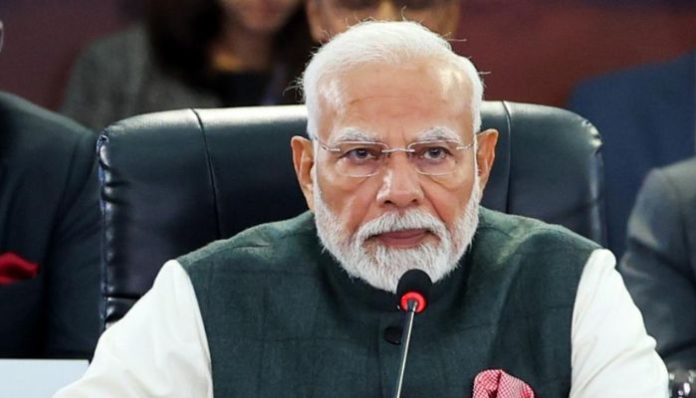
On Tuesday (2nd September), Prime Minister Narendra Modi inaugurated ‘Semicon India – 2025’, aimed at catalysing India’s Semiconductor ecosystem, at Yashobhoomi in New Delhi.
The Prime Minister will also participate in the Conference on September 3 from around 9:30 AM, during which he will also attend the CEOs roundtable, the PMO said on Monday in a statement.
The three-day Conference, from September 2nd to 4th, will focus on advancing a robust, resilient, and sustainable semiconductor ecosystem in India.
It will feature sessions on the progress of the Semicon India Programme, semiconductor fab and advanced packaging projects, infrastructure readiness, smart manufacturing, innovations in R&D and artificial intelligence, investment opportunities, state-level policy implementation, and other topics.
A defining chapter in India's semiconductor journey is unfolding, with innovation and investment driving a new wave of growth. Addressing Semicon India 2025 in Delhi. https://t.co/5jurEGuYnI
— Narendra Modi (@narendramodi) September 2, 2025
The event will highlight initiatives under the Design Linked Incentive (DLI) scheme, the growth of the startup ecosystem, international cooperation, and the future roadmap for India’s semiconductor sector.
As per a press release issued by the Prime Minister’s Office, over 20,750 attendees will participate in Semicon India 2025, including more than 2,500 delegates from over 48 countries, over 150 speakers, including over 50 global leaders, and more than 350 exhibitors. It will also include 6 countries Round Table discussions, country pavilions and dedicated pavilions for Workforce Development & Start-Ups among others.
First ‘Made in Bharat’ Chips! ?? pic.twitter.com/QYFGA4HFLG
— Ashwini Vaishnaw (@AshwiniVaishnaw) September 2, 2025
Taking to X, Prime Minister Modi highlighted that Semicon India conference will bring together leading stakeholders from the world of semiconductors.
“At 10 AM tomorrow, 2nd September, will inaugurate Semicon India – 2025, an important platform that brings together leading stakeholders from the world of semiconductors. This is a sector in which India’s recent strides have been remarkable. The Conference will focus on key themes like Semiconductor Fabs, Advanced Packaging, Artificial Intelligence, research and investment,” PM Modi posted.
At 10 AM tomorrow, 2nd September, will inaugurate Semicon India – 2025, an important platform that brings together leading stakeholders from the world of semiconductors. This is a sector in which India’s recent strides have been remarkable. The Conference will focus on key themes…
— Narendra Modi (@narendramodi) September 1, 2025
Notably, the Modi government has been working to make India a hub for semiconductor design, manufacturing and technology development.
During his address on the occasion of India’s 79th Independence Day, PM Modi highlighted the work India is putting in to become self-reliant in the field of semiconductors.
PM Modi said, “Today we are pursuing the goal of semiconductors in mission mode. We have laid the foundation of six semiconductor units. In our country, 50 years ago, files for semiconductors were started. Ideas started. But the youngsters will be surprised to know that 50-60 years ago those files got stuck.”
“The idea of semiconductors was aborted. After us, many countries are establishing their power in the world by mastering semiconductors. Today we are moving forward with the goal of semiconductors in mission mode. We have laid the foundation of six semiconductor units. By the end of this year, Made in India, that is, chips made in India, made by the people of India, will come in the market,” PM Modi said.
During his recent Japan visit, PM Modi visited a semiconductor plant. He was accompanied by Japanese Prime Minister of Shigeru Ishiba for the visit to Sendai in Miyagi Prefecture on a bullet train. In Sendai, the two leaders visited Tokyo Electron Miyagi Ltd (TEL Miyagi), a leading Japanese company in the semiconductor sector. Prime Minister Modi was briefed about TEL’s role in the global semiconductor value chain, its advanced manufacturing capabilities and its ongoing and planned collaborations with India. PM Modi highlighted how India has made significant strides in the semiconductor sector and that India and Japan are expanding cooperation.
In a detailed analysis, Bastion Research observed that, unlike the global race for cutting-edge nodes, India is positioning itself to fill a critical gap in the global supply chain by producing essential, widely used chips. India is already delivering world-class, high-quality integration services. What sets India apart is its ability to match global standards, both in capability and talent, and its swift progression towards scaling these operations to meet the growing demand for advanced semiconductor-based solutions, the report said.
India is well poised to capture a larger share of the global market, as the China +1 strategy has become a powerful global trend, which is pushing companies to diversify their supply chains and look for alternatives to China.
In 2021, the Indian government launched the Semicon India Programme (also referred to as Indian Semiconductor Mission (ISM) 1.0) with Rs 76,000 Crore in incentives to attract global manufacturers, build fabs, packaging units (OSAT & ATMP, discussed later in detail), and a local supply chain to reduce reliance on imports. The initial focus is on mature-node fabs (28nm to 65nm), not bleeding-edge nodes like 5nm or 3nm, which are dominated by TSMC and Samsung.
In August this year, the Centre cleared four new semiconductor manufacturing projects with a total investment of Rs 4,600 crore under the India Semiconductor Mission (ISM). These semiconductor units will be set up in Odisha, Andhra Pradesh, and Punjab. The approvals take the total India Semiconductor Mission (ISM) portfolio to 10 projects across six states with cumulative investments of Rs 1.6 lakh crore.
In May, the Union Cabinet approved India’s sixth semiconductor manufacturing unit in Jewar in western Uttar Pradesh. It will be established near Jewar Airport through a joint venture between the HCL Group and Taiwanese electronics giant Foxconn.
Among the five semiconductor plants, four are in Gujarat: Tata Electronics-PSMC Semiconductor fab, CG Power-Renesas-Stars Microelectronics ATMP unit, Micron Technology’s ATMP unit, and Kaynes Semicon ATMP unit, while the Tata Semiconductor Assembly and Test (TSAT) Unit is in Assam.


