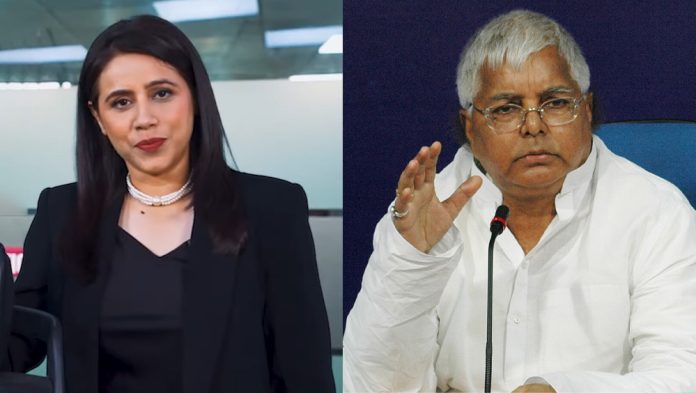
In the turbulent 1990s, Bihar under Lalu Prasad Yadav’s Rashtriya Janata Dal (RJD) was witnessing politics of caste-based mobilisation masquerading as social justice. The so-called upper caste Hindus were singled out, targeted and villainised by the RJD and its supporters with slogans like “Bhura Baal Saaf Karo”. Decades after, India Today journalist Marya Shakil has justified the RJD’s genocidal “Bhura Baal Saaf Karo” slogan.
Marya Shakil is the daughter of Shakil Ahmed Khan, who was a minister in Rabri Devi’s cabinet for 10 years.
During a panel discussion program on India Today, Marya Shakil said that in the Bihar of 1990s, “Lalu Prasad Yadav was a political necessity. When he carried out the movement of ‘Bhura Baal Saaf Karo’ and the entire movement against the upper castes, that was the need of the hour.”
#BiharElectionsOnIndiaToday | #DemocraticNewsroom@SardesaiRajdeep: "Caste makes certain people uncomfortable because it brings out all the social cleavages and inequalities in our society."@GauravCSawant counters him. @maryashakil and @PreetiChoudhry put forward their views.… pic.twitter.com/27P6GHJrg9
— IndiaToday (@IndiaToday) October 30, 2025
She further justified the anti-upper caste movement and genocidal calls by the RJD in the 1990s by saying that when Nitish Kumar arrived on the political scene in 2005 and emphasised “Mahila voters (women voters), etc that was the need of the hour. How conveniently, Marya Shakil whitewashed a political movement calling for the targeting and elimination of upper caste Hindus, not only a ‘political necessity’ but also equating with other social issues like the push to increase participation of women in voting.
This is not only an attempt at justifying and romanticising caste-based targeting and genocide calls as some sort of savvy realpolitik, but also normalising it. Just imagine, if today a BJP leader gives a slogan calling for genocide of a particular religious or ideological group it deems oppressive, arguing that most terrorists or anti-national elements emerge from this community, would Marya Shakil call it ‘political necessity’, ‘need of the hour’ or ‘realpolitik’?
No! Then it would have been hate speech, collapse of democracy, ‘Hindutva fascism’ and triggered ‘Minority khatre mein hai’, ‘I can’t breathe’, ‘Not the India I grew up in’ and similar such responses.
Bhura Baal Saaf Karo: RJD’s genocidal call becomes a political necessity for the daughter of a Jungle Raj-era minister
It is essential to recall that back in the 1990s, particularly 1996, RJD coined the slogan “Bhura Baal Saaf Karo” which became a rallying cry to wipe off the ‘upper-caste’ Hindus. This slogan was not confined to seeking social justice or a mere subtle poetry used during election campaigns. It was an acronym targeting specific Hindu upper castes, Bhu for Bhumihars, Ra for Rajputs, Ba for Brahmins and L for Lalas or Kayasths.
Taking inspiration from the British ‘divide and rule’ policy, the RJD came up with this anti-Savarn slogan to sow divisions within the Hindu community on caste lines by projecting RJD as the sole fighter and defender of the backward caste against ‘oppressive’ Savarn groups. RJD aimed to unite and empower the Hindu backward castes and Muslims. This became the infamous “MY” formula replicated by the Samajwadi Party in Uttar Pradesh.
It was after Lalu Yadav gave the ‘Bhura Baal Saaf Karo’ slogan, which essentially meant eliminate Bhumihars, Rajputs, Brahmins, and Lalas/Kayasths, a series of caste-based killings targeting the upper caste Hindus unfolded in Bihar. The caste fire ignited by the RJD engulfed Bihar and significantly contributed to the Lalu era’s “Jungle Raj”. Lawlessness, kidnappings for ransom, caste-based murders, loot and absolute lawlessness became the new normal in Bihar.
Driven by political desperation and perhaps genuine hatred for the upper caste Hindus, Lalu Yadav and his party’s caste-based politics devolved into a license for goons, especially those linked to his own party, to terrorise upper-caste Hindu villages. These incidents resulted in forced migrations. While Lalu’s Yadav-Muslim supremacist regime rode this wave to power, it scarred generations.
During the 15-year RJD rule, law enforcement collapsed, crimes became rampant, the economy decayed, kidnappings for ransom became a thriving industry, and mass murders, caste clashes became the new normal. This opprobrious era also marked the rise of brutal ‘Bahubalis’ like Mohammed Shahabuddin and Mohammed Taslimuddin, who ran their fiefdom with impunity. Police became a puppet of the RJD government, and migration of youth in search of jobs and to flee violence contributed to the law and economic collapse in the state.
Unsurprisingly, much like his denial of involvement in corruption cases he was convicted in, Lalu Yadav denies coining the ‘Bhura Baal Saaf Karo’ slogan and blames the media for falsely attributing it to him.
However, even decades later, the RJD is using election campaign strategies for the coming state assembly election, particularly songs glorifying guns, violence, the idea of establishing Yadav supremacy and eliminating political opponents just as it used to be during the Jungle Raj.
In fact, the dormant but never dead “Bhura Baal Saaf Karo” has resurfaced in poll-bound Bihar’s charged political chatter. In July this year, a senior RJD leader while addressing a public event has said the same genocidal slogan.
RJD के वरिष्ठ नेता ने बताया बिहार में लालू के 'भूरा बाल साफ करो' नारे का मतलब:
— BJP (@BJP4India) July 17, 2025
-भू: भूमिहार
-रा : राजपूत
-बा: ब्राह्मण
-ल: लाला (कायस्थ)
स्वर्ण जातियों और हिंदुओं के प्रति नफरत… यही हैं लालू प्रसाद यादव की राजनीति के मुख्य तत्व… pic.twitter.com/06FqxlEqNR
In another incident reported from Gayaji, a crowd in July this year, ‘Bhura Baal Saaf Karo’ slogans were raised in the presence of RJD MLA from Attari, Ranjit Yadav.
Munarik Yadav, husband of Sahoda Panchayat head Photu Devi, referring to former Chief Minister Lalu Prasad Yadav, said, “Our leader used to say, ‘Bhura Baal Saaf Karo,’ and he was right. Now is the time to truly execute the Bhura Baal Saaf Karo slogan.’”
While Marya Shakil’s blatant justification of the ‘Bhura Baal Saaf Karo’ slogan has sparked online outrage, it is not shocking coming from the daughter of Ahmed Shakil Khan, who was a close aide of Lalu Prasad Yadav and served as the energy and law minister when Lalu’s wife Rabri Devi was the chief minister of Bihar. The daughter of a jungle-raj era minister justifying the horrors of those days would not have been very surprising; however, it coming from a journalist does raise concern.
If Bihar’s casteist and violent nightmare is what Marya Shakil would call ‘political necessity’, then the state is better off without those dreaming of scripting its sequel.