

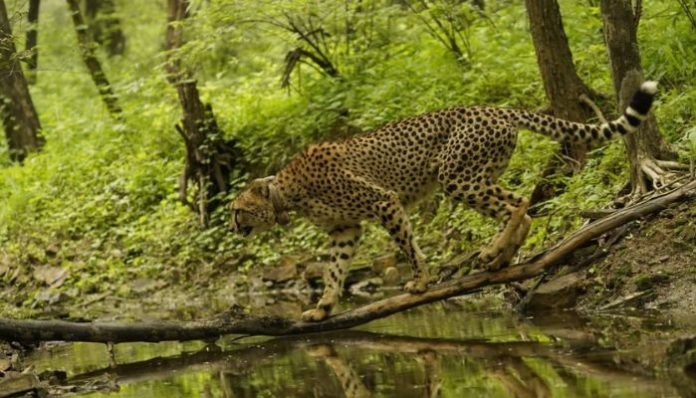
The ambitious Cheetah reintroduction programme initiated by the Government of India has entered a new and promising phase. Once dismissed as an over-optimistic experiment by the opposition, the initiative has now delivered some of the strongest results recorded anywhere in the world for a large carnivore rewilding project.
A thriving population and rising births
Since September 2022, a total of 20 Cheetahs have been brought to Kuno National Park in Madhya Pradesh. Out of these, eight arrived from Namibia in the first month and twelve from South Africa in February 2023. During the reintroduction of Cheetah in the Indian wild, many opposition leaders and those who oppose the Modi government as their regular job doubted the feasibility of the programme. Notably, Cheetah went extinct in India in the 1950s and it took 72 years to bring them back to the country.
Despite the initial speculations drawn by the opposition, as of December 2025, India sustains 32 Cheetahs, out of which 21 are India-born cubs. This marks one of the most successful early-stage reintroduction scenarios globally. In a key milestone for the programme, Mukhi, an India-born female, delivered five healthy cubs in November 2025, further strengthening the country’s growing big-cat population.
What PM Modi said on International Cheetah Day
On 4th December, celebrating International Cheetah Day, Prime Minister Narendra Modi praised the conservation efforts that have brought the species back from extinction in India. He said, “On International Cheetah Day, my best wishes to all wildlife lovers and conservationists dedicated to protecting the cheetah, one of our planet’s most remarkable creatures. Three years ago, our Government launched Project Cheetah with the aim of safeguarding this magnificent animal and restoring the ecosystem in which it can truly flourish. It was also an effort to revive lost ecological heritage and strengthen our biodiversity.”
PM added, “India is proud to be home to several cheetahs, and a significant number of them are born on Indian soil. Many of them now thrive in the Kuno National Park and the Gandhi Sagar Sanctuary. It is heartening to see cheetah tourism growing in popularity as well. I encourage more wildlife enthusiasts from across the world to visit India and witness the cheetah in all its splendour.”
“Our progress in cheetah conservation has been possible only through the collective support of our people, especially our dedicated Cheetah Mitras. Protecting wildlife and living in harmony with nature are integral to India’s civilisational ethos and we see that spirit alive today in these efforts,” he said.
How opposition and left-liberal voices speculated against the programme
While the project has now delivered clear results, the reintroduction effort endured intense criticism and political speculation, often amplified by sections of the opposition and left-liberal commentators.
In January 2024, Congress MP Abhishek Singhvi described the government as “mass murderers of the big cat”, alleging lack of planning and accusing the Centre of prioritising photo opportunities over scientific management.
The BJP Govt would be remembered as mass murderers of the big cat.
— Abhishek Singhvi (@DrAMSinghvi) January 17, 2024
No rationale, deliberations, or thourough planning. #Cheetahs just brought to satisfy the ego of the Supreme Leader and doing photo ops. Pathetic!https://t.co/G616faO3KY
TMC MP Saket Gokhale raised similar concerns in July 2023, blaming two cheetah deaths on preventable causes such as unsuitable radio collars and alleged government complacency.
Important:
— Saket Gokhale MP (@SaketGokhale) July 18, 2023
Last week, 2 cheetahs named Tejas & Suraj died at the Kuno National Park in MP in just 2 days.
A total of 8 cheetahs have died in JUST the last 5 months
The Modi Govt predictably first blamed their deaths on "fighting". But reports have now disclosed that a post… pic.twitter.com/ySSJaYhfAl
The official TMC account labelled the initiative “ill-conceived” and a “PR stunt” after reporting seven deaths between March and July 2023, insisting that habitat suitability had been ignored.
The tragic death of yet another Cheetah in PM @narendramodi's ill-conceived Reintroduction Program serves as a heartbreaking reminder of the consequences of prioritising PR stunts over conservation & wildlife management.
— All India Trinamool Congress (@AITCofficial) July 13, 2023
With this seven felines, including 3 cubs born to Namibian…
In September 2024, Kerala Congress raised objections over Rs 44 crore being spent on the project and the decision to reintroduce Cheetahs instead of rehabilitation of Gir lions.
Project Cheetah was never about wildlife diversity, it was always a photo op. The original plan was to rehabilitate Gir lions, not import cheetahs. But let’s be real, how many Instagram likes would Saheb get for releasing Gujarati lions in Bhopal's forests?
— Congress Kerala (@INCKerala) September 18, 2024
The real question:… pic.twitter.com/aNVwm8FrF4
X user Kapil, who is pro-AAP, said, “Not only wasted taxpayers’ money but is also responsible for the death of Cheetahs.”
#AnpadhRaja neglected the opinion of the environmentalists against #ProjectCheetah.
— Kapil (@kapsology) May 26, 2023
Not only wasted taxpayers' money but is also responsible for the death of Cheetahs.
But he got the desired media publicity when these Cheetahs were introduced and that is what he lives for. https://t.co/p3RY6hWPnT pic.twitter.com/gBybYDj7Ks
Pro-Congress user Ankit Mayank said, “Remember non-stop propaganda by Godi Media when few cheetahs were brought to India in 2022? Out of 20 cheetahs, AT LEAST 8 have died so far. Who will take responsibility for the waste of hundreds of crores of taxpayers’ money? All that for one man’s PR?”
BIG EXPOSE ?
— Ankit Mayank (@mr_mayank) August 27, 2024
Remember non-stop propaganda by Godi Media when few cheetahs were brought to India in 2022?
Out of 20 cheetahs, AT LEAST 8 have died so far ?
Who will take responsibility for the waste of hundreds of crores of taxpayers’ money?
All that for one man’s PR? ?? pic.twitter.com/qM7Wtc0n6b
Propagandist and anti-BJP YouTuber “The Deshbhakt” wrote, “In need for ever more publicity, Govt stopped listening to experts. Citizens too now disregarded any studied opinion / critique / warning is as ‘negative’ / ‘anti-national’. Conservationists like Valmik Thapar were dismissed year ago & now half the imported cheetahs are dead.
In need for ever more publicity, Govt stopped listening to experts. Citizens too now disregarded any studied opinion / critique / warning is as 'negative' / 'anti-national'
— The DeshBhakt ?? (@TheDeshBhakt) August 2, 2023
Conservationists like Valmik Thapar were dismissed year ago & now half the imported cheetahs are dead. pic.twitter.com/Sy61rdP3qH
These criticisms fuelled a larger narrative that the programme was destined to fail, with many commentators predicting the deaths would continue and that India lacked the expertise to manage the species.
Two years on, the data speaks for itself. Despite early setbacks expected in any large wildlife translocation effort, the cheetah population has not only stabilised but grown significantly through natural births. India-born cubs now form the backbone of the population, and both Kuno and Gandhi Sagar are emerging as strong habitats.
The programme has secured international partnerships, revived lost ecological heritage, and placed India among the handful of nations capable of successfully reintroducing the cheetah. Far from collapsing, the initiative is flourishing, proof that the world’s fastest land animal has found its stride once again on Indian soil.


