

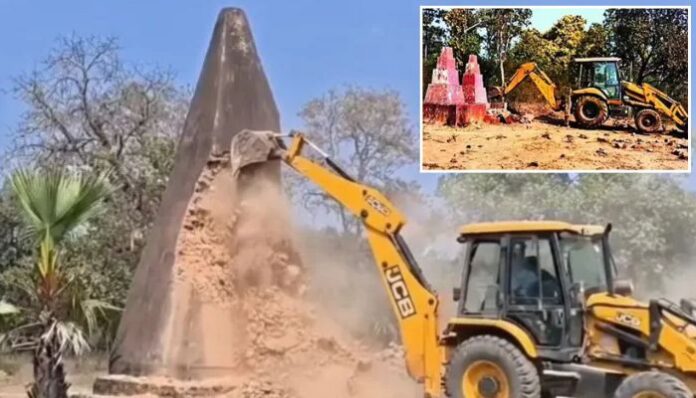
In a fresh push towards the Centre’s target of a Naxal-free India by March 31, 2026, security forces demolished four Maoist memorials in Bijapur district of Chhattisgarh on Friday, 20th February. The memorials were located under the Farsegarh and Tarrem police station areas, both of which have witnessed intense anti-Maoist operations in recent years.
For more than four decades, the Bastar region of Chhattisgarh remained a stronghold of the Maoists. They held sway over vast stretches of territory and constructed hundreds of memorials that came to represent their influence and control in the area.
Bijapur, Chhattisgarh | A total of four Maoist memorials constructed in the jurisdictions of Farsegarh and Tarrem police stations were demolished yesterday. To completely eradicate Maoism and establish lasting peace, security, and development in the region, security forces are… pic.twitter.com/o4yJSIBEbI
— ANI (@ANI) February 21, 2026
Inspector General of Police for Bastar region, Sundarraj P, said, “The removal of Maoist memorials and symbols is a conscious decision to end the ideological influence of Maoism and to strengthen the process of restoring normalcy in the region, reinforcing good governance, and integrating society into the mainstream. The demolition of memorials established by Maoists is a significant step toward eliminating their symbolic and psychological influence.”
“Earlier, such memorials were used by Maoists as instruments to maintain fear, dominance, and ideological control within local communities. Their removal sends a clear message that the legitimate authority of the state and the rule of law are being steadily reinforced in the region, and that Maoist influence is gradually weakening,” the IG said.
“Brick by brick, we would destroy the idea and its manifestation in each and every form,” G P Singh, Director General of the Central Reserve Police Force (CRPF), said in a social media post.
Earlier this month, the Central Reserve Police Force (CRPF) demolished a memorial of Ravula Srinivas alias Ramanna, a central committee member of the CPI (Maoist), in Gogunda village of Sukma district. Assistant Commandant of the 74th Battalion said the area had remained under Maoist influence for a long time and was earlier inaccessible to security forces. After a forward operating base was set up in November 2025, the forces moved in and razed the structure in a joint operation, calling it a step toward a “brighter future” for the younger generation.
Meanwhile, Union Home Minister Amit Shah on Monday, 16th February, again reiterated the Central government’s commitment to end Naxalism by March 31 this year, a decades-old menace that left hundreds of civilians and security forces dead. Shah’s assurance came while speaking at the 79th Foundation Day of Delhi Police, as the Centre’s deadline to eradicate Naxalism would expire in the next 44 days.
44 Naxal memorials razed in Gadchiroli
Just days earlier, on Wednesday, 18th February, a massive demolition drive was carried out in the Gadchiroli district of Maharashtra. The Gadchiroli Police and the CRPF jointly demolished 44 Naxal-built monuments spread across the district.
The drive included nearly 800 personnel from 18 teams, including the elite C-60 anti-Naxal force, the Bomb Detection and Disposal Squad, and the CRPF. The monuments were situated in forested zones, which are strongholds of the Left-wing terrorists, in 15 police posts and sub-posts in areas such as Pengunda, Kawande, and Tumarkothi.
Demolitions were conducted in Etapalli of Gadchiroli district, where 18 structures were torn down, 17 in Hedri, five in Bhamragad, and a few more in Jimlagatta, Dhanora, and Pendhari. Superintendent of Police Nilotpal stated that the demolition is a part of the efforts to destroy the infrastructure of the Maoist movement. He further stated that the Maoist activities in the region have significantly reduced due to continuous security operations.
The demolition drive is not only meant to destroy the infrastructure but also to convey a message that the government is in complete control. Gadchiroli, which was once one of the worst-hit districts in Maharashtra by Maoists, is now witnessing a gradual transition towards development and enhanced security.
Maharashtra Chief Minister Devendra Fadnavis congratulated the Gadchiroli police force on this success. He said the move goes beyond just tearing down physical structures and marks a clear triumph of democracy over the fear that had dominated people’s lives for years.
53 memorials demolished in 15 days
The demolition campaigns in Bijapur and Gadchiroli are a part of a larger, joint effort. In the last 15 days alone, the CRPF has destroyed 53 Naxal memorials in Sukma, Bijapur, and Bastar in Chhattisgarh.
This is in line with the directives of Union Home Minister Amit Shah in a review meeting on Left-Wing Extremism held in Raipur on 8th February. With the help of location mapping, often conducted with the assistance of local villagers, the security forces are working towards the destruction of all such infrastructure by the end of February. After this, plantation drives will be conducted to ensure that the land becomes a part of the surrounding forests, leaving no trace of Maoist activity.
The CRPF has played a central role in this campaign, maintaining a strong presence in interior villages through forward-operating bases. Among the memorials destroyed recently are those erected after the neutralisation of CPI (Maoist) general secretary Namballa Keshava Rao alias Basavaraju in Narayanpur in May 2025 and central committee member Ramachandra Pratap Reddy alias Chalapathi in Gariyaband in January 2025.
In the last three years, security forces have killed over 520 Maoists and destroyed more than 100 such memorials in Bastar alone. Between 2018 and 2023, around 60 memorials were destroyed. However, between 2023 and February 2026, the figure shot up to 113, indicating the intensified crackdown.
One of the tallest structures, a 64-foot memorial at Komatpalli village near the Telangana border, was destroyed in January 2025. The village had once witnessed massive Maoist rallies, including the ‘Shahidi Saptah’ rally in 2022, which was attended by senior Maoist leaders and members of Battalion 1 of the People’s Liberation Guerrilla Army. That area was once beyond the reach of security forces, a situation that has now completely changed.

Why the demolitions matter
The removal of these Naxal memorials is both practical and symbolic. Practically, these structures served as rallying points and psychological markers of Naxal supremacy in remote regions. They reminded villagers of the insurgents’ power and often reinforced fear.
Demolishing them represents the dismantling of Naxal-Maoist ideology itself. When Home Minister Amit Shah set March 31, 2026, as the deadline to end Naxalism, it was presented not as a political slogan but as a firm timeline. The government’s message is that the insurgency has already weakened significantly, and what remains is the final phase of closure.
Naxalism had been India’s longest-running internal insurgency for almost five decades. It had spread across the region that was once known as the Red Corridor, covering several states. However, 2025 was a turning point in the history of Naxalism. Top Maoist leaders were eliminated, recruitment networks were busted, and hundreds of cadres surrendered. Entire districts fell out of Maoist hands.
Inspector General of Police for the Bastar range, Sundarraj P, said that removing these memorials helps restore normalcy and strengthen governance. Earlier, such structures were used to maintain dominance and ideological control. Their removal sends a clear signal that the rule of law is firmly back.
Operation Kagar and the centre’s initiative for a Naxal-free India
The demolition drives are part of a broader national strategy under Operation Kagar, launched in January 2024. Over the last decade, the central government has amped up operations in Naxal strongholds to entirely uproot the Maoist cadres. The government has adopted a two-pronged strategy of eliminating the Maoist cadres through military operations clubbed with development-oriented works such as expansion of roads, transport facilities, water, electricity and other welfare schemes of the government reaching the villagers.
As part of this strategy, the central government launched this operation in January 2024 to eradicate Naxalism in Chhattisgarh, Maharashtra (Gadchiroli), Odisha, Bihar, Jharkhand, Madhya Pradesh and Telangana. Under the operation, around 1 lakh para-military troops, including the Central Reserve Police Force (CRPF), its elite CoBRA units, District Reserve Guards DRG), and state police, equipped with modern technology, have been deployed in the left-wing terrorism affected areas to completely uproot the naxal terrorism from its last remaining strongholds.
The success of the centre’s anti-Naxal operation can be estimated from the fact that from 2015 to 2025, the number of Naxal-affected districts came down from 106 to 18. Out of these districts, 12 were considered the worst affected by Naxalism. However, this number further reduced to only 6 worst Naxal-affected districts, including Bijapur, Kanker, Narayanpur, and Sukma in Chhattisgarh, West Singhbhum in Jharkhand, and Gadhchiroli in Maharashtra.
On 19th February (Thursday), Bihar authorities announced that the state is now “Naxal-free” after the surrender of prominent Maoist Suresh Koda, also known as Mustakim, who had a reward of Rs 3 lakh. He surrendered himself to the Special Task Force (STF) of the Munger district police a day ago. It is pertinent to note that the number of districts affected by left-wing extremists (LWE) has also decreased to seven, as per a recent analysis of the affected region.
Last month, the Centre released a detailed 10-point plan to ensure that areas cleared of Left-Wing Extremism remain peaceful. The plan is meant for the post-Left-Wing Extremism phase and focuses on stabilising districts that have lived through years of violence. It aligns with the development-oriented part of the Centre’s two-pronged strategy for eliminating Naxalism.


