

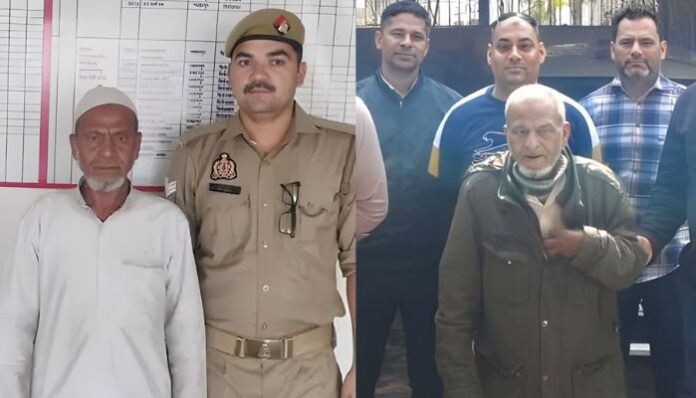
An occult practitioner identified as 70-year-old Kamruddin, also known as ‘Baba’, has been arrested in connection with the triple murder case in Delhi. Three people were poisoned with laddus during a so called “Dhanvarsha” ritual by Kamruddin. During the preliminary investigation, Delhi Police found that Kamruddin had already been booked last year in Uttar Pradesh in a separate murder case and was also named in a 2014 murder case in Rajasthan.
OpIndia accessed case files of the 2025 UP murder case, which revealed that he was denied bail twice by the sessions court in Firozabad. In that case, the modus operandi was similar to the current case of triple murder in the national capital.
Kamruddin poisoned two Hindus in Firozabad, UP
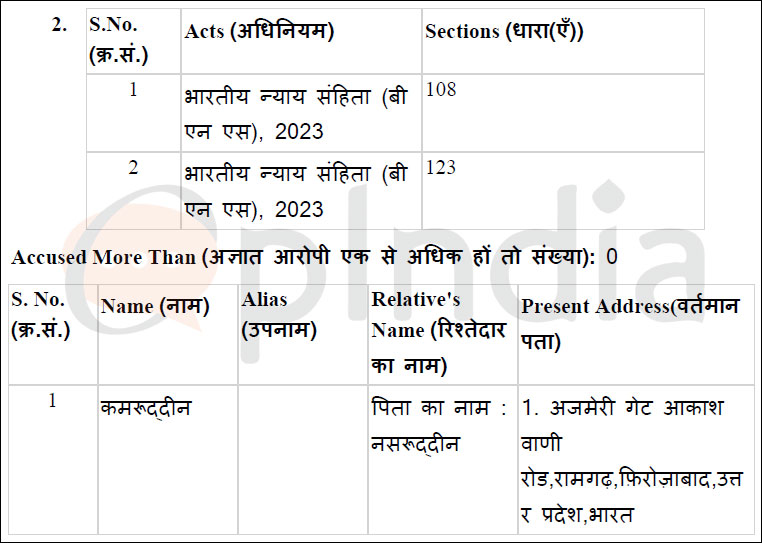
During the probe, Delhi Police discovered multiple murder cases across states where Kamruddin is an accused. One such case was registered at Makkhanpur Police Station in Firozabad district of Uttar Pradesh in 2025. The case was registered under Sections 103(1) and 123 of the Bharatiya Nyaya Sanhita (BNS). He was earlier booked in a 2014 murder case as well. That particular case was registered under Sections 143, 363 and 302 of the Indian Penal Code (IPC) in Dholpur, Rajasthan.
Furthermore, during research Opindia found that he was booked under Section 304, culpable homicide not amounting to murder, at North Police Station in Firozabad as well. However, details of that case, and the Rajasthan case were not available at the time this report was published.
OpIndia accessed the orders passed by the Sessions Court in Firozabad in the dual murder case. The documents showed that his bail application was rejected twice, first on 18th June 2025 and again on 18th August 2025.
What happened in the Firozabad case
The FIR in the UP case was lodged by Ram Singh, a resident of Nagla Gokul in Firozabad district. He alleged that his elder brother Ramnath and a relative named Pooran were close friends and had been visiting Kamruddin’s residence for some time. Kamruddin claimed to perform occult rituals and had taken a substantial amount of money from Ramnath and Pooran under the pretext of occult practices. When they demanded their money back, he allegedly bore a grudge.
On 8th May 2025, Kamruddin called Ramnath and Pooran to his house and promised that through a special occult ritual he would help them recover buried treasure. The complainant stated that Kamruddin used his influence and trust to administer some poisonous substance during the ritual and instigated them to commit suicide.
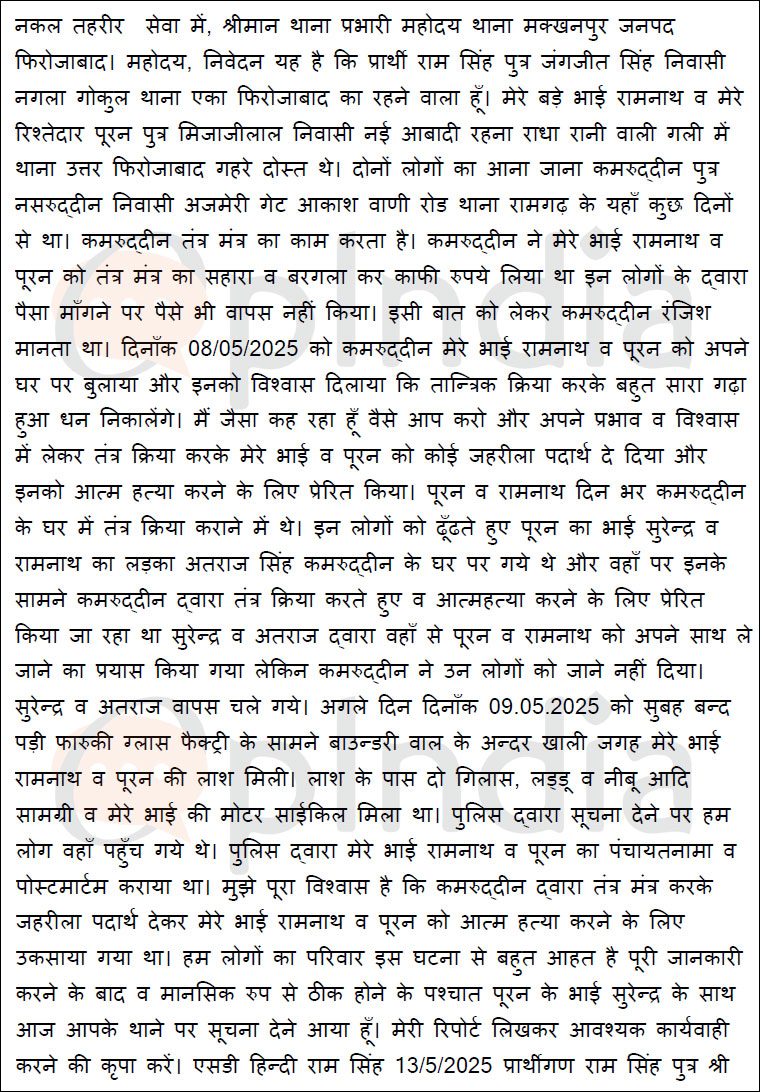
Ramnath and Pooran reportedly spent the entire day at his house. When their family members went searching for them, they allegedly saw Kamruddin performing rituals and persuading the two men towards self harm. Attempts were made to take them away, but Kamruddin allegedly did not allow them to leave.
The next morning, on 9th May 2025, the bodies of Ramnath and Pooran were found inside the boundary wall of a closed glass factory. Two glasses, laddus, lemons and other ritual items were found near the bodies, along with a motorcycle belonging to one of the deceased.
थाना मक्खनपुर क्षेत्र में 2 व्यक्तियों के शव मिलने की सूचना पर पुलिस द्वारा मौके पर पहुँचकर शवों को पोस्टमार्टम हेतु मोर्चरी भिजवाया गया । प्रथम दृष्टया किसी जहरीले पदार्थ के सेवन करने से मृत्यु होंना प्रतीत हो रहा के सम्बन्ध में ASP ग्रामीण द्वारा दी गयी बाइट @dgpup @Uppolice pic.twitter.com/mUIhTbdNtz
— Firozabad Police (@firozabadpolice) May 9, 2025
Court observations and bail rejection
Post mortem reports in the Firozabad case noted that the immediate cause of death could not be ascertained and the viscera was preserved for chemical analysis. However, the court recorded that there was supporting material in the case diary and statements under Section 180 of the BNSS that indicated the accused had allegedly administered a poisonous substance and instigated the victims.
On 18th June 2025, the Additional Sessions Judge, Firozabad, rejected his first bail application. The court observed that he was specifically named in the FIR and the allegations involved administering poison through occult rituals and abetment to suicide. Considering the gravity of the offence and the material on record, the court held that there was no sufficient ground to grant bail.
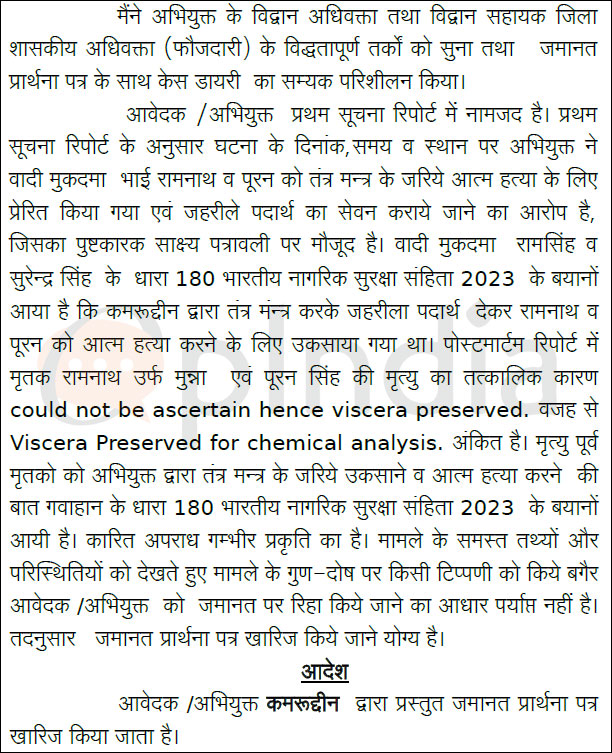
Subsequently, after the filing of the charge sheet, Kamruddin moved a second bail application. On 18th August 2025, the Sessions Judge, Firozabad, again rejected his plea, noting the seriousness of the crime, the evidence collected during the investigation and the earlier rejection on merits.
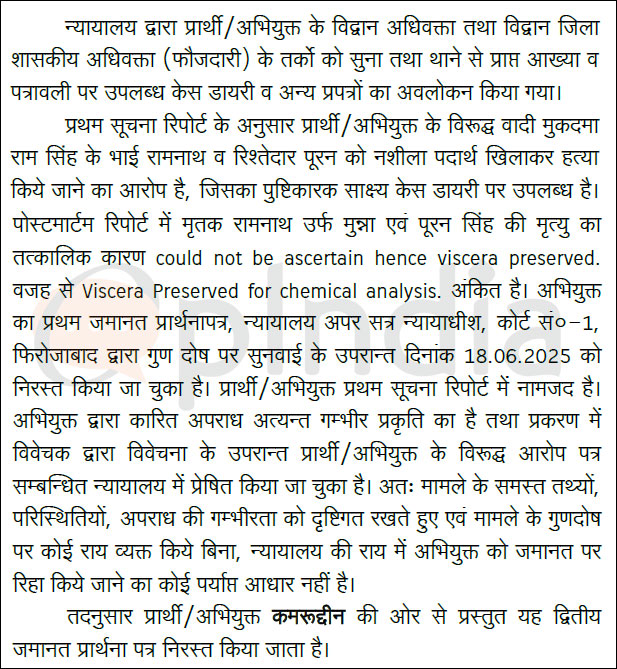
The court emphasised that without expressing any opinion on the merits of the case, the nature and gravity of the allegations did not justify his release on bail.
Delhi triple murder and the dhanvarsha promise
On 8th February, a PCR call alerted Paschim Vihar East Police Station about three people lying unconscious inside a white car near the Peeragarhi flyover in Outer Delhi. The victims, identified as Laxmi, Shiv Naresh and Randhir, were rushed to Sanjay Gandhi Memorial Hospital, where doctors declared them brought dead.
Police recovered liquor bottles, cold drink bottles, empty glasses, sweets, personal belongings and documents from the vehicle. While there were no visible external injuries, families of the deceased ruled out suicide and expressed suspicion, prompting a deeper probe.
Technical analysis of call data records and location tracking revealed that the three had been in contact with Kamruddin, who allegedly promised them financial gain through occult rituals. Investigators found that he boarded their vehicle in Loni, Ghaziabad, and later exited it before abandoning the car at the spot where the bodies were discovered.
According to police, Kamruddin lured the victims with promises of “Dhanvarsha”, asked them to arrange Rs 2 lakh in cash along with liquor and cold drinks for the ritual, and then fed them laddus mixed with poison during the journey back to Delhi. After they fell unconscious, he allegedly took the cash and fled.
During questioning, he reportedly confessed to the crime and admitted that an accomplice named Salim had introduced him to one of the victims.


