

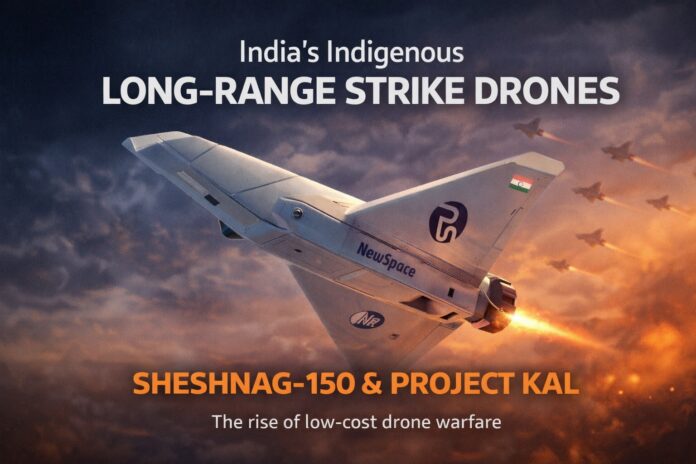
Earlier wars were fought with swords and bows, but today wars involve missiles, drones, cyber attacks, and advanced technology. Conflicts such as the Russia-Ukraine war and the Nagorno-Karabakh conflict have shown how relatively inexpensive drones and loitering munitions can easily alter the balance of power on the battlefield. Iran’s Shahid-136 drone, a low-cost Uncrewed Combat Attack System, has surprised with its efficiency.
It has emerged as one of the most influential platforms driving this shift in military strategy. The concept of mass-produced attritable drones has gained traction among military powers, including the United States, with its Low-cost Uncrewed Combat Attack System. Acknowledging the strategic ramifications of this change, India has also stepped up efforts to develop domestic long-range strike drones, such as Project KAL and the Sheshnag-150, indicating a wider shift towards affordable, mass-produced unmanned warfare systems.
How Iran’s Shahed drones changed warfare
One of the most influential developments in modern drone warfare has been the introduction of Iran’s Shahed-136 drone, a low-cost drone designed for long-range, precise strikes. It operates as a Kamikaze drone, which means it crashes straight into the target while carrying an explosive payload, unlike conventional drones that return after completing the mission. It is designed with a relatively simple delta-wing structure, which makes it inexpensive to manufacture while still capable of travelling long distances. According to reports, the cost per unit is approximately $20,000–$50,000, which is significantly lower than that of conventional missiles or advanced combat aircraft.
The Shahed-136 has a range of approximately 2000-2500 km with a capacity of around 40–50 kg explosive payload. It works on GPS and inertial navigation guidance and is launched by the trucks or racks. During the Russia-Ukraine war, it gained global traction when Russia deployed the system under the name Geran-2 to target Ukrainian infrastructure and military positions. These drones were frequently used in large numbers simultaneously, allowing them to overwhelm air defence systems. The Shahed-136 has a strategic advantage because it creates uneven costs. To stop these kinds of drones, air defence systems need to use expensive missiles. For instance, one Patriot interceptor missile can cost about $4 million, which means that protecting against dozens of cheap drones can quickly become too expensive.
Because of this imbalance, militaries around the world have had to rethink their traditional defence strategies. Many countries are now investing in mass-produced, attritable drones that can attack in swarms, rather than relying solely on high-value platforms like fighter jets or cruise missiles.The success of the Shahed-style drone concept has also influenced other countries. The United States has reportedly developed a similar platform, the Low-Cost Uncrewed Combat Attack System, based on the same idea: striking from a long distance at low cost.
JUST IN: 🇺🇸The U.S. has reverse-engineered Iran's Shahed drone to make the LUCAS, a $35,000 clone. pic.twitter.com/Mkgu7yWRQv
— Radar 𝘸 Archie🚨 (@RadarHits) March 6, 2026
Why drone warfare matters for India
With the growing dominance of drones in modern wars, it becomes significant for India’s security situation to adopt this kind of warfare. India has two active strategic fronts against China and Pakistan. India’s operational landscape is complex, with high-altitude mountains, deserts, and densely populated border areas. In this kind of terrain, unmanned systems are highly useful because they enable continuous surveillance, rapid intelligence gathering, and precise strikes without risking pilots or large troop deployments. Drones are especially useful in sensitive areas like the Line of Actual Control and the Line of Control, where tensions can rise quickly and response time is very important. Recent global conflicts have reinforced the strategic importance of unmanned systems.
The Iran-Israel conflict, the Russia-Ukraine War and the Nagorno-Karabakh conflict between Azerbaijan and Armenia showed how cheap drones can break down advanced air defence networks and change the way battles are fought. From India’s perspective, it becomes more important and relevant as its adversaries also expand their drone capabilities. China has invested heavily in a wide range of unmanned platforms, while Pakistan has built up its drone arsenal by working with outside suppliers and building up its own capabilities. Given the situation, it is essential for India to rapidly strengthen both its offensive drone capabilities and its counter-drone defences. India has already been integrating drones more actively in its military operations. During the operation Sindoor, India used UAVs (Unmanned Aerial Vehicles), a technical term for drones. It showed how India’s tactical doctrine is changing. Drones are increasingly used with precision standoff weapons to carry out targeted strikes. India has also improved its defences by adding layered air-defence networks and homegrown counter-drone technologies that can find, block, or destroy enemy UAVs.
To address emerging battlefield realities, India is accelerating the development of indigenous combat drones capable of long-range precision strikes. One prominent project in this initiative is the Sheshnag-150, a domestically developed loitering munition designed for swarm attacks and deep-penetration missions against enemy targets.
Sheshnag-150: India’s home-made drone
One of India’s most notable efforts to develop a long-range, low-cost strike drone is the Sheshnag-150. It is an indigenous loitering munition being developed by Bengaluru-based defence startup NewSpace Research and Technologies. It is one of India’s most prominent attempts to create a long-range, affordable strike drone. The drone is intended to give the Indian military an affordable weapon that can carry out swarm attacks and deep-strike operations against adversaries.
It is inspired by the growing use of long-range kamikaze drones worldwide, including the Shahed-136. The Sheshnag-150 integrates cutting-edge autonomous and swarm technology specifically designed to meet India’s operational needs. In Sheshnag-150, the range is approximately 1000-1200km, with a capacity of 25-40kg of explosive. It has more than 5 hours of endurance, meaning it can stay in the air for over five hours over a single mission without landing. These specifications enable the drone to penetrate deep into enemy territory and strike strategic targets, including logistics hubs, radar systems, and military installations.
Swarm technology and autonomous aoordination
Swarm technology enables multiple unmanned aerial vehicles (UAVs) to coordinate and collaborate to perform a range of tasks that would be too inefficient or impossible for a single drone to complete. Each drone may have a comparable function or one of several specialised functions, such as communications relaying, data collection, or weaponry. In Sheshnag-150, it is one of the defining features: an AI-enabled swarm capability. Instead of operating as a single platform, multiple drones can be launched simultaneously and coordinate their movements autonomously. In this type of attack, Several drones are launched together from different locations and operate as a coordinated group rather than as individual platforms. These drones can communicate with each other and adjust their flight paths in real time to adapt to changing battlefield conditions. Within the swarm, some drones may act as decoys to distract or confuse enemy air defence systems, forcing them to engage multiple targets simultaneously. Meanwhile, other drones in the formation exploit the gaps created in the defence network and penetrate deeper to strike the intended targets. This coordinated approach enables swarm drones to overwhelm sophisticated air defence systems, significantly increasing the chances of a successful strike.
Project KAL: India’s long-range strike drone
Alongside the development of the Sheshnag-150, India is also working on another indigenous drone programme, Project KAL. The project is being developed by the Noida-based defence company IG Defence. It aims to create a long-range loitering munition capable of deep-penetration strike missions. It is designed as a Kamikaze drone. Project KAL is expected to deliver an explosive payload directly to enemy targets after identifying them in flight.
According to the report, the drone may have a range of about 1,000 kilometres and an endurance of three to five hours. This allows it to travel deep into hostile territory before striking strategic targets. Unlike conventional missiles, such drones can adjust their flight path during the mission. This enables operators to identify and engage targets with greater precision.
If Project KAL is successfully operationalised, it could complement systems like the Sheshnag-150. This would expand India’s indigenous arsenal of long-range, low-cost strike drones. It would strengthen the country’s ability to conduct precision attacks while reducing reliance on expensive missile systems.
Expanding India’s drone arsenal
In addition to new strike-drone initiatives such as Project KAL and Sheshnag-150, India is gradually building a diverse unmanned aerial systems ecosystem to support training, combat, and surveillance across its armed forces. Intelligence, surveillance, and reconnaissance missions frequently employ long-endurance platforms such as the Heron Mk2 and Searcher Mk II, especially along sensitive frontiers like the Line of Actual Control (LAC). Moreover, India is also advancing its capabilities through projects like DRDO’s TAPAS-BH-201 (Rustom), which is expected to strengthen the country’s medium-altitude surveillance capacity. Nagastra-1, loitering munitions provide frontline troops with portable strike capability, while systems like Rudrastra, a VTOL loitering UAV tested in 2025, add flexibility for operations in difficult terrain. In addition, India is set to acquire MQ-9B SeaGuardian drones to enhance maritime surveillance in the Indian Ocean Region, while future projects such as the stealth Ghatak UCAV aim to expand India’s deep-strike capabilities. Together, these platforms illustrate how India is gradually developing a comprehensive drone arsenal that combines imported systems with indigenous innovation to meet the evolving demands of modern warfare.
Conclusion
The growing use of drones in modern warfare has become a crucial part, significantly altering the character of warfare and making unmanned systems a central component of military strategy. It is evident that a relatively inexpensive unmanned platform can have a major impact on the battlefield over traditional methods. These developments have encouraged the countries to rethink their traditional doctrine and invest in mass-produced, cost-effective drone systems.
For India, it is a strategic necessity to adapt to these advancements. Over time, strengthening domestic unmanned systems has become increasingly crucial as their capabilities have grown. Projects like KAL and Sheshnag-150 demonstrate India’s efforts to develop cost-effective long-range strike drones capable of operating in challenging combat environments. Future military capabilities will be greatly influenced by the capacity to create, implement, and mass-produce unmanned systems as warfare continues to change. In this quickly evolving era of drone warfare, India hopes to improve its operational flexibility while lowering reliance on foreign systems by investing in domestic technologies and bolstering its military industrial ecosystem.


