

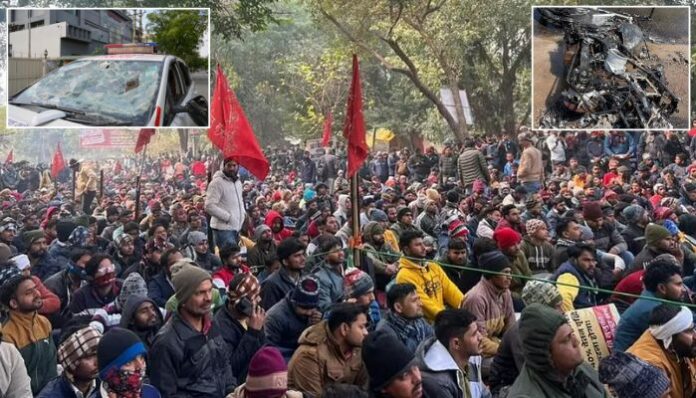
Police uncovered a larger conspiracy behind the violent protests of IMT Manesar and arrested six key accused on Monday, 13th April. What began as a protest over salary hikes quickly turned violent on 9th April, in the industrial area of Manesar. Workers from multiple companies gathered in the IMT area demanding better wages and working conditions. The situation escalated when a section of the crowd turned aggressive, leading to stone pelting, vandalism, and arson.
#WATCH | Haryana: Protest by employees of several companies in Manesar, Gurugram turned violent as they vandalised Police vehicles and company property. They were demanding an increase in their salary. pic.twitter.com/XH3fU2FKXf
— ANI (@ANI) April 9, 2026
WhatsApp chats reveal a larger conspiracy
As the investigation progressed, police uncovered a much bigger conspiracy behind the violence on Monday, 13th April. According to officials, several provocative messages were shared in WhatsApp groups that included workers from different factories. These messages played a key role in inciting the crowd.
According to media reports, many of these messages were sent by “outsiders” who were not linked to the companies. These individuals tried to provoke workers and push them towards violence. Some messages even talked about targeting specific individuals.
In one such message, there was a call to bring out a manager named Rambir, suggesting plans to attack him to trigger chaos.
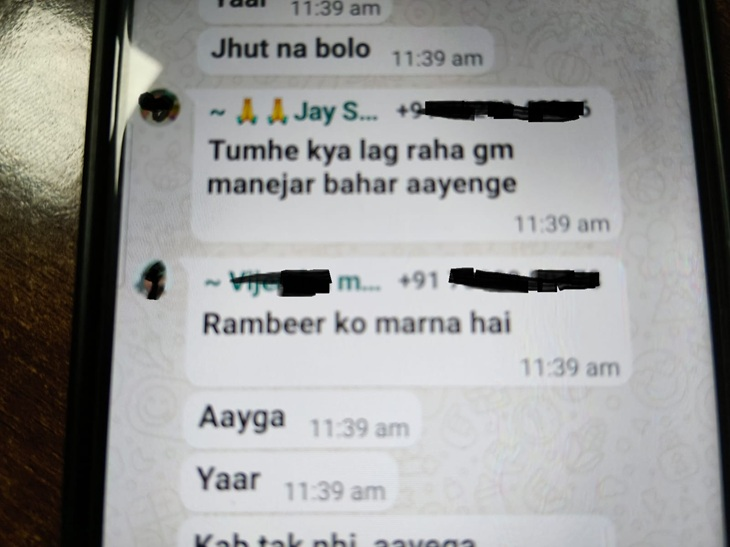
More alarming were messages suggesting planned attacks at night. One message said to “wait till night and then set fire,” indicating that the violence may have been pre-planned to escalate after police presence was reduced.
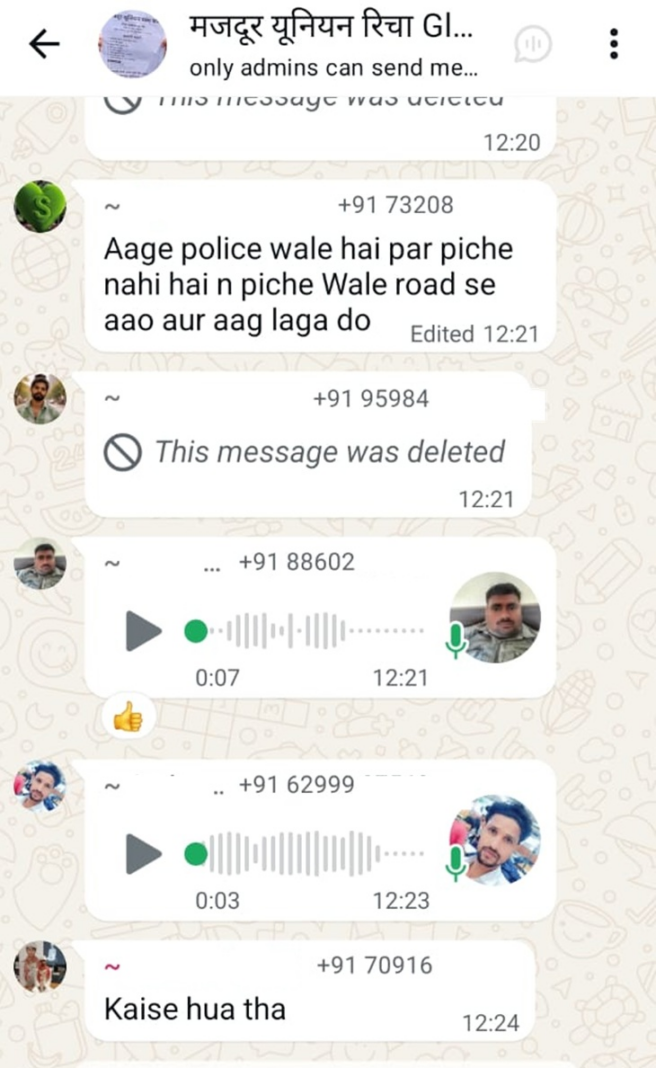
There were also clear references to petrol bomb attacks. Messages instructed people to bring beer bottles, fill them with petrol, and throw them at the factory premises. Police believe this shows a deliberate attempt to target multiple industrial units and create large-scale disruption.
Officials said that so far, 61 people have been arrested in connection with the violence, including 15 women. While some have been granted bail, others are currently lodged in Bhondsi jail.
Six key accused arrested, identified
In a breakthrough, police on Monday, 13th April, arrested six “primary conspirators” linked to the violence. These accused have been identified as Akash from Rohtak, Harish Chand from Pauri Garhwal, Pintu Kumar Yadav from Madhubani, Raju Singh from Udham Singh Nagar, Shyambir from Badaun, and Ajit Singh from Jind.
According to investigators, these individuals were not workers and had no professional connection with the companies in Gurugram. “The investigation further revealed that most of the arrested individuals are not labourers… they are accused of infiltrating the strike to incite workers toward violence,” an officer said.
Police added that the violence on 9th April targeted three branches of a private company in Sector 7. Protesters damaged company property, attacked staff, and pelted stones at police personnel “with the intent to murder.”
Digital evidence, especially WhatsApp chats, played a crucial role in identifying the accused and exposing the conspiracy.
Police had already imposed restrictions under Section 163, asking workers not to protest. However, tensions continued to rise. During the clash, some protesters attacked a company’s premises, after which police resorted to a lathi-charge to control the situation. In retaliation, a police bike was set on fire, and several vehicles were damaged.
#Haryana | Section 163 Imposed In IMT Manesar As Police Lathi-Charge Protesting Contract Workershttps://t.co/rkhQ0rX5Lr
— News18 (@CNNnews18) April 9, 2026
The protests were not sudden. Just days earlier, on 6th April, workers at a major automobile company had gone on strike over wages, and their demands were accepted the next day. This encouraged workers from other companies in the Manesar industrial belt to begin similar protests, which eventually led to the large-scale unrest on 9th April.
Administration steps in with strict directives
Following the violence, authorities moved quickly to prevent further unrest. Senior officials, including DCP Manesar Prabina, SDM Darshan Yadav, and Labour Commissioner Naveen Kaushik, met with company owners and contractors.
The administration has issued a set of instructions to industrial units to ensure smooth functioning and avoid further issues. Companies and contractors have been clearly told to pay workers their salaries and honorariums as per the government’s rules.
They have also been asked to display wage details on notice boards outside their premises so that workers can easily check and understand what they are supposed to be paid.
At the same time, management has been strictly directed to make sure that no worker faces harassment, unfair treatment, or any kind of victimisation at the workplace.
To maintain peace in the area, companies have also been advised to keep a calm environment and ask workers not to pay attention to rumours being spread by outsiders.
Police appeal and ongoing investigation
Police have registered FIRs at the IMT Manesar Sector 7 police station, and the investigation is still ongoing. Police spokesperson Sandeep Kumar said the WhatsApp messages clearly indicate that there was a “large conspiracy” behind the violence.
“We appeal to all workers not to be misled by non-workers or outsiders who attempt to disrupt the peace for their own motives,” the police said in a statement. “If any external element tries to incite you, please inform the police immediately.”
Meanwhile, the Centre of Indian Trade Unions (CITU) has criticised the police action and demanded the release of 55 workers, including 20 women, who were detained after the protest. CITU leader Suresh Nouhra claimed that workers were protesting peacefully but were met with a lathi-charge. He said, “Cases have been registered against 55 workers… and labour leaders are being issued notices and arrested.”
The union has also demanded a minimum monthly wage of ₹30,000 and announced statewide protests on 16th April.
Protests spread to Noida and nearby regions
The unrest in Manesar has not remained limited to Gurugram. Similar violent protests have now been reported from other parts of the National Capital Region, especially Noida.
In Noida, protests that began a few days earlier turned violent on Monday, 13th April. Workers in areas like Phase 2 and Sector 60 were involved in stone pelting, arson, and vandalism. Several vehicles were set on fire, and industrial units were damaged.
By evening, over 300 protesters were arrested under preventive provisions for arson and vandalism, while more than 100 were detained for questioning.
Noida Violence: Sanyog ya Prayog? Was a Communist organization continuously plotting the unrest?
— OpIndia.com (@OpIndia_com) April 13, 2026
First the Panipat Refinery, then Adani’s power plant, and now factories in Noida have become targets of goons.
Is there an attempt to undermine the ‘Make in India’ initiative?… pic.twitter.com/QgOf1baug1
The protests also disrupted traffic, with long queues seen on roads leading to Delhi. In some areas, protesters blocked National Highway 9, causing major inconvenience to commuters.
The authorities revealed that the protestors in Noida have similar demands as the protestors in Manesar, mainly an increase in wages. The Uttar Pradesh government has denied the factory workers’ pay hike demand, saying they had increased the prices on 1st April. The interim rates fixed by the government in Gautam Buddha Nagar and Ghaziabad had increased to ₹13,690 for unskilled workers, ₹15,059 for semi-skilled workers, and ₹16,868 for skilled workers.
The nature of the protest has made some speculate if there are some similar elements trying to foment trouble in the industrial area.


