

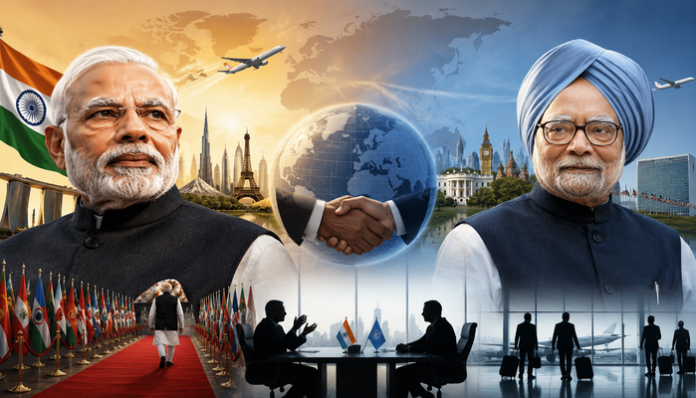
The Ministry of External Affairs’ latest disclosure on PM Modi’s foreign visits has once again triggered a familiar cycle of outrage on social media. Within hours of the data being tabled in Parliament, opposition leaders and anti-Modi commentators began circulating isolated expenditure figures, portraying the Prime Minister’s overseas engagements as extravagant exercises at taxpayers’ expense.
However, a closer examination of the data reveals that much of this criticism is built on selective numbers stripped of context. Far from exposing wasteful spending, the available figures suggest that PM Modi has undertaken a far more ambitious diplomatic outreach than his predecessor while keeping expenditure broadly comparable, and, in some respects, even more restrained.
The disclosure came in response to questions raised in the Rajya Sabha by AAP MP Sanjay Singh and CPI(M) MP Dr V Sivadasan. The MPs sought details of PM Modi’s country-wise visits since 2021, the expenditure incurred on each visit, bilateral agreements signed and the Foreign Direct Investment (FDI) received during the period.
According to the MEA, PM Modi’s foreign visits in 2026 up to July cost around ₹74.5 crore. During these six months alone, he travelled to 13 countries, including Malaysia, Israel, the UAE, the Netherlands, Sweden, Norway, Italy, France, Slovakia, Seychelles, Indonesia, Australia and New Zealand.
Around 74.5 Cr Rs were spent on PM Modi's foreign visits this year, Parliamentary Papers Show.
— Sidhant Sibal (@sidhant) August 6, 2026
Total cost of PM's all visits since 2021 also given out
Papers say FDI received during April 2021 – December 2025 period was USD 381.8 billion due to PM Modi's foreign visit: https://t.co/biKPTNB8EV pic.twitter.com/IUs9gQ5K9F
Predictably, critics ignored the broader picture and instead highlighted the expenditure on individual visits. Some insufferable detractors questioned how more than ₹17 crore was spent on the Norway leg of the Prime Minister’s European tour, attempting to portray the figure as evidence of extravagance.
Modi was in Norway for just one day.
— Kapil (@kapsology) August 6, 2026
It cost taxpayers ₹17 crore.
Aisa kya hua wahan par? 😲😲😲 pic.twitter.com/m35xjZM0Eu
That criticism ignores the fundamental nature of official prime ministerial visits.
Looking beyond the headline figures
The expenditure disclosed by the government is not simply the cost of flying the Prime Minister from one country to another. It includes charter aircraft, security arrangements, advance teams, official delegations, communication infrastructure, logistics, protocol requirements and numerous operational expenses associated with high-level diplomatic engagements. Multi-country tours involving meetings with several heads of government naturally cost more than ordinary travel.
Looking at one destination in isolation while ignoring the larger itinerary creates a misleading impression.
More importantly, the criticism begins to unravel when the expenditure is compared with that incurred during the tenure of former Prime Minister Dr Manmohan Singh.
Available parliamentary records show that Dr Singh undertook 73 foreign visits between 2004 and 2014. During those ten years, approximately ₹795.18 crore was spent on air travel alone.
The words “air travel alone” are critical.
The comparison critics rarely make
Unlike the figures disclosed for PM Modi’s visits, which broadly include charter flights, security, official delegations and logistical expenditure, the ₹795.18 crore figure relating to Dr Singh accounts only for aviation expenses. It excludes security deployment, accommodation, transport, communication systems, advance teams, protocol arrangements and numerous other costs that necessarily accompany visits by a serving Prime Minister.
Consequently, the actual expenditure incurred on Dr Singh’s foreign visits would have been considerably higher than the available figure.
Several of Dr Singh’s individual trips cost more than PM Modi’s recent tours
The comparison becomes even more revealing when one examines individual visits.
Dr Singh’s June 2012 visit to Mexico and Brazil cost approximately ₹26.94 crore in air travel expenditure alone. His 2010 visit to Washington DC and Brazil incurred around ₹22.70 crore on aircraft operations, while his November 2009 visit to the United States and Trinidad and Tobago cost approximately ₹21.27 crore. Another visit to the United States in 2013 involved air travel expenditure of around ₹23.30 crore.
Each of these figures pertains only to aircraft costs.
By contrast, many of PM Modi’s recent multi-country tours—including security, logistics and official delegation expenses—have cost less than or roughly the same as these air travel bills from the previous government.
This alone demonstrates why drawing sensational conclusions from isolated expenditure figures is intellectually dishonest.
The broader comparison is equally significant.
More diplomacy, comparable expenditure
Between 2015 and 2025, PM Modi undertook more than 100 overseas visits, substantially more than Dr Singh’s 73 visits over a comparable ten-year period. Yet the cumulative expenditure on PM Modi’s foreign visits has been estimated at around ~₹800 crore.
In other words, a Prime Minister who has travelled considerably more frequently and engaged with far more countries has incurred overall expenditure that remains lower than the available air travel figure alone for his predecessor.
Unless one assumes that Dr Singh’s security arrangements, hotels, logistics, official delegations and local transportation were somehow free of cost, the conclusion becomes difficult to escape: the total expenditure during the UPA years would almost certainly have exceeded the available aviation figures by a substantial margin.
One major expense PM Modi eliminated: Taxpayer-funded ‘foreign junkets’ for journalists
Another important distinction rarely acknowledged by PM Modi’s critics relates to the composition of the official delegation.
During the UPA government, it was common practice for journalists representing leading media organisations to accompany the Prime Minister on overseas visits. Their travel formed part of the official delegation, requiring seats aboard the special aircraft and additional logistical arrangements.
Soon after assuming office in 2014, PM Modi ended this practice. Journalists no longer routinely travel with the Prime Minister aboard official aircraft, and media organisations generally make their own arrangements if they wish to cover foreign visits.
This policy change inevitably reduces one component of expenditure that existed during previous governments.
Yet critics comparing the two administrations rarely acknowledge this distinction.
Instead, they selectively publicise expenditure figures relating to PM Modi while overlooking both the larger diplomatic agenda and the differences in the way official visits are organised today.
Diplomatic outreach cannot be measured merely by expenditure
The criticism also ignores the scale of India’s international engagement under the Modi government.
PM Modi’s overseas visits have extended beyond bilateral diplomacy to include G20, Quad, BRICS, SCO, ASEAN, COP and numerous multilateral summits. His diplomatic outreach has covered regions that received comparatively limited prime ministerial attention in earlier decades, reflecting India’s growing geopolitical ambitions and expanding strategic partnerships.
The MEA further noted that India received Foreign Direct Investment worth approximately US$381.8 billion during the April 2021 to December 2025 period. While it would be incorrect to attribute the entire inflow directly to the Prime Minister’s foreign visits, successive governments have consistently viewed high-level diplomacy as an important tool for attracting investment, strengthening trade relations and advancing India’s strategic interests.
Modern diplomacy is not merely ceremonial.
Prime ministerial visits facilitate negotiations on defence cooperation, technology transfers, semiconductor manufacturing, critical minerals, energy security, mobility agreements, supply chains and investment partnerships. They also provide opportunities for direct engagement between world leaders during periods of geopolitical uncertainty.
This is particularly relevant at a time when India is positioning itself as a leading voice of the Global South while simultaneously deepening engagement with advanced economies.
Scrutiny of public expenditure is entirely legitimate in a democracy. Parliament exists precisely to ensure accountability.
However, scrutiny should be based on complete and comparable information rather than isolated figures circulated without context.
The latest MEA disclosure does not support the narrative that PM Modi’s overseas diplomacy has been recklessly expensive. On the contrary, it suggests that India has pursued a far more active global diplomatic agenda while keeping expenditure broadly comparable with, and potentially lower than, that incurred during the previous government, despite undertaking significantly more visits.
Ironically, the parliamentary data ends up strengthening the very case that detractors sought to undermine. Instead of proving that PM Modi’s foreign travel has been extravagant, it highlights a Prime Minister who has travelled more extensively, expanded India’s diplomatic footprint, curtailed certain ancillary costs such as the practice of carrying media delegations on official aircraft, and done so without any disproportionate increase in public expenditure.
When viewed in their entirety rather than through selectively amplified headlines, the numbers tell a story not of extravagance, but of a more active foreign policy pursued with a relatively conservative approach to official travel costs.


