

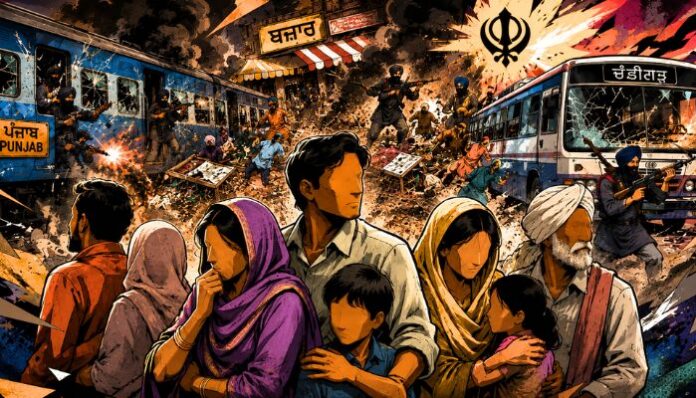
Punjab’s insurgency remains part of public debate, but many of those killed during the violence have gradually disappeared from popular memory. While terrorists, political leaders and major events retain detailed narratives, ordinary passengers, journalists, Sikh opponents of Khalistan and lower-ranking policemen often survive only as names in old reports, FIRs, memorials or casualty figures.
The 1987 Lalru bus massacre illustrates this imbalance. Thirty-eight people were killed, yet most victims remain largely anonymous. One was 28-year-old Savitri Devi, who shielded her husband and five-month-old daughter with her body and died while both survived. Abohar presents a different example, where residents continue commemorating those killed in the 1990 market massacre through a local memorial.
Sikhs who rejected Khalistani terrorism also became targets. Harchand Singh Longowal was assassinated after signing the Punjab Accord, while editor Sumit Singh and communist activist Baldev Singh Mann were murdered for opposing extremism. Their stories challenge attempts to reduce the insurgency to a Hindu-Sikh conflict.
Journalists and broadcasters faced similar violence. ML Manchanda was abducted and beheaded after Babbar Khalsa attempted to dictate broadcasting language, while AIR Chandigarh director Rajinder Kumar Talib was killed amid disputes over terminology. Newspaper agents and hawkers were targeted as terrorists sought to control the entire information network.
Punjab Police later began documenting 1,784 personnel killed during the terrorism period, yet many constables, guards, Home Guards and Special Police Officers remain little more than short departmental entries. At the same time, remembering victims of Khalistani terrorism cannot erase fake encounters, disappearances, illegal detention or the anti-Sikh violence of 1984. A complete history has room for every category of victim.
The challenge now is preservation. Punjab’s record remains scattered across police websites, newspaper archives, court documents, memorials and family collections. As survivors and relatives age, details that were never formally recorded risk disappearing permanently.
Read the full article on Chapter One Magazine.


