

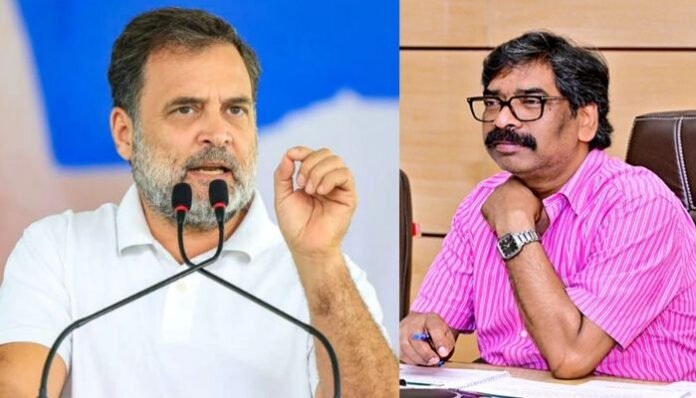
Rahul Gandhi asking Jharkhand Chief Minister Hemant Soren to meet the protesting students has put the spotlight back on the JMM-Congress government’s handling of the agitation. The appeal from a Congress leader to his political ally is significant because students have been protesting for weeks over irregularities in recruitment examinations, while the situation on the ground has continued to worsen.
Instead of opening a serious dialogue with the students, the government’s response has increasingly been marked by heavy police deployment, barricades, water cannons and lathi-charge. Police have also said pellet guns are being kept ready for use in an emergency. At a time when students are demanding answers on recruitment exams, Rahul Gandhi’s intervention can be seen as an indirect admission that the state government has failed to handle the matter properly.
Students march towards Vidhan Sabha amid heavy police presence
On 10th August, thousands of students took out a “Vidhan Sabha Gherao” march towards the Jharkhand Assembly in Ranchi. Their main demand is action on irregularities in various recruitment examinations, including those linked to JPSC and JSSC.
The police prepared for a large gathering by deploying a substantial force in Ranchi. Ranchi City SP Paras Rana said that peaceful protesters would not face any inconvenience. At the same time, he warned that anyone resorting to violence would face legal action.
The controversy grew after a video showing police personnel carrying guns went viral. Rana clarified that the weapon shown in the video was a paintball gun, which fires soft, coloured balls to mark and identify troublemakers. However, he also made it clear that pellet guns were being carried by police personnel for use in emergencies.
Pellet guns are 12-bore pump-action shotguns that fire cartridges containing pellets. They are classified as less-lethal or non-lethal crowd-control equipment and are part of the standard equipment used by specialised riot-control units.
The fact that police are keeping such weapons ready during a student protest has raised serious questions about the manner in which the government is dealing with the agitation.
Rahul Gandhi’s appeal puts Hemant Soren under pressure
Against this backdrop, Rahul Gandhi’s request that Hemant Soren meet the protesting students becomes important. If the government had been effectively engaging with the students and addressing their concerns, such an intervention from a Congress leader would hardly have been necessary.
The appeal also comes after reports of police action against protesters and restrictions around the agitation. Students who have been demanding reforms and clarity over recruitment examinations are now facing a situation where the focus has shifted from their demands to police action.
For a government led by JMM and supported by Congress, the responsibility should have been to sit with the students, hear their complaints and give clear answers on the recruitment process. Instead, the use of force and the reported restrictions have created the impression of a government trying to control the protest rather than resolve the problem.
This is why Rahul Gandhi’s intervention is politically significant. His request to Hemant Soren to meet the students effectively highlights the failure of the state government to bring the situation under control through dialogue.
Devendra Nath Mahato is in critical condition
The situation has become even more serious with the hunger strike led by Devendra Nath Mahato. On the 15th day of his fast, his condition was described as extremely critical. Mahato suffered chest injuries after Jharkhand Police stopped him from participating in a Tiranga Yatra.
Mahto received chest injuries today as Jharkhand Police stopped him from participating in a tiranga yatra on Day 15 of his hunger strike.
— Shiv Aroor (@ShivAroor) August 15, 2026
Hundreds of FIRs against Ranchi protesters.
The beautiful hypocrisy of silence. pic.twitter.com/o65xEdCmmO
The central question now is why Hemant Soren has not met Mahato or the protesting students despite the seriousness of the situation.
Mahato has continued his fast while demanding attention to the concerns of the protesters. His deteriorating condition makes the government’s silence even more difficult to ignore. When a protester reaches such a critical stage during a hunger strike, meeting him and listening to his demands should be among the first steps taken by the administration.
Instead, the continuing distance between the government and the protesters has added to the sense of anger among students.
Sonam Wangchuk’s hunger strike
The response of the BJP leadership during the CJP protest in Delhi provides a clear political comparison. When climate activist Sonam Wangchuk was on hunger strike, BJP president JP Nadda met him, repeatedly urged him to end his fast and offered him his first sip from a cup to help him break the hunger strike.
Activist Sonam Wangchuk ends hunger strike in presence of Union Ministers J.P. Nadda and Jitendra Singh. pic.twitter.com/AEc5AGs8fo
— All India Radio News (@airnewsalerts) July 23, 2026
The contrast is difficult to miss. In Delhi, a senior BJP leader personally met a hunger-striking protester and appealed to him to end his fast. In Jharkhand, Devendra Nath Mahato has continued fasting for 15 days; his condition has become critical, and yet Hemant Soren has not met him or the protesting students.
This difference has raised questions over whether political leaders apply the same standards when dealing with protests in states ruled by their own allies.
Different standards over police action?
The Jharkhand episode also brings back the controversy surrounding the CJP protests in Delhi. During the “Chalo Sansad” march on July 20, the Delhi Police used lathi-charge and other crowd-control measures after the protest turned violent.
At that time, Congress, Samajwadi Party and other INDIA bloc parties, along with their supporters, strongly criticised the Delhi Police. Claims were also made that pellet guns had been used against peaceful protesters. CJP spokesperson Saurav Das had claimed that Delhi Police used pellet guns and shared a video showing marks on a protester’s body.
The Delhi Police, however, denied these claims and said it neither possessed nor used pellet guns during the protest. It called the claims false and misleading and asked people not to circulate unverified information.
The situation in Jharkhand presents a different picture. Here, the Ranchi Police has openly said that pellet guns are being carried for emergencies. Police have also used lathis and water cannons during the student agitation.
The question, therefore, is not simply about whether pellet guns were actually fired. It is also about the very different political reactions to police action in BJP-ruled Delhi and Congress-supported Jharkhand.
Questions over press freedom in Ranchi
The concerns have also extended beyond the protesters. On 9th August, an OpIndia reporter was removed by Jharkhand Police after questioning Hemant Soren about JPSC reforms. The journalist was also stopped from approaching the stage where the Chief Minister was seated during an event near the protest site.
Journalist Aman Chopra has also been booked in connection with his coverage of the student protests. He was detained and questioned by police and has said that he was restricted from covering the ongoing agitation in Ranchi.
These developments have added another layer to the controversy. During the Delhi protests, journalists were present on the ground despite political disagreements over the coverage. Some reporters were even called “Godi media” and heckled by protesters, but Delhi Police did not book media persons in connection with the CJP agitation.
The Jharkhand government now faces questions not only about its handling of students but also about the space being given to journalists covering the protests.
The larger question is, why not talk to the students?
The central issue is simple. Students have been protesting for weeks over recruitment examinations and demanding reforms. Their agitation has now reached a stage where a hunger striker is in critical condition, police are carrying crowd-control weapons and journalists covering the protests are facing restrictions.
In such a situation, dialogue should have been the first response.
Rahul Gandhi’s appeal to Hemant Soren to meet the students has therefore come at a crucial time. Rather than solving the political problem for the JMM-Congress government, the appeal highlights how badly the situation has been handled.
The contrast with JP Nadda’s meeting with Sonam Wangchuk makes the issue even sharper. When a protester is fasting, the priority should be to meet him, hear his concerns and find a solution, not wait until the situation turns into a larger confrontation.
For the JMM-Congress government in Jharkhand, the immediate challenge is to move away from police action and towards meaningful talks. Students demanding answers on recruitment exams need a government willing to listen. Rahul Gandhi’s intervention suggests that even within the alliance, there is now recognition that Hemant Soren needs to engage with the protesters directly.


