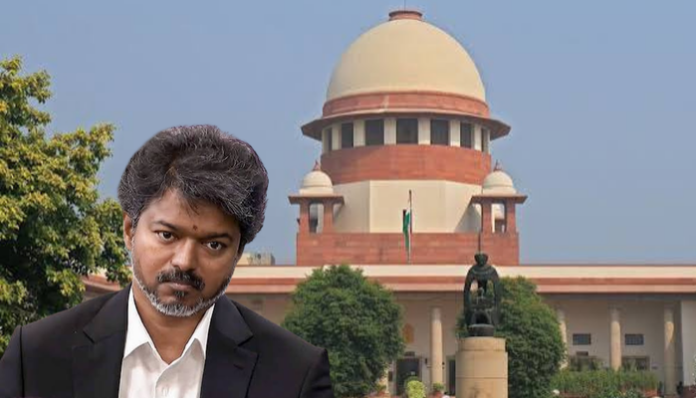
On 28th November (Saturday), the Karthigai Deepam lamp will be lit at the Deepathoon, a stone pillar atop Madurai’s Thiruparankundram hill, after the Supreme Court’s severe criticism of the TVK government for blatantly disobeying its previous ruling.
The Supreme Court on Friday took strong action against the officials of the Joseph Vijay-led Tamilaga Vettri Kazhagam (TVK) government and the administration of Arulmigu Subramaniaswamy Temple at Thiruparankundram, Madurai, over their failure to implement its earlier direction to light the Karthigai Deepam at Deepathoon located atop the Thiruparankundram hill on November 24, 2026.
A Bench of Justices Aravind Kumar and Vipul Pancholi expressed its “pain and anguish” over the blatant defiance of its order and said that “time has come to deal with such situations with an iron hand, as otherwise it may lead to Constitutional chaos”.
“The orders of the Court can’t be diluted by whoever he or she is. If anybody is attempting to create a constitutional chaos, we will set it right,” Justice Aravind Kumar warned.
Holding that there was a prima facie case of wilful disobedience of its order, the Court issued contempt notices to the Tamil Nadu Chief Secretary, Director General of Police, Hindu Religious & Charitable Endowments Secretary and Commissioner, Madurai District Collector, Commissioner of Police, Superintendent of Police, temple authorities and others.
The Bench suspended the Board of Trustees of the Subramaniya Swami Temple for defying the order and appointed two former High Court judges as joint receivers to administer the temple. The Court further directed that the Karthigai Deepam be lit at the Deepathoon on November 28, 2026.
“At this stage, we are satisfied that there has been a complete failure on the part of the Board of Trustees to administer the Devasthanam. Hence, we suspend the functioning of the Board of Trustees and supersede it for the time being,” the Court said.
Executive followed political bosses: SC
The Bench expressed serious displeasure over deliberate obstruction of its earlier order, observing that disobedience of judicial directions strikes at the foundation of the rule of law. The Court said that the conduct of Tamil Nadu government officials “prima facie reveals a state of utter administrative chaos in the State of Tamil Nadu or at least in Madurai District”.
“The chain of events that has unfolded in the instant case would indicate that the executive authorities seem to have acted at the dictates of their political bosses,” the Bench stated.

District Collector shedding crocodile tears: SC
The Court expressed strong dissatisfaction over the reason cited by the District Collector, Madurai, in his preliminary report, in which he blamed the temple administration for non-compliance with the order. It said that the District Collector had all the powers to enforce the directive, yet he failed to implement it and shifted the blame entirely on the temple administration.
“He has also tendered a formal apology, stating that he took all steps to comply with the orders of this Court and has attempted to shift the blame for non-compliance entirely on the temple administration. We are surprised that the Collector, who is a District Magistrate, has taken such a stand,” the bench stated, adding that his powers are wide enough to ensure implementation of the Court order.
The Court said that the District Collector acted helpless when he shed crocodile tears before the Court by tendering an apology and submitting the preliminary report.
“…it would suffice to state that the stand of the Collector reminds us of the saying ‘You play dead, and I’ll pretend to grieve’. This report prima facie is nothing but shedding crocodile tears, and the preliminary report is taken on record for statistical purposes only,” the Court observed.
A Court order is not negotiable: SC
The Bench expressed strong displeasure over the conduct of the Tamil Nadu government officials and other concerned authorities and observed that the incident raised serious questions about the authority of judicial orders and the constitutional obligation of government authorities to implement them.
“Any attempt to pollute the stream of justice, by any person howsoever high he may be, would not be tolerated, is the message which we intend to convey by this order,” the Court sternly remarked.
The Apex Court underscored that an order passed by it has a binding force of law and it is not open to be negotiated. It further reminded that it is a Court of Record empowered under Article 129 of the Constitution to take punitive action for its contempt. “An order of this Court is not an invitation to negotiate. It binds the State, its officers and every statutory or religious institution functioning under the State’s laws, until this Court itself modifies it,” the Bench said in its order.
Temple Board wilfully obstructed the implementation of court order: SC
The Bench noted that the temple’s Board of Trustees passed a resolution barely hours before the Court order was to be implemented and declined to authorise a team to light the Deepam at Deepathoon. “The Devasthanam Board has sought to overreach the orders of this Court by placing a strained construction on this Court’s orders and has been wilfully obstructing its implementation,” the Court said.

Examining the preliminary report submitted before it by the Collector, the Court said that it “discloses wilful and flagrant disobedience” of its order by the Devasthanam Board. The Court noted that the Board refused to light the lamp on the Deepathoon by invoking temple traditions and expressed shock at the Board’s audacity in stating that temple traditions and customs should be brought to the notice of the Court.
The Court said that through the statement, the Board tried to insinuate that the Court passed its earlier decision without considering the temple traditions. “Knowing fully well that the Court in fact had heard both sides at length on the temple traditions before passing the interim order…The statement thus carries the unwarranted insinuation that this Court had failed to apprehend the very traditions canvassed before it,” the Court said.
The Court stated that an executive authority cannot arrogate to itself a power the Constitution has never conferred upon it and go on to decide whether an order of this Court deserves to be obeyed.
It declared, “Wilful defiance by officers charged with carrying the orders of this Court into effect is itself a flagrant breach of constitutional duty. It obstructs the administration of justice and strikes at the very root of the rule of law. The affront is all the graver when it comes from the very authorities whom the Constitution commands to act in aid of this Court. The willful non-compliance with the order of the Court, especially by the Executive authorities, cannot go unnoticed, and it has to be dealt with iron hands.”
The Bench directed those who received contempt notices to appear on the next hearing on December 15, 2026 and file detailed replies explaining why contempt proceedings should not be initiated against them. Besides, the Court permitted devotees to light lamps on Thiruparankundram hill and directed the Commandant of the CRPF, Chennai, to immediately take over security arrangements for the temple and the entire Thiruparankundram hill.