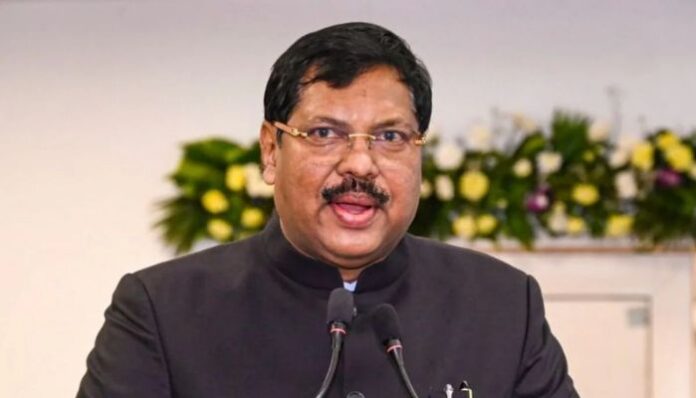
BR Gavai, the second Ambedkarite to become the Chief Justice of India, has stirred the hornet’s nest by bringing rabid caste politics to the Supreme Court of India.
Gavai, who made Hinduphobic remarks during his tenure at the highest office in the Judiciary, wrote a letter to the President of India on Friday (27th November), dogwhistling against the judges who belong to the Brahmin community.
While he did not drop names, his statement made it crystal clear. Gavai alleged, “Candidates belonging to one particular section of the society are being favoured for recommendation/elevation to the exclusion of everyone else including marginalized communities.”
He went on to claim that a community which constitutes less than 5% of the Indian population has more than 40% representation in the apex court.
#BREAKING : Former Chief Justice of India BR Gavai writes to President Droupadi Murmu seeking her intervention in judicial appointments and transfers, alleging that recent Collegium recommendations favour a particular community at the expense of merit, diversity and inclusivity. In a strongly worded three-page letter, former CJI Gavai alleges: • A community comprising less than 5% of India’s population has had over 40% representation in the Supreme Court. • Judges previously transferred on punitive considerations are now being rewarded with appointments as Chief Justices of prominent High Courts. • A meritorious and hardworking Chief Justice has been transferred to a smaller High Court to accommodate another judge. • Recent recommendations have sidelined marginalised communities, minorities, women and even members of other forward communities. Gavai asserts that the primacy of Collegium recommendations does not make the Collegium unaccountable or absolve the President of her constitutional duties. "I am constrained to voice my dissent and disappointment," he writes. The letter also marks copies to Prime Minister Narendra Modi and Union Law Minister Arjun Ram Meghwal. #SupremeCourt #Collegium #Judiciary
— Bar and Bench (@barandbench) November 27, 2026
Gavai further whined, “I may not be misunderstood as being opposed to any section of the society in so far as the candidates belonging to forward section are duly considered and my endeavor has always been to strike balance between all the sections. However, now there (are) compelling circumstances which support the perception that increasingly recommendations are being made with a focus on appeasing and rewarding a single community“
In his letter, he alleged that all communities were being excluded to accommodate this particular community belonging to the ‘forward caste’, thereby leaving no ambiguity that the former CJI was referring to Brahmins.
While continuing with his provocative rhetoric, Gavai stated, “I admit that this is not something new and that is precisely why it is increasingly becoming unforgivable“
Gavai brazened out, “For appointments between January 2021 and January 2026, the reported share of the forward communities is close to 80 per cent. The Other Backward Classes, perhaps 40 to 50 per cent of our people, have received under 14 per cent. Within that pool, one community has been preferred at the Apex Court.”
If that wasn’t enough, the former CJI flagged the lack of ‘official caste data’ for Supreme Court appointments as part of the problem. He called upon President Draupadi Murmu to intervene under Article 124(2) to remind stakeholders of the “constitutional duty of equal representation.”
The dangerous precedent set by BR Gavai
At a time when divisive caste politics is creating mass resentment against Brahmins, Gavai’s disturbing letter has added fuel to the already raging fire of polarisation.
While it is expected of political parties to stoke unsubstantiated caste atrocity or make unproven claims of underrepresentation in top institutions, the former CJI’s remarks are directly contributing to the suspicion and hate against Brahmins.
This makes judges from that community vulnerable to unnecessary criticism, trolling, hate messages, and suspicious scrutiny of their judgments. BR Gavai, knowingly or unknowingly, also spread canards about the incumbent CJI Surya Kant being involved in judicial appointments based on caste.
It must be mentioned that the apex court has no constitutional reservation. Appointments rest on the Collegium system’s assessment of merit, integrity, and suitability.
An artificial push for ‘diversity’ threatens to undermine meritocracy. We cannot explicitly rank representation of any community by population percentage and allege evidence of “complete disregard” for fair representation.
It normalises caste as a primary filter rather than a secondary consideration. This threatens to turn the Judiciary into a playground for quota politics, something which BR Ambedkar did not conceive in the Indian Constitution.
Maligning Brahmin Judges by claiming appeasement politics and casting aspersions on their appointment brings into question their reputation and competence alike in the public eye. It erodes the perception of judicial independence and impartiality.
If judges are increasingly viewed as community representatives rather than interpreters of law, public confidence in outcomes involving serious constitutional matters will weaken.
The Collegium is already criticised for opacity. BR Gavai wants to add another layer of unverified caste narrative without transparent, verifiable data. His pressure tactics are forcing the government to second-guess Collegium recommendations on grounds of caste.
Gavai’s letter is a direct post-retirement, public limelight-seeking intervention into the working of his successor’s Collegium.
His caste-based framing of judicial selection and identity politics is threatening the legitimacy of the Supreme Court and bringing into question the verdicts passed by it.
Antics of BR Gavai
In August 2025, the Supreme Court Collegium recommended 14 lawyers to be appointed as judges of the Bombay High Court. One of them was Raj Damodar Wakode, who is the nephew of the then Chief Justice of India (CJI) Bhushan R. Gavai.
Wakode is the son of his cousin. Naturally, questions were raised on whether CJI Gavai had any role in the recommendation of his relative. Supreme Court sources claimed that Gavai recused himself from Collegium meetings where candidates related to him were being considered.
Still, Wakode’s name, along with those of two other lawyers who had previous professional links with him, figured in the final list.
A month later, a Supreme Court bench headed by B.R. Gavai and Justice Augustine George Masih dismissed a petition seeking restoration of a seven-foot mutilated idol of Lord Vishnu at the Javari temple in Khajuraho, Madhya Pradesh.
The idol, part of the UNESCO-protected Khajuraho group of monuments, was beheaded centuries ago during the Mughal invasions. It was left desecrated and dishonoured ever since.
The petitioner, a devotee named Rakesh Dalal, argued that restoring the idol was not merely about archaeology but about faith, dignity, and the fundamental right of Hindus to worship their deities in wholeness.
Gavai then went on to make a Hinduphobic remark. He stated, “This is purely publicity-interest litigation. Go and ask the deity itself to do something now. You say you are a staunch devotee of Lord Vishnu. So go and pray now.”
For Hindus, this remark cut deeper than the centuries-old wound inflicted by Mughal swords. It echoed a familiar taunt: “If your gods are real, why didn’t they protect themselves?”
This Hinduphobic trope, weaponised for centuries by Islamist rulers and modern-day secular elites, had now found a resounding endorsement in Gavai.
In fact, his mother Kamaltai made disturbing remarks about Dusshera when she was invited by the RSS to the Hindu festival. “I assure you that I will not cause any harm to social consciousness in any way,” she brazened out.
This gives us a clearer picture of the hate and disdain that runs in the Gavai family. After all, the apple does not fall far from the tree.