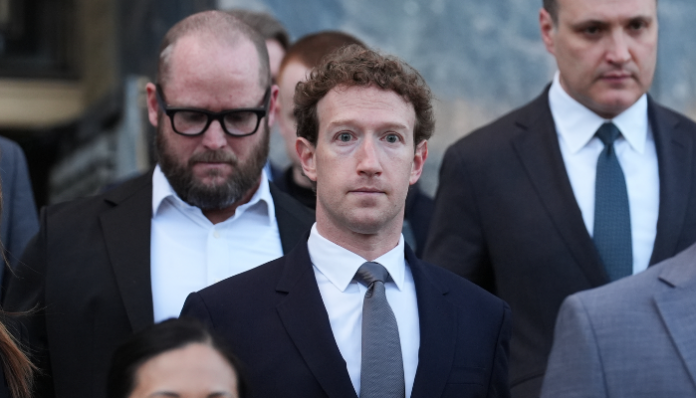
On 18th February (Wednesday), Meta chief Mark Zuckerberg testified in a historic trial revolving around the addiction of popular social networking sites among kids and teenagers in Los Angeles, United States. The lawsuit commenced on 9th February in Los Angeles County Superior Court and focused on allegations against Google-owned YouTube and Meta, the parent company of Facebook and Instagram. It examined the tech giant’s awareness of the possible risks and whether it took adequate precautions.
A 20-year-old Californian named Kaley, also known as KGM, and her mother sued YouTube, TikTok, Snapchat and Meta in 2023, charging that they had designed their applications to encourage compulsive use, which resulted in her physical dysmorphia, anxiety and depression. According to her solicitors, she became obsessed with social media platforms as young as 6 and functions like auto-scrolling made her dependent on them.
The plaintiffs contended that the corporations intentionally created features that promoted obsessive use among minors, leading to long-term mental health damage. Zuckerberg, who was presented with many internal documents, seemed to find it difficult to shield his company against the critical charges as he maintained that the lawyers were “mischaracterising” him.
It was his debut appearance before a jury following years of growing criticism of Meta, which also owns WhatsApp. He responded to enquiries concerning the usage of Instagram by youth and his congressional testimony.
No negative consequence on mental health: Mark Zuckerberg
During questioning, the Meta chairman and chief executive officer (CEO) asserted to continue his earlier assertion that current research has not demonstrated social media’s adverse effect on mental health. Mark Lanier, the lead plaintiff’s advocate, challenged whether people use something more frequently if it’s addictive, to which he answered, “I’m not sure what to say to that. I don’t think that applies here.”
Meta consistently insists that it has taken steps to safeguard minors and prohibits users under the age of 13. However, Lanier produced internal emails, chats and findings in court that showed Zuckerberg and other Meta staff members talking about how teens and younger people use Facebook and Instagram. He highlighted that his client was on the app when she was a 9-year-old, prior to the implementation of the new limitations.
The 41-year-old accepted that Instagram’s age rules are hard for Meta to impose and added, “I always wish we would have gotten there sooner, but I think we’re in a better place.”
Lanier initially asked him whether a business should “prey upon” those from poor families or who are “less fortunate in educational opportunities,” implying that Kaley’s upbringing made it even more crucial that Meta protect vulnerable users. Zuckerberg replied, “I think a reasonable company should try to help the people who try to use its services.”
Special focus on teenagers
It was unveiled that Zuckerberg and three senior Meta executives received an email criticising the company’s “unenforced” age restrictions in 2019. Former deputy prime minister of the United Kingdom, Nicholas William Clegg, who was Meta’s head of global affairs for a number of years pointed out that it was “difficult to claim we’re doing all we can” in the communication.
Lanier raised a 2019 study conducted by an outside firm on behalf of Instagram that disclosed that teenagers who employed the app felt “hooked despite how it makes them feel” and that they had “an addict’s narrative about their Instagram use.” The report mentioned, “It can make them feel good, it can make them feel bad, they wish they could spend less time caring about it.”
Zuckerberg declared that the same analysis also noted “positive” aspects of Instagram after he was inquired about it by Paul Schmidt, Meta’s attorney who presented it as a component of the corporation’s constant efforts to investigate the operation of its platforms and make improvements to them.
Furthermore, Lanier displayed intimations from Zuckerberg and other private correspondence in which employees talked explicitly about “teen usage” and how to boost it. A 2017 internal conversation had two junior workers complaining about Zuckerberg’s strategy to “go after under 13-year-olds.” It stated,”Yeah, it was gross the last time he mentioned it.”
He confronted the billionaire with internal documents from Instagram head Adam Mosseri in 2022 which revealed that the data indicated that the “primary goal” was to keep people, particularly teenagers, engaged on the platform. Lanier also included an email from Zuckerberg that outlined the aim of growing application utilisation by 12% over a three-year period and to see the “teen trend be reversed.”
Aim to boost user time
Lanier specifically grilled the Meta chief about a statement he made at an earlier congressional hearing, announcing that Instagram personnel aren’t given objectives to increase the amount of time spent on the platform. However, the internal records appeared to refute the latter’s statements.
Lanier highlighted an Instagram “milestones” document in 2022 which predicted that the average amount of time spent on the app would increase from 40 minutes in 2023 to 46 minutes in 2026. However, Zuckerberg retorted, “This is something we expect to see if we do good work,” he stated.
Lanier introduced a document in which Mosseri announced in an internal memo that the short-form video Reels had “driven time to all-time highs” and his own “stretch goal was to get on track to pass TikTok in terms of time spent.” However, Zuckerberg stated, “The way I read this, we try to increase the value of our services, but also try to measure progress against competitors like TikTok.”
Artificial beauty hack
People can alter photographs with Instagram’s beauty filters, mimicking plastic surgery or other alterations. Hence, Lanier argued that these could harm a teen’s perceptions of themselves and experts consulted by Meta reached that same conclusion. Zuckerberg asserted that in the interest of free speech, they chose to authorise the filters but not endorse them as it would have been “paternalistic” to refuse the tools.
Lanier showcased an email which was sent to Zuckerberg by an employee, a mother of two underage girls, who remarked that teenagers are under a lot of pressure, warning about the filters. She wrote, “I respect your call and I support it, but I want to say for the record, I don’t think it’s the right call.”
Luring tweens
According to internal documents, over 4 million children, almost one-third or 30% of all 10 to 12-year-olds in the nation were on Instagram in 2015. Instagram did not require new users to enter a date of birth until December 2019 and only asked them to confirm that they were above 13 years old. Instagram began requesting current users to enter their birthdate if they hadn’t already in August 2021.
Additionally, Lanier pulled out an internal document that stated, “We must bring them in as tweens if we want to win big with teens.” An executive’s email in 2017 likewise conveyed, “Mark has decided the top priority for the company is teens.” However, the latter expressed, “We changed that,” after agreeing that the firm had set those objectives in the past.
The company, in a different 2018 presentation, discussed how “tweens” were successfully retained on the platform despite assurances to the contrary.
Feeble defence in the face of compelling evidence
Zuckerberg accused Lanier of misrepresenting the tween document and stressed that teens accounted for “less than 1%” of the company’s advertisement income. He claimed that his business had “many conversations” about creating products that youngsters under 13 could use “in a regulated way.”
Zuckerberg then stated the Messenger Kids service offered by his conglomerate which he explained was “not very popular” but he uses it “with my own kids.” He added, “You’re mischaracterising what I’m saying. I’m not surprised that people internally were studying this.”
The frustrated tech mogul voiced, “I don’t see why this is so complicated,” insisting that the regulation forbids children below 13 and tries to identify those who have lied about their ages to get around the restrictions, amid an extensive exchange over verification policies.
Zuckerberg underlined that Meta would not have survived this long if they had simply concentrated on measures like time spent on its platforms and remarked that he has devoted years addressing “problematic use” of social media sites like Instagram “because it’s the right thing to do.”
Schmidt brought up the 2018 Instagram tools that let individuals set daily usage caps, configure time-spent alerts and disable notifications at night. However, Lanier referred to a Meta internal paper to illustrate that very few had chosen to apply them. For example, just 1.1% of teenagers used the daily limit.
A week prior to Zuckerberg’s hearing, Mosseri resisted the science of social media addiction by disputing that users might be “clinically addicted” during his testimony.
The trial is under close observation due to its impact on similar cases. The verdict could have a bearing on the hundreds of other cases filed by families who submitted that social media has caused harm or even death to their children. The suit also implicated TikTok and Snapchat, both of which reached a settlement just before the trial was about to start.
India considers to ban social media for adolescents below 16 years of age
Global concerns have been raised about the risks connected with Meta and the entire social media. Children under the age of 16 and 15 have been prohibited from using such platforms in countries like Australia and France, respectively. Similar rules are under consideration in Denmark, Malaysia and Spain.
On 17th February (Tuesday), Information Technology minister Ashwini Vaishnaw declared that India is also planning to follow suit. “This is something which has now been accepted by many countries that age-based regulation has to be there. It was part of our DPDP (Digital Personal Data Protection) Act,” he pointed out at the AI (Artificial Intelligence) Impact Summit.
The DPDP Act indirectly restricts the usage of social media platforms by minors because companies cannot collect their data or provide targeted adverts without parental consent. He added, “Right now we are in a conversation regarding deepfakes, age-based restrictions with the various social media platforms and what is the right way to go about this.”
The minister observed, “We need much stronger regulation on deepfakes. It’s a problem which is growing day by day. And certainly there is a need for protecting our children, protecting our society from these harms.” Last week, India strengthened regulations on artificial intelligence technology, mandating that social media companies prominently label AI content and remove it within three hours of an authority’s request.
The central government has also been directed by the Madras High Court to consider if passing a comparable bill is feasible. The January Economic Survey, which emphasised the financial and social consequences of young people’s compulsive screen use, provided proof in favour of age-based regulation of digital platforms. Stricter age verification procedures and age-appropriate default settings were suggested, especially for social media sites, gambling apps, autoplay functions and targeted advertising.
What is the way forward
The Union government is contemplating amending the Information Technology (Intermediary Guidelines and Digital Media Ethics Code) Rules to limit access to social media for people under the age of 16. “Certain accounts should be accessible but there are certain accounts that shouldn’t. We have to think judiciously whether kids should have access or not,” expressed an official.
The centre is examining the Australian model, but unlike the nation, it does not want a total prohibition for those under the age limit. Officials are contacting social media enterprises about stronger age verification systems and debating potential changes to digital laws. The move suggests that the online safety of children has turned into an essential policy issue for the Modi government.
Platforms are required by the DPDP Act to get verifiable parental consent before processing the personal information of users who are younger than 18. Thus, the companies already have some obligations under this law to protect the data of minors. Officials are presently debating whether age-based regulations could be strengthened further by amending the IT rules.
The purpose is to prevent children from being exposed to hazardous content, features that can be addictive or targeted advertising without the necessary protections. The authorities are looking into how platforms could set up tougher compliance procedures and age-appropriate defaults.
Furthermore, states such as Goa, Karnataka and Andhra Pradesh are also exploring methods to stop teens from using social media excessively. The policymakers are researching international models and strategies to lessen screen addiction, cyberbullying and exposure to objectionable material. These laws cannot be enacted by states but they can recommend them to the centre.
Why the mounting concern over social media usage among children
India has recently been shaken by the case of three sisters, Nishika (16), Prachi (14)and Pakhi (12), who jumped to their deaths. Their deaths uncovered the troubling situation that led them to develop an unhealthy attachment to Korean pop culture, entertainment and online communities.
They were unable to access the Korean platforms or apps on their mobile phone after their devices were sold which added to their distress and eventually claimed their lives. This is not the first instance where such devastating news has been associated with social media.
A 13-year-old boy passed away inexplicably after spending several hours playing an online game in the Indiranagar police station neighbourhood of Lucknow in October. “He used to play Free Fire every night till around 11 pm and got very angry if disturbed,” his sister Chandni narrated the tale of his addiction.
Vivek skipped work in the morning to play nonstop and she later discovered him unconscious, assuming he had dozed off while playing the video game. However, he didn’t react when she came back to wake him for lunch. He was taken to Lohia Hospital where doctors pronounced him dead.
Likewise, games including “The Blue Whale Challenge” which originated in Russia in 2013 and spread rapidly was reported to have taken many lives by pushing young players to inflict self-harm. While the claims are exaggerated, as is often the case with any online phenomenon, the reality cannot be dismissed that copycats did try to inflict maximum damage in their pursuit of followers, jeopardising children’s lives and frightening many impressionable minds.
The many perils of allowing kids on the internet
The risks are not confined solely to online games and they extend to applications utilised by children, the content they consume and even the individuals with whom they interact. The fixation with Instagram reels has resulted in fatal or life-altering injuries to adults who endangered their safety for social media recognition, making it quite clear how these features might be influencing the underage population.
Moreover, the advancement of AI has only exacerbated these fears, including the notoriety of deepfakes. Elon Musk’s X has also been harshly criticised for allegations involving deepfakes and the trafficking of child pornography on the platform.
Interestingly, popular American shows like “To Catch a Predator” demonstrated how predators utilise online platforms to lure children for perverted desires. Therefore, the threats have multiplied with the progression of the technology, highlighting the desperate need for tighter online regulations.
The toxic content ranging from betting applications to nudity has established a presence on different apps not only has a profound detrimental assault on the minds of kids but also drives them towards unrealistic body image expectations, disrupts their mental health, tarnishes the innocent element of their upbringing and effectively pollutes their childhood.
Parents in the US have regularly blamed Meta for hooking up young people to its apps and generating mental health problems that have resulted in eating disorders, anxiety, depression and self-harm. Tech policy and child safety groups have also made similar accusations. The US Surgeon General urged for warning labels to be incorporated into social media in 2024, noting that the platforms were linked to negative effects on the mental health of youngsters.
Zuckerberg has often been summoned before Congress in relation to the critical issue of child safety. He even had to stand and offer an apology to parents who mentioned social media played a role in their children’s deaths during a hearing in 2024. Meta has been sued by dozens of state solicitors general in the country on charges of child sexual exploitation and other matters.
Conclusion
The recent hearing in the United States, along with the collective actions of various countries to restrict children’s access to the internet and India’s initiative to introduce similar legislation, underscored the magnitude of the problem that has permeated all corners of the globe.
Social media companies, despite their assurances and commitments, have terribly failed to address these threats and have primarily focused on serving their own interests and maximising profits. Thus, governments appear to have taken it upon themselves to ensure the safety of children, which should be the foremost priority of any responsible state.