

Azam Khan is once again making headlines after the Rampur Development Authority (RDA) declared 38 buildings at Mohammad Ali Jauhar University illegal. The development has brought renewed attention to several projects carried out during his time as a minister in the Samajwadi Party government.
Among the issues being discussed is the construction of a fly-ower inside Jauhar University, which reportedly cost around Rs 150 crore. Questions have also been raised over the acquisition of land from poor farmers and labourers for university-related projects.
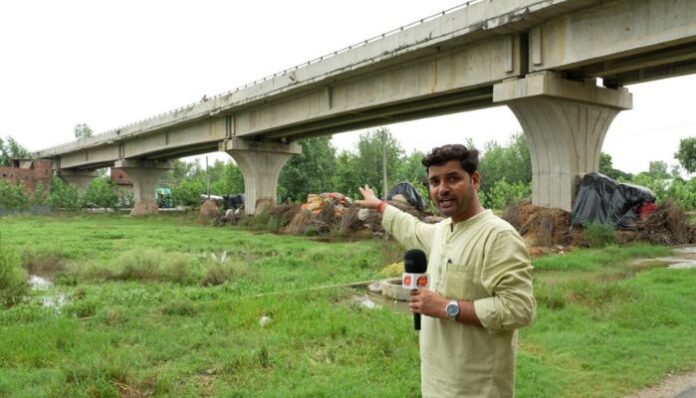
To understand the situation on the ground, OpIndia visited Rampur and spoke to residents living near the 5-kilometre-long flyover that leads directly to the back gate of Jauhar University.
A flyover that leads to the University
The flyover starts from Ekta Tiraha in Rampur, close to Azam Khan’s ancestral house. Interestingly, his house is located only a short distance away, while the Rampur district jail where he has been lodged for years is situated right opposite it.
Travelling on the flyover, dense mango orchards and forested areas can be seen on both sides. Locals said a large number of trees were cut during its construction. Unlike other busy roads in Rampur, this flyover remains largely empty.
What makes the flyover unusual is that it does not cross any railway line, river, stream or major highway. It also does not connect any important road, town or village. Only two small village roads pass underneath it.
A man standing on the flyover told OpIndia that there is rarely any traffic on it. According to him, the road is mainly used by students travelling to and from Jauhar University, while most people in Rampur receive no real benefit from it.
‘Our land was taken for very little money’: Villagers
After getting off the flyover, the OpIndia team met women working in a mango orchard near a village. One of them, Kamlesh, said they had only four bighas of land, which was acquired for the flyover.
“Our valuable land was taken for a very small amount. We did not want to give it, but we are poor people. What could we do?” she said.
Bhagwan Das, who was also working in the orchard, claimed the land was taken under pressure. He said people feared that if they refused, they could be sent to jail.
According to him, the flyover has not helped villagers in any way. He believes that if a normal road had been built instead of an elevated flyover, the area could have developed. Shops, houses and small businesses could have come up, benefiting local people. Instead, he said, the project mainly served Azam Khan’s own purpose.
Some villagers also claimed off-camera that the flyover was built so Azam Khan could travel directly from his home to Jauhar University without getting stuck in city traffic.
‘We were forced to register our land’
The OpIndia team also visited Kishanpur village, located below the flyover.
Dinesh, a resident, said his family’s land was not acquired, but their house is located next to the structure. He said the village has received no benefit from the flyover. Instead, people had hoped a road would be built underneath it, but that never happened.
Two women passing through the village also said the project had not helped residents.
Another villager, Ummed Singh, said part of his land was acquired for the flyover. According to him, officials, including the Kanungo and Tehsildar, came to his house and forced him to complete the land registration.
He further claimed that large-scale financial irregularities took place during the construction of projects linked to Jauhar University.
Ummed Singh also said that while he was driving an auto-rickshaw, an RTO official used to collect money from drivers. According to him, the official claimed that 40% of the collection was meant for Jauhar University. He blamed Azam Khan for the situation and said people in Rampur faced harassment during the Samajwadi Party government. He added that action being taken under the Yogi Adityanath government is the result of those past actions.
A Rs 150-crore flyover that still faces questions
The 5-kilometre-long flyover connecting Rampur to Jauhar University was built during 2013-14 at an estimated cost of around Rs 150 crore. Since its construction, it has remained surrounded by controversy.
Many residents told OpIndia that the flyover was built mainly for easier access to Jauhar University and has provided little benefit to the public. Several villagers say they lost their land for very low compensation and believe the project did not contribute to the development of their villages. With fresh action now being taken against Jauhar University, these old concerns have once again come back into public discussion.


