

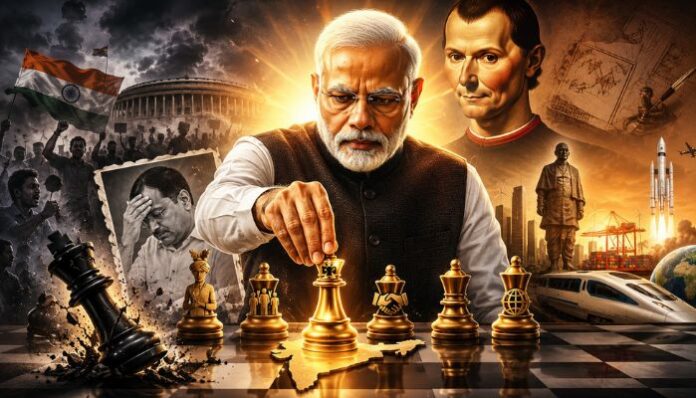
Most people describe Narendra Modi’s power in the same familiar terms. Dominance, electoral strength, and authority. It is the language of a ‘strongman’, and for much of the past decade, it seemed adequate. But strongman is also the least revealing way to understand him because it captures only the scale of his mandate and says very little about how he responds when that mandate comes under pressure.
On Saturday, India’s education minister resigned. Just like that, a month of nationwide student protests that had been building into a real political crisis was over within hours. Looked at one way, it seems like Narendra Modi was forced into a retreat. Looked at properly, it’s more like a trade he was always ready to make. Sacrifice one cabinet minister, someone who could be replaced by Monday morning, to shut down a movement that was starting to look a lot like the youth uprisings that had recently brought down governments elsewhere in the region. That’s not losing. That’s knowing exactly which piece on the board is expendable and which one isn’t.
Farmers got a policy reversal back in 2021. Coalition allies got cabinet seats and veto power in 2024. Students got a minister’s resignation in 2026. Every single time, Modi gave up the smallest thing he could give up to neutralise the biggest threat he was facing, and every single time he was still standing at the end of it, still setting the agenda, still the one person whose own position was never actually on the table. Call it the defining discipline of his politics, ‘he wins big by losing small.’
The traits nobody credits him with
A lot of people think of Modi mainly in terms of his hard-line politics and the strong image he has built around himself. But that misses some quieter strengths that have mattered just as much to his rise and staying power. Patience, the ability to manage alliances, control over his message, and a very sharp sense of timing. His way of communicating is especially important. Since 2014, he has mostly spoken to people directly through social media and Mann Ki Baat, instead of relying on the regular press. That helped him create an image of himself as a Pradhan Sevak, a chief servant, rather than a distant supreme leader.
The idea is that he is there to serve the country, and that image is also meant to connect with Gandhi in a very deliberate way. Scholars who study his media strategy have pointed out that this direct approach let him go around elite media and speak to the public on his own terms. The same instinct for careful presentation can also be seen in foreign policy. During India’s 2023 G20 presidency, the government made a clear effort to present India as a leading voice for the developing world, with scholarships, science initiatives, and a platform for the Global South. This was not just for show. It was a kind of political groundwork, laid long before he needed it to deal with a hung parliament or a difficult election.
Why bending is not breaking
In politics, people usually treat flexibility as just a polite way of saying someone’s dumped their principles. Modi’s career points the other way. Look at how the farm laws got repealed, it’s interesting less because of the fact that he backed down and more because of the way he handled it. The announcement was timed to land right alongside a major Sikh religious festival. Most people saw that as an attempt to spin a clear policy defeat into a gracious gesture toward the Sikh farmers who’d been at the centre of the protests.
At the time, the commentary largely framed it as a tactical move rather than a forced surrender, even though it did dent his strongman image and handed his critics some fresh ammo. Others went further and argued the climbdown wasn’t really an admission of defeat at all, more a calculated bid to protect his voter base ahead of some tightly contested state elections, driven by a real sense of vulnerability after a string of disappointing results in recent state and civic polls. The underlying push for agricultural reform never actually disappeared, it just went quiet. That’s been the pattern right through his career, which is to give ground on the method, hold the line on the objective, and keep tight control over how the concession gets told. A leader who can’t do that ends up hostage to his own past positions. One who can is simply a lot harder to defeat.
The political mind behind the public image
Look, none of this is actually new in political thought, even if it sounds pretty cynical when you just say it straight out. Machiavelli was already arguing this stuff five centuries ago, that the ruler best set up to survive isn’t the most consistent one, but the most adaptable. Someone who can completely shift how they behave the moment circumstances change. Modern takes on ‘The Prince’ basically describe this quality, virtù, as needing what one standard account calls a ‘flexible disposition’, basically the ability to change your approach as conditions shift, while never losing sight of the two things that really matter. Holding on to power and actually getting something done with it.
Machiavelli even borrowed that image of a general reading a changing battlefield instead of stubbornly fighting yesterday’s war all over again. Judged by that old standard, Modi’s willingness to trade a single party, Hindu nationalist posture for coalition dependence, or to switch from confrontation abroad to quiet accommodation and back again, doesn’t read like the record of a leader with no real convictions. It’s just a much older lesson applied with unusual discipline; methods are disposable while objectives are not.
What critics get right and what they miss
Look, the obvious objection here deserves a proper hearing, not just a quick brush-off. Independent monitors have genuinely got more and more worried about the state of Indian democracy under Modi. Freedom House has downgraded India’s scores on political rights and civil liberties, and they trace that decline straight back to the years since he took power in 2014, pointing to things like intensifying intimidation of journalists and growing pressure on rights groups. Sweden’s V-Dem Institute went even further and labelled India an electoral autocracy. These aren’t fringe complaints; they’re among the most carefully documented critiques you’ll find levelled at any large democracy right now. But the same body of research also muddies the simplest version of the story. India’s elections are still genuinely contested, opposition parties actually run major states, and as one recent survey of the evidence notes, the courts have struck down big government initiatives.
You can have a government that wins real popular support at the ballot box while the civil liberties framework around future elections is quietly narrowing at the same time, and that’s exactly the combination these indices are designed to flag. PM Modi’s own foreign minister S Jaishankar has just dismissed the rankings outright, calling them the work of self-appointed international arbiters trying to impose their own rules on a country that’s stopped asking for their approval. It’s not really a rebuttal so much as a reminder that the same flexibility that lets Modi make peace with rebellious allies also lets him soak up institutional criticism without ever being forced into a full retreat. Both of those readings can be true at the same time, and that’s precisely the point that critics and admirers both tend to flatten.
Why this kinds of leadership wins now
This week’s exam protest resignation follows the exact same logic, just on a much shorter fuse. Youth movements in Sri Lanka, Nepal and Bangladesh had recently escalated all the way to the point of leadership collapse. Modi’s government spotted the first real signs that this one might be heading the same way and quickly cut the losing piece off the board, trading a single minister to keep the presidency, the youth vote and the 2027 election calendar completely untouched.
The 2024 election result is probably the clearest real-time test of all this, because it forced an adaptation that nobody really expected Modi to have to make. After ten years of governing with a clear majority, he suddenly found himself dependent on Chandrababu Naidu’s Telugu Desam Party and Nitish Kumar’s Janata Dal (United). Two allies with long track records of switching sides whenever it suited them, exactly the kind of unreliable partners a leader used to having complete authority would normally never choose to lean on. Instead of fighting the shift, he moved quickly to absorb it, getting a formal, unanimous resolution from every NDA party naming him their leader within just a few days of the result.
You see the same instinct at work abroad. Throughout the Ukraine war, India has refused to condemn Moscow, yet the prime minister has also visited Kyiv, as what one Western analysis described as a display of strategic autonomy that avoided any sharp break with Russia while still sending a signal to Washington. And the G20 presidency was set up to serve a domestic political purpose just as much as a foreign one, boosting India’s global standing while quietly banking political capital ahead of the next election. In a fragmented, multipolar world, this is increasingly what leadership rewards, not rigid consistency, but the discipline to keep one objective fixed while constantly rewriting the tactics used to get there.
Conclusion
A leader who’s this good at soaking up pressure without ever really changing course can also be one who never quite has to answer for it, and the steady drop, as per so-called renowned think tanks, in India’s press freedom and civil liberties scores is the cost side of that same ledger, not some separate story. But writing Modi off as just the lucky beneficiary of Hindu nationalism and a compliant electorate misses what’s actually kept him at the centre of Indian politics for two decades. It isn’t the rigid strongman style people usually associate with leaders like him. It’s a rare ability to bend on almost everything except the one thing that really matters to him, staying the man who gets to decide what happens next. Critics keep waiting for him to break. Admirers keep waiting for him to triumph. Both of them keep missing the same point, ‘he was never trying to stand still in the first place.’


