

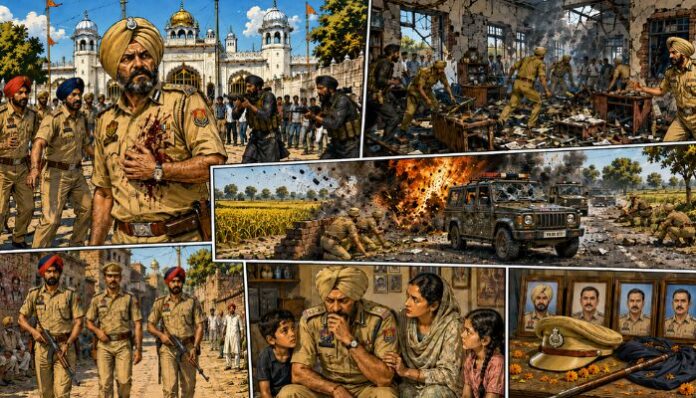
During the Punjab insurgency, Khalistani terrorists did not restrict their attacks to senior police officers or personnel engaged in operations. Policemen were assassinated outside religious places, ambushed on patrol, bombed inside headquarters and abducted from their homes. Their guards, drivers and eventually their families were also targeted. Punjab Police says 1,784 of its officers and personnel were killed during the terrorism period.
One of the earliest shocks came in April 1983, when DIG Avtar Singh Atwal was shot dead after offering prayers at the Golden Temple. Three years later, terrorists wearing police uniforms entered the Punjab Armed Police headquarters in Jalandhar and opened fire on police chief Julio Ribeiro and his wife. Inspector General of Prisons Trilok Chand Katoch was killed near his Chandigarh home in 1987, demonstrating that senior officers were vulnerable even away from duty.
Lower-ranking personnel faced the same danger without the protection available to senior officers. Inspectors and ASIs were killed during raids and patrols, while guards and drivers often died in attacks aimed at their commanders. In 1991, ASI Lalu Ram and ASI Amin Chand were killed when a remote-controlled explosive targeted Chandigarh SSP Sumedh Singh Saini’s convoy. District memorials preserve the names of many constables, Home Guards and Special Police Officers whose deaths received little wider attention.
The conflict changed further when terrorists began targeting police families. KPS Gill wrote that 506 policemen were killed in 1990, most while at home on leave, while relatives were increasingly threatened and murdered. Families fled villages and some even published newspaper notices pleading with terrorist organisations not to punish them for having relatives in the police. Fear was becoming intensely personal.
By the early 1990s, repeated assassinations, bombings, attacks on homes and threats to families had helped transform the psychology of the force. Sections of Punjab Police moved from conventional law enforcement towards increasingly aggressive counterterrorism, and eventually brutal retaliation. The article argues that this context helps explain how the police response hardened, but does not justify unlawful killings, torture, disappearances or fake encounters.
The dead also challenge attempts to portray the insurgency simply as a Hindu-Sikh conflict. Many policemen killed by Khalistani terrorists were themselves Sikhs who opposed separatist violence and served the Indian state. The police force that eventually crushed the insurgency had itself been hunted for years, at work, at home and through its families.
Read the full article on Chapter One Magazine.


