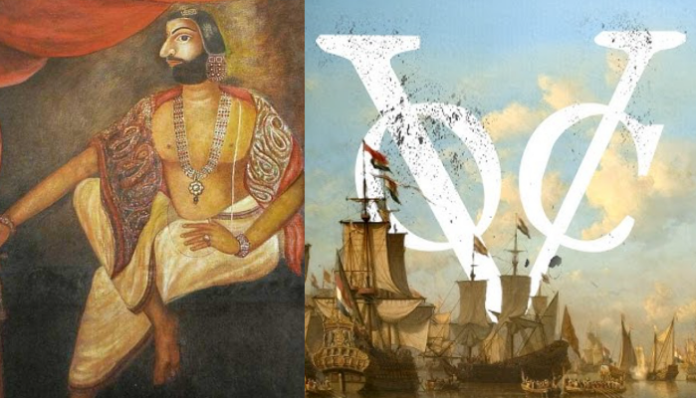
HomeVarietyCulture and HistoryWhen Travancore king Marthanda Varma challenged the Dutch monopoly on the Malabar Coast spice...

When Travancore king Marthanda Varma challenged the Dutch monopoly on the Malabar Coast spice trade

The Dutch were losing their exclusivity on pepper, cardamom and cinnamon as Marthanda Varma refused to maintain the monopoly accords they had made with the areas freshly absorbed by Travancore. To add insult to injury, this action was not perpetrated by a European but rather by an Indian monarch who steadfastly refused to comply with their demands. Varma had dared to upset the power equilibrium, much to their chagrin.

India, has historically been renowned for its immense wealth, both natural and otherwise. Its fertile land, spices, textiles, indigo and an abundance of natural resources made it exceptionally prosperous. The country bounded by the Indian Ocean enjoyed a significant advantage that further enhanced its appeal with its strategically located peninsular geography and extensive coastline.

India controlled the trade in luxury goods and held nearly unrivalled monopoly in commodities such as cotton, silk and spices. However, its glorious past also bears the scars of numerous invasions and attacks by imperialists and marauders who sought to exploit its wealth and influence for their own benefit.

From the Muslim invaders and eventually the Europeans, foreign occupiers arrived in the country with the intent to loot, dominate and ultimately conquer it by any means necessary. The colonial era was characterised by profound losses, but it was also marked by extraordinary moments of brilliance from certain kingdoms, warriors and freedom fighters who fought valiantly to protect their homeland and humbled the colonisers.

India has witnessed many such scenes throughout its recorded civilisational history and a confrontation involving the Kingdom of Travancore stands among the most remarkable of them.

The arrival of Vasco da Gama near Calicut (Kozhikode) on the Malabar Coast in 1498 set in motion an unprecedented chain of events that transformed not only the fate of the Indian subcontinent but also that of the wider world. The Portuguese established the first direct maritime route between the two sides, opening the door for other European entities to follow in the hopes of changing their fortunes by abusing India’s tremendous riches.

Image via Endless Explorer

Among them, the British emerged as the most successful, setting up a vast empire that ruled the subcontinent for nearly two centuries. However, another European power landed in India 107 years after the Portuguese with the ambition of challenging their authority and replacing them as the leading colonial force in the region.

The Dutch East India Company

The Dutch Republic (Netherlands) founded the United East India Company also known as the Dutch East India Company (VOC), on 20th March 1602 and consistently fought with the Portuguese, English and French over India’s wealth. The local kings on the Malabar Coast understood the potential of pepper to buy weapons, raise armies, construct palaces and increase their dominance. Hence, they also made agreements with the Europeans and switched allegiances when it suited them.

Dutch coins used in the 18th century (Source: Endless Explorer)

The Dutch wanted to expand their hold in the Indian Coast from their base in Ceylon (Sri Lanka), however, their ambitions were short-lived as a formidable resistance inflicted a crushing humiliation upon them bringing their aspirations to an abrupt end.

The Battle of Colachel, where the Travancore kingdom met with the Dutch, was the first time an Indian kingdom had defeated a naval power from Europe and demonstrated that the courage of a native monarch and his army could surpass the might of the Europeans.

The rise of Marthanda Varma: A fierce challenge to Dutch monopoly

Kerala in the early 18th century was a tumultuous blend of troubled monarchies, warring nobility and broken territorial dreams. Travancore (Thiruvithamcode) was a member of a loose network of temple states and colonies in south Malabar. The small state was split into 3 parts: Venad, Jayasimhanad and Odanad which were presided over by various branches of the royal dynasty who had difficult ties and frequently targeted one another.

Travancore kings like Aditya and Ravi Varma made repeated initiatives to bring the kingdom together and create a centralised government but in vain. Fear and distrust only exacerbated the divisions. Internal confrontations threatened to disfigure Travancore’s spirit while the Dutch East India Company aggressively bared its teeth.

However, unbeknownst to everyone, the tide was about to turn, setting the stage for an unprecedented incident. The royal house of Thirappur Swaroopam welcomed Anizham Thirunal Marthanda Varma, popularly known as Marthanda Varma in 1706. This new addition took on the role of a custodian of a profound legacy that altered the trajectory of the throne of Venad.

A depiction of Marthanda Varma. (Source: Wikipedia)

He had two essential tools at his disposal: the political insight of his mother, Karthika Thirunal Uma Devi and the martial traditions rooted in Kilimanoor. The Malabar Coast region was split up among several small chiefdoms at the time. Venad’s divided and fighting royal lineages sent the kingdom into a never-ending cycle of plots, conspiracies, schemes, betrayals and succession struggles. The common people were trapped in a whirlwind of uncertainty as assassinations, betrayals and switching alliances became routine.

On the other hand, the insatiable Dutch East India Company was keen to stake its claim on commodities including pepper and cardamom. 23-year-old Varma ascended the throne in 1729 after his maternal uncle and initiated a campaign of ruthless efficiency to consolidate his power with the help of his strong army and subjugated multiple of these tiny states. He shut down the internal feud and then set his sights on the lush, spice-rich areas that European powers had long coveted.

Varma gained command of marine trade by capturing Kollam, a crucial port and pepper source. He also took over Attingal which was inherited by his mother. Venad was unified by his iron will as he surged toward Kochi (Cochin). He affirmed Travancore’s supremacy over the heartlands that produced spices and contested the Dutch presence there.

As a result, the company’s leadership in Malabar, whose trade relied on obtaining spices from these locations was put in jeopardy. The resounding call for economic liberation from Travancore was evident, provoking anger among the feudal middlemen and the white expansionists.

The company flag (1630) (Source: Wikipedia)

Varma’s soaring banner above the spice-rich coast alarmed the VOC which realised that it was no longer an unwavering maritime overlord of the Indian Ocean. He was also interested in the kingdom of Odanad, famous for its pepper production. However, the Dutch maintained a firm grip on the pepper trade there. Furthermore, Varma was also making deals with the British East India Company which set off warning bells.

The Dutch were losing their exclusivity on pepper, cardamom and cinnamon as Marthanda Varma refused to maintain the monopoly accords they had made with the areas freshly absorbed by Travancore. To add insult to injury, this action was not perpetrated by a European but rather by an Indian monarch who steadfastly refused to comply with their demands. Varma had dared to upset the power equilibrium, much to their chagrin.

The tensions between the Kingdom of Travancore and the Dutch: The beginning of the rivalry

The king of Deshinganad (Quilon or Kollam) asked the Dutch for help against an anticipated Travancore onslaught, threatening to submit to Varma if they failed to assist him. The states of Maruthurkulangara, Eledattu Svarupam (Kottarakkara) and Peritally or Perakattavali (Nedumangad) also had monopoly agreements with the Dutch. Travancore annexed them in 1733-1734 and the company’s trade in Malabar was hurt greatly as their procurement from the trio ceased entirely.

The Dutch commander at Kochi, Julius Valentyn Stein van Gollenesse, asked Varma to stick to the monopoly treaty with Peritally in 1736. It was inked between the company and the state in 1688. He emphasised that its exiled ruler had promised his entire territory in exchange for protection, but they had refused to stand with him against Travancore.

Julius Valentyn Stein van Gollenesse (Source: Wikipedia)

Varma consented to send his envoys to meet the Dutch delegates in August 1736 but denied it after they arrived at the place while Peritally’s black pepper continued to be supplied to other international traders. Julius urged the queen of Maruthurkulangara to enforce the monopoly arrangement with the Dutch in September of that year, but she did not consent either because her state was also under Travancore’s suzerainty.

The prized spice trade was gradually slipping away from the clutches of the worried Dutch. Thus, they attempted to coerce Varma through their Governor of Ceylon, Gustaaf Willem van Imhoff. Varma was advised to curtail his military ambitions. This diplomatic manoeuvre was essentially a veiled intimidation move that could not impact Varma.

Scared of assimilation into Travancore, Dutch-backed smaller kingdoms entered the standoff to hold onto their authority. However, they had chosen the wrong side and would understand it sooner rather than later. The company strengthened coastal outposts, set up naval blockades and made an effort to mobilise local opposition, but they could not beat Varma’s forces which were trained in modern combat and adhered to a centralised leadership.

Gustaaf Willem van Imhoff (Source: Wikipedia)

The Dutch were desperate to put a lid on Travancore’s expanding borders before it devoured their spice trade, and Gustaaf travelled to Kochi for this purpose in January 1739. He visited as a representative of the highest authority of the Dutch East India Company at Batavia (Jakarta), the headquarters of the Dutch East Indies, to review the operations of their command in Malabar.

Gustaaf, like a true imperialist, accused Varma of inciting the Dutch to abandon their comparatively “peaceful” stance and held the English accountable for corrupting his mind. He dispatched a report in July and highlighted that Varma’s expanding power endangered their trade interests in the area due to his support for their opponents.

Gustaaf advocated for military action to pressure the coastal authorities to carry out their contractual assignments and dismissed a recommendation to pay market price for pepper procurement, citing it as unprofitable. The region was such a valuable asset in Dutch commercial interests that they did not grant it “ordinary” status, which would have required its residents to pay additional taxes.

They could not risk losing the lucrative black pepper trade that was substantially filling their coffers. Gustaaf argued for “violent redress” to save Dutch colonisation in a December 1739 report, asserting that the company was in “complete ruin.” They were on the lookout for a chance, and the ousting of the princess of Elayadathu Swarupam created that opening.

Pepper harvesting (Source: Endless Explorer)

Gustaaf wanted Varma to reinstate her when she showed up in Thekkumkur after escaping from captivity in Travancore. He presented himself as an adjudicator and a champion of her rights, while in reality, he merely desired to use her as a stepping stone for an ulterior motive. However, Varma likely perceived his true intentions and declined.

The Dutch official personally met with him in the name of peace but soon revealed his cards in a subsequent negotiation, announcing war if their proposals were rejected. The resolute king brushed aside the threat, asserting boldly that he had been considering the possibility of invading them someday.

He retorted that “should the Dutch lose the war, he would invade the Netherlands and Europe itself one day with fishing boats” and stood undaunted in front of his adversary.

An intense encounter was clearly on the horizon, and the Dutch who were motivated by their successful factory establishments and the internal disputes engaged in political intrigues with the rulers hostile to Varma. Kochi, Thekkumkur, Vadakkumkur, Purakkad, Kollam and Kayamkulam forged a coalition with the colonisers while the action was planned on multiple fronts, including Nedumangadu and Karunagapally.

The simmering confrontation explodes: The Dutch taste initial successes

The Dutch command in Malabar made the decision to wage war on Travancore without receiving authorisation or waiting for supplies from Batavia after the talks with Varma were unsuccessful. A contingent of their soldiers was deployed from Ceylon under the leadership of Captain Johannes Hackert.

They pressed Varma to return the acquired territories, but he turned down the submission. Afterwards, the Travancore army, which was positioned close to Kollam, a strategically important port, was struck by the Dutch and their allies on 12th November 1739.

Deshinganad, Kayamkulam and Kochi were among those who joined the Dutch camp. The Travancore soldiers were chased by the invaders till Tangasseri (Quilon de Sima) after a hand grenade detonated their gunpowder storage during the ensuing altercation.

The Dutch captured 16 cannons there and marched to Paravur. They were congratulated on their success by their fellow colonisers, the British EIC, at Anchuthengu and requested to spare their factory at Edava. The Dutch and their partners advanced on Attingal and Varkala at the beginning of December 1739.

Image via Endless Explorer

Travancore put up a stockade manned by 5,000 Nair men as Kayamkulam and Kollam marched against the defenders. Varma, who was occupied with repelling the Dutch attack, was caught off guard by a new front when Chanda Sahib, the general and son-in-law of Nawab Dost Ali Khan of the Carnatic Sultanate, orchestrated an incursion against his army.

Travancore army retreated to thwart the offensive while the Dutch seized Elayadathu Swarupam and reinstated the princess. She then gifted them Ayiroor village, where they erected a modest fort to solidify their position. However, Travancore soon surrounded it after which she ran away to Kochi.

Attingal was the next target for the Dutch, but they were driven back. They halted the charge until they were supported by troops from Ceylon and retreated to Ayiroor, burning and pillaging the region en route.

Travancore had to vacate Navaikulam on 30th December 1739 and Attingal on 25th January 1740 due to the Nair regiment of Kollam. However, the continuous violence exacted an extensive toll on the Dutch-led bloc, primarily the Indian kingdoms. They managed to take down the Travancore troops at the Attingal ferry on 20th February 1740, but the victory was attained at a steep cost. Kollam lost half of its men and left the battlefield alongside Kayamkulam.

The British EIC factory at Anchuthengu, who had their own colonial interests in the region, also conveniently intervened to safeguard the same. They gave 150 soldiers, weapons and ammunition to Travancore. The Dutch were compelled to withdraw but they acted to prevent Varma from capitalising on the opportunity.

They persuaded the distressed ruler of Kollam to gather a fresh army of 10,000 Nair warriors. Furthermore, Varma had to endure defeat at the hands of Chanda Sahib, and the Dutch strived to exploit this situation but clashes in Batavia obstructed their expected reinforcements.

These early successes emboldened the Dutch, convincing them that they had weakened Varma and could overwhelm him with their forces. However, fortune favoured the brave as this overconfidence proved to be a grave miscalculation and went down in history as the first massive defeat of a European naval power by an Indian king. Notably, it is regarded as the first triumph of Asians against the Europeans.

Note: This is a two-part series on the Battle of Colachel. The battle will be comprehensively discussed in the next segment.

Join OpIndia's official WhatsApp channel

  Support Us  

For likes of 'The Wire' who consider 'nationalism' a bad word, there is never paucity of funds. They have a well-oiled international ecosystem that keeps their business running. We need your support to fight them. Please contribute whatever you can afford

Rukma Rathore
Rukma Rathore
Accidental journalist who is still trying to learn the tricks of the trade.

Related Articles

Trending now

- Advertisement -