

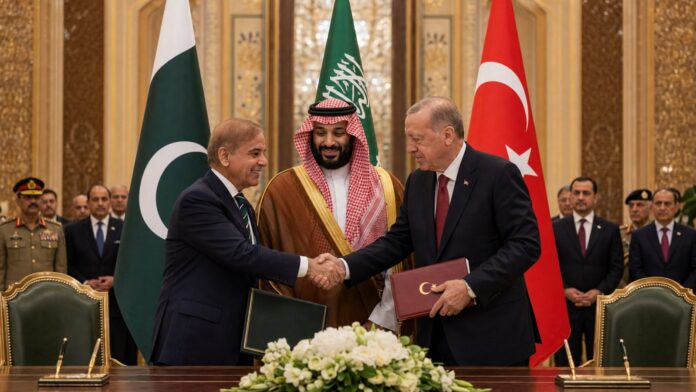
Amid the ongoing war and worsening security situation in the Middle East, Pakistan, Saudi Arabia and Türkiye have signed a significant defence pact called the Mecca Joint Defence Agreement.
Under the agreement, an armed attack on any one of the three countries will be treated as an attack on all three. The pact aims to strengthen collective security, enhance defence cooperation and promote regional stability at a time when West Asia continues to face conflicts, missile attacks and rising geopolitical tensions.
Key trilateral summit held in Mecca
The agreement was signed during a high-level summit held in the holy city of Mecca, Saudi Arabia. The meeting was attended by Saudi Crown Prince and Prime Minister Mohammed bin Salman, Turkish President Recep Tayyip Erdoğan, and Pakistani Prime Minister Shehbaz Sharif.
Shehbaz Sharif arrived in Saudi Arabia on a three-day official visit accompanied by a high-level delegation, which also included Pakistan’s Chief of Army Staff, Field Marshal Asim Munir.
The three leaders held detailed discussions on regional security, defence cooperation, economic relations and future strategic partnership.
During the summit, they formally signed the Mecca Joint Defence Agreement, which is being viewed as a major step towards strengthening collective security among the three nations.
What are the key provisions of the agreement?
According to Pakistan’s Ministry of Foreign Affairs, the primary objective of the agreement is to strengthen collective deterrence against any form of aggression.
🔈 PR No. 2️⃣0️⃣4️⃣/2️⃣0️⃣2️⃣6️⃣
— Ministry of Foreign Affairs – Pakistan (@ForeignOfficePk) August 7, 2026
Makkah Al-Mukarramah Summit for Joint Defence
🔗⬇️ pic.twitter.com/mIzASADmau
Its most significant provision states that if any one of the three member countries comes under an armed attack, it will be considered an attack against all three countries.
The agreement also seeks to strengthen cooperation across all areas of defence. This could potentially include joint military exercises, troop training, defence technology cooperation and intelligence sharing, although the detailed operational framework has not yet been made public.
According to the official statement, the agreement is intended to promote peace, security and stability in the region and has not been presented as an alliance directed against any particular country.
Why is this agreement considered significant now?
The Middle East has witnessed persistent instability over the past few years. Developments involving Iran, Israel, Gaza, Lebanon and Yemen have significantly affected the region’s security environment.
Saudi Arabia has also faced repeated drone and missile attacks targeting its oil facilities and critical infrastructure. Against this backdrop, Riyadh is looking to expand its security partnerships beyond its traditional allies and develop new defence cooperation frameworks.
Regional conflicts have also disrupted maritime trade through the Strait of Hormuz, impacting global energy supplies and international markets.
As a result, the new trilateral defence agreement is being viewed as a significant development in the evolving regional security architecture.
What strengths do the three countries bring?
One of the defining features of this new defence partnership is that each participating country contributes distinct strategic strengths.
Saudi Arabia is among the world’s largest oil producers and possesses considerable economic influence. It also holds significant religious and regional importance as the custodian of Islam’s two holiest sites.
Türkiye is a NATO member and has NATO’s second-largest military. In recent years, it has made notable advances in defence manufacturing, drone technology and its domestic military industry.
Pakistan, meanwhile, remains the world’s only nuclear-armed Muslim-majority country and has long played an important strategic military role.
However, experts note that Pakistan’s nuclear capability is not formally part of this agreement, and its nuclear deterrence continues to remain primarily India-focused.
An expansion of earlier defence cooperation
The agreement is not entirely new but is widely seen as an expansion of the bilateral defence pact signed between Pakistan and Saudi Arabia last year.
That agreement also stated that an attack on one country would be treated as an attack on the other. Türkiye has now been added, creating a trilateral security framework.
The three countries have already maintained defence cooperation for years. Pakistan has long provided military training and technical assistance to Saudi Arabia, while Türkiye and Pakistan have collaborated on defence equipment, warships and military training aircraft.
In 2023, Saudi Arabia also signed a major agreement to purchase drones from Türkiye.
India and the international community are watching closely
India is also closely monitoring the development. Ministry of External Affairs spokesperson Randhir Jaiswal said that India is keeping a close watch on the agreement and that further information will be shared as appropriate.
Experts believe that if this trilateral partnership evolves into a more institutionalised framework and expands into regular joint military activities, it could play a significant role in shaping the security dynamics of both West Asia and South Asia.
For now, however, the agreement has been officially described as a framework focused on collective security and defence cooperation rather than a military alliance directed against any specific country.


