

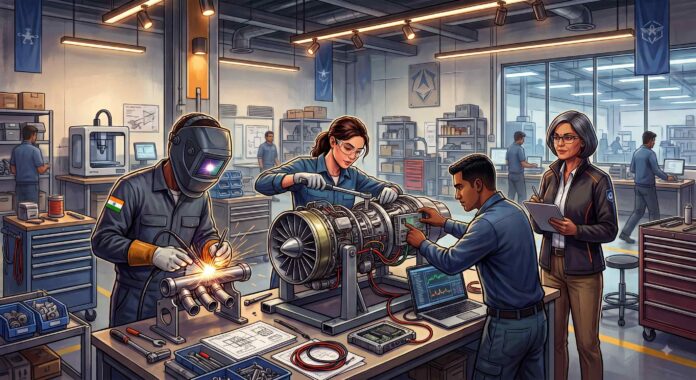
India’s aerospace propulsion sector is currently experiencing a major transformation that is reshaping the country’s defence manufacturing landscape. If the state-owned behemoths represent the heavy industry of this revolution, India’s private sector is its agile, disruptive vanguard. Historically, the development of aero-engines was exclusively the domain of state-owned entities and government laboratories.
However, a quiet but powerful revolution is underway as private conglomerates and deep-tech startups bypass bureaucratic inertia to aggressively enter the field. No longer functioning merely as component vendors, these private companies have evolved into primary designers, innovators, and prime contractors. They are now actively designing, testing, and manufacturing complete jet engines from scratch. Their primary focus lies in dominating the micro and small-thrust engine categories, a strategic move essential for powering India’s rapidly expanding fleets of unmanned aerial vehicles and advanced missile systems.
A leading example of this private-sector vanguard is Paninian, a defence technology firm developing the Yantur family of indigenous aero-engines. Their portfolio includes compact turbojets specifically engineered to power autonomous aerial targets and decoy systems used for realistic air defence training. More significantly, the company is advancing a privately developed turbofan engine program intended for long-range, autonomous land-attack cruise missiles.
Another landmark achievement highlights the successful synergy between state research and private manufacturing. Azad Engineering recently collaborated with the government’s Gas Turbine Research Establishment to produce the country’s first fully indigenous, expendable turbojet engine. While the state agency provided the foundational laboratory design, Azad Engineering managed the comprehensive manufacturing, assembly, and integration.
Similarly, several private sector companies, both established platers and startups, are successfully developing engines for missiles, jet-powered loitering munitions, drones and UAVs, small aircrafts, etc. Ultimately, these private-sector advancements are rapidly accelerating national self-reliance in critical aerospace propulsion technologies.
The tale of India’s aero-engine sector is no longer one of delays and dependencies; it is a tale of an aerospace superpower finally taking flight on its own terms. India’s private sector has proven it can design, iterate, and assemble complex propulsion systems.
You can read the full article in Chapter 1 Magazine.


