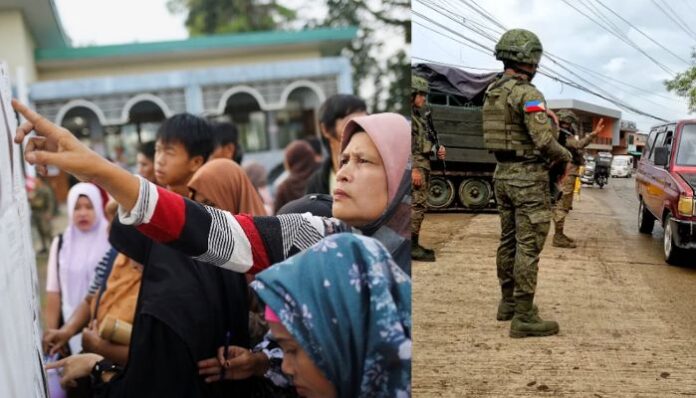
The Muslim-majority Bangsamoro Autonomous Region in Muslim Mindanao (BARMM) in the southern Philippines has completed its first parliamentary election on Tuesday, 15th September, marking a major step in the region’s transition from an armed separatist struggle to elected self-government. The election produced a hung parliament, with no single party winning the 41 seats needed for a majority in the 80-member regional legislature.
Predominantly Muslim region in southern Philippines holds its first parliamentary election, marking key milestone in its decadeslong pursuit of self-rulehttps://t.co/0MdLXLmvnL
— Daily Sabah (@DailySabah) September 14, 2026
According to the latest partial results, the Bangsamoro Federalist Party (BFP), led by transitional Chief Minister Abdulraof Macacua, emerged as the largest party, securing around 36% of the regional party vote and 16 seats.
The United Bangsamoro Justice Party (UBJP), associated with former Moro Islamic Liberation Front (MILF) chairman Al Haj Murad Ebrahim, followed with around 32% and 15 seats.
The remaining seats were divided among other parties and representatives. With no party holding a majority, coalition-building will be necessary before the new Parliament can choose the region’s chief minister.
🇵🇭 The Bangsamoro Federalist Party (BFP) took 16 of the 40 party seats in the Bangsamoro Autonomous Region in Muslim Mindanao (BARMM) parliament, according to a Commission on Elections canvass report cited by GMA News. The United Bangsamoro Justice Party (UBJP) took 15 seats, the…
— Defense Politics Asia (@DefensePolitics) September 15, 2026
The election saw a turnout of about 84% among nearly 2.4 million registered voters, according to election authorities and reports. The vote was conducted amid heavy security because of the region’s history of armed conflict and election-related violence.
More than 20,000 military and police personnel were deployed for security. Voting in some areas was also extended after authorities discovered pre-filled ballots in Maluso town on Basilan island.
Gunshots were heard at a polling station in the Muslim-majority Bangsamoro region of the southern Philippines, which is holding its first parliamentary elections.
— Al Jazeera English (@AJEnglish) September 14, 2026
Local journalists took cover during the shooting which injured at least four people. pic.twitter.com/sShPYUQ4lw
The 80-member Parliament consists of 40 regional party representatives, 32 district representatives and eight sectoral representatives. Unlike the Philippines’ national presidential system, voters do not directly elect the regional chief minister.
The newly elected Parliament will choose the chief minister from among its members by majority vote. The elected parliamentarians are scheduled to assume office on 30th October.
Why did Bangsamoro get its own Parliament?
The election is the result of a peace process that sought to end one of the Philippines’ longest-running separatist conflicts. For decades, Muslim rebel groups in Mindanao fought the Philippine government, demanding greater political control over areas where Muslim communities had historically lived.
The most important development came in 2014, when the Philippine government and the Moro Islamic Liberation Front signed the Comprehensive Agreement on the Bangsamoro after years of negotiations.
Instead of continuing its demand for an independent Muslim state, the MILF agreed to pursue self-government within the Philippines through an autonomous political arrangement. In return, the government committed to creating a more powerful and better-funded autonomous region.
The agreement therefore did not create a separate country. The Bangsamoro remained part of the Philippines but received wider powers over regional governance. The arrangement also included a process for the MILF to decommission its fighters and help former combatants move into civilian life.
The Bangsamoro Organic Law later established the legal framework for the autonomous region. Voters approved the creation of BARMM in a 2019 plebiscite, after which a transitional government, known as the Bangsamoro Transition Authority, was formed.
That transitional government largely comprised former rebel leaders and was intended to govern the region until regular parliamentary elections could be held.
The first regular parliamentary election was therefore not simply another regional election. It was intended to complete the political transition promised under the peace agreement, from a region governed by an appointed transitional authority to one governed by elected representatives.
Where is the Bangsamoro Autonomous Region?
The Bangsamoro region is located in Mindanao, in the southern part of the Philippines, and covers five provinces, three cities and 63 villages. It has around 2.4 million registered voters. The area is home to a large Muslim population and is the only region in the Philippines operating under a parliamentary form of government.
Mindanao’s conflict has deep historical roots. Muslim communities in the southern Philippines, often referred to collectively as the Moro people, had a long history of opposing the ‘outside’ rule. Over time, colonial rule, migration and changes in political and economic control altered the demographic and political balance in parts of Mindanao.
By the 1970s, armed separatist movements had become a major challenge to the Philippine state. The conflict was not limited to one organisation. Different rebel and militant groups operated in the region, while clan rivalries, private armies and disputes over land and political power also contributed to violence.
The human cost was enormous. Since the 1970s, around 150,000 combatants and civilians have been killed in conflicts in the southern Philippines, according to figures cited by the Associated Press. The violence also contributed to poverty and underdevelopment in an area that has remained among the poorest parts of the country.
Once a haven for al-Qaeda and the Islamic State terrorist groups
Although the 2014 peace agreement was primarily aimed at ending the conflict between the Philippine government and the MILF, the region continued to face threats from other armed groups.
For years, Western and Asian governments feared that these tenacious, long-running insurgencies could help foster Islamic extremism in Southeast Asia. Mindanao was widely viewed as a haven for al-Qaeda and the Islamic State terrorist groups, complete with bombing attacks and kidnappings, until a U.S.-backed Philippine offensive weakened the extremists.
In 2016, ISIL-linked terrorists briefly took control of a local town, and the following year, the same terrorist group laid a devastating siege to Marawi City. The Philippine military used air strikes and ground operations to retake the city. The fighting caused widespread destruction and displaced large numbers of residents.
From Muslim-majority clusters to territorial autonomy
The Bangsamoro case also shows how Muslims first tend to live in clusters, slowly make ghettos in the name of migration and protection and later, over decades, develop increasingly strong claims over a particular territory. In Mindanao, historical settlement, migration and conflict helped create areas where Muslim communities became concentrated and developed a collective identity and claimed the place as their ancestral homeland.
Over time, this identity became closely linked with demands for greater political control, protection of land and resources, and eventually a separate system of governance. What began as demands for recognition and protection therefore developed into a wider political movement seeking control over territory and institutions.
In this case, the Moro Islamic Liberation Front eventually gave up its demand for a separate Muslim state and accepted autonomy within the Philippines under the 2014 peace agreement. The creation of BARMM gave this territorial and political identity a formal constitutional framework, allowing the community to exercise substantial self-government without formally separating from the country. The election has moved Bangsamoro from a transitional government to an elected Parliament.