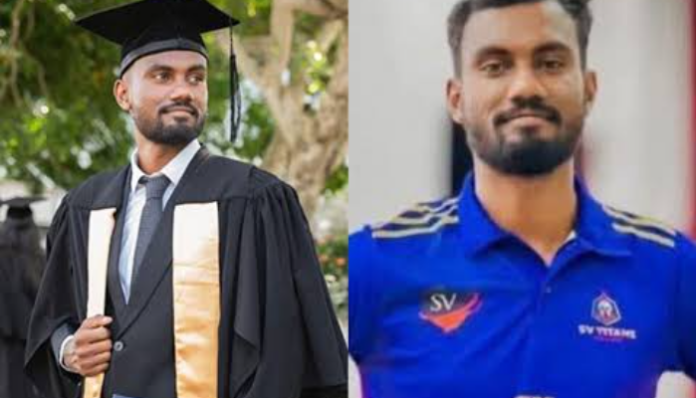
A Sri Lankan Tamil Hindu migrant worker, Anojan Sivarasa, is facing the death penalty in Saudi Arabia in an alleged blasphemy case that began with a Facebook comment. The Al-Ahsa Criminal Court had initially sentenced him to five years in prison and imposed a fine of three million Saudi riyals.
The case, however, took a dramatic turn when prosecutors pressed to have him tried under Sharia Law. The appellate court accepted the request and announced capital punishment for him.
The remark at the centre of the matter, which was reportedly against Islam and Prophet Muhammad, was made over an insult directed at a Hindu deity. Anojan later deleted the post and even uploaded an apology video. According to his brother, someone had taken a screenshot and sent it to his employer and Saudi authorities, eventually resulting in his arrest and imprisonment in July.
Hamsidan Sivarasa conveyed, “People in Saudi Arabia knew nothing about this matter. It was individuals in Sri Lanka who sent emails to the company where my brother worked. I do not even wish to mention who those people are,” in a conversation with the BBC.
Anojan’s personal devices have been confiscated, while all communication between him and his family has ceased. They have received no information about his condition since 28th September, leaving them anxiously waiting as his fate remains uncertain.
Meanwhile, legal and diplomatic efforts are underway to secure his release as his family members are desperately exploring every possible avenue to bring him home, with no clarity yet on what lies ahead for the young man.
Of greater concern, the kingdom has a history of carrying out executions without informing either the families or the concerned foreign embassies. The relatives are only notified after the sentence has been enforced.
Hence, Anojan’s family is forced to spend the days ahead in dread while the unknown future of their son continues to weigh heavily on them.
When social media remarks put a target on back: How Islamo-leftists target Hindus
However, it is not the first time an individual has suffered severe consequences over a social media post or comment, with deliberate campaigns launched by the Islamo-leftist cabal spilling over into attempts to threaten their livelihood, personal safety and even life regardless of the context or merits of the issue.
The risks can be particularly serious for the Hindus staying and working in Gulf countries, where such controversies can have consequences far beyond the online sphere. More importantly, no one is immune from such targeting, whether an ordinary person or a well-known public figure.
A similar episode unfolded in 2018, when Indian-born British celebrity chef Atul Kochhar posted a tweet criticising Priyanka Chopra and her American television show “Quantico” over a deeply anti-Hindu storyline. The episode showed Rudraksha wearing Indian nationalists plotting to detonate a nuclear bomb in Manhattan before framing Pakistan for the attack.
Kochhar expressed his displeasure with the portrayal and argued that, contrary to the show’s depiction, Hindus had themselves faced centuries of violence and persecution at the hands of Islamist forces. This prompted a wave of attacks from the usual suspects, after which he removed the tweet and issued an apology.
The controversy, however, did not end there. Rupa Subramanyam tagged the JW Marriott Marquis Hotel Dubai, where the Michelin-starred chef operated a restaurant. She wrote that his remarks would “not go down well with authorities in the United Arab Emirates (UAE), the hotel or his Muslim patrons around the world.”
She then mocked that he would, on the other hand, become popular with the Indian Right. Others from the ecosystem similarly pounced on him, and the hotel ended its association with Kochhar.
Probably not going to go down well with authorities in the UAE where @atulkochhar does business ( @JWDubaiMarquis ) or his Muslim patrons around the world. But on the other hand he’ll be popular on the Indian Right. 😬 https://t.co/aK9Oo9WUnw
— Rupa Subramanya (@rupasubramanya) June 11, 2018
In fact, even sharing views on geopolitical issues can jeopardise one’s employment in the Middle East. This was evident when the Kuwaiti government deported two nurses from Kerala over social media posts expressing support for Israel after Hamas attacked the country in 2023.
A few years earlier, in 2020, several Indians endured similar action over content that was deemed blasphemous, resulting in job loss, legal action and even deportation. One such case involved Rakesh B. Kitturmath, a Hindu man from Ranebennur in Karnataka. He was a team leader at Emrill Services, an integrated facilities management company headquartered in Dubai, at the time.
Kitturmath was targeted over TikTok comments criticising Muslims who claimed that offering namaz five times a day was enough to protect against the coronavirus. He was immediately terminated from his job and faced jail time.
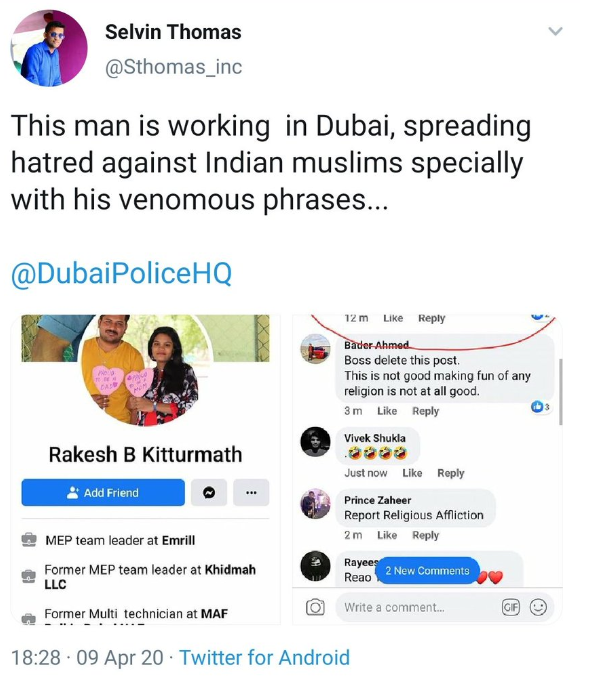
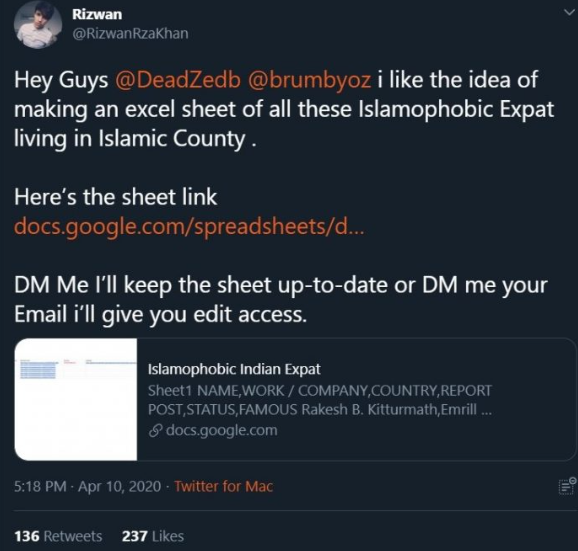
The Muslim fundamentalists in India, from infamous names like former journalist Irena Akbar to ordinary trolls, had compiled a list of purported “Hindutva terrorists” for intimidation by demanding the same action against them based on false allegations, and they also succeeded in their nefarious agenda.
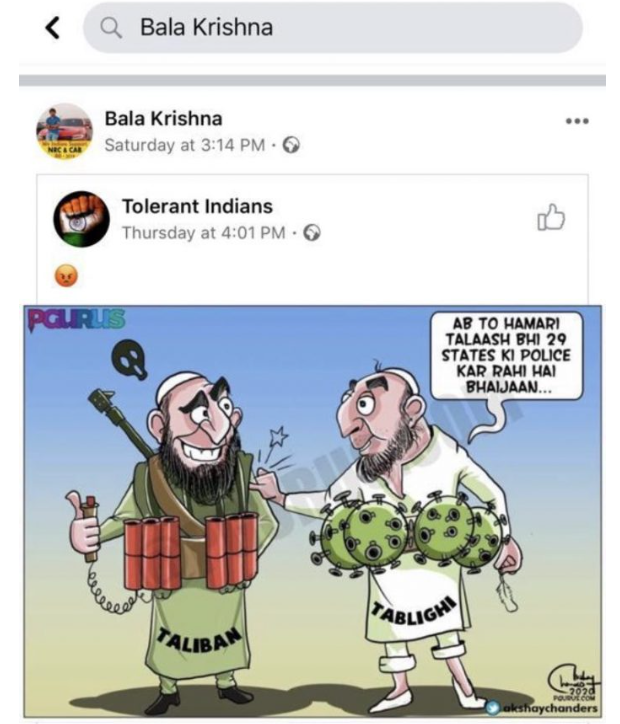
Balakrishna Nakka was sacked from his job in Dubai for sharing memes on Facebook mocking the Taliban and Tablighi Jamaat. The Islamists insisted that the “Islamophobic” cartoons showed Muslims as suicide bombers and coronavirus carriers as part of a conspiracy.
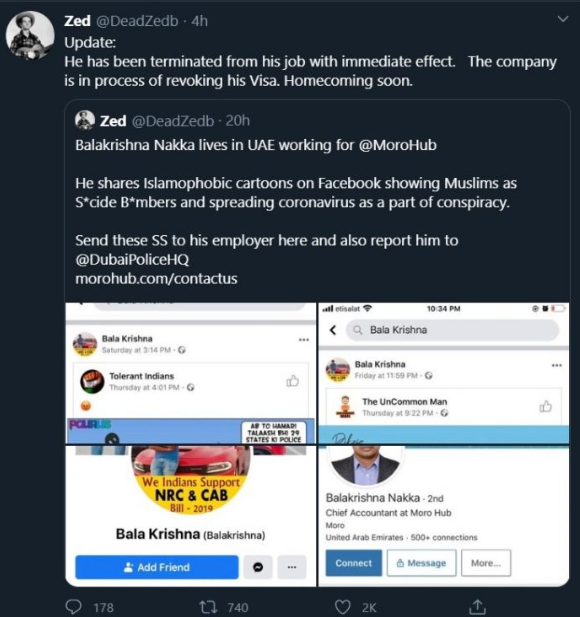
However, it is clear from the meme itself that its subject was the Taliban and Tablighi Jamaat, with no reference to or connection with the broader Muslim community. It is noteworthy that the Tablighi Jamaat organised a religious congregation in New Delhi that became a major coronavirus cluster despite a ban on such events during the pandemic.
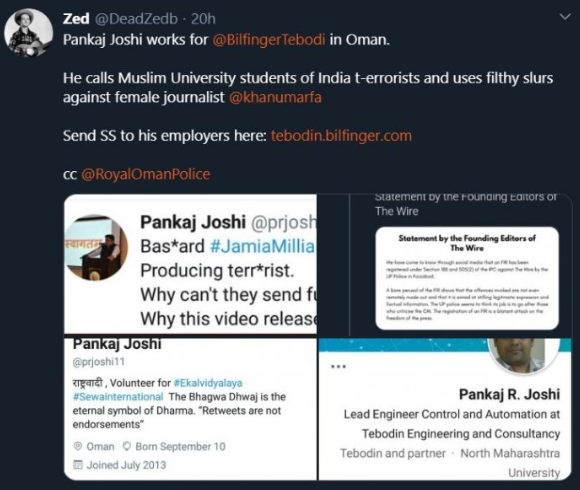
These extremists also wanted police action against an Indian in Oman for posting against Jamia Millia Islamia University.
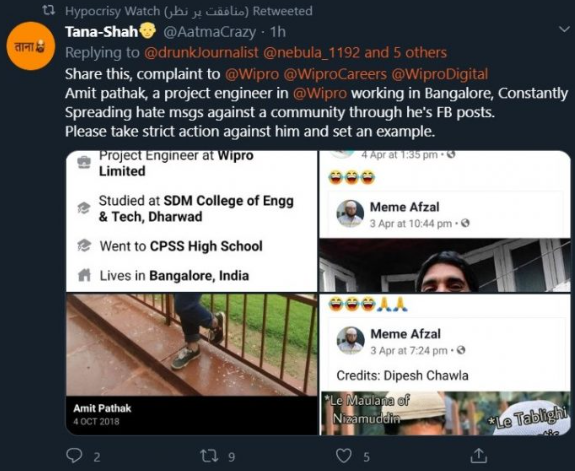
This ecosystem was not only after the Hindus in Islamic countries but even those in India, as a complaint was raised with Wipro after its project engineer highlighted the role of the Tablighi Jamaat during the Covid-19 pandemic.
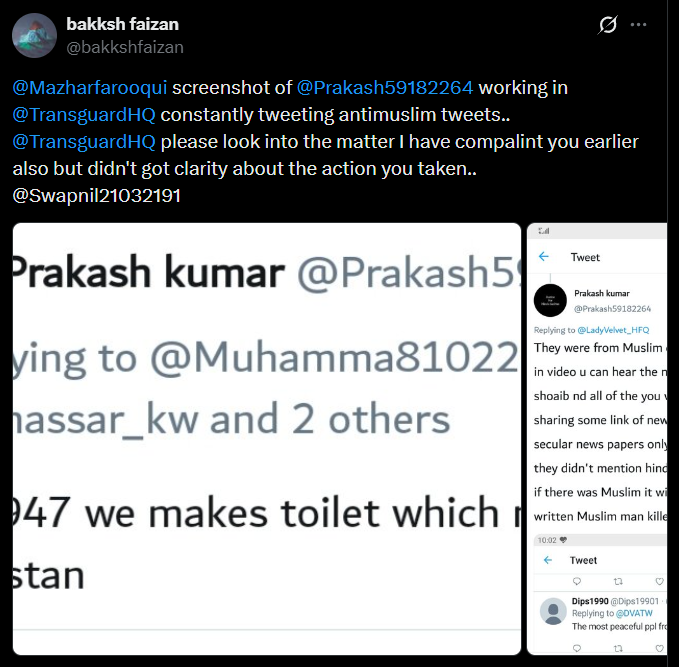
The Islamists also encouraged Transguard Group to take action against a man identified as Prakash Kumar, who made anti-Pakistan tweets. He also mentioned that the Gujarat riots began after the Godhra train burning. However, it was later found that he did not work for the company.
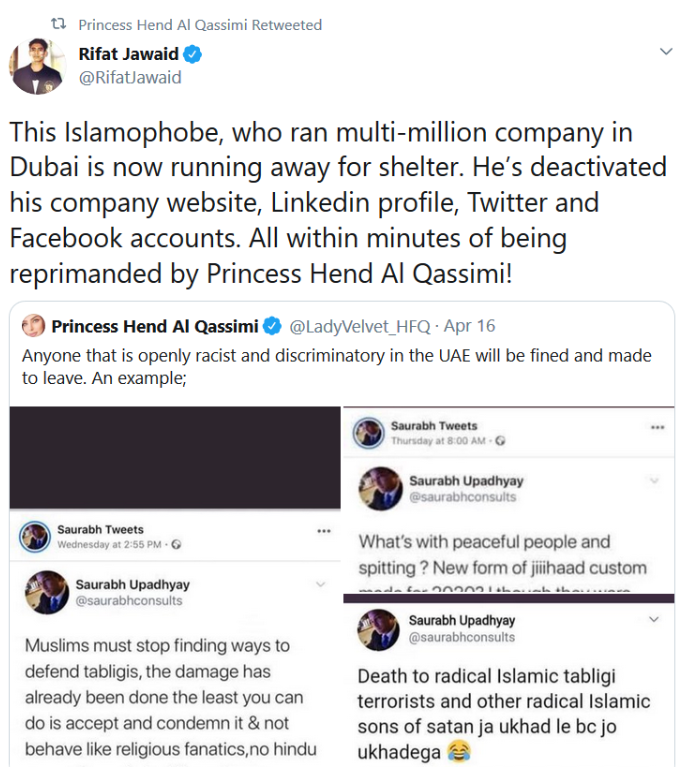
Propagandist masquerading as a journalist Rifat Jawaid mocked Saurabh Upadhyay, a businessman based in Dubai, as action was started against him after he denounced the Tablighi Jamaat and other radicals and urged Muslims not to defend them. Jawaid gleefully claimed that Upadhyay was “running away for shelter” and had “deactivated his company website, LinkedIn profile, Twitter and Facebook accounts” after Princess Hend Al Qassimi spotted his posts.
Sohan Roy, founder chairman of Sharjah-based Aries Group, had to apologise in a Facebook live video over his Malayalam poem “Viddi Janman” (Fool’s life). He did not mention any religion or community and made an oblique reference to Tablighi Jamaat through the accompanying images.
Roy asserted that religion had blinded people because they were disobeying coronavirus rules in the name of God. The poem went viral but was deleted from his X, Instagram, and Facebook accounts as the radicals attacked him.
Mitesh U, a financial manager at an Abu Dhabi-based company, was likewise targeted after sharing a Facebook post about how members of the Tablighi Jamaat had spat on others, potentially increasing the spread of the coronavirus and resulting in more casualties than a suicide attack.
Notably, many Hindus were subjected to serious action under the guise of “Islamophobia” or simply for slamming the Tablighi Jamaat’s activities during the pandemic on social media. People were forced to apologise, fired or suspended from their jobs without notice, had their salaries withheld, and were even handed over to the police over such accusations.
The conduct of the Tablighi Jamaat during that period, and the criticism it attracted, sparked the targeted harassment of those who spoke out and thus were accused of harbouring anti-Islam or anti-Muslim sentiments.
Different years, same pattern: Alleged anti-Islam posts land people in trouble
Three security personnel from Sri Lanka were accused of disparaging Islam on Facebook and Instagram after the 2019 Easter bombings in their country. The trio, working at a high-end hotel in Palm Jumeirah, were reported to the authorities by their coworkers after they shared images and posts online.
A Pakistani employee at the hotel alleged, “Some employees told me that the defendants insulted Islam on Facebook. We have 84 different nationalities working in the hotel. We summoned them for internal questioning, and they admitted making the posts.”
Al Barsha station police went to the hotel and took them into custody. Their cell phones and laptops were seized by the authorities for additional investigation after they searched their home. The men, however, refuted the charge and maintained that their uploads were about terrorism following the bombings in their nation.
In 2015, an Indian man was booked for “insulting Islam” in Dubai due to a Facebook post regarding the growing carnage in Iraq as ISIS (Islamic State of Iraq and Syria) swept over the nation. Another Indian man who also worked there was made aware of it by a friend via a WhatsApp message, after which he approached the Al Rafaa police station.
Conclusion
It is apparent that, for non-Muslims, specifically Hindus in the Gulf, even an allegation can be enough to wreak havoc on their lives, irrespective of the truth about the incident. More concerningly, action against them can be triggered by social media outrage before the charges or the circumstances surrounding them have been properly examined.
Radical elements in the Indian subcontinent have repeatedly sought to exploit such situations to demand action against the members of the Hindu community, taking advantage of the region’s stringent Islamic laws. Of course, people should exercise greater sensitivity when speaking about faith and avoid making inflammatory or offensive remarks.
However, the reality on the ground is far more complicated when those making such complaints themselves display hostility towards Hinduism and never hesitate to insult India’s majority community. On the other hand, this ecosystem swiftly turns towards its Arab overlords when it comes to making complaints against Hindus, raising the spectre of “Islamophobia,” even without any provocation.