

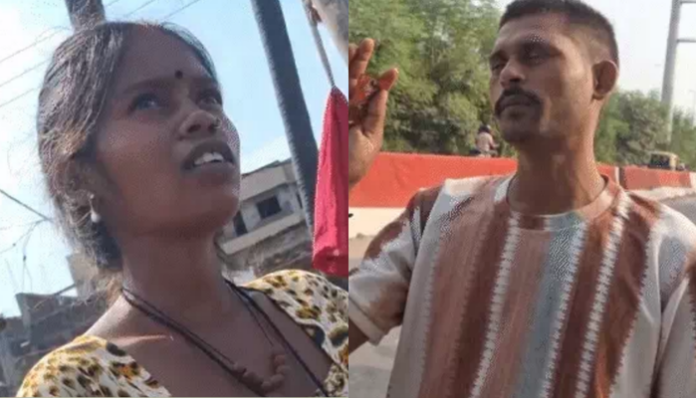
An extortion racket has been exposed in Bihar that misuses the Scheduled Castes and the Scheduled Tribes (Prevention of Atrocities) Act, 1989, commonly known as the SC/ST Act, to threaten people and extort money from them. The racket is reported to be run by a man named Ravi Yadav, along with his wife, Rinki, who belongs to the Scheduled Caste (SC) community. The couple and their relatives have been making money through government compensation and extortion by filing false cases under the SC/ST Act against people.
According to an investigative report and sting operation by Dainik Bhaskar, Ravi Yadav, a non-SC/ST, uses his wife, Rinki, to file false cases under the SC/ST Act and extort money. He also files these fake cases on request, charging hefty sums. Yadav explained his modus operandi to an undercover Dainik Bhaskar reporter, who approached him to file a fake SC/ST Act case against a person.
Blatant misuse of the law meant to protect genuine victims
Ravi Yadav told the reporter on camera that he married a woman from an SC community to make money by misusing the Act. He admitted to having filed multiple fake cases over the years and extorted huge amounts of money, in addition to the compensation given by the government, meant for genuine victims of caste atrocities.
He said that if the reporter was willing to spend money, he could get his wife to file a fake case of sexual harassment and caste discrimination against anyone. He said that the case could be made more stringent depending on the money the reporter was willing to spend. He added that if more money is paid to him, he could get his wife’s family and relatives to appear as witnesses, which would further strengthen the case. However, he made it clear that he would keep the compensation amount that will be offered to his wife after she files the case.
A wider network fuelled by extortion money and compensation
Ravi Yadav further divulged that he has several acquaintances in Bihar who have been making money in this manner. He said that he learnt about “the scheme” from a relative in Muzaffarpur. “I turned this into a weapon. Since my wife belongs to the SC/ST category, I use her status as a tool,” Ravi said.
बिहार में SC/ST के झूठे केस कराने वाली गैंग: पत्नियां मुकदमा करातीं, पति गवाह बनते हैं; एजेंट बोला- 2.5 लाख का पैकेज, सभी की हिस्सेदारी पूरा वीडियो देखने के लिए लिंक पर क्लिक करें- https://t.co/NaxTIAeauB #SCSTAct #BiharNews #FakeCase #CasteAct #CrimeNews #BhaskarInvestigation
— Dainik Bhaskar (@DainikBhaskar) October 7, 2026
He advised the reporter to file the case at the Danapur Court, stating that he has his people in the court, who will get the job done. When the reporter told him that he wanted to file the case at Shrikrishnapuri, Yadav said that it would be done. He also made the reporter meet his wife and her family.
The reporter was told that he would have to pay ₹2.5 lakh for filing the fake case. Four people will be involved in the process: one victim and three witnesses. He was also told that he would have to bear additional expenses, including travel, accommodation, and food for all the people who will be involved in he process, in addition to the lawyer’s fee.
How the law has been weaponised
The SC/ST Act, which was introduced as a safeguard against caste-based violence and discrimination, has been reduced to a tool being used for harassment and extortion. Instead of helping genuine victims, the law has led to the creation of a new class of victims.
Under the SC/ST (Prevention of Atrocities) Rules, 1995, as amended in 2016, complainants are entitled to monetary relief at multiple stages. This monetary relief is disbursed immediately on FIR registration, as interim relief during trial, and as final compensation on conviction.
Roughly, 25% to 50% of the amount is released by the District Collector within seven days of the FIR’s filing, another 25% after the chargesheet is filed, and the balance on conviction, drawn from a schedule that ranges between ₹1 lakh for offences like caste slurs up to ₹8.25 lakh for murder or gang rape.
It is crucial to note that this financial relief is linked to registration and charge-sheeting; these stages occur well before any court has even tested the allegation, and not conviction alone.
Many instances of false cases filed under the SC/ST Act have come to light over the past many years. The law has been weaponised for a range of reasons, including personal disputes, property matters, and the greed for financial compensation. In 2018, the Supreme Court noted the possibility of the SC/ST Act being used for “extraneous considerations”. The court introduced additional safeguards in cases involving allegations against civil servants. However, this was overturned by a subsequent amendment by the Modi government.
Last month, the Allahabad High Court ordered a statewide probe into compensation claims made under the Scheduled Castes and the Scheduled Tribes (Prevention of Atrocities) Act, 1989. The order came after the High Court came across a case in which an advocate and his family members received over ₹23 lakh in relief money in multiple claims made under the SC/ST Act.
Registration of cases under the SC/ST Act saw a consistent upward trajectory from 2020 through 2023, with the number of cases filed rising from 45,995 cases in 2020 to 45,800–46,100 in 2021, and sharply rising to 52,866 cases in 2022. The upward trend peaked at a five-year high in 2023 with 53,372 registered cases, and registered a slight drop to 48,669 cases in 2024. The situation warrants special attention and effective resolution.
In a classic case of how the SC/ST Act is misused for compensation money, a woman named Chandrawati Devi, a resident of Hastpur village, allegedly misused government schemes meant for Scheduled Castes (SC) and fraudulently pocketed around ₹46 lakh.
It was reported that in the last 10 years, 15 different cases have been registered against Chandrawati Devi and her family. Many of these cases were filed under the SC/ST (Prevention of Atrocities) Act, 1989.
Under this law, victims are provided financial assistance and legal protection. The allegation is that Chandrawati and her family repeatedly filed false cases to avail the benefits of these schemes and have so far received nearly ₹46 lakh.


