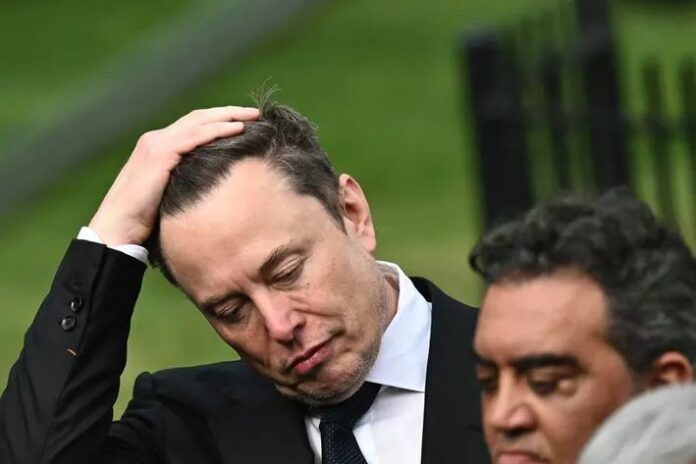
Elon Musk has spent the past 24 hours turning his Starlink regulatory impasse in India into a very public confrontation with the Indian government. What began with vague references to unnamed “oligarchs” has now become considerably more pointed, with Musk directly naming Mukesh Ambani and questioning why Starlink still does not have the final clearances required to begin commercial operations.
On Wednesday, Musk accused “certain oligarchs” of blocking Starlink to maintain a “monopolistic chokehold” over Indians, describing the alleged obstruction as “a crime against the people of India”. On Thursday, he dropped the remaining ambiguity.
“Starlink is licensed in over 165 countries and has spent five years complying with every single law and requirement of the government of India, so why still no license? Is Ambani the real boss of India?” Musk wrote on X.
Starlink is licensed in over 165 countries and has spent five years complying with every single law and requirement of the government of India, so why still no license? Is Ambani the real boss of India?
— Elon Musk (@elonmusk) October 8, 2026
The language is striking, not merely because Musk is publicly accusing one of India’s most powerful businessmen of influencing government policy, but because it represents an attempt to frame a complex regulatory process as a straightforward battle between a technology company seeking to bring connectivity to Indians and an entrenched oligopoly supposedly determined to keep it out.
The facts, however, are considerably more complicated.
Starlink already has a licence, but that is not the end of the process
One important distinction has been blurred in Musk’s campaign.
Starlink has indeed obtained an authorisation to provide satellite communication services in India. But that does not automatically mean it can switch on commercial services nationwide.
The government said on Thursday that all three licensed satellite communication operators are currently at broadly the same regulatory stage and are undergoing security assessments. Once those assessments are completed, an operator can move to the next stage of seeking spectrum assignment. The Communications Ministry called the suggestion that Starlink was being singled out “baseless and misconceived”.
In other words, the remaining hurdles are not simply a mysterious refusal to issue Musk a licence. Security compliance and spectrum assignment are part of the regulatory framework governing satellite communication services.
This distinction matters because Musk’s public campaign risks reducing a multi-stage regulatory and security process to a simple question: Why is the government protecting Ambani?
That is a much more politically potent argument than explaining the intricacies of telecom licensing.
Musk’s X following gives him an unusual lobbying weapon
There is nothing inherently unlawful about a businessman lobbying a government, criticising regulation or making his case publicly. Companies routinely engage with regulators, policymakers and the public when seeking market access.
What makes Musk’s approach unusual is the scale of the platform he controls.
As the owner of X, Musk has the ability to turn a regulatory dispute involving one company into a global political conversation almost instantly. A single post can be amplified by millions of followers, journalists, influencers and political commentators.
That makes his latest Starlink campaign more than a conventional corporate disagreement.
Rather than quietly waiting for regulatory processes to run their course, Musk is taking his case directly to the Indian public—and, by extension, to the political establishment.
His message is simple: Starlink wants to bring connectivity to underserved Indians, while powerful domestic interests allegedly want to prevent it from entering the market.
It is a compelling narrative. But compelling narratives and complete regulatory explanations are not necessarily the same thing.
And then there are the accounts Musk is amplifying
Perhaps the most intriguing aspect of Musk’s campaign is not simply what he is saying, but whom he is choosing to amplify.
One of the accounts he quoted was that of Dr Aniruddha Malpani, a doctor as per his X bio, but a detractor who posts opinions on everything under the sun.
Musk amplified Malpani’s argument that the government was more interested in protecting “crony capitalists” than citizens.
But there is an obvious question missing from that argument: what exactly does Starlink offer the average Indian consumer that existing broadband services do not?
Starlink’s strongest proposition is not necessarily competing with conventional urban fibre broadband on price. Its technological advantage is the ability to provide connectivity in locations where terrestrial infrastructure is difficult or uneconomic to deploy.
A remote village with no fibre connection and unreliable mobile coverage may genuinely benefit from satellite broadband. A middle-class household in a city already receiving 100 Mbps or 300 Mbps fibre broadband has a very different proposition.
Airtel’s broadband offerings, for example, include plans starting at ₹499 and 100 Mbps service at ₹799 per month, excluding taxes.
By contrast, Starlink’s India pricing has previously been reported as potentially ranging between roughly ₹3,000 and ₹4,200 a month, with hardware estimated at around ₹33,000. These were reported prospective prices rather than an officially launched Indian tariff, but they illustrate why Starlink’s principal selling point in India is unlikely to be cheap urban broadband.
The stronger argument for Starlink is therefore coverage, not necessarily affordability. But even at 7-8x the existing cost, it is practically unaffordable for those living in remote regions.
Meshram’s village story, and the problem with the rural-connectivity argument
Another account Musk amplified was that of Supreme Court advocate Nitin Meshram, who described the absence of mobile connectivity in his village.
“In my village, there has been no mobile network coverage since Independence,” Meshram wrote. It is worth noting that Meshram is the same lawyer who got the death sentence of a man guilty of raping and murdering a 4-year-old girl commuted to life imprisonment.
He went on to recount how a friend from the Supreme Court had once sent him birthday wishes while he was visiting his village. He never received the message because there was no network, leading his friend to believe that he had deliberately ignored him.
Musk responded that Starlink could help areas of India with poor or nonexistent internet and mobile coverage.
Starlink will be of great help to areas of India that have bad or no Internet and even no mobile coverage. No country has perfect coverage, including America, but Starlink can fill in the coverage gaps for those who most need it.
— Elon Musk (@elonmusk) October 8, 2026
Meshram subsequently went a step further, writing that Starlink “is essential for India” and urging the government to allow it to operate, arguing that its ability to connect directly to devices through satellites could fundamentally expand internet connectivity and break the existing duopoly.
There is certainly an emotional force to Meshram’s anecdote. But it also provides a convenient opening to examine one of the principal arguments being made in Starlink’s favour: that the service will finally connect India’s villages and remote regions that have remained beyond the reach of conventional telecom networks.
It is an appealing argument, but a rather specious one if presented as proof that Starlink will automatically benefit the people living in these areas.
The villages that remain without reliable internet connectivity are, by definition, often places where conventional telecom companies have found the economics of deployment difficult. They are not sprawling commercial centres with a large concentration of customers capable of generating sufficient revenue to justify the cost of laying fibre, installing towers and maintaining the necessary infrastructure.
A private telecommunications company cannot simply extend its network to every remote habitation irrespective of the economics involved or whether the residents can actually afford its services.
Starlink’s satellites may solve one part of that problem, the physical difficulty of reaching remote locations. But they do not magically eliminate the second and arguably more important problem: affordability.
Starlink is a commercial service. The fact that a satellite can beam internet to a remote village does not mean that every household in that village will be able or willing to pay for the equipment and recurring subscription. If the very people being invoked as beneficiaries cannot afford the service, satellite coverage alone does little to bridge the digital divide.
There may, of course, be legitimate use cases. A school, hospital, government facility, business or community centre in a remote area could potentially use Starlink and spread the cost across a large number of users. Governments or institutions could also subsidise connectivity in strategically important or underserved areas.
But that is very different from suggesting that Starlink will simply arrive in India’s unconnected villages and make affordable high-speed internet available to their residents.
In fact, the economics of India’s rural connectivity problem are precisely why governments have historically had to intervene through programmes designed to subsidise or facilitate rural telecommunications infrastructure.
So when Musk and his supporters invoke India’s unconnected villages as an argument for immediately allowing Starlink to operate, there is a basic question that deserves an answer: how many of the people in these villages will actually be able to afford Starlink?
Until its Indian pricing, equipment costs and actual deployment model are clear, “Starlink will connect India’s unconnected villages” remains an attractive proposition, but it should not be confused with proof that Starlink will provide affordable internet to India’s poorest and most remote households.
The “Ambani versus Musk” narrative also ignores an inconvenient fact
There is another detail that makes Musk’s oligarch narrative particularly interesting.
Bharti Airtel, the company associated with billionaire Sunil Bharti Mittal, actually signed an agreement with SpaceX in March 2025 to bring Starlink services to India.
Under the proposed arrangement, Airtel and SpaceX would explore selling Starlink equipment through Airtel’s retail network, offering Starlink services to business customers and using Starlink to connect remote communities, schools and healthcare facilities, subject to SpaceX obtaining the required authorisations.
And then came another development that makes the “Indian telecom oligarchs are simply blocking Starlink” narrative even harder to sustain: Reliance Jio also agreed with SpaceX.
Jio announced its own partnership with Starlink just one day after Airtel’s announcement, with plans to explore offering Starlink solutions through its retail and online platforms, subject to regulatory approvals.
So both of India’s largest telecom operators have, at different points, positioned themselves as potential partners for Starlink.
That does not prove that every regulatory objection is legitimate, nor does it rule out competitive lobbying. But it makes the claim that Airtel and Jio simply want to keep Starlink out considerably less straightforward.
In fact, Airtel’s involvement turns the supposed competitive war on its head: one of the very “oligarchs” ostensibly threatened by Starlink was willing to help distribute it.
Musk’s second amplification is even more curious
The other account Musk quoted was Nitin Meshram, the Supreme Court lawyer whose comments about his village’s lack of connectivity have now been transformed into part of Musk’s public argument for Starlink.
What makes the episode particularly interesting is that Meshram has previously criticised Musk over Starlink, including raising concerns about the possibility of the technology being misused amid the unrest in Manipur.
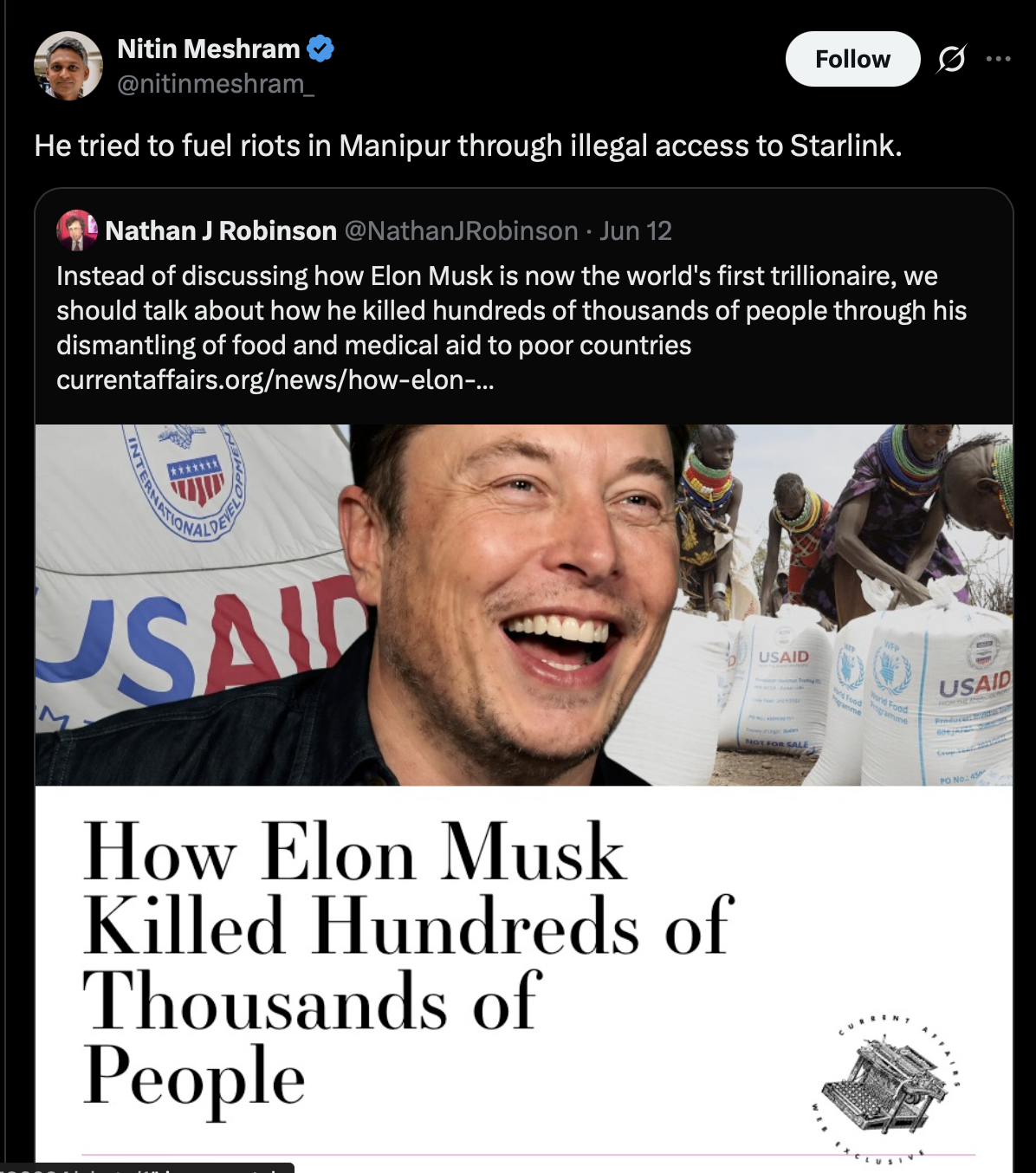
Yet he is now publicly urging the Indian government to permit Starlink to operate as soon as possible.
A change of position is not in itself evidence of anything improper. People can obviously revise their opinions as circumstances change. But what changed so drastically that Meshram suddenly started yearning for Starlink’s entry in India’s telecom sector? Certainly, the internal security of India takes precedence over internet connectivity in Mr Meshram’s “remote” village. Why would Mr Meshram endorse an organisation for internet which he had accused of fuelling riots in Manipur a few months ago?
Nevertheless, the juxtaposition is striking, particularly because Musk is amplifying the very account that provides him with a powerful anecdote for his rural-connectivity argument.
And that brings us back to the broader pattern.
Musk’s posts are not merely promoting Starlink as a technology. He is amplifying individual accounts that reinforce his preferred interpretation of India’s regulatory process, namely, that Starlink’s entry is being delayed because entrenched interests want to protect the existing telecom players.
It would be premature to claim that this is a coordinated or “inorganic” campaign without evidence showing coordination, paid amplification, bots or organised manipulation.
But the visible pattern is undeniable: Musk is using his enormous social-media reach to elevate voices that support his case.
That is influence. Whether it amounts to an organised influence operation is a separate question.
India is not obliged to replace regulation with Musk’s timetable
There is also a fundamental principle at stake.
A company being licensed in 165 countries does not mean that India must automatically adopt the same regulatory conditions. Satellite communication involves spectrum, national security, data protection, lawful interception and infrastructure requirements. India is entitled to impose conditions it considers necessary for its own jurisdiction.
The government’s current position is that Starlink, along with the other licensed satellite operators, is undergoing the applicable regulatory and security processes.
That does not mean the government’s process should be immune from scrutiny.
If Starlink has fulfilled every requirement, as Musk maintains, the government should explain clearly what remains outstanding and why. Transparency would be far more useful than either side reducing the dispute to accusations of “oligarchy” or claims of unquestionable regulatory virtue.
But there is a difference between challenging regulation and attempting to delegitimise the regulator’s process in the court of public opinion.
Musk appears increasingly interested in the latter.
Starlink may eventually enter India, but Musk’s method deserves scrutiny
There is a perfectly reasonable case for Starlink in India.
Satellite broadband could improve connectivity in remote areas, provide redundancy during disasters and extend high-speed internet to places where fibre and mobile towers are commercially difficult to deploy.
There is also a reasonable case for competition. More providers can create more choices for consumers.
But none of that means Starlink should receive a regulatory exemption, or that the government should be pressured into treating a pending security and spectrum process as an anti-competition conspiracy.
The irony is that Musk’s own Indian partnerships undermine the cleanest version of his argument. Airtel has partnered with SpaceX. Jio has partnered with SpaceX. Starlink has built significant infrastructure in anticipation of its launch. And the government says the licensed satellite operators remain subject to the applicable regulatory and security processes.
A regulatory dispute that might otherwise have played out between SpaceX and Indian authorities has suddenly become a public campaign involving accusations of oligarchy, references to Indian billionaires and amplification of sympathetic voices on X.
The Iran factor: why India may be wary of giving Starlink free rein
There is another reason New Delhi may be reluctant to simply wave Starlink through: Iran has demonstrated how difficult it can be for a government to control a satellite network once it is deployed on the ground.
During the US-Israel conflict with Iran in 2026, Starlink terminals were used inside Iran to circumvent the government’s near-total internet shutdown. Reuters reported that Iranians were using Starlink to stay connected despite the blackout, while SpaceX subsequently made the service available free to Iranians. Cybersecurity researchers also reported that Starlink or other satellite terminals were being used to restore connectivity and maintain cyber activity during the conflict.
That episode demonstrated something strategically significant: a foreign satellite network can potentially keep communications flowing even when a sovereign government has deliberately shut down its terrestrial internet infrastructure. In short, sovereign government are right in being concerned that Starlink could be used by the US as a tool to engineer regime change operation or fuel anarchy in a country of their interest.