Islamo-leftists across the world are thrilled by the victory of Democrat leader with alleged Muslim Brotherhood links, Abdul El-Sayed, in the recent US Senate midterm elections. The euphoria that swept social media a few months back when another Islamist, Zohran Mamdani, won the New York mayoral elections has returned, and so has the itch to find an India connection. After Abdul El-Sayed won the Michigan Senate seat, Vijay Prashad, the Neville Roy Singham transnational CCP propaganda network-linked Marxist journalist, published an X post highlighting the connection of Sayed’s wife with the Bhatkal town in India’s Karnataka, which he claimed was ‘invaded’ by the RSS.
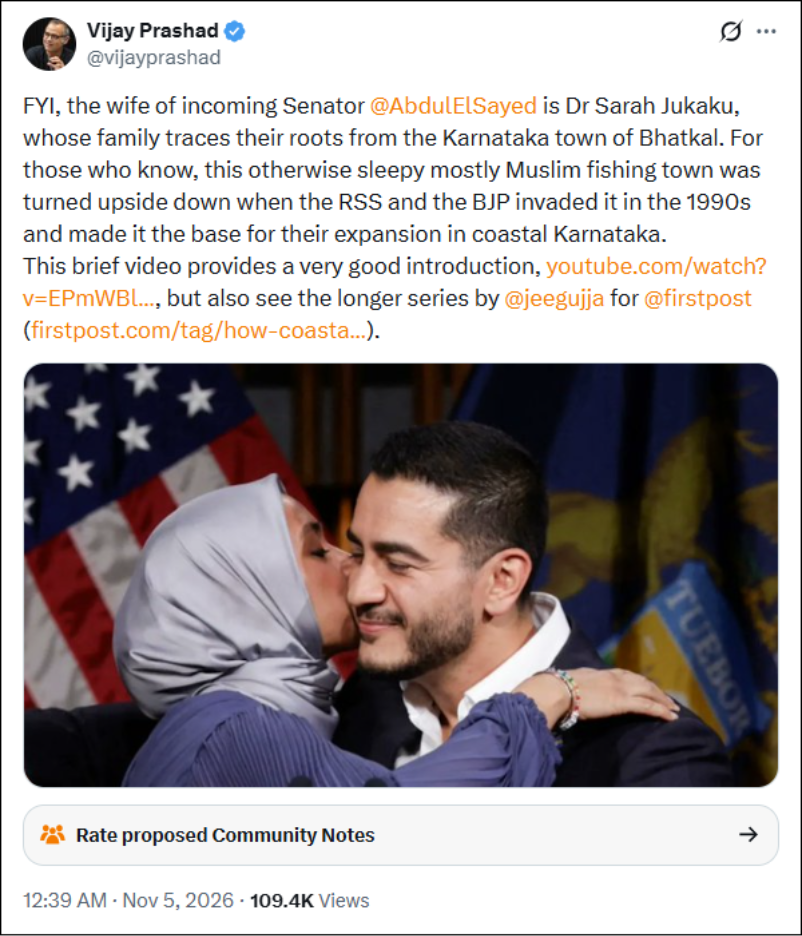
On 4th November, Vijay Prashad, the director of the Tricontinental propaganda portal, published an X post in which he wrote that Abdul El-Sayed’s wife, Dr Sarah Jukaku, has her roots in Karnataka’s Bhatkal town. Vijay Prashad claimed that Bhatkal was a ‘sleepy mostly Muslim fishing town’ until the Rashtriya Swayamsevak Sangh (RSS) and the Bharatiya Janata Party (BJP) “invaded” it in the 1990s.
“FYI, the wife of incoming Senator @AbdulElSayed is Dr Sarah Jukaku, whose family traces their roots from the Karnataka town of Bhatkal. For those who know, this otherwise sleepy mostly Muslim fishing town was turned upside down when the RSS and the BJP invaded it in the 1990s and made it the base for their expansion in coastal Karnataka,” Prashad wrote.
Interestingly, the newly elected Michigan Senator Abdul El-Sayed is a known RSS detractor. In August this year, Sayed was among the 100 US politicians who signed a pledge against receiving donations from RSS-linked entities or its supporters.
In a press release issued on 31st August, Hindus for Human Rights Action and SACRED Acts said, “– Hindus for Human Rights Action and SACRED Acts announce an historic commitment against hate with nearly 100 American political leaders from across the United States pledging to reject political contributions from the anti-democratic movement behind the assassination of Mohandas K. Gandhi, the Rashtriya Swayamsevak Sangh (R.S.S.).”

Being true to his ideological imperative of portraying Muslims as perennial victims even as they are the perpetrators, Vijay Prashad made villains out of BJP-RSS, declared them, and, by extension, Hindus as ‘invaders’ who ‘invaded’ Muslim town.
Prashad attempted to convey that the Bhatkal town, which was ‘forever communalised’ by RSS invaders, has links to a Muslim woman whose husband ‘defeated’ RSS-BJP-like forces in the US.
The anti-India propagandist, however, conveniently skipped mentioning the fact that the same Bhatkal town is the birthplace of Indian Mujahideen (IM), the Islamic terror group behind numerous jihadi attacks across India.
Before delving into the ‘Mujahideen’ connection of Bhatkal, it is pertinent to address Prashad’s “the RSS and the BJP invaded” Bhatkal claim.
Did the RSS ‘invade’ Bhatkal, as Vijay Prashad claims?
Vijay Prashad’s claim that the RSS invaded Bhatkal is as true as his claim that he is not linked with the violent protests in France.
The RSS is not a foreign militia that ‘invades’ India, Indian states or cities; it is an Indian nationalist organisation, which has the right to set up its branches anywhere in the country.
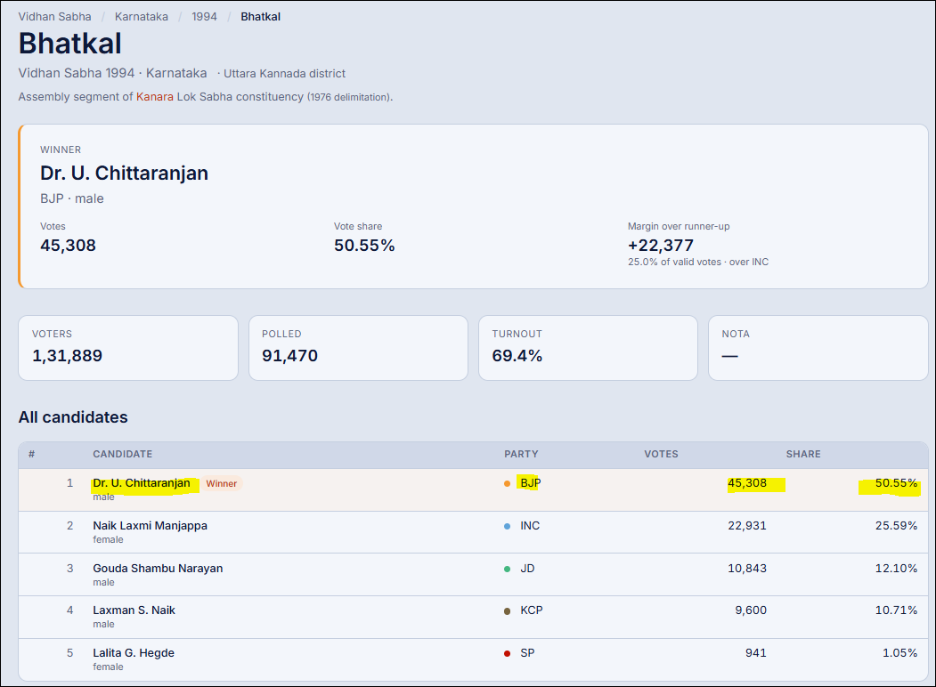
In the early 1990s, the RSS and BJP expanded their organisational work in Bhatkal through a doctor, U. Chittaranjan, who was an RSS activist.
Dr Chittaranjan had set up a practice in the Muslim-dominated Bhatkal, charged a nominal fee of Rs 5 from local patients, and earned local popularity across communities.
Chittaranjan’s popularity significantly helped the BJP establish itself in Bhatkal, which had elected historically elected only Muslim candidates from the constituency.
BJP’s rise in Bhatkal, however, did not result in immediate electoral gains. In fact, despite his personal popularity, Dr U. Chittaranjan lost two elections.
Things began to change, however, in 1993. The shift did not come due to any ‘RSS invasion’ as Vijay Prashad claims, but due to a Muslim mob attack on a Hindu Rath Yatra procession near a Hanuman temple in Bhatkal.
Muslims pelted stones and attacked a peaceful Hindu procession. It was this Muslim mob attack on Hindus that triggered continuous communal violence in Bhatkal for about nine months, with around 19 people from both sides losing their lives.
While CCP stooge Vijay Prashad portrays RSS as the aggressor and invader, even Muslim doctors recall that the RSS man Dr U. Chittaranjan played a significant role in bringing the situation under control.
In 1994, Dr U. Chittaranjan won the election and became the BJP MLA from Bhatkal. Under his leadership, Anant Kumar Hegde and other leaders emerged who later secured key positions in State and Central BJP governments.
The RSS’s expanded footprint and the BJP’s electoral success came amid existing economic shifts and a surge in Hindu unity, and not a military-style invasion by the ‘paramilitary organisation’ of Bhatkal.
Contrary to Vijay Prashad’s insinuation that it was the RSS that flared up communal tensions in the ‘sleepy Muslim fishing town’, the Justice Kedambadi Jagannatha Shetty Commission, set up by the Karnataka government, which probed the 1993 Muslim mob violence, found that it was Muslim organisations and individuals that orchestrated the riots.
Pertinently, the Commission also found evidence of the agents of the Pakistani intelligence agency ISI operating in Bhatkal. Despite the Shetty Commission’s report pointing to Muslim radicalisation and a separate police report raising alarms over an ISI operation in Bhatkal in the early 1990s, the Muslim-appeasing Congress government of that time did nothing about it.
In 1996, Dr Chittaranjan was killed by unidentified individuals in 1996. The RSS activist’s killing triggered another wave of communal violence, leaving 17 dead.
While the BJP-RSS grew stronger politically, the Bhatkal Muslims, or Nawayaths/Navayats, began moving to Gulf countries and sending strong remittances, boosting their prosperity in the town. Meanwhile, Hindus, predominantly Namdhari or Billava groups, remained economically less dominant.
Babri structure demolition in Uttar Pradesh’s Ayodhya in 1992, and the later 2002 Gujarat riots, which too were initiated by Muslims, were the key national events that also contributed to tensions in Bhatkal.
What further debunks Prashad’s ‘sleepy Muslim fishing town until RSS invaded’ bogey is the later jihadist trajectory of Bhatkal.
Bhatkal’s Muslim youths began coming under the influence of the Islamic terror group Students’ Islamic Movement of India (SIMI). Intelligence reports found evidence of external influence, particularly of the ISI, Dawood networks, and possible RDX explosives smuggling through fishing vessels.
Bhatkal at the core of Indian Mujahideen
Notably, Indian Mujahideen is a terrorist organisation proscribed under the Unlawful Activities (Prevention) Act, which was formed around the end of the year 2003. Indian Mujahideen was banned as a terrorist organisation on 22nd June 2009.
The Islamic terror group Indian Mujahideen emerged around 2003-2005 as an offshoot of SIMI’s more Islamised jihadi elements, merging with the Asif Reza Commando Force. Bhatkal brothers formed IM alongside Amir Reza Khan and Sadiq Israr Sheikh, who was an engineering graduate from Uttar Pradesh’s Azamgarh.
The Indian Mujahideen has a deep connection with Azamgarh as well. In addition to Saqid Israr Sheikh, a Maulana named Mufti Abu Bashir was a chief ideologue linked to the group. Bashir was arrested as the mastermind behind the devastating 2008 Ahmedabad serial bombings, which were executed in tandem by the Azamgarh module and the IM.
In 2013, intelligence agencies busted the IM’s Azamgarh module and arrested Asadullah Akhtar aka Haddi.
Indian Mujahideen’s core members included Riyaz Bhatkal, Iqbal Bhatkal, and Yasin Bhatkal. They had conspired to wage war against India.
Jihadis linked to the Indian Mujahideen undertook large-scale recruitment/induction of new members for the commission of terrorist activities in various parts of India, with active aid and support from Pakistan-based associates, as well as sleeper cells within the country, to commit terrorist acts by bomb blasts at prominent places in India, especially in Delhi.
These jihadis belong to different parts of India, including Bhatkal, Azamgarh, Kolkata, Mumbai, Delhi and others, and they entered into a conspiracy to carry out terrorist attacks in different parts of India to wage war against the Government of India.
Since the Indian Mujahideen came into existence, it has been involved in several terror conspiracies and attacks, including the Varanasi blasts in March 2006, the Mumbai sequential explosions in July 2006, the detonations in the courts of Uttar Pradesh in Varanasi, Faizabad and Lucknow in November 2007 as well as the Jaipur periodic bomb blasts, Delhi serial explosions and the Hyderabad twin blasts in August 2007.
The terrorist group claimed responsibility for the 13 May 2008 Jaipur bombings in an e-mail addressed to Indian media, threatening to “demolish the faiths (all religions aside from Islam) of the infidels of India.”
The group’s largest and most audacious strike to date was the series of explosions in Ahmedabad in 2008, which received national attention due to the more than 50 casualties.
The Indian Mujahideen also joined hands with Al Qaida in the Indian Subcontinent (AQIS).
In 2013, Yasin Bhatkal, the then Head of the terror outfit Indian Mujahideen, revealed that 2 Indians were managing the terror operations of Al Qaida from India and Afghanistan.
It was only two years later, in 2015, that the identity of the two men was confirmed as Mohammad Asif and Sanaul Haq. The founder of Indian Mujahideen, Riyaz Bhatkal, reportedly met Sanaul Haq in Afghanistan to expand terror operations in India. Later, Yasin Bhatkal learned about him through Riyaz.
During his interrogation, Mohammad Asif, a later convicted AQIS terrorist, revealed that he, along with his two aides, went to Tehran in June 2013 after securing a 3-month-long visa to Iran. They had gone there under the pretext of paying ‘ziyarat’ (visitation) at the tomb of former Iranian Supreme Leader Ayatollah Khomeini.
In July 2023, a special court of the National Investigation Agency (NIA) in Delhi handed down 10-year prison sentences to four individuals involved in the Indian Mujahideen conspiracy case. The probe pertained to a plot orchestrated by Pakistan-backed terrorists to carry out bomb blasts across India.
The NIA revealed that the perpetrators were closely associated with Indian Mujahideen members, notably the prime accused Riyaz Bhatkal, with ties to Pakistan and Yasin Bhatkal, who is based in India.
The NIA stated that Yasin Bhatkal, one of the founding members of the Indian Mujahideen, was “instrumental in motivating young Muslim boys into the path of violent Jihad and further indoctrinated them and inducted them into Indian Mujahideen.” He actively participated in “causing bomb blasts resulting in the loss of several lives and destruction of properties,” based on the agency’s submission.
In April 2025, the Telangana High Court upheld the death sentences awarded to five convicts in the 2013 Dilsukhnagar twin bomb blasts case. The Division Bench comprising Justice K Lakshman and Justice P Sree Sudha dismissed the criminal appeal filed by the convicts, who are linked to the Pakistan-based terror outfit. Founder of the terror organisation Indian Mujahideen, Yasin Bhatkal, is one of the convicts sentenced to death.
The Special Court of the National Investigation Agency had sentenced IM operatives Bhatkal, Zia-ur-Rehman alias Waqas, Asadullah Akhtar alias Haddi, Tehseen Akhtar and Aizaz Shaikh to death for the blasts that killed 18 people, including an unborn child. 130 people were reported injured in the incident. The explosions occurred seconds apart on 21st February 2013 at Dilsukhnagar market in Hyderabad.
Pakistani ISI and Lashkar-e-Taiba ran the ‘Karachi Project’ to recruit and train Indian jihadis of IM.
Several Bhatkal-linked figures also had ties to later ISIS recruitment bids, including Shafi and Sultan Armar from the ‘sleepy Muslim fishing town’ who joined or founded ISIS affiliates after splitting from Indian Mujahideen.
All this while, the ‘Hindu nationalist paramilitary organisation’, the ‘invader of Bhatkal’, the quintessential communal villain as by Islamo-leftist logic, RSS, was involved in zero religiously or ideologically motivated terrorist attacks.
Bhatkal has earned notoriety not due to any RSS invasion but due to it being the birthplace of Indian Mujahideen, and for a long time, a breeding ground of Islamic terrorists.
Vijay Prashad, the Islamist-sympathising anarchist
It is, however, unsurprising that Vijay Prashad withheld key facts related to Bhatkal town’s legacy to present a one-sided ‘it was all good until RSS happened’ picture, given his limerence for Islamo-leftist anarchy.
Vijay Prashad is a key player in the transnational pro-China information laundering network run by Chinese Communist Party (CCP) stooge Neville Roy Singham.
The House of Singham pro-China propaganda and activism network’s origins can be traced to Neville Roy Singham’s wedding to Jodie Evans, the co-founder of CodePink Women for Peace, in Jamaica in 2017. The wedding event was attended by more than 80 core leaders, including Vijay Prashad of “TriContinental: Institute for Social Research”. Vijay Prashad, a Marxist journalist, later populated other boards within the network across shell-like entities, including Mutod LLC and Likewise Conceptions LLC.
Notably, Vijay Prashad-led TriContinental has been at the forefront of amplifying Islamo-Communist violence in France in recent weeks.
Roy Singham’s Justice and Education Fund donated $10.5 million to Delhi-based pro-China propaganda outlet, NewsClick.
A prominent member of Roy Singham’s pro-CCP propaganda and anarchy-fueling machinery is Vijay Prashad. He has contributed several propaganda anti-India articles to NewsClick. Prashad is the nephew of Brinda Karat, a CPI(M) leader and wife of Prakash Karat, also a senior CPI(M) leader, whose email exchanges with Neville Roy Singham earlier revealed their close ties in the NewsClick Chinese funding scandal.
Interestingly, Vijay Prashad has also been a council member of Progressive International.
Prashad also has close links with Urban Naxal P Sainath, whose propaganda portal PARI removed references to Singham after his connection with the Chinese propaganda arm had come to light.
Vijay Prashad has, on social media handles, recently expressed joy at watching France being burnt by the Islamist and Communist rioters, the propaganda network he is a part of glorifies.
Laying bare his delight over Islamo-leftist anarchy spreading across Europe and India, Prashad posted on X recently: “Paris-New Delhi-Buenos Aires Let fury have the hour, anger can be power. (The Clash, Clampdown, London Calling, 1979).”
NewsClick Chinese funding scandal
NewsClick has also faced scrutiny for its alleged connections with the Chinese Communist Party (CCP). In 2023, an investigation by the New York Times uncovered an ecosystem of activist organisations, non-profits, shell corporations, and their intimate ties to China and Chinese propaganda, with Neville Roy Singham at its helm. A Delhi Police chargesheet filed in 2024 called the Chinese state the “ultimate paymaster”, with funds routed to stoke anti-India narratives, especially regarding Kashmir and farmers’ protests. The case is ongoing in court.
Back in 2021, OpIndia conducted a detailed investigation into the links of NewsClick and uncovered how it was linked to several individuals who regularly spew venom against India, from Urban Naxals to those like Teesta Setalvad, Abhisar Sharma and several others.
That investigation by OpIndia can be read here.’
In February this year, the Enforcement Directorate fined NewsClick and its founder-editor Prabir Purkayastha Rs 184 crore under the Foreign Exchange Management Act (FEMA) for violating foreign funding regulations.
The NewsClick founder is accused of conspiring with Chinese Communist Party (CCP) member Neville Roy Singham to defame the Indian government and its efforts to contain the spread of COVID-19 and cast aspersions about the efficacy of the Indian vaccine ‘Covaxin’ developed by Bharat Biotech.
NewsClick is alleged to have obtained funds from China to provoke disturbances in India, especially amid the anti-CAA (Citizenship Amendment Act) protests to topple the Modi government and has links to anti-India voices like Gautam Navlakha.
Its founder faced allegations of having ties to LeT (Lashkar-e-Taiba) terrorists, giving money to anti-Hindu 2020 Delhi riots accused Islamist Sharjeel Imam and Naxals in Delhi Police’s chargesheet.