

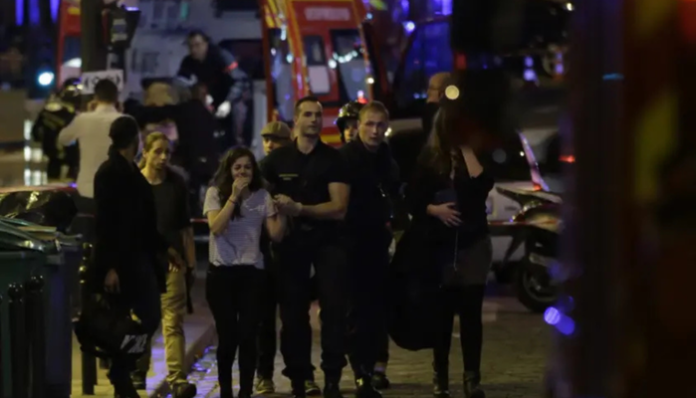
11 years ago, on this day (November 13, 2026), the ‘City of Lights,’ Paris, was enjoying a usual evening until it was suddenly jolted out of its serenity by a ghastly Islamic terrorist attack. On November 13, 2015, France witnessed what is described as the deadliest attack within its territory since World War II.
Terrorists belonging to the Islamic State (IS) carried out six coordinated attacks at the national stadium, in a crowded concert hall, in restaurants and on streets in Paris and its northern suburb of Saint-Denis. In total, 130 people were killed, and more than 400 were injured, out of whom 100 were critically injured. Two of the victims were reported to have later died by suicide.
How the events unfolded
The coordinated terrorist attacks began with a blast at 9:16 p.m. outside the Stade de France, where a football match between France and Germany was happening. The then French President François Hollande was among the 80,000 spectators watching the match in the stadium. A suicide bomber tried to enter the stadium but was blocked by security, and his explosive was also detonated.
Stade de France
This was followed by a suicide bombing minutes later. A suicide bomber blew himself up at the entrance of the Stade de France stadium in Saint-Denis, and an explosion happened near a restaurant. Four people, including three suicide bombers, died in a total of three explosions.
Restaurants and cafés
While law enforcement was still responding to the suicide bombings, a series of shootings were carried out by terrorists at various cafés, restaurants and other crowded spots. Around 9:25 pm, shootings happened at Le Carillon and Le Petit Cambodge located in the 10th arrondissement of Paris. Fifteen people died in the attack on the bar and restaurant, with 15 severely injured. More than 100 bullets were fired.
Another shooting happened around 9:32 pm in front of the Café Bonne Biere and La Casa Nostra pizzeria in rue de la Fontaine au Roi. Five people were killed, and eight were severely injured in the shooting. Minutes later, another gunfire incident happened at La Belle Equipe bar in the rue de Charonne in the 11th district. Nineteen people died in the shooting, with a further nine in a critical condition.
Bataclan central hall
At around 9:40 pm, a suicide bombing happened at the restaurant Le Comptoir Voltaire on the Boulevard Voltaire. This was followed by the deadliest terrorist attack at the Bataclan music venue, where 1500 were attending an Eagles of Death Metal concert. A group of terrorists opened fire on the people attending the concert, resulting in the highest number of casualties and some people being held hostage by terrorists. The terrorists moved through the auditorium, opening fire at everyone who came in their way.
Within minutes of the attack, security forces arrived at the concert hall. A standoff ensued between the terrorists and the security forces. A police officer fired a shot at one of the terrorists, leading to the detonation of his suicide belt. Two other terrorists also blew themselves up. The operation of security forces went on for around 30 minutes and ended in the killing of three terrorists. 90 people died inside the Bataclan concert hall.
French and Belgian nationals among the terrorists
A day later, officials confirmed that a total of 8 terrorists were killed, 7 of whom had blown themselves up. A total of ten jihadist gunmen and suicide bombers carried out the attacks in three teams. The shooting at the Bataclan theatre was carried out by three terrorists identified as Omar Ismaïl Mostefai, Samy Amimour and Foued Mohamed-Aggad. Two of them, Mostefai and Mohamed-Aggad, were French citizens. The suicide bomber who detonated near the cafés on Boulevard Voltaire was identified as Ibrahim Abdeslam. Two unidentified terrorists and one identified as Bilal Hadfi carried out the suicide bombings at the stadium.
Another terrorist named Salah Abdeslam, who had dropped the terrorists who carried out the suicide bombings near the stadium, fled to Belgium. His brother was among the terrorists who opened fire at the restaurants. Abdeslam was later arrested by the French authorities and was tried. An alarming fact that emerged relating to the terrorists was that most of them did not come from an Islamic country; they were either born or had been living in Europe. Two of the terrorists were reportedly from Iraq and the others were from France and Belgium. They had received terrorist training in Syria and came back to Europe.
On November 14, 2015, IS claimed responsibility for the Jihadist attacks, calling the attacks a response to French airstrikes in Syria and Iraq. The entire plot of the terrorist attack was directed from IS territory in Syria and carried out by a network that had moved through Europe with support from logistics cells in Belgium.
French response to the terrorist attack
Within hours of the attack, the French President called the attacks “an act of war” and declared a state of emergency, which was later extended to three months. He deployed soldiers and police across major cities, intensified border checks, and expanded surveillance and counter-terrorism powers. French security forces carried out raids across Paris and France to nab any remaining terrorists. Between November 15 and 16, French fighter jets launched strikes at IS sites in Raqqa, Syria.
On November 18, 2015, French authorities raided an apartment building in the northern Paris suburb of Saint-Denis. The apartment was suspected to be a hideout of the mastermind of the terrorist attack, Abdelhamid Abaaoud. During the raid, a confrontation happened between the police and the occupants of the apartment. A suicide device also detonated during the standoff.
Three people were killed in the confrontation, including Abdelhamid Abaaoud. A female relative of Abaaoud, Hasna Ait Boulahcen, was also killed in the raid. According to investigators, Abdelhamid Abaaoud was a Belgian ISIS operative who had travelled to Syria. Later investigations revealed that the terrorists used encrypted apps, including Telegram and WhatsApp, to plan the attacks.
Next year, in March, Salah Abdeslam, along with four others, was captured by Belgian authorities in an anti-terror raid. The following month, another terrorist, Mohamed Abrini, was arrested in Belgium along with two other people in Brussels.
The captured terrorists and their accomplices were tried in a trial that went on for ten months, from September 2021 to June 2022. A total of 20 accused, including Salah Abdeslam, the only surviving member of the ISIS cell that carried out the attacks, were put on trial. On June 29, 2022, the special Paris criminal court convicted all 20 accused. Abdeslam was sentenced to life in prison without parole, the most severe penalty available under French law. Other defendants received sentences ranging from time served to life, and a number were convicted in absentia.
The 2015 Islamic terrorist attacks in Paris left a deep impact not just on France but also on Europe and the wider Western world. The scale of damage, including 130 casualties, reminded the West that Islamic terrorism was not some distant potential threat but a real danger staring in the face. While the human toll of the attack could not be reversed, France and other European countries strengthened their security laws and expanded counter-terrorism cooperation to prevent such attacks.


