There is a particular category of international journalists who appear to approach India’s political landscape with a predetermined conclusion: Narendra Modi’s government represents a threat to democracy, the Opposition represents the resistance, and every instance of political discontent is evidence of an impending political upheaval. Lydia Polgreen, an opinion columnist at The New York Times, has increasingly come across as one of the most prominent representatives of this school of journalism.
Rahul Gandhi is heading to the US again to speak at Columbia University. But guess who will share the stage with him? Lydia Polgreen, woke NYT journalist who visited India in October and declared that the Modi government was heading for ‘ouster’. https://t.co/RTqT6vYHhg
— OpIndia.com (@OpIndia_com) November 17, 2026
Her writings on India are not merely critical of the Modi government. They repeatedly employ the vocabulary of authoritarianism, majoritarianism and democratic decline, often presenting the Congress party and its political positions in a favourable light. What makes this particularly consequential is the institutional credibility that comes with writing for The New York Times, a publication whose international standing allows its editorial positions to be consumed as authoritative accounts of political developments across the world.
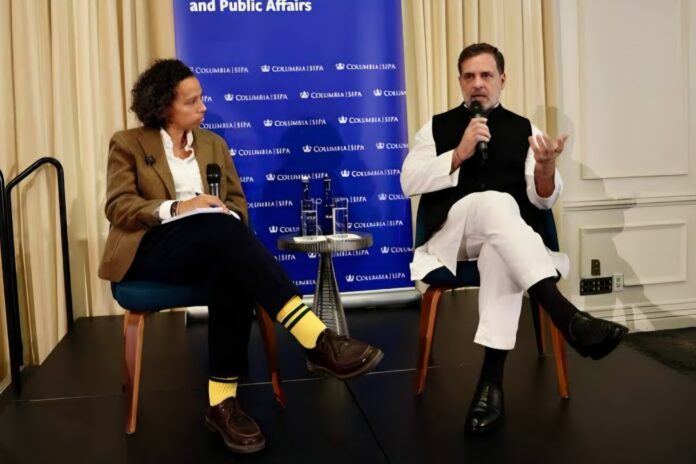
Polgreen’s latest engagement with Congress leader and Leader of Opposition Rahul Gandhi at Columbia University, New York, on Tuesday, November 17, 2026, has brought this question of journalistic neutrality into sharper focus.
The event was presented as an academic conversation about India’s youth-led protests, the role of the Opposition and the future of Indian democracy. But the choice of moderator is noteworthy, particularly when examined against Polgreen’s own record of writing about India’s political establishment.
From NYT correspondent to an opinion columnist with a familiar political worldview
Polgreen is no newcomer to India or its politics. She moved to New Delhi in 2009 as a foreign correspondent for The New York Times and subsequently held several senior positions within the publication. Her career also includes serving as editor-in-chief of HuffPost and managing director of Gimlet, Spotify’s podcast studio. HuffPost’s contempt for India, especially against the Modi government is widely known and document, including by OpIndia.
She is currently an opinion columnist at The New York Times, writing on subjects including democracy, human rights, migration and international affairs.
A reading of her opinion pieces on India, particularly those published in February 2023 and October 2026, reveals a remarkably consistent political framing. The Modi government is presented through the prism of authoritarianism, while political developments that could benefit its opponents are frequently interpreted as signs of an impending democratic correction. Could it be a favour the author is returning to the Opposition which was in power when she first landed in New Delhi in 2009 as a foreign correspondent?
Nevertheless, her projection of the Modi government as authoritarian and anti-democracy is striking. This is not simply a matter of disagreeing with a government. It is about the larger narrative constructed around a democratically elected administration and the political actors seeking to replace it.
Predicting Modi’s political vulnerability after a brief India visit
Polgreen’s October 26, 2026, New York Times column, titled I Went to India and Found It Has Lessons for Us All, is a particularly revealing illustration of her approach.
After spending time in Delhi, she presented student protests and public discontent as evidence that Narendra Modi was facing an unprecedented political challenge. Her opening paragraph described the Prime Minister as a ‘barrel-chested strongman’ who had finally met his match in a 20-year-old university student, Mohini Majumdar. It is another thing that a large section of population is still wondering who Mohini Majumdar is. But not for the NYT scribe bent on showing the democratically elected government as draconian and against the interests of its population.
The language was revealing. Rather than begin with an assessment of the scale, geographical spread or political composition of the protests, Polgreen constructed a dramatic confrontation between an allegedly omnipotent political leader and a young student.
She subsequently described Modi’s government as facing an open revolt from educated, middle-class Hindu youngsters, supposedly representing a section of society that had traditionally supported the BJP.
The article repeatedly returned to familiar allegations concerning unemployment, inflation, examination paper leaks, electoral rolls and the government’s handling of dissent. These are legitimate subjects for journalistic investigation and public scrutiny. However, Polgreen’s treatment of them went considerably further than documenting grievances.
She portrayed them as signs of a deeper political transformation, writing that Modi’s aura of omnipotence and serene competence had been shattered. This framing helps the Opposition because when elections take place and the BJP returns with a thumping majority, Congress and other regional parties could lean on propaganda pieces like Lydia authored to further groundless claims of ‘vote chori’ engineered by systematic undermining of democratic institutions.
She also argued that the protests had transformed Rahul Gandhi, allowing him to shed his image as the pampered and ineffectual heir to a political dynasty.
This is an extraordinary political assessment to emerge from a journalist who had spent a week in Delhi observing a particular protest movement. The article effectively elevated a set of local demonstrations and individual accounts into a larger verdict on the political future of a country of more than 1.4 billion people.
Interestingly, even Polgreen acknowledged that there would be no sudden fall for Modi and that the Prime Minister would not face the national electorate again until 2029.
Yet the broader impression created by the article was unmistakable: Modi’s political dominance was supposedly crumbling, a new generation was rising against him, and Rahul Gandhi was emerging as the beneficiary of this transformation.
The distinction between reporting political developments and projecting a desired political outcome becomes increasingly important here.
India’s political future is ultimately determined by its electorate, not by the impressions formed by foreign correspondents during a week-long visit.
February 2023: The BBC documentary becomes another weapon against Modi
Polgreen’s October 2026 column was hardly an isolated instance of this editorial approach.
In February 2023, she authored another opinion piece for The New York Times examining the controversy surrounding the BBC documentary India: The Modi Question.
The documentary revisited the 2002 Gujarat riots and Narendra Modi’s role as the state’s Chief Minister at the time. The subject has been extensively investigated, debated and litigated in India, with the Supreme Court upholding the findings of the investigation that found no prosecutable evidence against Modi.
Polgreen nevertheless used the documentary controversy to construct a broader argument about the alleged deterioration of India’s democracy under the BJP government.
Her article described the government’s response to the documentary as evidence of a systematic crackdown on free speech and dissent. It also suggested that Modi’s electoral victories and popularity among Indians were accompanied by an increasingly authoritarian political environment.
She went beyond discussing the documentary and its claims, presenting the larger political project of Hindu nationalism as a threat to India’s constitutional foundations.
Her conclusion was particularly revealing. Polgreen argued that India’s rise was taking place alongside the fading of Jawaharlal Nehru’s vision of a secular and democratic nation, suggesting that the country was becoming less free and less tolerant.
The problem with such an argument is not that a journalist should refrain from examining the conduct of a government. It is that complex political developments are repeatedly fitted into a predetermined ideological framework.
The Supreme Court’s findings, the electoral mandate secured by the BJP, the political aspirations of millions of Indian voters and the competing interpretations of India’s constitutional identity all deserve serious examination. They cannot simply be reduced to a narrative in which the government represents authoritarianism and its political opponents represent democratic salvation.
Polgreen’s February 2023 and October 2026 columns demonstrate how consistently she has returned to this framework.
The Rahul Gandhi connection: When the critic of Modi becomes the moderator of his political challenger
It is against this background that Polgreen’s appearance alongside Rahul Gandhi at Columbia University becomes significant.
On Tuesday, November 17, Gandhi participated in a conversation with Polgreen at Columbia University’s School of International and Public Affairs. The event was followed by an open question-and-answer session with students and faculty.
The discussion was centred on India’s youth-led movement, the country’s political situation, the role of the Opposition and the future of Indian democracy.
During the interaction, Gandhi made a series of sweeping allegations against the Modi government. Needless to say, like always, Mr Gandhi didn’t furnish evidence to back his allegations. In fact, when he is questioned, “Are you from the BJP?” comes the jab as recently seen when he raised aspersions against an India Today journalist. But for the foreign audience, such incidents wouldn’t augur well for the Congress party and Rahul Gandhi. So, the Gandhi scion tends to sound a bit intellectual and sedate in his conversation.
Responding to Polgreen’s question about India’s youth, the Congress leader declared that India was sitting on an ‘economic disaster’. He alleged that the country was facing massive unemployment and serious problems with its education system.
Gandhi claimed that young Indians were increasingly frustrated because they did not see a future for themselves. He also attacked the government’s economic policies, questioned the country’s manufacturing performance and repeated his allegations of ‘vote chori’ against the Election Commission.
He claimed that 140 million people who would have voted in the 2024 elections had been removed from electoral rolls, and alleged that there was substantial evidence of electoral fraud. These allegations were presented without an independent examination of the evidence during the conversation.
The Congress leader also raised the possibility of the government resorting to violence if political pressure increased.
These were not minor criticisms of individual government policies. Gandhi used an international university platform to present India as a country facing an economic disaster, an electoral credibility crisis and a deteriorating democratic environment.
The BJP subsequently hit back at Gandhi. Its national spokesperson Pradeep Bhandari described him as a leader of anti-India propaganda and accused him of insulting India abroad.
But there is another aspect of this interaction that deserves attention: the person moderating the conversation.
Polgreen is not an observer without a publicly established editorial position on the very government Gandhi was criticising. Her own columns have repeatedly described Modi’s rule through the language of authoritarianism and democratic decline. She has also written favourably about the political significance of protests that could strengthen the Congress leader’s position.
That does not establish that the Columbia conversation was coordinated with the Congress party, nor does it prove that Polgreen endorsed every assertion made by Gandhi. But it does raise a legitimate question about the editorial distance expected of someone moderating a conversation involving a major political figure whose political interests align with the arguments she has repeatedly advanced in her own commentary.
An independent journalist is perfectly entitled to hold strong political opinions. An opinion columnist is entitled to criticise governments, question institutions and challenge elected leaders. However, readers should also be able to distinguish between independent reporting, political commentary and advocacy.
The distinction becomes particularly important when a journalist’s commentary is subsequently invoked as an authoritative assessment of the political situation she has herself helped frame.
The global Left’s preferred narrative about India
Polgreen’s writings also fit into a broader pattern in sections of the international liberal and Left-leaning media establishment.
For years, a section of Western commentary on India has interpreted the BJP’s electoral success, Hindu political mobilisation and the assertion of India’s civilisational identity primarily through the vocabulary of majoritarianism and authoritarianism.
This framing often leaves little room for examining why millions of Indians continue to vote for the BJP, why Modi retains a substantial political constituency, or why voters may view his government’s policies and political agenda differently from the way they are portrayed in international opinion columns.
It is equally revealing that political figures from the Congress ecosystem are frequently presented as representatives of democratic resistance, even when their own political claims warrant rigorous scrutiny.
Polgreen’s coverage offers a particularly clear example of this asymmetry. The grievances of protesters are treated as evidence of a national political transformation, while the electoral preferences of those who continue to support the incumbent government receive considerably less attention in the narrative she constructs.
India’s democracy is certainly not beyond criticism. Unemployment, inflation, examination integrity, electoral transparency and civil liberties are important issues that deserve scrutiny. But scrutiny must be accompanied by context, proportionality and an appreciation of the country’s democratic processes.
A journalist cannot claim the mantle of neutrality merely by invoking the credibility of an internationally recognised publication.
Ultimately, the question is not whether Lydia Polgreen is entitled to oppose Narendra Modi or criticise his government. She is. The question is whether her readers are being presented with an independent assessment of India or an ideological interpretation that consistently advances one side of its political contest.
When the same journalist repeatedly portrays the elected government as authoritarian, interprets protests as signs of its impending political decline, highlights the political rehabilitation of Rahul Gandhi and then moderates an international university conversation with that very Opposition leader, questions about editorial neutrality are hardly unreasonable.
For a country whose political future is decided by more than a billion citizens, the last thing it needs is for the opinions of influential foreign columnists to be mistaken for the verdict of its people.