

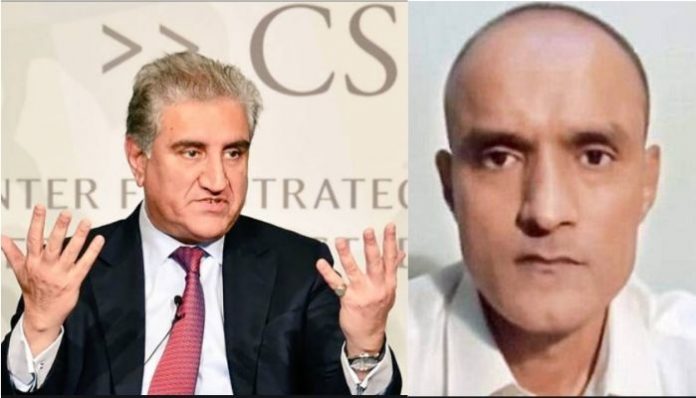
On Sunday (June 13), Pakistan Foreign Minister Shah Mehmood Qureshi sparked controversy by claiming that India wanted Pakistan to not provide consular access to Indian citizen Kulbhushan Jadhav. He alleged that India wanted to leverage the lack of consular access to Jadhav in the International Court of Justice (ICJ).
While speaking to the media, Qureshi claimed, “We have taken steps to implement the directive of the International Court of Justice. India wants Pakistan to deny consular access to Kulbhushan Jadhav so that it could have grounds to go to the ICJ. The opposition should not show ignorance by making statements in this regard. It should avoid strengthening the Indian point of view.”
Qureshi had also blamed the previous Nawaz Sharif government for ‘mishandling’ of the Kulbhushan Jadhav case. His contentious comments came at the backdrop of the ICJ (Review and Re-consideration) Bill, 2020 passed by the Pakistani Parliament recently. The law would provide new consular access to the Indian citizen in accordance with the order of the ICJ. After the Bill was approved, the Opposition parties raised slogans of ‘Hang Kulbhushan’, ‘Modi’s friend is a traitor’ in the National Assembly.
In May, the top law officer of Pakistan claimed before the Islamabad High Court that India had rejected the proposal for consular access, citing ‘sovereignty’ issues. The officer alleged that India had said that its sovereignty would be violated if Jadhav stood on trial in a Pakistani court. Qureshi said, “Opposition members will not exhibit a lack of understanding [on the issue] and will be cognisant of Indian’s wicked ways.”
ICJ directed Pakistan to provide consular access to Kulbhushan Jadhav
The International Court of Justice (ICJ), headquartered in Hague in the Netherlands, had in July 2019 directed Pakistan to stay Jadhav’s execution and allow him consular access. Based on ICJ’s verdict in a 15-1 decision on July 17, Pakistan had on July 30 sent its first proposal to India but with 2 riders attached. One that Pakistani security personnel would be present during the meeting and second there would be CCTV cameras present in the room.
After the ICJ verdict stayed the execution and allowed India consular access, India had declared that it would push for shifting Jadhav’s case to a civilian court, to ensure he got proper legal representation. After the consular access was finally granted in September 2019, India has stated that Jadhav was under extreme pressure by Pakistan to parrot a false narrative.


