

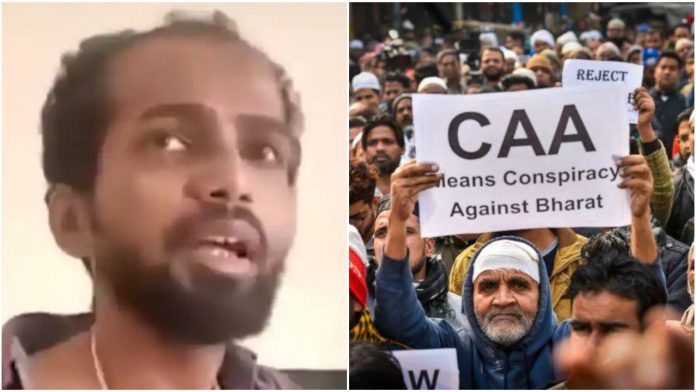
Ahmad Murtaza Abbasi, accused in the attack on security personnel outside Gorakhpur’s Gorakhnath temple, has said that his attack was a response to the passing of the Citizenship Amendment Act (CAA) and the proposed National Register of Citizens (NRC).
According to reports, the accused Ahmad Murtuza Abbasi confessed to the police that his hatred spawned from alleged atrocities committed against Muslims. The attacker said he was not happy with the Citizenship Amendment Act (CAA) and the proposed National Register of Citizens (NRC) as he deemed them as an act of “injustice to Muslims”.
“I thought about the act from various angles before committing the crime. They [government] were implementing CAA and NRC against Muslims. Even in Karnataka, Muslims were being wronged. No one was doing anything about the issue. Someone had to do something. This is how I justified the act in my mind,” he said.
Abbasi confessed that he decided to attack Gorakhnath temple as there was a constant police presence at the premises, and it was easy for him to escape after attacking the cops.
“I was depressed and wasn’t being able to sleep,” Abbasi reportedly confessed to the police.
The police said that the confession indicated that Abbasi had been radicalised to the extent that he was even willing to die committing such crimes.
Abbasi, who is a graduate of the Indian Institute of Technology (IIT), had attempted to break in to the Gorakhnath temple premises on April 3 while shouting Allahu Akbar. The 30-year-old chemical engineering graduate attacked the security personnel with a sickle when they tried to stop him, injuring two Provincial Armed Constabulary (PAC) constables.
गोरखपुर गोरक्षनाथ मंदिर के सुरक्षाकर्मियों पे IIT मुम्बई केमिकल इंजीनियर अहमद मुर्तज़ा का हमला…
— अज्ञानी (@MhaAgyaani) April 3, 2022
इन्हें कुछ भी पढ़ा लिखा लो कुछ भी बना दो … इनके ख़ून में सनी है ये कट्टरता .. pic.twitter.com/L1WkFU5XCL
He was later captured by other security staff and arrested.
The attack had come a day before UP CM Yogi Adityanath was scheduled to visit the temple. Following the attacks, Abbasi’s family claimed he was mentally unstable, however, the claims were refuted by police and doctors who treated him after the attack.
Abbasi, Gorakhnath Temple attack accused, had connections to ISIS
During the interrogation, it was revealed that Abbasi had sent lakhs of rupees to bank accounts linked to ISIS. The investigating agencies are now looking into its financial dealings with Abbasi.
He has accounts in ICICI Bank, IDFC First Bank, and Platinum Federal Bank, among others. He had transferred money from a bank account in Nepal to Syria.
During the interrogation, it was revealed that Abbasi’s mentor was an American identified as Imam Anwar al-Halaki, who originally hails from Yemen. Abbasi was highly influenced by banned Islamic preacher Zakir Naik as well.
Some documents recovered from Abbasi revealed a link to Jamnagar. Gujarat ATS would be interrogating him as well in Lucknow.


