

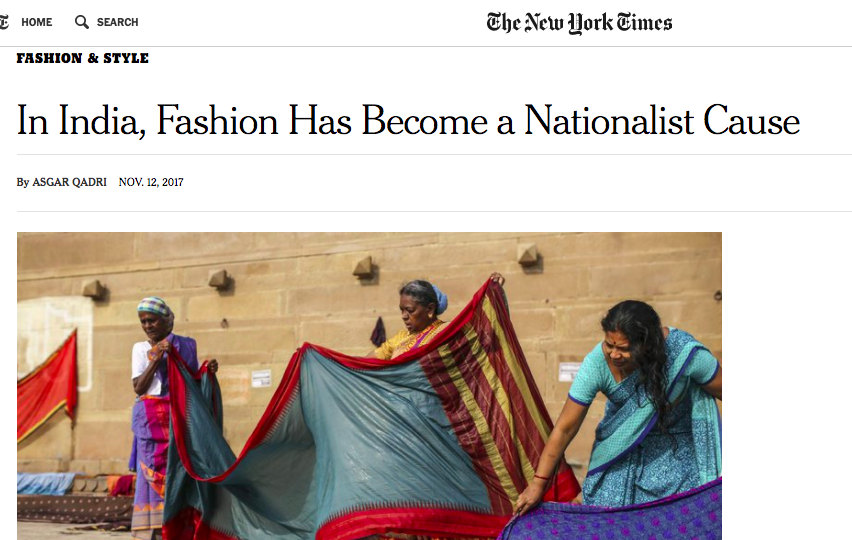
As if whitewashing of barbaric Mughals by foreigners in Indian publications wasn’t enough, we now have foreign publications like New York Times (NYT) publishing outrageous claims about post-2014 India. One Asgar Qadri, who writes frequently in NYT wrote an article which claims that the saree is a symbol of Hindu nationalism.
He writes that promoting saree is an effort to align ‘party’s broader political program: to project multi-faith India, a country of more than 1.3 billion, as a Hindu nation.’ Amongst other claims, the author links journalist Gauri Lankesh’s murder and says that those who disagree with Prime Minister Modi are “branded as “anti-national,” some shot and killed by Hindu nationalist activists.”
Sample this paragraph from the article full of propaganda and exaggerations:
“And with Narendra Modi, the party’s strongman of Hindu nationalism, as prime minister, fears that the country would head into a phase of aggressive nationalism have largely come true. Members of minority communities, accused of being disrespectful to cows, sacred to Hindus, have been lynched. Critics of Mr. Modi have been branded as “anti-national,” some shot and killed by Hindu nationalist activists.”
There are multiple things wrong with the article, especially the above paragraph; like how there is no conclusive evidence on who killed Gauri Lankesh, but for now, let us focus on the saree as symbol of Hindu nationalism. It is the same publication which publishes the regressive hijab gives women self confidence, but saree is a tool to increase ‘Hindu nationalism’.
Social media called out NYTimes asinine reporting which was completely devoid of facts.
This kind of idiotic story in the New York Times confirms the Modi government’s suspicion that foreign newspapers lie about it. pic.twitter.com/Xoj0oeL7Lc
— Tavleen Singh (@tavleen_singh) November 13, 2017
Wearing Saree is communal, so dear Indian ladies if you want to be secular wear jeans, skirts, minis etc as per @nytimes https://t.co/xWJTklrqfP
— Avinash (@avinashbhat01) November 13, 2017
What is this journalist @qadri_asgar been smoking? @nytimes do you even verify what your reporters write? pic.twitter.com/WwcH4mtyQq
— India First (@OurIndiaFirst19) November 13, 2017
@nytimes when opinion piece is @ hijab- personal identity to be worn w/ pridehttps://t.co/5VRTpuQ5qQ@nytimes when opinion piece is @ Sari – all possible negative connotationshttps://t.co/t0AzvrB2pS
— Yogini (@yoginisd) November 13, 2017
This asinine @nytimes article links the #saree with Hindu Nationalism!
Real issue is that Indians sticking to traditional attire get in the way of pushing Western attire. Pathetic drivelhttps://t.co/UefV1ntwJv— Smita Barooah (@smitabarooah) November 13, 2017
Earlier, when Raveena Tandon had posted a picture of herself wearing a saree with a sarcastic tweet on whether she will be labeled a ‘Bhakt’, the condescending term used for supporters of Narendra Modi, she was trolled for the same, showing how it is not the right wing, but the so-called liberals have communalised the Indian attire.
A sareee day … will I be termed communal,Sanghi,bhakt,hindutva icon?if I say I love wearing the saree and I think it’s the most elegant??? pic.twitter.com/3ZYDJcyKJk
— Raveena Tandon (@TandonRaveena) June 10, 2017
The rot is so deep that now an attire which has been worn by Indian women through centuries is suddenly communalised just became Modi and his government is revive the industry? This just seems like a hateful propaganda gone international wherein every symbol of Indic traditions, or anything that is viewed as remotely Hindu is being vilified. Perhaps their idea to malign a leader who doesn’t fir in the grand leftist world order is to malign a majority population, however ridiculous that might sound. What they fail to perhaps understand, is that Hindus and Hindu traditions have survived far worse than pompous media. It has and it will.


