Home Blog Page 1082

After Arvind Kejriwal’s aide Bibhav Kumar, AAP’s Chief Media Coordinator Vikas Kumar under the scanner: Times Now crew files complaint that he assaulted them

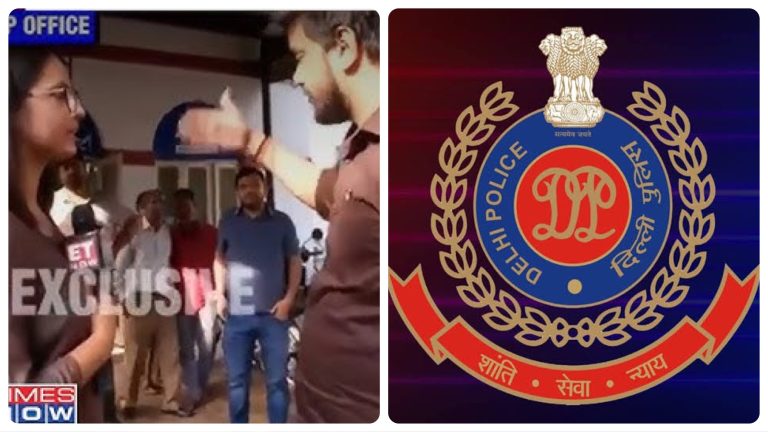
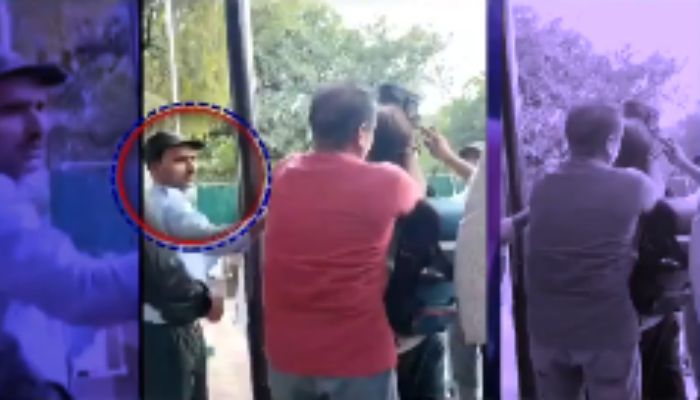
On Monday (20th May), the Times Now crew accused Vikas Kumar, the Chief Media Coordinator of the Aam Aadmi Party, of assaulting and abusing them and filed a Police complaint. Following the complaint, the Delhi Police visited the party’s office in the National capital to probe their allegations.

According to the complaint, Vikas Kumar pushed, slapped, and abused the female journalist of Times Now, journalist Aakanksha Khajuria, and also broke the camera screen after being confronted about recent findings by the Enforcement Directorate (ED). Incidentally, the attack was caught on camera. Notably, Times Now, in its “Operation Black Dollar”, reported that AAP received Rs 7.08 crore as foreign donations from 2014 to 2022, citing a dossier submitted by the ED.

The ED has sent the dossier to the Ministry of Home Affairs (MHA). According to the ED dossier, the Arvind Kejriwal-led party violated the Foreign Contribution Regulation Act (FCRA) and the Representational of People Act (RPA). Times Now accessed the document and is carrying out its reportage under the name ‘Operation Black Dollar’. 

According to the report, AAP received funds from countries like Canada, Saudi Arabia, and Australia. Many donors used the same credit cards while donating to AAP. According to the ED dossier, the foreign donation was directly deposited in the party’s account in the IDBI bank. Further details about the ED dossier can be read by clicking here.

The media house has highlighted that this is not the first time when its crew was attacked by the Aam Aadmi Party. Earlier, its staff was abused and attacked by the Arvind Kejriwal-led party after the media house exposed his grand CM house nicknamed ‘Sheeshmahal’. 

After the recent attack on Times Now’s journalist and cameraman, Navika Kumar, the Editor-In-Chief of Times Network Group issued a stern message to the Delhi CM Arvind Kejriwal asking him to control its media coordinator and goons.

Narrating the assault, Times Now’s video journalist Radha Krishna said, “While we were conversing with AAP workers, they abruptly snatched the cable and broke the camera. They then used the cable to strike me on the head.” 

Following the attack, the reporter dialed 100 on her phone and informed the Police about the incident. The Delhi Police asked them to undergo medical tests. 

Acting on the complaint, when the Delhi police personnel reached the AAP office, they were not allowed to enter.

AAP faces mounting criticism for acts of hooliganism

Several politicians, cutting across party lines, condemned the attack on the Times Now crew by AAP workers. National Conference leader Bashir Ahmad called the incident “unfortunate” and added, “Political parties should not stop reporters from asking pointed questions…this is their duty. I congratulate the Times Now reporter that despite being heckled, she continued with her reportage.” 

Responding to Times Now’s report about AAP’s foreign funding and manhandling of the channel crew, BJP leader Shazia Ilmi said, “It’s hardly a matter of surprise that AAP has been receiving foreign funds for so long illegally.”

Union Minister Hardeep Singh Puri also condemned the attack on the Times Now crew. He slammed the Aam Aadmi Party citing the examples of Swati Maliwal and Delhi Chief Secretary and pointed out that this has been happening constantly.

Minister Puri said, “First they beat up your (Times Now) reporter Bhavna, they (on Feb 19, 2018) called Delhi chief secretary at CM Kejriwal’s residence and at around 12:15 am, they beat up him.”.

Citing the Swati Maliwal assault case, the Minister added, “Troll army of this party targeted me when I spoke on these issues…they recently assaulted Swati Maliwal who is the MP of their own party. Sanjay Singh accepted that former PS of Kejriwal, Bibhav Kumar misbehaved with Maliwal and then retracted his statement.” 

“This is a murky game,” the Union Minister added. 
Rohingya Muslims continue persecution of Hindus and Buddhists in Myanmar: Over 5,000 houses torched amid escalating communal tensions

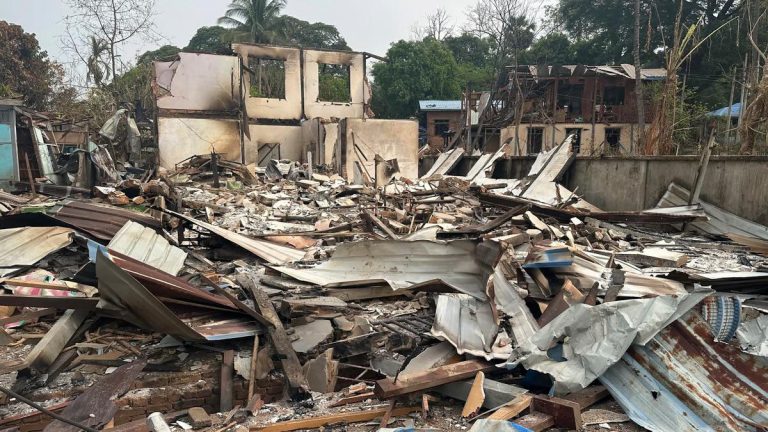
The situation in Myanmar remains dire, with intensified clashes between the military-led junta and ethnic rebel groups, particularly in Rakhine State. Tensions have escalated into communal violence, with reports indicating that nearly 5,000 houses belonging to Buddhists and Hindus were destroyed in Buthidaung, located just 25 km from the Bangladesh border.

“These 5,000 houses were targeted because they belonged to Buddhists and Hindus. Many residents had fled to safer areas, leaving houses empty, but those who remained were forcibly removed, and their homes were looted and burned before their eyes. Conscripts, including young boys from Rohingya camps in Bangladesh, were used for this operation,” a source revealed.

The destruction occurred between April 11th and 21st. Buthidaung is now under the control of the ethnic rebel group Arakan Army.

“In the 2018 census, Buthidaung had 3,000 houses. This number has since more than tripled to 10,000 as people fled other areas to settle here. Over 50 per cent of residents are Muslims, with the remainder being Buddhists and Hindus,” a source reported.

Communal tensions in Rakhine State, which flared more than a decade ago, led to a significant exodus of Rohingyas, many of whom sought refuge in neighbouring Bangladesh.

“Some Rohingyas from refugee camps are being forced into conscription. While some manage to flee, others are compelled to fight civilians. This divide-and-rule strategy will worsen the situation on the ground,” a source added.

Thousands of young people across Myanmar have fled to safer areas, with some crossing into other countries to avoid forced conscription.

Recently, Bangladesh’s Foreign Minister, Hasan Mahmud, expressed hope that the Rohingya refugees they are sheltering would return to Myanmar. It is estimated that there are one million Rohingyas in Bangladesh.

Additionally, 138 Myanmar military personnel, including a lieutenant colonel and two majors, have taken refuge in Bangladesh. “They will be sent back just like other military personnel were repatriated,” Mahmud stated last week, noting that the Rohingyas also want to return.

Meanwhile, those who have fled face survival challenges due to a lack of livelihood opportunities.

The monsoon season, which begins in a few weeks, offers the only respite. Mobility became restricted, and clashes on the ground reduced drastically for nearly two months.

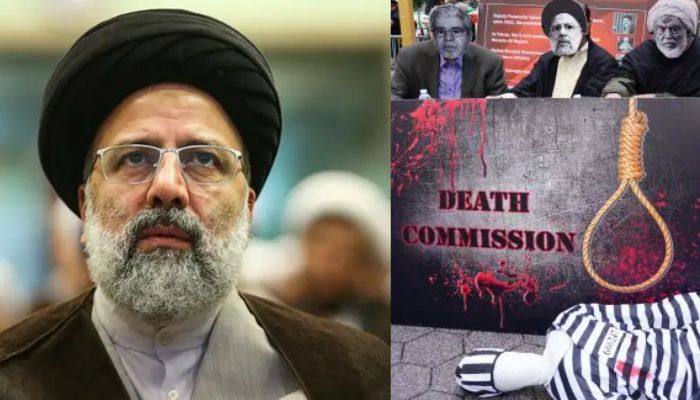
Why deceased Iranian President Ebrahim Raisi was known as ‘The Butcher of Tehran’: An insight into the brutal past of a dictator

The death of Iranian President Ebrahim Raisi on the 19th of May in a helicopter crash in northern Iran sparked an outpour of condolences on the one hand and celebrations on the other. The 63-year-old Islamist hardliner, also dubbed as the “Butcher of Tehran”, was seen as a potential successor to Iran’s supreme leader Ayatollah Ali Khamenei. However, his death has added to the ongoing tumult in the Middle East. Last month, Iran, under his presidency, had launched unprecedented drone and missile strikes against Israel in what Iran called “retaliatory” action after Israel allegedly attacked the Iranian embassy in Damascus, Syria.

Notably, Ebrahim Raisi took over Iran’s presidency in 2021 after winning the presidential election receiving around 62% votes when the voter turnout was 48.8%,  the lowest ever for a presidential election. Raisi had also contested the 2017 presidential elections, however, he lost to Hassan Rouhani.

Following the death of Mahsa Amini, 22, in 2022, a crackdown on historical large rallies and the imposition of a stringent dress code for women tarnished Raisi’s presidency. Thousands of schoolgirls protested in the streets raising what became iconic, “Zan, Zendegi, Azadi (Women, Life, Freedom)” slogans, demanding an end to Iran’s mandatory hijab laws. This came after Amini was arrested and assaulted by the country’s “morality police” for not wearing the hijab resulting in her death. In a brutal crackdown on the anti-Hijab protests, more than 500 people were reported to have been killed under Raisi’s presidency.

The saga of Ebrahim Raisi’s crimes against humanity, however, goes back decades before the Mahsa Amini protests. Raisi received criticism for his brutality long before he was elected President, garnering the notorious moniker “Butcher of Tehran”.

Butcher of Tehran and the “Death Commissions” of Iran

In 2019, the US Treasury Department announced sanctions on Iran while mentioning Ebrahim Raisi’s involvement in a “death commission” that mandated thousands of political detainees be executed without trial. “Previously, as deputy prosecutor general of Tehran, Raisi participated in a so-called “death commission” that ordered the extrajudicial executions of thousands of political prisoners in 1988,” the US Treasury Department said.

Following in his father Seyyed Haji Rais Al-Sadati’s footsteps, Ebrahim Raisi studied under Supreme Leader Ayatollah Ali Khamenei in the fields of theology and Islamic jurisprudence. He became a member of the clergy and took part in demonstrations against the Shah of Iran, which eventually resulted in the Shah’s overthrow.

The Islamic Revolution in 1979 marked the beginning of the Islamist hardliner Raisi’s career. At the age of 20, he was appointed prosecutor general for the provinces of Karaj and Hamadan. He is accused of having been a major player in the persecution of political opponents and minorities, particularly the Baha’is, who make up the largest religious minority in Iran. Numerous Baha’is were tormented and imprisoned, while many were executed on Raisi’s watch.

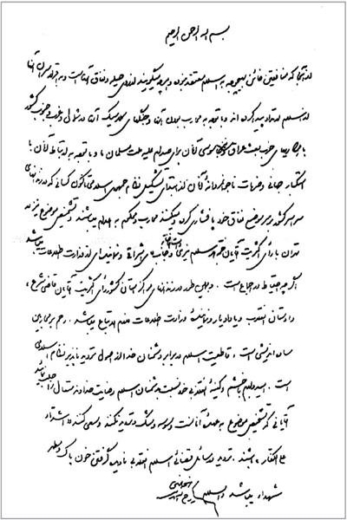
Iran consented to a ceasefire imposed by the UN in July 1988 to put an end to the eight-year conflict with Iraq. Soon after, Ayatollah Ruhollah Khomeini, who was then the supreme leader, issued a fatwa directing the execution of political prisoners who were already serving their sentences. They were brought before four-person inquisition panels—dubbed “Death Commission” by the prisoners—for questioning, and the sessions lasted just a few minutes. The targeted persons mostly included those associated with the People’s Mojahedin Organization of Iran (PMOI).

Khominei’s Fatwa (Source: Amnesty International)

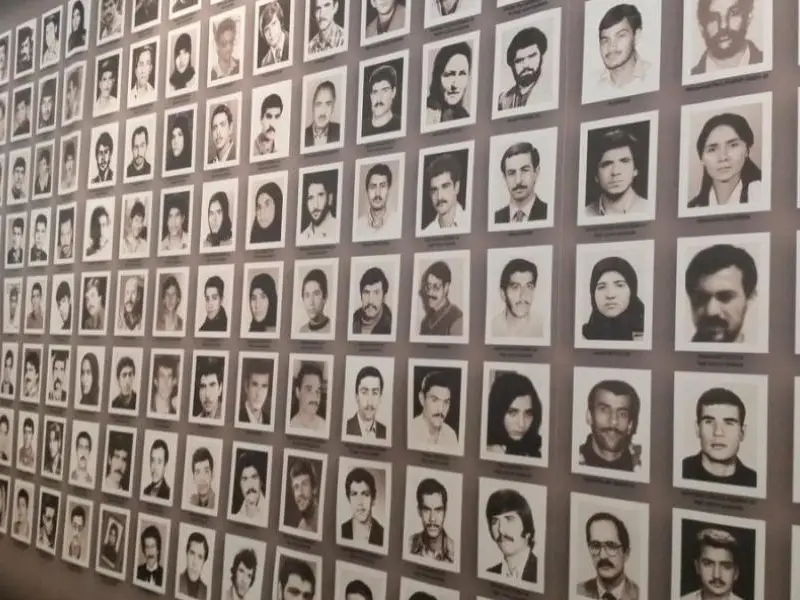
These inquisitions, which were set up across the Islamic Republic, were led by Islamic judges, prosecutors, and representatives of the intelligence services. Amnesty International reported that in a matter of minutes, the Death Commission rendered decisions regarding the fate of thousands of inmates through arbitrary trials. Reports say that over 5000 prisoners were executed at that time.

“In Tehran province, hundreds of men affiliated with leftist opposition groups were also executed. Their interrogations appeared more like a religious inquisition. They were asked: Are you a Muslim? Do you pray? Did your father pray and read the Qur’an? Those who identified as non-believers and said their fathers prayed were condemned to death for deserting Islam. Others were spared the death penalty but were ordered to be flogged until they agreed to pray,” the Amnesty report titled Blood Soaked Secrets reads.

Pictures of some prisoners summarily executed in Iran in 1988 (Image: Iran International)

The report says that women were also asked similar questions and the “incorrect” answers led to five lashes during each of the namaz performed in a day “until they agreed to pray regularly or die under torture.”

The hatred against “infidels” has been such that the Iranian security forces earlier this year barred the families of 1988 execution victims from visiting the graves of the political prisoners.

In June 2023, Hossein Mortazavi Zanjani, who was the head of Tehran’s notorious Evin prison in 1988, said that he was “ashamed” over the executions. “I’m ashamed, and…I want to express shame… They killed kids, they made families mournful,” he said.

Ebrahim Raisi and a continued legacy of human rights violations

In November 2019, amidst widespread protests over a sudden hike in fuel prices, Raisi oversaw a human rights crackdown while serving as the president of the Iranian judiciary. Raisi’s judiciary allowed security personnel and officials to kill hundreds of men, women, and children while torturing and secretly detaining thousands more. All of this occurred while he was in charge. Reports say that nearly 300 people were killed in the 2019 crackdown.

While the Iranian leader’s demise may have left a void in the country’s politics, with numerous mourning, a significant section of people also reported to have celebrated and lit fireworks after the death of the “Butcher of Tehran”.

‘Confused’ Gauhar Khan alleges deprivation of voting rights, vents anger at authorities, only to find her name on the voter list at old address

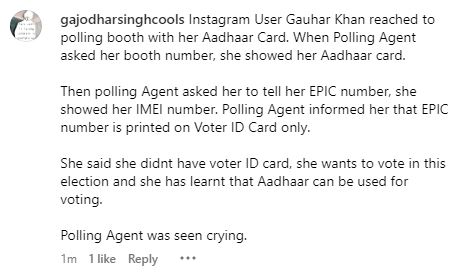
On Monday, 20th May, alleged actress Gauhar Khan gave netizens a field day when she went out to vote in Mumbai, which went for polling in the fifth phase. Claiming that the polling officials didn’t allow her to cast her vote using her Aadhaar card, Gauhar Khan vented anger against the authorities. She alleged that things are “very confusing” and “badly organised”.

Taking to Instagram, Gauhar Khan also asserted that she was being deprived of her voting rights, later she posted another story on Instagram to reveal that she cast her vote at some other polling booth.  

According to Gauhar Khan, the confusion happened because her name on the voter list was enrolled at her old address. However, her post is going viral, with netizens trolling and schooling her for her remarks about the Aadhaar card being proof of citizenship. Several others have slammed her for spreading falsehoods and playing the victim when she is not one. 

Notably, it all started when Gauhar Khan came out of a polling booth in the afternoon and started venting anger against the polling officials and accused them of inefficiency. Gauhar Khan stated that she was not allowed to cast a vote even though she had her Aadhaar card with her. She argued that while her name was not on the voter list of that polling booth, she should have been allowed to cast her vote there as she had her Aadhaar card with her, which according to her should have been enough to vote. 

Taking to her Instagram Stories, Gauhar Khan said, “I have an appeal. Why do we have Aadhaar cards if we are not considered citizens enough to vote? Your Aadhaar card is your identity that you are an Indian citizen and you should be able to vote with that.”

Insinuating malpractice and casting aspersions on the preparation of the voter list, Gauhar Khan further alleged that while her name and her family members’ names were not on the voter list at that polling booth, she saw the names of many people who no longer live in the apartment building.

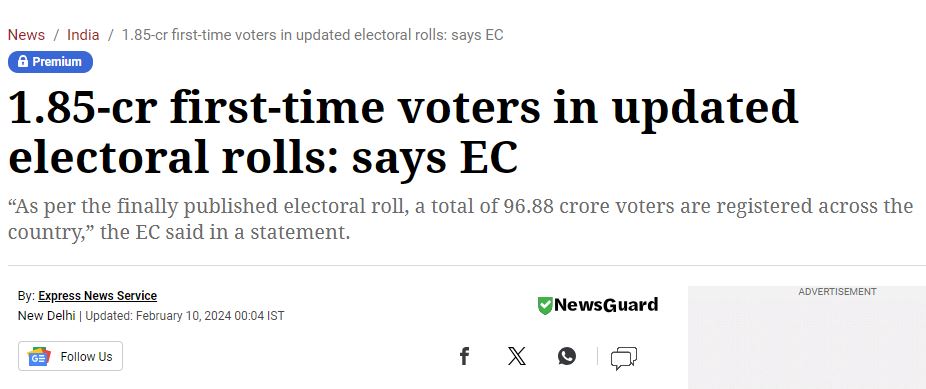
It is important to note that before the start of any election, the polling body carries out extensive exercises to update electoral rolls. This is done because several voters enroll their names at the nearest polling station to their new address, to correct their details, new voters become eligible for the first time, and the names of deceased voters need to be deleted. However, if the voters or local agents/representatives fail in their duty, anomalies such as the names of some deceased voters and voters’ names at their old addresses remain in the updated voter list.

(Electoral rolls are updated from time to time and Election Commission carry out extensive excercise for it. Additionally, voters on their own can use Election Commission Website to find their names in the electoral rolls, make correction, among other facilities provided by the polling body)

In her Instagram story, Gauhar Khan added, “People who have left the building are still on that list. I have seen it myself. And if I, my mom, my husband, everyone is registered on that building…. none of us are there. So how does one vote? We go with our Aadhaar card, Id proof and they say, ‘No you cannot vote.’” 

Gauhar Khan further stated that it makes ‘no sense’ that an Aadhaar card is not applicable in this situation.

Alleging that she and other people are being deprived of their voting right, Gauhar Khan added, “Here literally people are fighting and going berserk over there because they have their IDs but the survey doesn’t have their name on the list. They are saying if you are not on the list then you cannot vote. I think that is the most basic deprivation of your rights to vote!” 

However, Gauhar Khan later deleted her story and shared another one revealing that she was allowed to vote now. She said, “Yes! Finally, I have done it! Humne vote kar diya (We cast our vote)! I want to tell you no matter how difficult it is, it can be confusing. Lekin (But) please guys go and vote!”

She also appealed to voters to find their booths and vote. According to her, she had a very confusing and frustrating time as she and her family members’ name were missing from the address that she have lived for 9 years. Only 1 person from her family had received the voting slip. She then went looking from booth to booth in her area and finally found her name along with her mother’s name at her 15-year-old address. 

An Aadhaar Card is not proof of Citizenship

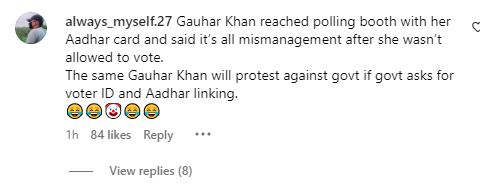
Several users took a dig at her argument that an Aadhaar card alone should be enough to cast a vote even on wrong/any polling booth, and sarcastically extended her argument to other fields. Several other users slammed her after she deleted her initial story arguing that an Aadhaar card is proof of citizenship and playing the victim when she was not one.  

Responding to her second Instagram story, one user commented, “Behen delete kyu kar di Insta story. Wese modi govt ne Adahar card ko Voter ID se link krne ke liye bhi kaha hua hai, u can do it by yourself from ECI website. Jo apko pyari Congress kabhi na karti coz farzi voters kum ho jate h us se jo ek baar voter id or dusri baar adhaar card dhundte h vote k liye na mile to Insta story dalo.” 

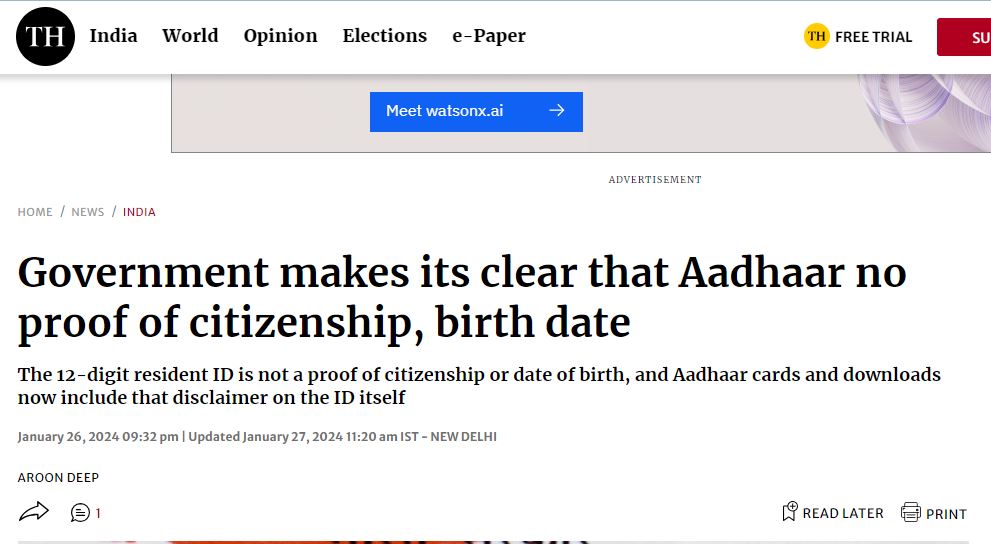
It is pertinent to note that the Government of India, time and again, has made it categorically clear that an Aadhaar Card is not proof of citizenship. Incidentally, this disclaimer is now included on the ID itself.

(Aadhaar card is not a proof of Indian Citizenship)
(The Election Commission has allowed voters to show their Aadhaar card or 10 other IDs in place of voter ID card, however, voters have to ensure that their name is in the voter list of that polling booth.)

However, the Election Commission of India has allowed voters to use any one photo identity proof along with their voting slip. It has allowed 11 alternative documents that one can carry along with their voting slip to cast their votes. These alternative IDs include – an Aadhaar card, PAN card, Driving license, and MGNREGA job card among others. However, voters have to ensure that their name is listed in the official voter list provided by the Election Commission.

Jaipur Police arrests serial rape accuser Bhavna Sharma who filed 14 rape cases since 2016: Details

On Saturday, 19th May, a woman identified as Bhavna Sharma has been arrested by Rajasthan police for filing a false rape case against an advocate. The woman accused of filing false rape case against the advocate has a history of filing fake rape cases in different cities to extort money. The arrest was made after an advocate filed a case against her in the district court accusing her of filing false rape charges against him to extort money.

A complaint against Bhavna Sharma was filed at Sadar Police Station on 8th May. Reportedly, Bhavna Sharma allegedly filed 14 false cases of rape and blackmail across different police stations over the past eight years between 2016 and 2024.

The Modus Operandi of Bhavna Sharma

According to the complaint, Bhavna Sharma befriended Nitin Meena and pressured him into marriage. When he refused, she allegedly threatened to file false rape charges and demanded money. Nitin Meena stated that Bhavna had already filed similar cases against several individuals. In one instance, Bhavna filed a rape case against Meena at the Jyoti Nagar police station.

After receiving the complaint, the police acted swiftly and arrested Bhavna Sharma. She was presented in court and sent to police custody. The investigation revealed that she has filed 14 cases over the years and many of them were found to be false. In some of the cases, the final report or FR has already been submitted dismissing them as baseless. In other cases, the investigation is underway.

Speaking to the media, Additional DCP Guru Sharam Rao of the Special Investigation Unit for Crimes Against Women confirmed that Bhavna Sharma was found guilty of extortion during the investigation. The police obtained substantial evidence including online transaction records that supported the allegations against her. She was booked under Sections 388 and 504 of the Indian Penal Code (IPC).

Cases filed by Bhavna Sharma since 2016

In September 2016, Bhavna Sharma filed her first case at Shyamnagar police station under Sections 323 and 341 of the IPC. In the same month, she filed another case against the same person under Sections 376 and 354 of the IPC. While the chargesheet in the first case was filed in the matter, the accused man was acquitted in the second matter.

Bhavna Sharma’s third case was filed in October 2018 at Jyoti Nagar police station under Sections 376, 307, 354 and 500 of the IPC. A chargesheet has been filed in the case.

The fourth case was filed by her in May 2019 at Kanota police station under sections 376D, 377, 354, 307, 342 and 323 of the IPC against four five men. FR has been filed in the matter.

The fifth case was filed by her in May 2020 at DLF PH3 police station in Gurugram under Sections 376(2)N and 420 of the IPC. While the accused was acquitted in the case, she was convicted of 344 CrPC in March 2022.

A sixth case was filed by Bhavna Sharma at Shipra Path police station in January 2021 under Sections 376(2)N and 420 IPC. FR has been submitted in the matter and was accepted by the court.

The seventh case by Sharma was filed in February 2021 at Pachore Rajghar police station under Sections 376, 376(2)N, 342 and 506 of the IPC. The case is under investigation.

The eighth case was filed by her in June 2022 at Chitrakoot police station under Sections 323, 341, 354, and 506 of IPC and Section 66 of the IT Act. FR has been accepted by the court in the matter.

The ninth case was filed by her in June 2022 at Nagar police station under Sections 376(2)N, 354D and 506 of the IPC. FR has been submitted in the matter.

The tenth case was filed by her in June 2022 at Suket police station in Kota under Sections 376, 354, 354D, 342, 323, 313, 450 and 120B of the IPC. The matter is under investigation.

The eleventh case was filed by her in June 2023 at er Sections 228A, 500, 501, 506, 509, 120B of IPC and Section 72 of the IT Act. FR has been submitted in the case.

The twelfth case was filed by her in June 2023 at Shyam Nagar police station under Sections 376, 354, 420, 341, 323 and 120B of the Indian Penal Code. The matter is under investigation.

The thirteenth case was filed by her in December 2023 at Mahesh Nagar police station under Sections 376, 377, 354, 323, 506 and 190 of the IPC and the matter is pending.

The most recent case was filed by her in April 2024 at Jyoti Nagar police station under Sections 376, 384, 195A and 120B of IPC. The matter is pending.

Apart from the recent case, two FIRs were filed against her, one in November 2018 by court order, and one in May 2023.

Background of Bhavna Sharma and Arrest

As per reports, Bhavna Sharma approached the victim under the pretense of needing legal assistance. She presented herself as an advocate. Initially, she borrowed Rs 7,000 from the victim suggesting there was some urgent need. Slowly, Bhavna Sharma started demanding more money and threatened to file false cases against the victim when he refused to give money. When the victim distanced himself, Sharma lodged a rape complaint against him at the Jyoti Nagar Police Station.

On 19th May, Sadar Police arrested her based on the complaint filed by the victim. DCP Amit Kumar confirmed that she was arrested and sent to police custody.

Previous Cases and Legal Proceedings against Bhavna Sharma

Bhavna Sharma has a history of filing multiple false rape, molestation and assault cases. Out of these, police have already filed charge sheets in three rape cases and one assault case. FRs have been submitted in nine other cases. In one of the cases, the investigation is still underway.

Notably, she changed her statement in a Gurugram court in one of the cases leading to a penalty imposed by the court against her for filing a false case. Bar Association has also demanded a thorough investigation against her.

The police are investigating Bhavna Sharma’s background to reveal more details about her extortion schemes. The pattern of filing false cases and extorting money has raised serious concerns and the facts in the cases filed by her are being determined.

From stones pelting not being dangerous to pepper spray being one: How some of the judiciary’s confounding decisions have left the public befuddled 

There have been several cases wherein the courts randomly decided whether an object used in attack or self-defence is deadly or not. The judiciary has in some cases gone overboard in its “every sinner has a future” syndrome.

In a recent ruling, the  Jammu and Kashmir & Ladakh High Court said that stones used in pelting cannot be considered “dangerous weapon” akin to those mentioned in Section 326 of Ranbir Penal Code (RPC) which pertains to causing grievous hurt with dangerous weapons.

The bench of Justice Sanjiv Kumar said in April this year that “The size of stones used for pelting cannot, by any stretch of reasoning, be termed as a ‘dangerous weapon’ or ‘an instrument’ used for shooting, stabbing or cutting etc., nor can it be termed as ‘any corrosive or ‘any explosive substance’ or a substance which it is deleterious to the human body to inhale, to swallow, or to receive into the blood etc.”

Justice Kumar made these remarks while hearing a criminal appeal against a 2009 judgment issued by Kathua Chief Judicial Magistrate. Appellant Jasbir Singh currently lodged in Kathua Jail, challenged his conviction and sentence under section 326 of the RPC. Singh was convicted after he pelted stones upon the complainant for having trespassed on the disputed land.

Although the court noted that Singh’s stone pelting resulted in the loss of eyesight of one eye of the complainant, the court observed that the stones used did not qualify as ‘dangerous weapons’ under Section 326 RPC. Consequently, the court set aside Singh’s conviction under RPC section 326 and convicted him under RPC section 325.

Pepper spray is ‘deadly weapon’, can’t be used for self-defence: Karnataka High Court

In April this year, the Karnataka High Court refused to dismiss a criminal case against the director of a private company and his wife, who was accused of using pepper spray on a man in self-defence. The court labelled Pepper spray a dangerous weapon, which has also mandated an investigation. A single judge bench of Justice M Nagaprasanna issued the ruling on the 22nd of April in response to a plea to quash criminal charges against the wife and director of C Krishnaiah Chetty and Company Private Limited.

It happened in a case wherein the director was ordered to stop making changes that would have limited access to the contested property’s walls and partitions. The director and his wife were accused of getting into a fight with the people who obtained the injunction and using pepper spray on them when they tried to block the property’s gate with a wall. The defence’s counsel said that the defendants used pepper spray in self-defence meanwhile, the other party contended that the use of pepper spray comes under the definition of deadline weapon in the Indian Penal Code.

In this case, the court observed that the director’s wife should not have used pepper spray in self-defence as there was no threat to life and ordered an investigation into the matter. “(She) could not have used pepper spray as private defence, as prima facie there was no imminent threat or danger caused to her life. Therefore, the case at hand would require investigation in the least”.

The question here arises how did the court decide that there was no threat or danger caused to her life when she used the pepper spray without any investigation?

“Used stone not axe”: Supreme Court reduces one of the convict’s sentences in a political murder case

In February this year, the Supreme Court ruled that there was not enough evidence to conclude that a man and the other three co-accused had the same intention to commit murder. Thus, the man was found not guilty of murder. Since he used a stone instead of an axe, unlike the other three culprits, the court found him guilty of a culpable homicide that did not qualify as murder, changing his conviction from Section 302 to Section 304 Part II of the IPC.

Wife kills husband with a wooden stick, Supreme Court reduces her jail term saying “stick is not a deadly weapon”

In August last year, the Supreme Court reduced the jail term of a woman convicted of beating her husband to death using a wooden stick. The court modified Nirmala’s conviction to that of non-intentional homicide saying that a stick lying in the house cannot be considered a deadly weapon, overlooking the fact that it was used by the convicted woman to thrash the deceased victim resulting in his death.

Additionally, Justices BR Gavai and JB Pardiwala of the Supreme Court bench observed that the woman might have been “provoked” into attacking her husband as the incident transpired amid a fight between them over the victim’s refusal to give Rs 500 to send their daughter to National Cadet Corps (NCC) camp.

Karnataka High Court says attacking a man’s testicles during a fight is not an “attempt to murder”

In June 2023, the Karnataka High Court modified the conviction of a person named Parmeshwarappa in a 2010 case saying that “squeezing a man’s testicles during a quarrel cannot be deemed an attempt to murder.” The Court said that since the convict did not bring any deadly weapon with intent to kill victim Omkarappa, although the convict attacked the victim’s testicles which may have resulted in death, and he had to undergo surgery to get a testicle removed, it is a grievous hurt.

The court went on to state that the injury can be brought under IPC section 325 for causing grievous injury.

“Though he had chosen the testicles, which is a vital part of the body and may cause death, and the injured was taken to the hospital, underwent surgery, and had a testicle removed, it is a grievous hurt. “In my view, this is the case which falls under the category of grievous hurt caused by the accused during the quarrel without using any deadly weapons. Therefore, I am of the view, that the sentence passed by the trial court finding guilty for the offence punishable under Section 307 of IPC is not correct and the offence committed by the accused falls under Section 325 of IPC,” the Karnataka High Court said.

What has emerged common in the above-discussed cases is that the honourable courts decided whether a certain object used to attack a person resulting either in death or serious injury is a “deadly weapon” or not. In some cases, the court modified the conviction citing the convict’s intent. It, however, raises a question of how the courts despite saying that attacking a man’s testicle may cause death do not consider the act as an “attempt to murder” but only grievous hurt, how does a woman beating her husband to death with a stick over refusing to give money is given a relaxation saying that she may have attacked her husband in a fit of anger but did not “intend” to kill him? Sticks, stones, and bricks are not deadly enough but pepper spray allegedly used in defence is a deadly weapon?

Interestingly, section 326 of the Indian Penal Code says that Whoever, except in the case provided for by section 335, voluntarily causes grievous hurt through any instrument for shooting, stabbing or cutting, or any instrument which, used as a weapon of offence, is likely to cause death, or using fire or any heated substance, or using any poison or any corrosive substance, or using any explosive substance, or employing any substance which it is deleterious to the human body to inhale, to swallow, or to receive into the blood, or using any animal, shall be punished with imprisonment for life, or with imprisonment of either description for a term which may extend to ten years, and shall also be liable to fine.”

While the courts in such cases as mentioned above said that sticks and stones are not categorized in IPC section 326, the very expression “any instrument which is used as a weapon” gives the law a broader scope. When the law has specifically stated punishment for voluntarily causing hurt with any instrument used as a weapon of offence, it remains unclear why the judges do not find sticks, stones used for pelting and other though seemingly ordinary but used as a weapon of offence “deadly” enough.

AAP received Rs 7.08 crore foreign funds from 2014-2022, violated FCRA and RPA norms: ED to Home Ministry

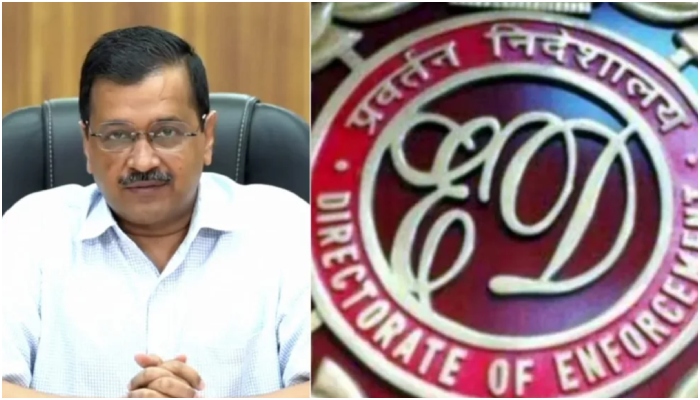
The Enforcement Directorate (ED) informed the Union Home Ministry on Monday (20th May) that the Aam Aadmi Party (AAP) received Rs 7.08 crore of foreign money between 2014 and 2022, reportedly violating the Foreign Contribution Regulation Act (FCRA), the Representation of People Act (RPA), and the Indian Penal Code (IPC).

The party led by Arvind Kejriwal disagreed with the ED’s assertions, claiming that they were part of a political effort to undermine the party.

In its report, the ED informed the Union Home Ministry that the AAP received funding from several countries, including the United States, Canada, Australia, New Zealand, Saudi Arabia, the United Arab Emirates, Kuwait, and Oman. The paperwork arrived ahead of the Lok Sabha elections in Delhi on May 25.

In its inquiry, the ED alleged multiple instances of anomalies in the collecting of foreign funds by the AAP and its leaders, accusing some of them, including AAP MLA Durgesh Pathak, of siphoning off funds raised during a fund-raising event in Canada in 2016 for personal gain.

The probe agency supported the allegations with the contents of e-mails swapped between various AAP volunteers and functionaries, including Aniket Saxena (Coordinator of AAP Overseas India), Kumar Vishwas (then Convenor of AAP Overseas India), Kapil Bhardwaj (then AAP member), and Durgesh Pathak.

“The investigations so far revealed that the amounts collected through fund-raising campaigns in the US and Canada and the identities of actual donors were concealed in the books of accounts maintained by the AAP to circumvent the restrictions imposed under FCRA on donations by foreign citizens to a political party,” it alleged.

According to the investigation agency, many individuals made donations to AAP using the same passport numbers, email addresses, cellphone numbers, and credit cards.

The ED shared all information gathered during the investigation under the Prevention of Money Laundering Act, 2002, with the Union Home Ministry, including donor information such as names, country of origin, passport number, amount donated, mode of donation and bank account number of receiver, billing name, billing address, billing telephone numbers, billing e-mail, time and date of donation, and payment gateway.

The investigation agency also obtained donation-related information from Canadian nationals’ e-mail addresses and mobile phone numbers.

According to the ED, 155 people residing abroad donated Rs 1.02 crore on  404 instances using 55 passport numbers. On 256 instances, 71 donors used 21 cell numbers to make donations totalling Rs 99.90 lakh, while 75 donors from abroad used 15 credit cards to make donations totalling Rs 19.92 lakh on 148 occasions.

Donations worth Rs 51.15 lakh were received through the email IDs and telephone numbers of 19 Canadian nationals, according to the ED. However, the names and nationalities of these Canadian people were suppressed and incorrectly recorded in the documents, the agency revealed. 

“Instead, different names have been mentioned against these donations and this was intentionally done by AAP to hide donations by foreign nationals, which violates Section 3 of FCRA, 2010 and Section 298 of Representation of People Act 1951,” it stated.

“The amount was raised by concealing, misdeclaring, and manipulating the identities and nationalities of foreign donors as well as several other facts relating to foreign donations,” it added.

Another inquiry discovered that AAP established an organization named AAP Overseas India, along with volunteers from countries such as the United States, Canada, and Australia, whose major function was to raise foreign funding for AAP. It was also discovered that in 2016, volunteers were given a target of Rs 50 crore in overseas donations.

During a fund-raising event organized by AAP in Canada in 2016, Aniket Saxena (Coordinator of AAP Overseas India) and Kumar Vishwas (then Convenor of AAP Overseas India) exchanged emails.

According to the ED, the communication revealed that Durgesh Pathak and Kapil Bhardwaj, then AAP members, had urged Aniket to make a donation of 29,000 Canadian dollars gathered during a fundraising campaign straight to Durgesh Pathak and Kapil Bhardwaj via one Bhagwant Toor.

During an AAP-organized event in Toronto on November 22, 2015, which Durgesh Pathak attended, 15,000 Canadian dollars were raised, and handwritten raw data sheets containing donor information and amounts donated were e-mailed to AAP Overseas India by Canadian party volunteers.

The ED claimed that following an inquiry, it was discovered that the names of these genuine donors, as listed on handwritten data sheets, were not reflected in the official records provided by AAP.

Another event organized by AAP in Toronto on January 30, 2016, raised a total of 11,786 Canadian dollars, with 3,821 Canadian dollars utilized to cover event expenditures, according to the inquiry agency.

“An amount of 7,955 Canadian dollars was sent to AAP in their IDBI bank account using the passports of 11 AAP Canada volunteers (Indian citizens) even though the said donation was claimed to be made by more than 200 people who had attended that event,” the Enforcement Director asserted.

Party leader and Delhi Minister Atishi meanwhile claimed that Prime Minister Narendra Modi was afraid of Delhi Chief Minister Arvind Kejriwal.

“This is not ED’s activity, but the BJP’s. This is a long-standing case, and we have provided comments to the ED, Central Bureau of Investigation (CBI), Union Home Ministry, and Election Commission,” she stated.

“This is simply another plan by Modiji to smear the AAP. The BJP resorts to such tactics before every election. Many such false allegations will be made in the next four days,” she said.

AAP’s streak of misbehaving with women remains unbroken: Delhi Police reaches AAP office after Times Now journalists dial 100 over mistreatment by party workers

Days after the Aam Aadmi Party got embroiled in the Swati Maliwal assault case after the Rajya Sabha member alleged that she was assaulted by the close aide of Arvind Kejriwal at his residence, another case of AAP workers manhandling journalists has come to the fore. 

Delhi Police on Monday (May 20) reportedly visited the AAP office situated in the national capital after Times Now journalist Aakanksha Khajuria and video journalist Radha Krishna dialled 100 to register a complaint against the party. The report said Khajuria and Krishna were allegedly misbehaved by AAP workers while reporting the Enforcement Directorate’s submissions to the Home Ministry.

According to Times Now reporters, the victims were misbehaved with by the AAP workers when they had sought Durgesh Pathak’s reaction to the Enforcement Directorate dossier that said AAP had violated the Foreign Contribution Regulation Act (FCRA) and the Representational of People Act (RPA) by receiving foreign donations of Rs 7.08 crores from 2014 to 2022. 

The current incident, unfortunately, comes hot on the heels of the Swati Maliwal assault case wherein Delhi CM Arvind Kejriwal’s close aide Bibhav Kumar had been accused of assaulting the Rajya Sabha MP while she was at the CM’s residence to seek an audience with him. 

Swati Maliwal accuses Arvind Kejriwal’s close aide of assaulting her

Earlier last week, on 13th May, the Delhi Commission for Women (DCW) chief Swati Maliwal accused the Personal secretary of Arvind Kejriwal of assaulting her. In her complaint, Maliwal has alleged that Kejriwal’s personal Secretary Bibhav Kumar “slapped” her “at least seven to eight times” while she “continued screaming” and “brutally dragged” her while “kicking” her in her “chest, stomach and pelvis area.” According to the Delhi Police FIR, Maliwal described the events of May 13 when she had gone to the Civil Lines residence of Chief Minister Kejriwal.

“I went inside the camp office and called CM’s PS Bibhav Kumar but I could not go in. I then sent a message to his mobile number (through WhatsApp). However, there was no response. I then went inside the residential area through the main door as I have always done in the past year since Bibhav Kumar was not present I entered the residence area and informed the staff present there to tell the CM here to meet him,” the FIR read. “I was informed that he was present in the house and I was told to wait in the drawing room. I went into the drawing room and sat on the sofa and waited for him to meet me,” Swati Maliwal said.

“He then abused me and asked who are you to not listen to what I say. While saying these words, he came and stood right in front of me. Without any provocation whatsoever on my side, he started slapping me with full force. He slapped me seven to eight times at least while I continued screaming. I felt shocked and was screaming for help over and over again. To protect myself I pushed him away with my legs,” she said.

Bhopal: Faizal alias Badhshah takes Hindu girl to Kerala’s Kozhikode, forces to convert, Islamic documents recovered from victim

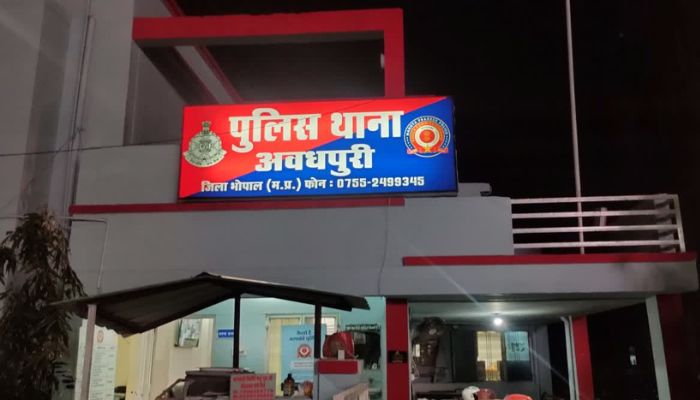
A case of alleged grooming and attempt to convert has recently came to light from Madhya Pradesh’s capital Bhopal. The family members of a girl who is said to be from the Yadav community have accused Faizal alias Badshah of abducting their daughter on the pretext of marriage and forcing her to recite Kalma and convert. After the investigation, Police rescued the victim on 18th May and arrested the accused. They are investigating the case from the angle of human trafficking as well. The victim has been sent to an NGO for counseling.  

In their FIR at Avadhpuri police station in Bhopal, the family members said, “A young man from the Muslim community took our daughter away on the pretext of marriage and then forced her to recite Kalma.” Police have registered a case under the Freedom of Religion Act. While EtvBharat’s report claims that the accused was arrested, according to media reports updated after the Etv report, the police stated that they would soon arrest the accused.  

Nonetheless, the details about the case came to light after the family of the victim filed a missing complaint at the Police station. 

According to reports, the accused is a resident of Anna Nagar, and he has been identified as Faizal alias Badshah. The 20-year-old victim hails from the Yadav community and is a resident of Awadhpuri. Faizal is accused of taking the victim to Kerala on 11th May on the pretext of marriage. He then started pressuring the victim to change her religion. However, the victim called her relatives and narrated her ordeal to them. Afterward, her family members lodged a complaint at the Awadhpuri police station. After the accused learned about the complaint, he reportedly booked a flight for the victim and sent her back to Bhopal. After arriving in the city on Saturday morning (18th May), she went to the police station to give her statements. 

According to reports, Police suspect that this could be a case of love jihad or human trafficking. Faizal alias Badshah is also accused of forcing the victim to do religious conversion. 

Speaking with Free Press, Awadhpuri police station TI Roshanlaal Bharti said that the woman used to reside in Anna Nagar, where she struck a friendship with a man named Badshah, who belonged to a different religion. The woman later shifted to Awadhpuri but stayed in touch with Badshah. In her complaint, the woman stated that Badhshah promised to marry her and said that he would reside with her in Kerala after marriage. 

TI Bharti added that an NGO working for the welfare of women has also taken cognisance of the issue.

Police recovered documents related to Islam and how to recite Kalma from the girl: Report

According to reports, the police have also recovered some documents from the victim girl that pertain to the Islamic faith and Kalma. According to the information received, police discovered a book titled “How to Become a Muslim” in the victim’s bag. Additionally, some papers were also found detailing how to recite Kalma. 

Following the recovery, the Police suspect that the girl was being pressured to do religious conversion. Additionally, the officials are also investigating this matter from the angle of human trafficking. 

According to Hindu organisations, Kerala’s Kozhikode is becoming a hotspot from where Hindu girls are being sent to Dubai and other places. In the wake of this, they have demanded the arrest of the accused in this case as soon as possible.

‘I respect Hinduism and support BJP, so I was assaulted’: Kutch resident Alimamad tells OpIndia why he was assaulted by miscreants of the Muslim community

On 10th May a shocking incident came to light from the Mandvi area of ​​Kutch, Gujarat where a Muslim youth, Alimamad Ilyas Shiroo living in Merau village was brutally assaulted for reportedly inducting his acquaintances into the Bharatiya Janata Party (BJP). In this incident, the Mandvi police registered a case under sections 365, 341, 323, 506 (2), and 120(b) of the IPC against the accused Akbarsha Abdulsha Syed, Hakimsha Kadarsha Syed, Jainulsha Kasamsha Syed and Aliasgar Ibrahimsha Syed.

The accused abducted Alimamad Ilyas and after tying him up they brutally beat the victim to such an extent that he suffered internal injuries.  

OpIndia reached out to the victim, and during the conversation, Alimamad explained in detail what transpired before and after he was assaulted by the miscreants. 

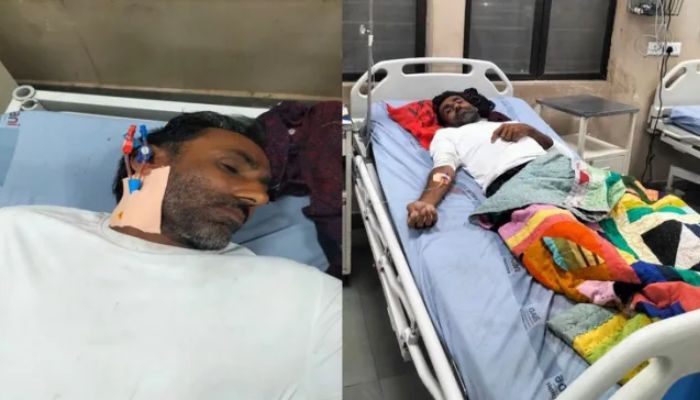
Alimamad Ilyas is currently in Bhuj and undergoing treatment at a government hospital there. According to him, due to excessive beating, his kidneys have been severely affected. The condition is serious, and the hospital doctors have also said that the treatment will take a long time. Talking about his health, he says that even after many days of treatment, there has only been a twenty percent improvement because he was severely beaten. He added, ‘I am in a lot of pain right now’.

‘I am a Muslim, but I believe in all religions, so they threatened me’

Narrating the entire incident, Alimamad told OpIndia, “I live in Merau (Kutch) and earn my livelihood by working as a labourer. I have one daughter. This whole incident started before the elections. I am a Muslim, but I have feelings for all religions. I especially have faith in Hinduism. I also go to listen to any katha or other religious programs in our village or the surrounding areas. It was this nature of mine that shocked those people (accused). I am a Muslim, but the people who assaulted me always told me that I had converted (religious conversion). Those people also threatened us many times, but I did not pay attention to it. Then Hakimsha Ibrahimsha Syed threatened to kill me and my daughter, so I filed a complaint at that time.”

The whole incident unfolded because I support the BJP

Alimamad Ilyas added, “I also support the Bharatiya Janata Party. Our country is a democracy, and anyone can believe in any religion and support any party, and that is my right. I have a friend in the neighbouring village of Shirwa, and after being influenced by my ideas, he also supported the BJP, which came as a shock to the accused: Akbarsha Abdulsha Syed, Hakimsha Kadarsha Syed, Jainulsha Kasamsha Syed, and Aliasgar Ibrahimsha Syed.”

He further said, “Amidst all this, there was a meeting of our local BJP MLA and he welcomed my friend in front of everyone. Those people (the accused party) support Congress, so we were on their watch. My friend told me that the accused were harassing him and I asked him to take the help of the police. But in the meantime, the accused abused my friend and had a fight with him.”

Picked me up from the road and brutally assaulted me: Alimamad

He further says, “When I was coming to Merau, Akbarsha Abdulsha Syed, Hakimsha Kadarsha Syed, Jainulsha Kasamsha Syed, and Aliasgar Ibrahimsha Syed came in a red car and hit my bike and knocked me down. Before I could even realize anything, they picked me up and threw me into the car. They then took me to the office that Kadarshah had illegally built on government land allocated for cattle rearing in Shirwa. There, they tied my hands and feet and gagged me. Then they brutally assaulted me for almost two-and-a-half to three hours.”

I am afraid that these people will kill me: Alimamad 

Speaking with OpIndia, he said, “After beating me, those people threatened me that if I filed a police complaint, they would kill me as soon as they got out of jail. I have been beaten to such an extent that I cannot even urinate properly after the attack. I have been beaten so severely on my buttocks, back, and legs that my entire skin has turned black. After brutally assaulting me, they threw me back to the place from where they picked me up. I was unconscious and I felt like I would not be alive. As soon as I regained consciousness, I called 108 and reached Mandvi Government Hospital for treatment. After the Police arrived, I filed a complaint against the accused.”

He further says, “Due to excessive beating, I was initially transferred to a private hospital and later to a general hospital in Bhuj. My kidney has been seriously affected. I don’t know how many more days I will be admitted here.” Meanwhile, he also told OpIndia that he was under threat and that the accused would kill him as soon as he came out of the hospital.

Grateful to Hindu Society and Organisations for help

Alimamad told OpIndia, “The accused are so headstrong that the people of my community are not even helping me out of fear of them. All the accused are involved in illegal business. Because of them, not a single Muslim came to help me. Whatever treatment I am currently undergoing and whatever help I am receiving is from Hindu organisations, including Vishwa Hindu Parishad and their workers. I am thankful to the Hindu society and organisations for this. My demand to the administration is that strict action should be taken against the accused who mercilessly assaulted me, and it should be fast-tracked.” 

It is pertinent to note that during the interaction, Alimamad also told OpIndia that he had once gone to a meeting of Kajal Hindustani and the accused were also aware of that.

An FIR has been registered in the entire matter, but till the report was published, the accused are yet to be arrested. OpIndia also tried to contact the Mandvi police to get more information, but no contact could be established. The report will be updated when a response is received or contact is made.