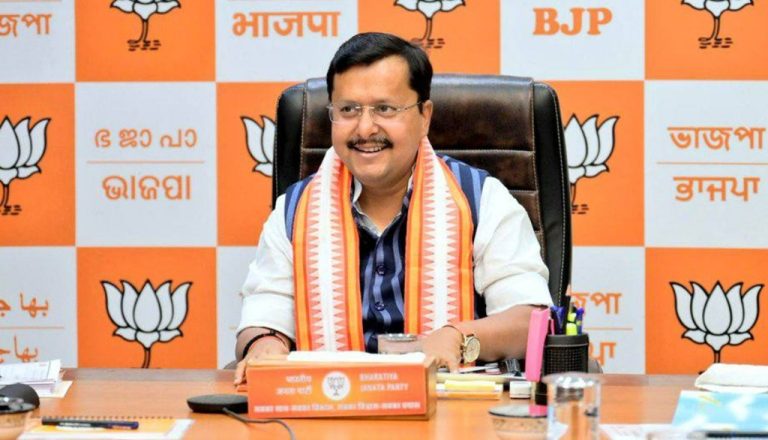
The Bharatiya Janata Party’s decision to appoint 45-year-old Nitin Nabin as its national working president on December 14, 2025, is far more than a routine organisational reshuffle. It is a landmark moment that encapsulates a delicate yet profound renewal in the BJP’s evolving relationship with its ideological mentor, the Rashtriya Swayamsevak Sangh (RSS). At a time when Indian politics is marked by coalition compulsions, generational churn, and ideological contestation, Nabin’s elevation signals a strategic pause and reset rooted in continuity rather than confrontation.
There is symbolism in abundance. Born in 1980, the same year the BJP itself was founded, Nitin Nabin represents a political generation that has grown alongside the party’s ideological maturation. At an age when many leaders are still negotiating state-level relevance, Nabin arrives at the national stage with a rare blend of youth, administrative credibility, organisational depth, and ideological grounding. Crucially, he does so without having been “Delhi-fied” a distinction that the RSS has historically valued, and one that has often placed it at odds with the BJP’s central leadership.
Nabin’s political journey began under tragic circumstances. Following the untimely death of his father, a respected BJP leader who twice won from Patna West during the politically hostile era of Lalu Prasad Yadav’s dominance, Nabin entered electoral politics in 2006 through a by-election. Critics initially dismissed his victory as a sympathy-driven mandate. Yet nearly two decades later, as a five-term MLA from Bankipur and Bihar’s Road Construction Minister, Nabin has decisively outgrown that label. His sustained connection with constituents, emphasis on accessibility, and focus on delivery over rhetoric have earned him cross-party respect.
In Nitish Kumar’s often-fluid alliance governments, Nabin stood out as a dependable and non-controversial performer. His stewardship of Bihar’s road infrastructure aimed at shrinking travel time between Patna and remote districts to mere hours, mirrored Prime Minister Narendra Modi’s national infrastructure vision. Roads, after all, are not merely concrete; they are instruments of economic integration, social mobility, and state capacity. That even persistent critics such as Prashant Kishor refrained from targeting Nabin on corruption underscores his clean image in a political environment not known for generosity.
Equally significant is Nabin’s organisational résumé. As head of the BJP’s youth wing in Bihar, and later as election in-charge in states like Chhattisgarh and Sikkim, he demonstrated an ability to mobilise cadres, manage internal dynamics, and convert ideological clarity into electoral outcomes. These experiences have shaped him into a rare hybrid: an administrator who understands organisation, and an organiser who respects governance.
It is here that historical parallels emerge most notably with the 2009 elevation of Nitin Gadkari as BJP president. That move, driven by the RSS after consecutive electoral setbacks, was an explicit attempt to break the dominance of Delhi-centric leadership and inject the organisation with ideologically grounded, non-metropolitan energy. Gadkari, then an outsider to Lutyens’ Delhi, brought innovation: digital mobilisation, diaspora outreach, and structured think-tank engagement. Many of these are now staples of the BJP’s formidable electoral machinery.
Yet Gadkari’s tenure was abruptly truncated amid allegations related to his private business ventures, controversies the RSS believed were amplified to sabotage its organisational reboot experiment. The subsequent reversion to familiar Delhi faces reinforced the perception that genuine decentralisation and generational renewal faced internal resistance.
The post-2024 Lok Sabha scenario offered a similar moment of introspection. While the BJP retained power, it fell short of its more ambitious targets and entered a phase of coalition dependence. Ground-level feedback from cadres and Sangh functionaries alike pointed to the need for grooming younger leaders steeped in ideological ethos, capable of sustaining the movement beyond immediate electoral cycles. Nitin Nabin fits this blueprint almost perfectly.
What distinguishes his appointment, however, is the absence of overt friction. Unlike 2009, this does not appear as an RSS imposition but as a consensual evolution within the Modi-Shah framework. For a leadership known for centralised control, accommodating Nabin reflects pragmatic adaptation. He is not an ideological novice being parachuted in, nor an organisational rebel. He has delivered within the existing strategic architecture, while also embodying the renewal many seek.
The RSS, for its part, has long maintained the formal separation between itself and the BJP mentor versus political instrument. Yet it has always excelled at long-term planning, preferring subtle cultivation over public confrontation. By backing a leader unexposed to what many in Nagpur view as Delhi’s “foul political air,” the Sangh advances its vision quietly: “I will not impose, but develop through you.”
Shared long-term perspectives make this truce sustainable. Prime Minister Modi’s intense engagement with Bihar, evident in repeated visits and development commitments, aligns with RSS chief Mohan Bhagwat’s personal familiarity with the state, where he served as prant pracharak. Bhagwat likely observed Nabin’s early ideological grooming, lending the appointment an additional layer of trust and continuity.
Geography, too, matters. As the first BJP working president from eastern India, Nabin’s rise signals a deliberate eastward thrust. With Bihar as the anchor, the party aims to consolidate gains and push deeper into challenging regions such as West Bengal, Odisha, and the Northeast. The objective is clear: replicate the ideological and organisational hegemony achieved in western India by blending development narratives with cultural self-assertion. Nabin’s Kayastha background adds a layer of social nuance without overshadowing the broader Hindutva agenda.
Ultimately, Nitin Nabin’s ascent represents a mature phase in the BJP-RSS relationship, one that balances ideological steadfastness with electoral pragmatism. In an era defined by coalition arithmetic, ambitious visions like Viksit Bharat, and an increasingly competitive political landscape, this appointment strengthens the party’s organisational spine. By entrusting a young yet seasoned leader with the task of organisational surgery, cutting inefficiencies while reinforcing core strengths, the BJP signals its intent to think not just in terms of the next election, but the next few decades.
In that sense, this is not merely a promotion. It is a statement: resilience lies not in abandoning roots for realism, but in reconciling the two with confidence and clarity.
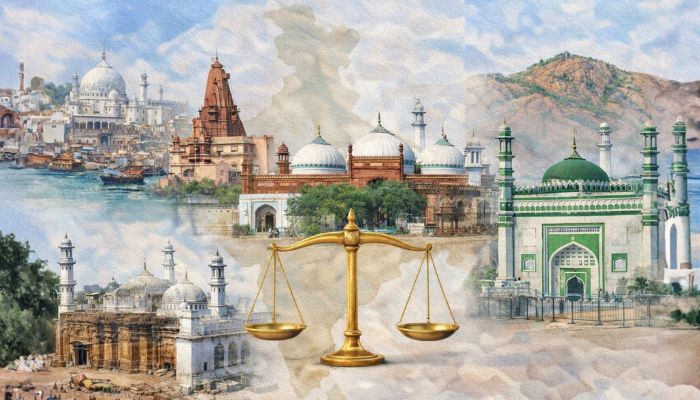
In 2025, religious conflicts once again took the front stage in India’s judicial system. From temple-mosque conflicts to questions of the administration and state intervention, courts across the country were repeatedly called upon to adjudicate matters where faith, law, history, and public order intersected. However, the year saw very few definitive results despite ongoing judicial involvement. Instead, most high-profile disputes were steered into a holding pattern through interim stays, status quo orders, court-appointed committees, and procedural pauses. Rather than delivering conclusive rulings, courts prioritised stability, restraint, and prevention of unrest, effectively postponing resolution.
The year 2025 emerged as one defined not by judicial closure but by judicial caution, as evidenced by the Gyanvapi complex in Varanasi, the Krishna Janmabhoomi dispute in Mathura, Madurai’s Karthigai Deepam row, and the Bhojshala controversy in Madhya Pradesh. These cases reveal a consistent pattern of the management of religious disputes through interim control rather than constitutional finality.
This article examines how and why these cases remained unresolved, where each dispute stood at the end of 2025, and what this prolonged judicial limbo signals for the future of religious litigation in India.
A year of interim orders, not judgments
In 2025, the commonality among religious disputes was the consistent reliance on interim mechanisms rather than final adjudication. Rather than settling questions of title, worship rights, or historical claims, courts repeatedly chose to pause proceedings through temporary legal tools.
Courts have granted temporary stays to halt surveys, inspections, or construction-related actions across cases. Status quo orders became the preferred instrument, freezing ground realities and preventing either side from gaining an advantage. In some cases, like the Banke Bihari Temple dispute, courts appointed committees to manage day-to-day affairs, effectively deferring substantive decisions. Elsewhere, administrative pauses were imposed to prevent escalation while appeals were heard.
One of the key factors of this type of judicial approach was the fear of violence and breakdown of public order. Many of these disputes carry the potential to trigger communal tensions, making the courts wary of making rulings that might exacerbate a situation beyond the bounds of the law. Moreover, these disputes were highly politically sensitive. Any final decision on disputes between temples and mosques, or between religious administrations, risks political mobilisation, public demonstrations, and charges of judicial overreach.
Courts seemed aware that they were operating in a politically sensitive atmosphere. At last, judges were walking a constitutional tightrope. Questions involving the Places of Worship (Special Provisions) Act, 1991, religious freedom, secularism, and historical claims present complex constitutional dilemmas. Courts choose to exercise caution rather than create irrevocable precedents or open legal floodgates.
Where each case stood at the end of 2025
Despite consistent judicial attention throughout the year, no significant religious disputes have reached substantive closure in 2025. But each case remained suspended at different procedural stages largely due to interim judicial interventions.
Gyanvapi–Kashi Vishwanath Dispute (Varanasi)
By the end of 2025, its proceedings in the Gyanvapi dispute remained firmly paused. The Supreme Court continued its interim stay on substantive actions arising from orders of the Varanasi court and the Allahabad High Court. Earlier, the Varanasi district court ordered an ASI survey and found the devotees’ 2023 lawsuit maintainable. Then, in January 2024, the court ordered that appropriate arrangements be made to allow worship in the basement of the Gyanvapi complex. The maintainability of the original 1991 suit had earlier been upheld in 2022.
The case originated in a 1991 suit filed on behalf of the deity Adi Vishweshwar, claiming that the mosque was constructed on the site of the Kashi Vishwanath temple.
In 2021, five Hindu women filed a separate suit before a Varanasi civil court seeking permission to worship idols located inside the mosque complex.
Krishna Janmabhoomi–Shahi Idgah Dispute (Mathura)
Multiple civil suits were filed seeking the removal of the Shahi Idgah mosque. It claims to stand on the birthplace of Lord Krishna. In May 2023, the Allahabad High Court transferred all the pending suits to itself and later rejected objections to their maintainability in August 2024. In January 2025, the Supreme Court stayed the high court’s order allowing inspection of the Shahi Idgah complex by a court-appointed commissioner. The mosque committee filed an appeal challenging the High Court’s remaining proceedings. As of now, the stay on inspection continues, and no further fact-finding or trial proceedings have been permitted to advance. The dispute centres on competing claims over land adjoining the Krishna Janmabhoomi temple complex and raises questions under the Places of Worship (Special Provisions) Act, 1991.
Shahi Jama Masjid-Harihar temple, Sambhal
The dispute arose after a civil court in Sambhal allowed a survey of the Shahi Jama Masjid premises in November 2024 on Hindu claims that the mosque stood on the site of the Harihar temple dedicated to Kalki. The mosque’s committee of management reached the Supreme Court to challenge the Survey order. In January 2025, the Supreme Court stayed the execution of a municipal notice concerning a well near the mosque and sought a status report. In August 2025, the Court ordered maintenance of the status quo and issued notice to the Hindu petitioners. The status quo order was subsequently extended, effectively halting any survey or alteration of the site. As of now, the dispute remains frozen pending consideration of procedural and jurisdictional issues.
This dispute centers on whether Hindu devotees can light traditional Karthigai Deepam atop Thiruparankundram Hill, which houses both the Murugan temple and a dargah. Hindu devotees argue that lighting the lamp on the hilltop is an essential and longstanding religious practice, and that the State and the HR&CE Department have repeatedly blocked it, citing law and order concerns. In December 2025, the Madras High Court allowed a plea seeking permission to light the Karthigai Deepam lamp at the ancient Deepathoon pillar on Thiruparankundram Hill, rather than its usual location near the Uchi Pillayar temple.
Justice G R Swaminathan allowed and directed the Subramaniya Swamy Temple management to arrange for the Karthigai Deepam lamp to be lit at the ancient Deepathoon pillar on the festive day on December 3. The Tamil Nadu government opposed the order, citing tradition and public order concerns. On the day of the festival, a protest broke out, which led to the violence and deployment of central security forces. The High Court subsequently initiated contempt proceedings against state officials for alleged failure to implement its directions. The Tamil Nadu government approached the Supreme Court challenging the High Court order, and the matter is pending.
Banke Bihari Temple management Dispute(Vrindavan)
The dispute centers on control and administration of the historic Banke Bihari Temple, which the Sevayat families have traditionally managed. In August 2025, the Supreme Court constituted a high-powered Temple Management Committee to oversee daily functioning and crowd management.
The committee was appointed pending adjudication of the constitutional validity of an Uttar Pradesh ordinance that brought temple administration under a statutory trust. In December 2025, the temple’s management committee and a Sevayat filed a fresh petition questioning the scope and authority of the court-appointed committee.
As of now, the matter is listed for further hearing in early 2026.
Ajmer Sharif Dargah Demolition Case
In December 2025, the Delhi High Court restrained the central government from demolishing structures within the Ajmer Sharif Dargah complex without providing an opportunity of hearing to affected parties. The interim order was passed on a plea filed by a khadim of the dargah challenging notices issued by the Ministry of Minority Affairs for removal of alleged encroachments.The Court emphasised adherence to principles of natural justice and also directed the Centre to expedite the formation of the Dargah Committee under the Dargah Khawaja Sahib Act, 1955. The matter remains pending.
Conclusion
By the end of 2025, Major religious disputes remained unsolved, governed largely by interim judicial control rather than final adjudication. While this cautious approach may have prevented immediate unrest, it also ensured that fundamental questions of history, rights, and constitutional interpretation were deferred. As these disputes move into 2026, the challenge before the judiciary will be whether continued restraint can substitute for constitutional clarity or whether decisive resolution will eventually become unavoidable.
In 2023, an Indian court convicted Congress leader Rahul Gandhi in a criminal defamation case. He was sentenced, and his membership of the Lok Sabha was temporarily disqualified. This was an entirely domestic Indian matter, from the complainant to the court and the law, everything was Indian. Yet the first international reaction to the verdict did not come from any of India’s neighbours or strategic rivals, but from Germany. The German Foreign Ministry said it was “monitoring the situation” and hoped that judicial independence would not be compromised.
This immediately raises a larger question. The issue is not that a statement was made, but why Germany felt compelled to comment on an internal judicial matter of India. That question forms part of a larger puzzle that has largely gone unnoticed.
DW News and Germany’s presence in the Hindi–Urdu space
When foreign interference, regime change, or narrative warfare in India is discussed, fingers usually point straight at the United States. Terms like CIA, USAID, and “deep state” have become commonplace. In this noise, however, one country often escapes attention: Germany.
Beyond the CIA playbook, is Germany scripting the anti-India narrative war?
Germany didn’t disappear after its Nazi past; it changed its strategy. No tanks, no armies. just institutions, ideas, and influence. From DW News to Dhruv Rathee, and now Rahul Gandhi’s speech at… pic.twitter.com/TDSVm5yOoH
After the BBC and Voice of America, if any foreign power has strategically cultivated India’s Hindi–Urdu media space, it has not been Russia or France, but Germany. Deutsche Welle (DW) News is the clearest example. In 2024, DW’s Hindi–Urdu platform completed 60 years in India. This taxpayer-funded, state-supported media outlet shows a clear pattern in its India coverage: sustained attacks on Prime Minister Narendra Modi, Indian media, and the majority community; narratives such as “out of control India” during COVID; describing security forces in Kashmir as an “occupying force”; and providing platforms to separatist voices.
The BBC’s deep roots in India can be understood through colonial and Commonwealth history. DW’s long, organised presence, however, cannot be dismissed as coincidence. It is part of Germany’s newer soft-power strategy, low noise, deep penetration, and consistent narrative-setting.
Post–World War II Germany: A return through ideas, not tanks
After World War II, the world assumed Germany would remain merely a commercial partner. In reality, after the initial shock, Germany never truly receded. Its return did not come with tanks and missiles, but through institutions, moral language, and the vocabulary of democracy.
Post-war Germany adopted the policy of Wandel durch Handel (“change through trade”), low politics, limited moral lecturing, and strong economic soft power. That was phase one. Today, Germany seeks to project itself not just as an economic power, but as a “moral superpower” that defines what democracy should look like, what human rights mean, and how freedom ought to be understood.
This is where the problem begins. When a country appoints itself as a moral arbiter, the sovereignty of others starts to feel like an obstacle. India, which does not seek certificates of democratic legitimacy from Western capitals, naturally becomes a focal point of this friction.
From guilt to moral bullying
Modern German foreign policy is deeply shaped by guilt over its Nazi past and the Holocaust. To move beyond this guilt, Germany chose “moral rebranding”, positioning itself as a global moral teacher. Over time, atonement turned into interference. That interference now manifests as an urge to “fix” the democracies of countries like India.
Where the United States often uses overt military interventions, coups, and wars, Germany’s approach is quieter and institutional, through NGOs, academic networks, media, and foundations. This is why Germany is less visible, yet often more deeply embedded at the grassroots level.
Germany’s fronts in India
Germany’s influence in India appears through multiple faces: civil society, academic networks, media, digital influencers, and frameworks such as “democratic backsliding.” The faces differ; the direction is the same.
This has not gone entirely unnoticed. When OpIndia researched CSDS, it highlighted how deeply German involvement runs behind such institutions. Our research paper documents how Germany funds organisations to operate in countries it has designated as places where “democracy is under threat.”
This is why the German Foreign Ministry does not hesitate to comment on the arrest of Arvind Kejriwal, the Manipur violence, or other internal Indian matters. These are not mere diplomatic reactions, but expressions of a new German foreign policy in which “human rights protection” is placed above national sovereignty.
Rahul Gandhi, the Hertie Foundation, and narrative export
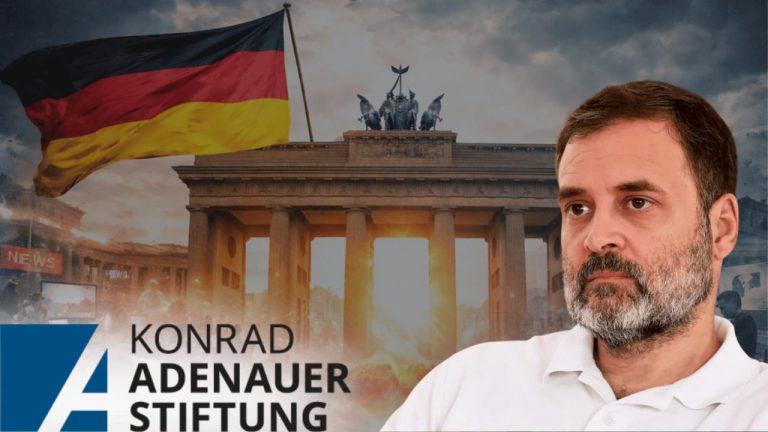
Rahul Gandhi’s visits to Germany must be viewed in this context. Recently, he delivered a lecture at the Hertie School of Governance. This institution itself is linked to Germany’s post-Nazi “atonement” ecosystem. The Hertie Foundation, which established the school, traces its origins to a 19th-century department store (Tietz). During the Nazi era, the Jewish Tietz family’s assets were expropriated under “Aryanisation,” from which the foundation benefited. Today, under the banner of atonement, the foundation invests heavily in “strengthening democracy.”
This so-called atonement has become a pretext for intervention in other countries’ democracies, including attempts to shape politics in India. When Rahul Gandhi speaks on such platforms about “institutional capture” or warns that “people will fight each other,” these are not just speeches; they are exported narratives. The real engine behind this export is KAS.
KAS: an ideological engine
The Konrad Adenauer Stiftung (KAS) is the most important actor in this story. It is not a neutral NGO or a generic think tank. KAS is the ideological machine of Germany’s ruling political tradition, directly rooted in the Christian Democratic Union (CDU). KAS openly acknowledges on its official website that it is politically affiliated with the CDU.
This should not surprise anyone. Both the CDU and KAS share the same ideological soul: Konrad Adenauer. Understanding him is key to understanding modern German politics, and why Germany today appears restless and aggressive on multiple fronts.
Konrad Adenauer: The first chancellor of post-war Germany
Konrad Adenauer was no ordinary leader. He became the first Chancellor of West Germany after World War II, rebuilding a country reduced to rubble by Nazi devastation and reintegrating it into the Western world. He aligned Germany with the United States and Western Europe, joined NATO, and laid the foundations of European integration beginning with the European Coal and Steel Community.
This was not merely strategic politics; it was ideological. Adenauer was a devout Roman Catholic who believed politics could not be separated from Christian morality. For him, Europe was not just a geographical entity but a Christian civilisation. Remove Christian values, he believed, and Europe would become hollow.
In Adenauer’s view, the real post-war global conflict was Christianity versus Marxism. He saw communism as just as dangerous as Nazism and regarded the Soviet Union as the greatest threat to freedom. This worldview led him to NATO and a close partnership with the United States.
On this ideological foundation, the Christian Democratic Union (CDU) was created, designed to unite Catholics and Protestants on a single platform rooted in Christian principles. Adenauer believed politics must be guided by Christian ethics.
A lawyer by training, Adenauer became Mayor of Cologne in 1917 but was removed in 1933 when the Nazis came to power. He was imprisoned under the Nazi regime and arrested again by the Gestapo after the failed attempt on Hitler’s life in 1944. After the war, he rose through the CDU, becoming President of the Parliamentary Council and eventually Chancellor of West Germany.
On 20 December 1955, CDU leaders founded the Society for Christian Democratic Educational Work to spread Christian democratic ideology through education, research, and international networks. In 1964, it was renamed the Konrad Adenauer Stiftung, making KAS the institutional extension of Adenauer’s ideology.
KAS in India and the ideological battlefield
Today, KAS operates actively in India. It funds institutions such as CSDS, through which India’s democratic processes are questioned, the majority community is targeted, and sovereignty-weakening narratives are constructed. Reportedly, since 2016, KAS has provided over ₹2.6 crore in funding to CSDS.
On paper, KAS speaks of education, research, and scholarships. On the ground, it trains youth, shapes policy narratives, and builds media and academic networks. Governments may not fall overnight, but societies are reshaped. Today, regimes are destabilised not by tanks, but by ideas and digital narratives.
German statements on India, whether on Kejriwal’s arrest, Manipur, or “human rights versus sovereignty”, emerge from this ideological framework. Organisations like KAS do not send tanks; they send narratives, networks, and ideas.
This model resembles USAID’s approach. The difference is that USAID promotes the American model, while KAS promotes a European—specifically German, path, often aligned with EU norms. This also explains occasional friction between the two.
Historically, Germany’s stance toward India has followed similar logic: criticism of India during the 1961 Goa liberation because Portugal was a NATO member; initial criticism during the 1971 Bangladesh war; suspension of assistance and pressure to join the NPT after India’s nuclear tests in 1974 and 1998.
Germany’s Stiftung model
Germany’s political system features a unique element: Stiftungen, political foundations affiliated with parties, funded by the state, and active worldwide to “teach democracy.” Because of their patterns in India, the Ministry of Home Affairs has often taken a strict stance. In this process, organisations such as CPR and Oxfam India have seen their FCRA licences cancelled.
Three major German foundations stand out:
Friedrich Ebert Stiftung (FES), linked to the Social Democratic Party (SPD), accused of funding NGOs that promote industrial unrest under the banner of labour rights. In 2022, an FES report controversially compared India to authoritarian regimes.
Heinrich Böll Stiftung (HBS), linked to the Green Party, considered the most aggressive toward India—opposing coal projects, nuclear energy, large infrastructure initiatives, and even the Aarogya Setu app. Investigations into money trails in some cases reportedly led back to such foundations.
Konrad Adenauer Stiftung (KAS), linked to the CDU, focusing on youth, policymakers, and academia. Through surveys, fellowships, and programmes, it is said to ideologically shape opposition narratives across media, research, and training.
Feminist Foreign Policy: morality or interference?
Germany has recently promoted the concept of “Feminist Foreign Policy,” championed by Foreign Minister Annalena Baerbock. In India’s context, this has raised concerns. German statements on Kashmir echoing Pakistan’s line, framing Manipur violence as “Hindu versus Christian,” and commenting publicly on Kejriwal’s arrest are seen as crossing India’s red lines.
Experts argue that Germany is not limited to diplomatic statements but has prepared digital and information-war fronts in India. International media and social platforms play a key role here, with DW frequently cited in these debates.
Some Indian digital platforms and media outlets are also discussed in connection with German networks. Publications like The Caravan are linked to KAS’s Media Programme Asia. Germany is said to adapt its information-war strategies with changing times.
Questions have also been raised about digital influencers whose reach surged ahead of the 2019 general elections, for example, Dhruv Rathee, who later appeared prominently on platforms like the BBC and NDTV on sensitive issues such as caste, reservations, elections, and EVMs.
Germany has effectively become a safe haven for India-critical digital influencers, aided by its strict privacy and free-speech laws that shield them from Indian legal action.
Germany’s normative power
Analysts describe all this as part of Germany’s strategy of “normative power.” In a multipolar world, Germany seeks influence not through military strength but through narratives, institutions, and ideology, positioning itself as the arbiter of who is “democratic” and who is not.
India is a key economic partner for Germany, but Germany’s political and intellectual elite appears uncomfortable with India’s rise as a civilisational state, especially as India advances toward the global top three economies, potentially pushing Germany back.
The question is whether we recognise that today’s battles are no longer fought at borders, but within institutions, ideas, and narratives. OpIndia continues to monitor these developments and will soon publish further in-depth research, similar to our CSDS investigation, into Germany’s other fronts, so readers can better understand the nuances and modus operandi of this entire nexus.
With around 80,000 residents, Minnesota hosts the biggest Somali diaspora in the United States. Many of them are refugees from the civil war that has raged in their native nation since 1991. They moved to Minneapolis and its suburbs, enticed by meatpacking jobs, Lutheran charity networks, and a more generous welfare system than others.
Notably, anti-India Congresswoman Ilhan Omar is also of Somali descent. However, the community has often come into the spotlight following significant scandals that erupted concerning Minnesota’s social programmes. An astounding $9 billion is the anticipated overall damage, which is close to Somalia’s entire GDP.
It was also determined that of the 98 defendants indicted and over 60 convictions in significant fraud cases across the state, 85 are either Somali Americans or of Somali heritage.
MINNESOTA FRAUD: @NickShirleyyy’s work has helped show Americans the scale of fraud in Tim Walz’s Minnesota. @TheJusticeDept has been investigating this for months. So far, we have charged 98 individuals – 85 of Somali descent – and more than 60 have been found guilty in…
On 27th December, the issue surfaced after Nick Shirley, a 23-year-old YouTuber, exposed the pervasive fraud at childcare centres run by Somalis using publicly accessible data from the Minnesota Department of Human Services. These facilities had received millions in government subsidies, but the footage showed deserted playgrounds, blacked-out windows, closed doors at licensed daycares and angry employees who screamed or ran away when confronted.
A woman even yelled, “Don’t open up, it’s ICE (Immigration and Customs Enforcement).” A neighbour also attested that no kids had been spotted there in eight years. Shirley stated, “This could be the largest fraud scandal in US history,” during his investigation. He pointed out that federal and state funding were diverted to businesses that had negligible or no operational history.
? Here is the full 42 minutes of my crew and I exposing Minnesota fraud, this might be my most important work yet. We uncovered over $110,000,000 in ONE day. Like it and share it around like wildfire! Its time to hold these corrupt politicians and fraudsters accountable
The places that were authorised to look after dozens of kids seemed empty during the day. Shirley’s guide, David, a local researcher who reported having been stabbed during his own inquiry, assisted him in recording $110 million in dubious payments. “I would drive by these childcare centres in the middle of the day, and there were never any kids there. That’s when I started asking, where are these children?” David remarked.
Shirley maintained that these centres received annual payments of hundreds of thousands of pounds, and in some instances, millions, even though they didn’t appear to be functioning. Additionally, abuse within home healthcare programs and non-emergency medical transport services was revealed in the video.
According to the YouTuber, officials knew about the suspicious activities but did nothing about them. Vice President JD Vance and former Department of Government Efficiency (DOGE) head Elon Musk both shared the footage.
The alarming reality sparks inquiry and outrage
The explosive disclosures in Shirley’s video resulted in major backlash against the administration, including Democrat Governor Tim Walz, after which an investigation was launched. On 29th December, federal agents were in Minnesota conducting a probe into the matter. ICE and Homeland Security Investigations (HSI) were present in Minneapolis.
A video of officers walking “door to door” at suspected fraud locations was made public by Homeland Security. It wrote, “The American people deserve answers on how their taxpayer money is being used and arrests when abuse is found.”
DHS is on the ground in Minneapolis, going DOOR TO DOOR at suspected fraud sites.
The American people deserve answers on how their taxpayer money is being used and ARRESTS when abuse is found. Under the leadership of @Sec_Noem, DHS is working to deliver results. pic.twitter.com/7XtRflv36b
“Our agents are conducting a massive operation to identify, arrest, and remove criminals who are defrauding the American people at daycares, healthcare facilities, and other suspected sites. We will not stop until we’ve rooted out this rampant fraud plaguing Minnesota,” Homeland Security vowed in another post.
The American people demand answers and accountability. DHS, under @Sec_Noem, will deliver on them.
Our agents are conducting a massive operation to identify, arrest, and remove criminals who are defrauding the American people at daycares, healthcare facilities, and other… pic.twitter.com/DvA62Sjl1J
The agency promised to deliver results under the leadership of Secretary Kristi Noem. A law enforcement official mentioned that Shirley’s video had a role in the increase of DHS (Department of Homeland Security) agents in Minneapolis, including visits to about thirty companies, reported CNN.
FBI director pledges to eliminate fraud schemes
The Federal Bureau of Investigation director also took to social media to address the issue. He informed, “The FBI is aware of recent social media reports in Minnesota. However, even before the public conversation escalated online, the FBI had surged personnel and investigative resources to Minnesota to dismantle large-scale fraud schemes exploiting federal programs. Fraud that steals from taxpayers and robs vulnerable children will remain a top FBI priority in Minnesota and nationwide.”
He further highlighted a $250 million scam in Minnesota that concluded in multiple charges. “The case led to 78 indictments and 57 convictions. Defendants included Abdiwahab Ahmed Mohamud, Ahmed Ali, Hussein Farah, Abdullahe Nur Jesow, Asha Farhan Hassan, Ousman Camara, and Abdirashid Bixi Dool, each charged for roles ranging from wire fraud to money laundering and conspiracy,” Patel noted.
CASE UPDATE: MINNESOTA FRAUD SCHEME
The FBI is aware of recent social media reports in Minnesota. However, even before the public conversation escalated online, the FBI had surged personnel and investigative resources to Minnesota to dismantle large-scale fraud schemes…
Patel emphasised, “The FBI believes this is just the tip of a very large iceberg. We will continue to follow the money and protect children, and this investigation very much remains ongoing. Furthermore, many are also being referred to immigration officials for possible further denaturalisation and deportation proceedings where eligible.”
SBA ends funding for Minnesota
The Small Business Administration (SBA) has also taken action to halt the grant from entering Minnesota in response to the critical development. “This administration will not continue to hand out blank checks to fraudsters – and we will not rest until we clean up the criminal networks that have been stealing from American taxpayers,” SBA chief Kelly Loeffler announced.
SBA is pausing annual funding to Minnesota while we investigate $430 million in suspected PPP fraud across the state.
This Admin will not continue to hand out blank checks to fraudsters – and we will not rest until we clean up the criminal networks that have been stealing from…
Earlier in December, a federal prosecutor suggested that at least half of the approximately $18 billion in federal monies that have been used to support 14 programs in Minnesota since 2018 may have been pilfered, and the majority of the accused are Somali Americans. “The magnitude cannot be overstated. What we see in Minnesota is not a handful of bad actors committing crimes. It’s staggering, industrial-scale fraud,” voiced First Assistant US Attorney Joe Thompson.
The fresh action ensued as 57 Minnesotans were found guilty after years of inquiry that started with the $300 million corruption at the charitable organisation “Feeding Our Future,” which was at the centre of the biggest COVID-19-related scam in the nation. The perpetrators misused a state-run, federally sponsored program designed to feed children.
Meanwhile, Tom Emmer, majority whip in the United States House of Representatives, charged, “Well, it’s amazing to me that a 23-year-old journalist, a YouTuber who’s now got over 80 million views on this video, found more in a matter of hours than Governor Tim Walz and Keith Ellison, Minnesota Attorney General, have found in 7 years.”
The history of the scam extends to 2014
There has been widespread fraud in Minnesota involving taxpayer-funded day care since at least 2014. The scammers stuffed carry-on luggage with up to $1 million each to smuggle out of the country. Tens of millions of dollars of cash flew out of the Minneapolis-Saint Paul International Airport roughly a decade ago, per a report in Fox 9. Minnesota taxpayers lost $100 million annually as a result.
The passengers left with a total of $84 million in 2016 and an additional $100 million the following year, marking an enormous rise. The amount travelled to Dubai, the Middle East and other locations. According to sources, MSP lost over $100 million in cash in 2017.
As of 2018, the state was probing potential fraud by dozens of companies suspected of obtaining millions of dollars in payments from the government for bogus childcare services. The state began to crack down on such scams in 2014. Ten companies were the subject of ongoing investigations at the time.
Millions of dollars in stolen funds have reportedly been moved to Somalia and ended up with al-Shabab, a terror group connected to al Qaeda, according to federal counterterrorism sources. A source unveiled, “The largest funder of al-Shabab is the Minnesota taxpayer,” according to the New York Post.
“It’s welfare fraud, it’s all about the daycare,” Glen Kerns quoted sources. He is a veteran Seattle police detective and served on the FBI’s joint terrorism task force for fifteen years. The extent of the rot was illustrated when Fozia Ali, who was under investigation for wire fraud and the misappropriation of public funds, took the oath as a member of the Hopkins Park Board.
The state’s food program, autism program and the Housing Stabilisation Program are considered to have lost at least $300 million, $220 million and $302 million, respectively. The scammers used the money to purchase expensive honeymoon trips to the Maldives, luxurious vehicles including Mercedes and Porsches, and even a suite at a Minnesota Timberwolves game in addition to shipping the illicit proceeds overseas.
President Trump lashes out at the Somali community in the U.S
President Donald Trump has been candid about his disapproval of Ilhan Omar and the Somali community. “Hundreds of thousands of refugees from Somalia are completely taking over the once great State of Minnesota. Somalian gangs are roving the streets looking for prey as our wonderful people stay locked in their apartments and houses hoping against hope that they will be left alone,” he outlined on the evening of Thanksgiving eve. He also attacked Governor Tim Walz for not taking any action and termed Omar as “the worst Congressman/woman” in the country and even talked about her controversial past including marriage.
“I wouldn’t be proud to have the largest Somalian – look at their nation. Look how bad their nation is. It’s not even a nation. It’s just people walking around killing each other. Look, these Somalians have taken billions of dollars out of our country. Billions and billions,” Trump later outlined.
“Those Somalians should be out of here. They’ve destroyed our country,” he further stated. “Go back to your own country and figure out your constitution. All she (Omar Ilhan) does is complain about this country, and without this country, she would not be in very good shape. She probably wouldn’t be alive right now. Somalia is considered by many to be the worst country on Earth. I don’t know. I haven’t been there, I won’t be there anytime soon, I hope,” the president added.
The Trump administration intends to deploy additional federal agents to Minneapolis with the authority to target Somalis, especially those who have final deportation orders.
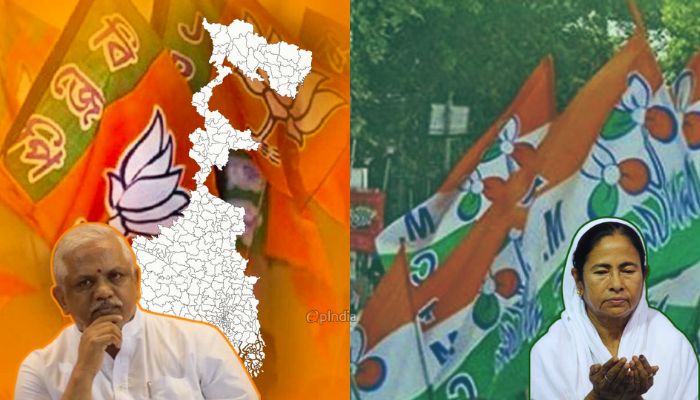
India, that is Bharat, is a civilisational state. Home to diverse social, religious, ethnic and linguistic communities, India, despite its modern nation-state outlook, has its roots in the Hindu civilisation and cultural continuity. The Indic civilisation has been under constant threat from foreign invaders and colonisers. Bengal, which has been the cradle of the Indian renaissance, is crumbling under the burden of TMC’s appeasement politics. Recently, BJP leader BL Santhosh declared that the coming West Bengal assembly election is a “civilisational battle”.
At the recently held ‘Sagar Manthan’ program in Goa, BJP’s organisational secretary, BL Santhosh, declared that the assembly election in West Bengal is not a mere battle for power but a civilisational battle.
“Bengal is not a political battle, it’s civilisational. We look at it in the same way. To save India, we have to save Bengal. That will not be our 19th or 20th state…to save India from a big demographic challenge, we want to win Bengal, and we will win Bengal because of your blessings,” he said.
Bengal is not a battle for power for us. For us, Bengal is a battle to protect civilisation.
If India has to be saved, Bengal must be saved.
With your blessings, we will form the government in Bengal, come what may.
Predictably, the BJP leader’s remarks have irked the ruling Trinamool Congress. The TMC leaders have criticised Santhosh’s remarks, saying that his remarks are divisive and that somehow India’s civilisation faces a threat from the BJP itself.
TMC’s Shashi Panja claimed that for the last decade, the BJP has undermined India’s foundational values, including pluralism, tolerance, and freedom, replacing them with hatred, cultural dominance and intimidation.
Amusingly, while the TMC government appeases Muslims in the state and the sitting Chief Minister Mamata Banerjee proudly declares that she is fighting against “Kafirs”, TMC MP Sagarika Ghosh invoked Netaji Subhash Chandra Bose, Rabindranath Tagore, and Swami Vivekananda to highlight Bengal very civilisation that TMC’s politics threatens.
While political violence is not a TMC-exclusive phenomenon in West Bengal, the state has seen its worst form under over a decade of Mamata Banerjee’s rule. Muslim appeasement, rapid demographic alteration, illegal infiltration of Bangladeshi Muslims via the porous Indo-Bangladesh borders and anti-Hindu activities coupled with economic downslide have defined the Mamata era in West Bengal. It is said that demography is destiny, and no civilisation can prevail and thrive if this ‘destiny’ is corrupted or dangerously modified.
Why West Bengal must be saved from TMC for the Civilisation to be saved
Such was Bengal’s intellectual and philosophical richness that it was said that “What Bengal thinks today, India thinks tomorrow.” Bengal is the sacred soil that gave the country gems like Bankimchandra Chatterji, Swami Vivekananda, Aurobindo, Rabindranath Tagore and Netaji Subhash Chandra Bose. However, in the contemporary political scenario, this civilisational goldmine is being reduced to a barren and gloomy desert by the Mamata regime.
For over three decades, the Communists ruled West Bengal; their Marxist ideology resulted in driving out big companies and investments. The communists stripped the state’s people of numerous jobs these industries could have generated, a better life, prosperity and dignity. Besides, mocking Hindu Dharma was also a core aspect of their ideological-political agenda.
Mamata Banerjee was a sharp, critical voice against the CPIM. When she came to power in the state in 2011, it was expected that Banerjee would heal the wounds West Bengal suffered under the communists. However, Mamata Banerjee only scratched the wounds and sprinkled salt over them, but also inflicted new injuries.
In around 14 years of the reign of “Didi”, over 6,668 companies have migrated out of West Bengal. Afghanistan is known as the “graveyard of civilisations”. Under the TMC rule, West Bengal has become a “graveyard of industries”.
While the people of West Bengal are already grappling with unemployment, the TMC government abolished all the policies implemented from 1993 to 2021 to attract industries, ensuring that businesses will not get any concession on setting up industries in the state, whether in the form of land or electricity prices.
Such is the condition that despite being the fourth most populous state in India, West Bengal has only a 3.5% share in India’s industrial output. It is estimated that over 22 lakh to 30 lakh Bengalis have moved to other states as migrant workers, because of a shortage of employment in their home state.
As per the latest CAG report, West Bengal’s debt-to-GSDP ratio now touches 33.7%, one of the highest in the country. In over a decade of Mamata Banerjee’s rule, West Bengal has witnessed a sharp jump in its debt burden.
In addition, West Bengal also falls into the category of 11 states that are using borrowed funds to finance routine expenditure, such as salaries, subsidies, and administrative costs, rather than creating assets that could improve the state’s financial health in the long run. Scams, syndicate raj and consequent migration of workers is crippling West Bengal’s economy, while the only flex TMC is left with is having a woman as the state’s Chief Minister.
The question arises: If economic growth is not the TMC government’s priority, what is? The answer is simple: Clinging to power through appeasement politics and political high-handedness is TMC’s modus operandi. Basically, TMC replaced Marx with Muslim appeasement. In a slogan, TMC’s rule is about ‘Maa, Maati and Manush’, in reality, it is ‘Mamata, Muslims and Menace’.
OpIndia has reported several incidents wherein the state government demonstrated its blatant favouritism towards Muslims and disdain towards Hindus. It was reported last year that a Durga Mandir was found blocked and barricaded in Kaliachak town in Malda district of West Bengal. The development came a day before the Islamic month of Muharram. Before this, CM Mamata Banerjee imposed restrictions on the immersion of Durga idols in 2016 and 2017 to make way for Muharram processions.
TMC’s Muslim appeasement is not confined to suppressing Hindu rights and doing special favours to its Muslim votebank; it extends to blatant support to the Islamisation of West Bengal. Last year, TMC leader and a Cabinet Minister in the state government, Firhad Hakim, derided non-Muslims as ‘unfortunate’ and openly called for their religious conversion to Islam. “Those who were not born into Islam were born with misfortune. If we can give them Dawat (call for proselytisation) and bring Iman (Faith) in them, then we will make Allah happy. We need to spread Islam among non-Muslims. If we can bring someone on the path of Islam, then we will prove to be true Muslims by ensuring the spread of Faith,” said Firhad Hakim, who is also Mamata Banerjee’s close aide.
The TMC leader getting a free hand to insult non-Muslims and openly advocate for the state’s Islamisation should not be a surprise, given CM Mamata Banerjee herself has on many occasions declared her political adversaries as “Kafirs” or infidels as per Islam, and that she is fighting against them.
In Mamata’s Bengal, a TMC MLA, Hamidul Rahman’s alleged close associate, Tajemul Haque alias JCB, holds an ‘Insaf Sabha’, and brutally assaults a woman in public, and the TMC MLA justifies this Taliban-style flogging by saying that there are some ‘codes’ in a ‘Muslim Rashtra’.
Another question here would be, why do ‘secular’ political parties go for a Muslim appeasement tactic when there are other religious communities too, with significant populations? Why not Hindu appeasement? This is because Muslims are arguably the only community who vote as a religious community; they think about elections from a religious perspective, consider voting out parties not coddle them as almost a religious duty. No other community trades their vote for religious benefits or dominance; the others largely consider local issues, governance, economy, inflation and other regular issues while voting.
Thus, Muslim appeasement is an effective tactic to consolidate votes, and since the influential section of the community has somehow mastered the art of being the extremists and victims of extremism at the same time, ‘secular’ parties go to any extent to have their backing.
This extent stretches to even allowing demographic change in the state. It is reported that West Bengal has nine districts presently that are Muslim majority, compared to three that were predominantly Muslim both before and after independence.
In districts like Murshidabad, Malda, Uttar Dinajpur, and North and South 24 Parganas, the Muslim population grew at a higher rate than the Hindu population. For this reason, the Hindu share in these districts declined. Even the Hindu population declined by over 1% in some districts, much higher than the national average. With a change in religious demography, a lifestyle change, the look of the localities, politics and overall functioning of an area alter. Shifting demographics determine local politics, school education, festival management, and land disputes. The inorganic Muslim population surge in once Hindu-dominant districts essentially indicates the eventuality of the erasure of Hindus and the civilisation there.
Hindus are now minorities in large parts of their own homeland, courtesy TMC’s state-sponsored vote engineering. While Hindus are forced to leave their state and work in other states for a livelihood, they are replaced by Bangladeshi Muslim infiltrators.
Any attempt to diffuse the demographic time bomb is met with sharp opposition from the TMC. OpIndia reported earlier about the Mamata regime’s scathing criticism of the Election Commission’s Special Intensive Revision (SIR) exercise. When the SIR began in Bihar, thousands of names of illegal voters emerged, and the ‘secular’ parties, including TMC, claimed that the BJP is targeting minorities (read, Muslims). When authorities launched a crackdown on Bangladeshi and Rohingya Muslim infiltrators illegally residing in various Indian states, the TMC government claimed that Bengali Muslims are being targeted and invoked ‘Bengali Asmita’ (Bengali pride).
During the ongoing SIR in West Bengal, it was recently revealed that since the last SIR in 2002, registered voters in the state have increased by 66% from 4.58 crore to 7.63 crore. Out of the 10 districts in the state which have experienced the alarming rise in the number of voters, 9 districts border Bangladesh. The minimum increase in the number of voters is over 70% with the highest percentage of increase crossing 100%. Uttar Dinajpur has witnessed the highest spike in the number of voters at 105.49%, followed by Malda at 94.58%. As discussed earlier, the Muslim population in these districts has increased inorganically and abruptly, indicating that a deliberate demographic shift is being pulled off.
When the security agencies and the Central government want to prevent the influx of Bangladeshi illegals into India via a 2,217 km porous Indo-Bangladesh border, the TMC government shows reluctance in cooperation. Earlier this year, it was reported that the TMC government did not agree to provide land for fencing 600 kilometres of area, which allowed several illegal immigrants to enter India. In December 2024, BJP leader Suvendu Adhikari accused the West Bengal government of not cooperating with the Border Security Force (BSF) in curbing infiltration.
Even when the state government approves the land acquisition for border fencing, the district officials are found to be causing delays in the disbursal of funds. Besides, when the Modi government brought the Citizenship Amendment Act (CAA) in 2019 to grant Indian citizenship to persecuted Hindu and other non-Muslim minorities from neighbouring Islamic or Muslim-majority countries, Mamata Banerjee and her party, linked it to the NRC and Uniform Civil Code (UCC) to fearmonger that somehow Muslims will be singled out, their citizenship will taken away, and they will be dumped in detention centres.
This fearmongering politics triggered violence back then, and the ultimate target in such Islamist violence, be it during anti-CAA agitation or the anti-Waqf Bill protests, is Hindus.
In Mamata Banerjee’s West Bengal, political violence, particularly after elections, be it assembly elections or panchayat elections, is almost ritualistic. The Trinamool Congress workers often attack workers from opposition parties, indulge in booth capturing during elections, and target voters who did not vote for TMC. Be it Islamist-orchestrated violence or TMC-unleashed post-poll violence, the casualty is always Hindus.
Before BL Santhosh, Assam BJP leader and Chief Minister Himanta Biswa Sarma had also called the impending Assam state elections a “civilisational battle”. CM Sarma’s remarks stemmed from the rampant menace of demographic change in the state. Illegal Muslim immigrants expelling tribals and local Hindus to settle there, illegal encroachment of land and properties, as well as assertion of Islamic religious dominance, have been highlighted by the Assam Chief Minister.
The BJP government in the state has been working relentlessly to free lands from illegal encroachments by illegal Bangladeshi and Rohingya settlers and prevent demographic change. The state government has been detecting, detaining and deporting Bangladeshi and Rohingya illegals from the state.
Earlier, CM Sarma warned that the rate at which the Muslim population is increasing in the state, Assam would make it a Muslim-majority state by 2041. In fact, the entire northeast is grappling with a rapid shift in the religious composition of the population. This is alarming. A seemingly slow but certain death of the Indic civilisation sans timely policy interventions.
What is happening in Bengal becomes even more concerning when we look at a chaotic Bangladesh, where lynching of Hindus for being Hindus, desecration of their temples by Muslims has become a disturbing ‘normal’.
Ever since the forced ouster of Prime Minister Sheikh Hasina from power and her country in August 2024, the persecution of Hindus and other non-Muslim communities, and Islamisation of the country, have been ongoing in full swing. The 5th of August 2024 marked the tearing apart of the semi-torn secular fabric of the Muslim-majority Bangladesh.
Since Hasina’s ouster, Rabindranath Tagore’s and Satyajit Ray’s ancestral properties have been vandalised by Islamist and India-hating mobs. Muslim mobs in Bangladesh attack cultural, religious, and historical sites. The visuals of mobs vandalising the statue and residence of Bangladesh’s founding father, Sheikh Mujibur Rahman, made it clear that the Islamist-dominated post-Hasina Bangladesh will cut off its secular roots.
Under Muhammad Yunus’s leadership, Islamists are erasing their secular history and mainstreaming Islamist anti-Hindu and anti-India viewpoints by groups which were earlier dismissed as fringe. Once the civilisational battle is lost and a civilisation collapses, the Islamist adversary gets on with the task, erasing even the memories of the fallen civilisation.
Even the Islamists in Bangladesh claim to be ultra nationalist and true protectors of Bangladeshi interests. However, crushing of the media, systematic targeting of political adversaries, glorification of anti-India ‘activists’, crackdown on music and cultural events, appeasement of Islamist populace and unchecked killings of Hindu minorities, and forced mass resignation of Hindu employees, indicates, that secularism, plurality, tolerance and other such cliches are used only till the ultimate power grab, be it via street veto, political conspiracy, a gradual demographic shift or through a combination of these. What follows is a full-blown erasure of the existing civilisation and establishment of Islamist anarchy.
India’s West Bengal is vulnerable to cross-border influences and infiltration. A restive Bangladesh under Islamist dominance may fuel communal tensions in the state. While it took only a few months to turn Mujibur Rahman and Sheikh Hasina’s somewhat secular and economically sound Bangladesh into a full-fledged Islamist dominated mess, the way demographic change, rising Muslim population and dominance as well as a systematic suppression of Hindu rights is unfolding in West Bengal, the state is indeed in a civilisational crisis and the coming elections, which the BJP calls a civilisational battle, will see the BJP fighting to save the civilisation while the TMC will defend its empire.
India has emerged as the centre of global attention. This is due to the innovative zeal of our people. Today, the world sees India with hope and confidence. They appreciate the manner in which the pace of progress has been accelerated with next-generation reforms, which are cross-sectoral and amplify the nation’s growth potential.
I have been telling many people that India has boarded the Reform Express.
The primary engine of this Reform Express is India’s demography, our young generation and the indomitable spirit of our people.
2025 will be remembered as a year for India when it focused on reforms as a continuous national mission, building on the ground covered over the past 11 years. We modernised institutions, simplified governance, and strengthened the foundations for long-term, inclusive growth.
We moved ahead decisively…with higher ambition, faster execution and deeper transformation. The reforms have been about enabling citizens to live with dignity, entrepreneurs to innovate with confidence and institutions to function with clarity and trust.
Let me cite a few examples of the reforms undertaken.
GST reform:
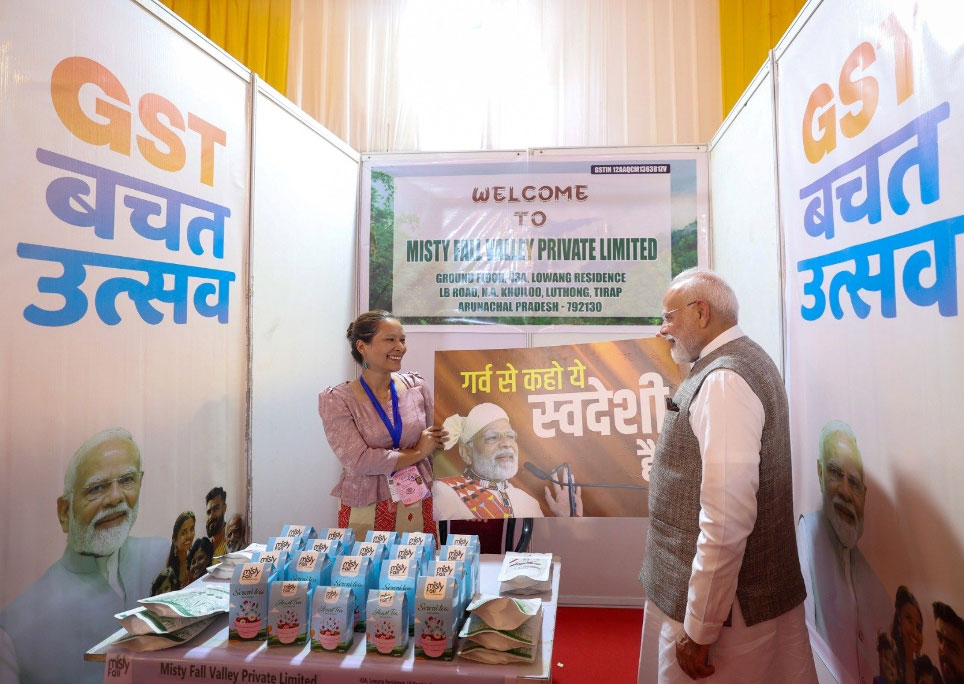
This reform has boosted consumer sentiment and demand. Sales have grown in the festive season.
A clean two-slab structure of 5% and 18% has been implemented.
The burden has been eased on households, MSMEs, farmers and labour-intensiVE sectors.
The purpose is to ensure dispute reduction and better compliance.
Source: Narendra Modi/LinkedIn
Unparalleled relief for the middle class:
In a first, individuals earning up to Rs. 12 lakh a year faced no income tax at all.
Obsolete Income-tax Act of 1961 has been replaced with the modern and simple Income Tax Act, 2025.
Together, these reforms mark India’s move towards a transparent, technology-driven tax administration.
Boost to small and medium businesses:
Definition of “small companies” has been expanded to include firms with turnovers up to Rs. 100 crore.
Compliance burdens and associated costs for thousands of companies will get reduced.
100% FDI Insurance reform:
100% FDI permitted in Indian insurance companies.
This will give a fillip to insurance penetration and security for the people.
Apart from enhanced competition, it would offer better insurance choices and improved service delivery for the people.
Securities Market Reform:
Securities Market Code Bill has been introduced in Parliament. It will enhance governance norms in SEBI, also enhance investor protection, reduce compliance burden and enable a technology-driven securities market for a Viksit Bharat.
Reforms will ensure savings thanks to reduced compliances and other overheads.
Maritime and Blue Economy Reforms:
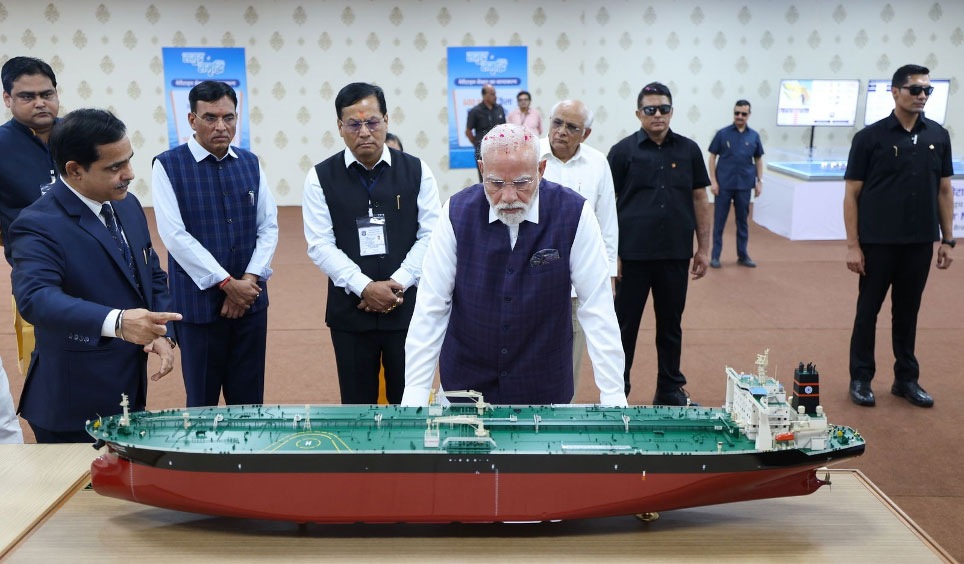
In a single Parliament session, the Monsoon Session, five landmark maritime legislations were passed: the Bills of Lading Act, 2025; the Carriage of Goods by Sea Bill, 2025; the Coastal Shipping Bill, 2025; the Merchant Shipping Bill, 2025; and the Indian Ports Bill, 2025.
These reforms simplify documentation, make dispute resolution easier and reduce logistics costs.
Outdated Acts dating back to 1908, 1925 and 1958 have also been replaced.
Source: Narendra Modi/LinkedIn
Jan Vishwas…Ending the Era of Criminalisation:
Hundreds of outdated laws have been scrapped.
71 Acts have been repealed through the Repealing and Amendment Bill, 2025.
Boosting Ease of Doing Business:
A total of 22 QCOs were revoked across synthetic fibres, yarns, plastics, polymers, and base metals, while 53 QCOs were suspended in various steel, engineered, electrical, alloy, and consumer end product categories, covering a broad spectrum of industrial and consumer materials.
This will increase India’s share of apparel exports; lower production costs in diverse industries like footwear, automobiles; ensure lower prices for domestic consumers for electronics, bicycles and automotive products.
Historic labour reforms:
Labour laws have been reshaped, merging 29 fragmented laws into four modern codes.
India has created a labour framework that secures the interests of workers while boosting the business ecosystem.
The reforms focus on fair wages, timely payment of wages, smoother industrial relations, social security and safer workplaces.
They ensure greater female participation in the workforce.
Unorganised workers including contract workers are brought under the ESIC and EPFO expanding the coverage of formal workforce.
Source: Narendra Modi/LinkedIn
Diversified and expanded markets for Indian products:
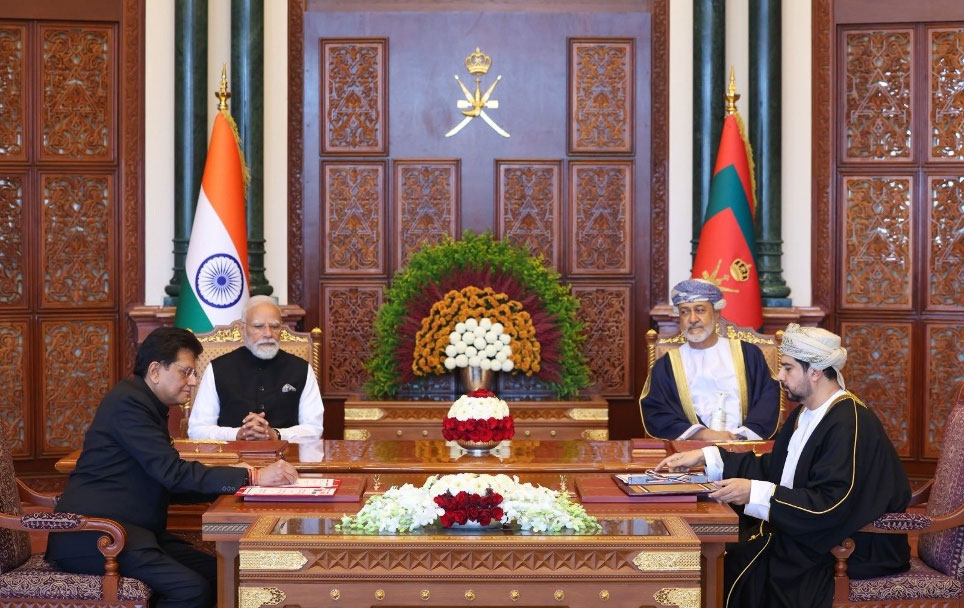
Trade deals inked with New Zealand, Oman and Britain. These will add to investments, boost job creation and also encourage local entrepreneurs. They reinforce India’s position as a trusted and competitive partner in the global economy. The FTA with the European Free Trade Association, comprising Switzerland, Norway, Iceland and Liechtenstein, has been operationalised. This marks India’s first FTA with developed European economies.
Source: Narendra Modi/LinkedIn
Nuclear Energy Reforms:
The SHANTI Act is a transformational step in India’s clean-energy and technology journey.
Ensures a strong framework for the safe, secure and responsible expansion of nuclear science and technology.
Enables India to meet the rising energy demands of the AI era, like powering data centres, advanced manufacturing, green hydrogen and high-technology industries.
Promotes the peaceful application of nuclear technologies in healthcare, agriculture, food security, water management, industry, research and environmental sustainability, supporting inclusive growth and improved quality of life.
Opens new pathways for private sector participation, innovation and skill development. Creates opportunities for India’s youth to lead in frontier technologies and next-generation energy solutions.
This is an opportune moment for investors, innovators and institutions to partner with India, to invest, innovate and build a clean, resilient and future-ready energy ecosystem.
A Landmark reform in Rural Employment guarantee:
Viksit Bharat- G RAM G Act, 2025 Rozgar Guarantee framework raises employment guarantee from 100 to 125 days.
This will result in increased spending towards strengthening village infrastructure and livelihoods.
The aim is to turn rural work into a means to ensure higher incomes and better assets.
Education Reforms:
Bill has been introduced in Parliament.
Single, unified higher education regulator will be established.
Multiple overlapping bodies like the UGC, AICTE, NCTE will be replaced with the Viksit Bharat Shiksha Adhishthan.
Institutional autonomy will be strengthened, with innovation and research boosted.
What makes the reforms of 2025 significant is not only their dimension but also their underlying philosophy. Our Government has prioritised collaboration over control and facilitation over regulation in the true spirit of a modern democracy.
These reforms were designed with empathy, recognising the realities of small businesses, young professionals, farmers, workers and the middle class. They were shaped by consultation, guided by data and anchored in India’s constitutional values. They add momentum to our decade-long efforts to move away from a control-based economy to one that operates within a framework of trust, keeping the citizen at its core.
These reforms are aimed towards building a prosperous and self-reliant India. Building a Viksit Bharat is the polestar of our development trajectory. We will continue pursuing the reform agenda in the coming years.
I urge everyone in India and abroad to deepen their bond with the India growth story.
Keep trusting India and investing in our people!
This article was written by Prime Minister Narendra Modi on LinkedIn and has been republished here with due credit. The original article can be read here.
In a blatant attempt to appease land grabbers, the Karnataka Congress government on Monday (29th December) announced compensation and alternate housing after they were removed from the government land in a demolition drive in the Kogilu in the northern part of Bengaluru during a demolition drive.
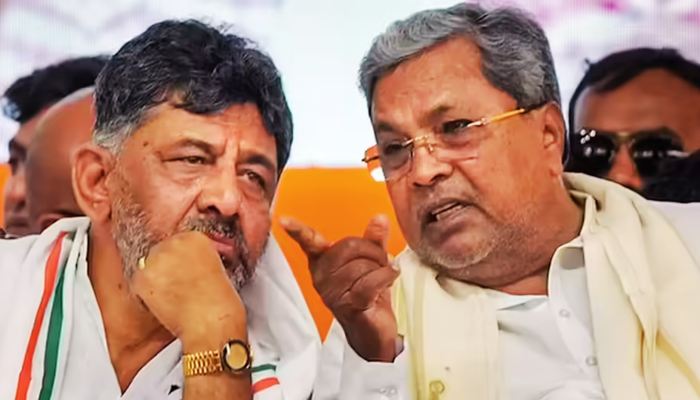
Facing political backlash for the demolition drive carried out in Waseem Layout and Fakir Colony on 20th December, Karnataka CM Siddaramaiah said that he directed Housing Minister Zameer Ahmed Khan to provide alternate housing to encroachers. “Keeping humanitarian concerns in mind, I have directed officials to identify eligible families who lost shelter and submit the list within two days. After discussions with Deputy Chief Minister Shri @DKShivakumar(DK Shivakumar), Housing Minister Shri @BZZameerAhmedK (Zameer Ahmed Khan), and local MLA Shri @krishnabgowda (Krishna Byre Gowda), we have decided to provide alternative houses at Baiyappanahalli, barely 7 km from Kogilu,” CM Siddaramaiah wrote on X on Monday.
I want to clearly explain our government’s decision on the Kogilu settlement issue. On December 20, illegal sheds built on government land were removed after due notice. This land belongs to the government and had been officially handed over for public purposes. Encroachment of… pic.twitter.com/Jgyhutd6ga
He said that the displaced encroachers will be provided government-built houses at Baiyappanahalli at heavily subsidised prices. “About 1,087 government-built houses are available there. Each house costs around ₹11.20 lakh. Beneficiaries will receive substantial State and Central subsidies. General category families will receive subsidies up to ₹8.70 lakh, and SC/ST families up to ₹9.50 lakh. The remaining amount will be provided as a small, verified loan,” the CM. Housing Minister Zameer Ahmed Khan has been directed by Siddaramaiah to ensure that the displaced families can move into the new houses by 1st January after the verification process.
Relief to encroachers on “humanitarian grounds”
Siddaramaiah said that the displaced families were occupying the government land illegally, and yet the state government has decided to provide them with alternate housing on “humanitarian grounds.” The demolition drive was carried out at Konglu’s Waseem Layout and Fakir Colony by the Bengaluru Solid Waste Management Limited to clear encroachments for a proposed solid waste processing unit. However, the legit demolition drive stirred a political controversy after Kerala CM Pinarayi Vijayan criticised the Karnataka government’s action, describing it as “brutal normalisation of the bulldozer raj”.
Subsequently, a review meeting was held by CM Siddaramaiah and Deputy CM DK Shivakumar with officials. After the meeting, the relief measures, including alternate housing under the Ashraya scheme, the CM’s one lakh housing scheme and up to ₹5 lakh compensation, were announced. “I have asked officials of the revenue department and the GBA to prepare a list of people who do not own land or houses so that alternative arrangements can be made. They will also be eligible for financial assistance,” Siddaramaiah said after the meeting.
Kerala CM created a political issue: Siddaramaiah
CM Siddaramaiah admitted that his government’s compensatory action was influenced by the Kerala CM’s remarks against the demolition. He accused CM Vijayan of turning the demolition drive into a political issue and added that his government was compelled to announce the relief measures. “While the state govt does not intend to encourage such illegal constructions on govt land, the Kerala chief minister turned this into a political issue. So we had to act,” Siddaramaiah said.
Justifying the demolition drive, CM Siddaramaiah said that “inhumane conditions” prevailed in the vicinity of the area, where around 15 acres were being used as a landfill and leachates or contaminated liquids were found in the groundwater. Around 167 sheds were reportedly cleared in the area after issuing multiple notices.
Disciplinary action against erring officials
In addition to that, he announced disciplinary action against officials who allowed encroachment on the government land. “To set a precedent, we will initiate disciplinary action against officials who were on duty when these encroachments began in 2021. These encroachments could not have happened without the knowledge of the tahsildar, shirestadar and village accountants,” the CM added. Siddaramaiah warned of strict action in future if encroachment happens on the government land. “If govt property is encroached upon, local officials will be personally held responsible and face disciplinary and administrative action,” he added.
The chief of the Samajwadi Party and former Chief Minister of Uttar Pradesh, Akhilesh Yadav, is attempting to project himself as a supporter of Brahmins. However, his real face has been revealed repeatedly, and his purported affection for the community is marred by violence.
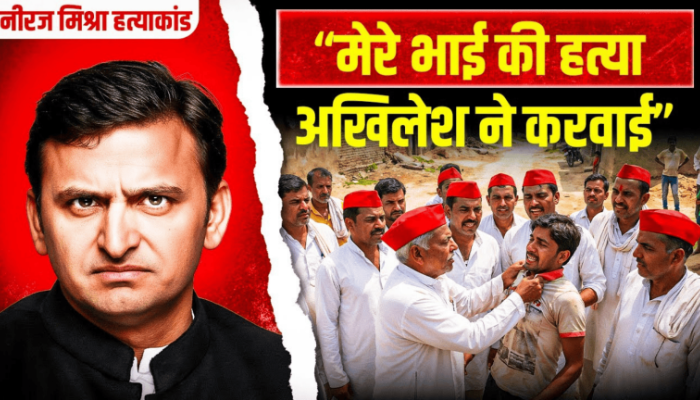
Many might not recognise the name Neeraj Mishra from Kannauj. He was the individual who once confronted Akhilesh. Afterwards, his decapitated body was discovered within a day. Neeraj’s sibling, Munish Mishra, in a conversation with OpIndia, openly accused Akhilesh of his brother’s murder.
Neeraj’s severed head has never been found
The incident dates back to 5th May 2004, during the polling for the general elections in the Kannauj Lok Sabha constituency of the state. Akhliesh, the son of the then Chief Minister Mulayam Singh Yadav, was the candidate from the Samajwadi Party, whereas the Bharatiya Janata Party was represented by Ramanand Yadav. This marked Akhilesh’s inaugural general election after he had just returned from his studies in Australia.
During the polling, the situation unexpectedly turned tense at the polling booth of Baba Haripuri Inter College located in Kasava village of the Chhibramau area of Kannauj. A fierce argument erupted between BJP and SP workers regarding booth capturing, which swiftly escalated into violence. Meanwhile, BJP booth president Neeraj Mishra suddenly went missing.
On 6th May, his torso was discovered in the Ishan River, but his head was never located. Neeraj was from Kasava village and was assigned to the same polling booth where the altercation took place. A prolonged legal battle followed against the accused in this murder case. The court eventually sentenced the perpetrators to life imprisonment, but over time, all of them were granted bail.
The victim’s family asserted that people linked to the then Member of Parliament arrived at the polling station with the aim of capturing it. Neeraj objected, but an altercation transpired between the two sides, and he pushed a leader during this time. Afterwards, the leader’s associates forcibly abducted him, and his headless corpse was located the next day.
Akhilesh Yadav orchestrated the murder: Munish Mishra
Munish Mishra conversed with OpIndia’s Arpit Tripathi regarding the tragic murder of his brother. During the discussion, he stated, “Akhilesh is behind the decapitation of my brother.” He then elaborated, “There was a polling booth located in Kasava village, where Neeraj served as the BJP’s booth agent. The residents from nearby Yadav villages would come to vote there previously, but it has since been removed.”
Munish recounted the entire event thoroughly and disclosed, “Akhilesh, following the looting of polling booths in Batela, Jafrabad and nearby regions, arrived in Kasava with a convoy of 25 to 30 vehicles. A presiding officer was treated disrespectfully, prompting a reaction. Akhilesh struck a man as a display of authority. My brother objected to this, leading to a dispute between them.”
I want Neeraj Mishra dead or alive
Munish pointed out, “The matter intensified as the prince (Akhilesh) felt offended that someone had dared to touch him. He was accompanied by the police force, the CEO and Inspector Umashankar Yadav.” He recalled how a furious Akhilesh had called Mulayam Singh and yelled, “I want Neeraj Mishra, dead or alive.”
Munish further informed, “Once the polling concluded in the evening, the SP workers began to create chaos. They vandalised the home of a Bahujan Samaj Party (BSP) worker who tended to our farm. His mother was there, and they mistreated her in front of other women. These workers inserted a fan rod into her vagina.” He added, “Afterwards, an SP worker was killed in the shooting. Neeraj had no connection to that instance whatsoever.”
SP workers brutally killed Neeraj: Munish Mishra
Munish unveiled, “Subsequently, they attacked our residence. Neeraj fled towards the tube well. He was by himself, defenceless, and the police surrounded him. He was apprehended by the cops and then delivered to the SP workers. They dragged Neeraj towards their village, mercilessly beating him en route as he was savagely and ruthlessly assaulted to death.”
Munish specifically identified Ashok Yadav, Avnish Yadav, Ram Sharan, also known as Munnu Singh, Pappu Singh, Sunil Yadav, and Ram Vilas Yadav as the men responsible for the murder. “They were Akhilesh’s closest aides and were on contact with him via phone. No one in the vicinity dared to oppose them due to the presence of the entire district police force. The Circle Officer instructed the inspector to dispose of the body, assuring that they would handle everything, after the murder,” he mentioned.
“These individuals beheaded him, kept the head to appease Akhilesh and discarded the body into the river. The SP workers attempted to seize the body upon its discovery. They wanted to make it disappear so that the case could be closed. The head remains missing to this day. It was reportedly sent to Akhilesh in Lucknow inside a briefcase. We pursued the case for a decade, and in 2014, Ashok, Avnish, Munnu, Pappu and Vilas received life sentences,” Munish informed.
Munish continued to receive threats and was even falsely implicated in multiple cases throughout the court proceedings. He added that Chief Minister Yogi Adityanath reached out to him and provided him with a security guard after taking office.
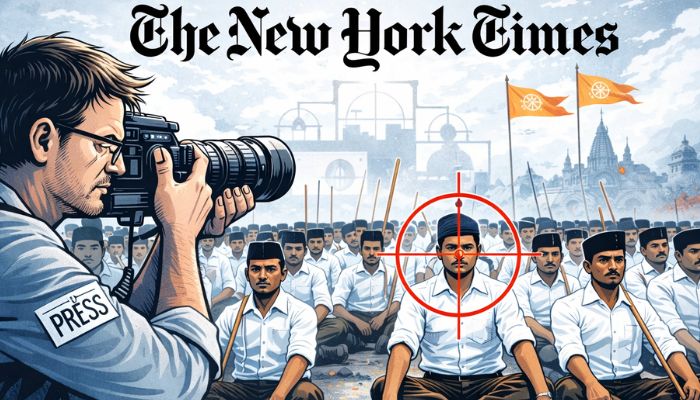
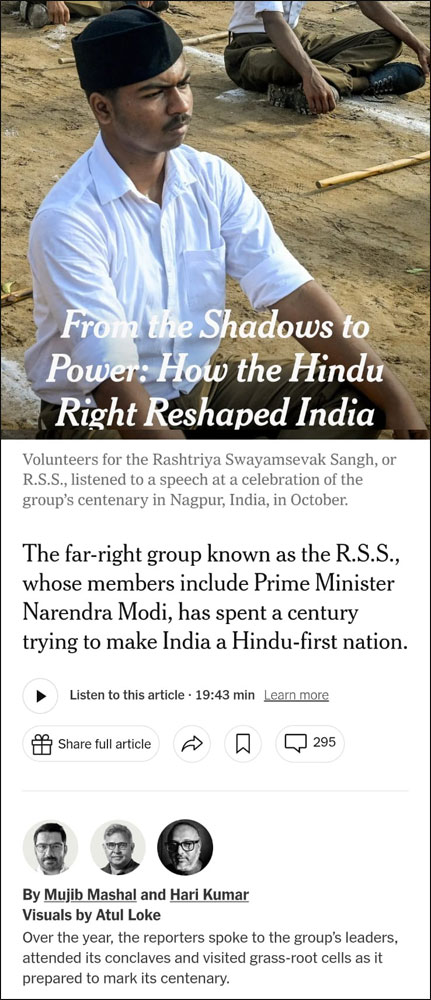
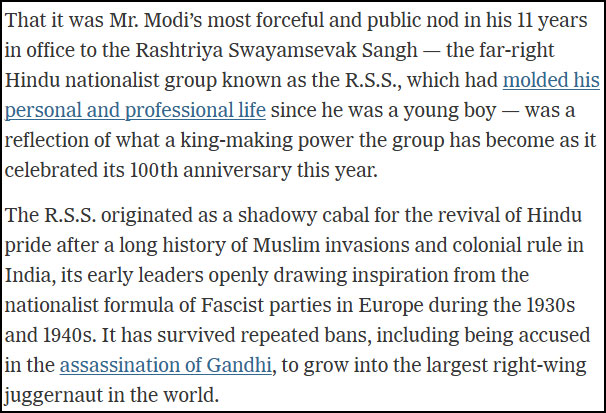
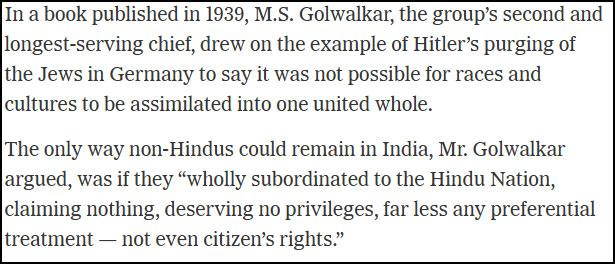
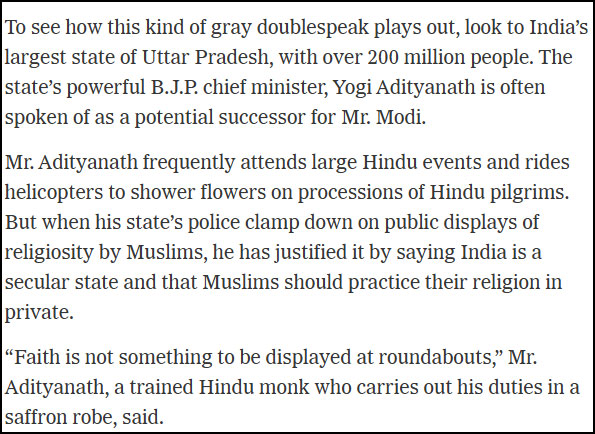
On 26th December, the New York Times published an article titled “From the Shadows to Power: How the Hindu Right Reshaped India”. The aim of publishing this particular piece, authored by Mujib Mashal and Hari Kumar, is simple. It is not just a critical piece on the Rashtriya Swayamsevak Sangh (RSS) but a downright attempt to vilify the largest Hindu organisation working tirelessly for the betterment of society.
The article constructs a work of ideological fiction that portrays the RSS as a shadowy, near-omnipotent “far-right” secret society, in other words, the “illuminati” of India. If the article, or, as a matter of fact, other such articles published by the NYT or other Left-liberal media houses, are to be believed, the RSS has “infiltrated” India’s institutions and is quietly dismantling the country’s secular republic.
Source: NYT
The issue is not that the NYT or any other media outlet criticises the RSS. It is well within their rights to question organisations that operate in India and influence the political landscape of the country. However, the issue is how it is being done. The loaded language, selective history, and insinuations that have replaced evidence, everything that these articles contain showcases a familiar Left-liberal narrative. It is a narrative that treats Hindu self-organisation itself as something inherently sinister, as if Hindus are the ones blowing themselves up, and the secular fabric of the country, while chanting religious slogans.
‘Far-right’ as a shortcut, not an explanation
The article published by the NYT repeatedly brands the RSS as a “far-right Hindu nationalist group”. It is a term borrowed wholesale from Western political vocabulary and applied without contextual explanation. The concept of the far-right is completely different in India and in Western countries. In India, the RSS is neither a political party nor a clandestine militia. It is a volunteer-based cultural organisation that has existed openly for a century.
Source: NYT
Yet “far-right” is used as a conclusion, not an analytical category. Once the Western concept of the far-right is applied to an Indian organisation, it absolves the writer of the responsibility to engage with Indian social realities. Everything that follows, from mass mobilisation to ideological influence, is automatically framed as extremism.
Nazi labels without saying ‘Nazi’
The New York Times article does not explicitly use the word “Nazi”, nor does it directly equate the RSS with Hitler or the Third Reich. That omission is deliberate. Instead, the article relies on implication and association, drawing repeatedly from fascist era imagery to guide readers towards a particular conclusion.
It states that early RSS leaders “openly drew inspiration from the nationalist formula of Fascist parties in Europe during the 1930s and 1940s” and references MS Golwalkar’s writings in connection with Hitler’s treatment of Jews. These historical references are not explored as part of a balanced inquiry but are used to anchor the present day RSS to the moral weight of European fascism.
Source: NYT
The language employed throughout reinforces this framing. Terms such as “shadowy cabal”, “secret society”, “paramilitary discipline”, “supremacy”, and “infiltration of institutions” mirror the standard vocabulary Western media uses when describing authoritarian movements.
By avoiding explicit labels while saturating the narrative with fascist tropes, the article creates moral suspicion without making a direct charge. This technique offers plausible deniability while still achieving its intended effect, framing Hindu social organisation itself as something inherently dangerous.
From political organisation to imagined ‘secret society’
RSS leaders, even when they venture into politics, give public speeches. They do not hide their association with the RSS. Those who lead the RSS locally organise open conclaves and operate daily shakhas in neighbourhood parks. This is not a secret but a well-known aspect of the organisation. In fact, anyone can attend these shakhas, irrespective of their association with the organisation itself.
Despite this clarity, the NYT insists on describing the organisation as “shadowy” and “secretive”. The authors never try to present a contradictory view or attempt to look at the organisation through an unbiased lens. The contrast between what the article presents and what the organisation really is never gets resolved throughout.
Prime Minister Narendra Modi has never concealed his RSS background. He has always called himself a “worker” of the organisation. Senior ministers, chief ministers, MPs, judges, civil servants, and professionals have openly acknowledged their association with the Sangh.
Despite this, the RSS is presented as a secret society, the “illuminati” of the Indian political and social landscape. This is not how secret societies operate. Members of secret societies are prohibited from talking about their association. As it is said, “The first rule of Fight Club is: you do not talk about Fight Club”. In the same way, the foremost rule of being a member of a secretive society is that you do not talk about it, not like Prime Minister Narendra Modi, who openly attends RSS events.
The discomfort of the NYT appears to stem not from secrecy, but from the sheer scale of the organisation. The RSS is large, disciplined, decentralised, and culturally embedded. For a Western liberal worldview accustomed to NGO-driven activism and elite gatekeeping, an indigenous volunteer network that does not seek approval is unsettling.
‘Infiltration’ without evidence
One of the allegations made in the article is that the RSS has “infiltrated” institutions such as the judiciary, police, media, and academia. This is a serious allegation. However, it is made without any evidence. There is no documentary proof, no command structure, no directives, and no financial trail demonstrating such capture.
Instead, the authors present ideological proximity and organisational overlap as evidence of subversion. By that logic, Left-leaning academics who have dominated Indian universities for decades would also qualify as an “infiltration”. Pro-Naxal ideologues ruling academia for decades can be seen as Urban Naxals ruining the Indian education system from its roots. However, when such allegations, which are actually true, are raised, Left-liberal ideologues claim an attack on free speech.
The word “affiliate” is repeatedly used by the authors as a convenient device. Any act by any group vaguely aligned with Hindu causes is folded into the RSS universe without establishing organisational responsibility.
Recycling fascism and Gandhi without legal closure
As is customary in Western coverage of the RSS, the article revisits alleged fascist inspirations of early Sangh thinkers and again invokes Mahatma Gandhi’s assassination. Notably, Indian courts exonerated the RSS as an organisation decades ago. However, outlets like the NYT carefully stop short of that legal conclusion and ensure that the insinuation lingers in their narrative. It is convenient to claim that the RSS was behind Gandhi’s assassination without engaging with the judicial outcome, as it fits the narrative.
This is not historical inquiry. It is narrative maintenance. The RSS has been permanently framed as morally suspect, regardless of judicial findings, because absolution would disrupt the story.
Bulldozers without chronology
Then comes the Uttar Pradesh section. It also follows a familiar template. Since Chief Minister Yogi Adityanath, the firebrand monk who governs the most populous state in the country, took charge, Western media has tried to build a negative image around him.
Source: NYT
The entire episode has been selectively constructed around the “I love Mohammed” poster controversy, which led to communal unrest in parts of the state. What the article omits is that the situation quickly escalated into public disorder, making it the chief minister’s responsibility to restore law and order and act against those who attempted to provoke communal violence.
At the same time, questions were raised in Western media over flower petals being showered on Kanwariyas, who were undertaking a peaceful religious pilgrimage across states. Police action in Uttar Pradesh has consistently followed incidents of law and order breakdown. In cases such as Gyanvapi and the Sambhal mosque, rioters attempted to create unrest along communal lines, and Chief Minister Yogi Adityanath’s decisive intervention prevented a local disturbance from turning into a wider conflagration.
Bulldozers, arrests, internet shutdowns, and police action are presented as religious repression without explaining the events that triggered the state response. When Yogi Adityanath took charge, the law-and-order situation was in the worst possible condition. Riots and communal tension were common. Gangsters dominated many areas. However, when Yogi Adityanath assumed office, he made it clear that law and order was his priority, and since 2017, much has changed in that regard. Even bulldozer action takes place only after it is evident that the building is illegal and linked to criminal activity.
Yet, in the article, law enforcement is stripped of chronology and converted into ideological persecution. Governance becomes authoritarianism by default, and popular support is dismissed as mob mentality.
When charity becomes fascist infrastructure
Western and Left-liberal media, including in India, has a habit of framing everything negatively if it is Hindu. In a recent article, The Caravan described schools, hostels, orphanages, old age homes, medical missions, yoga centres, and disaster relief initiatives associated with the RSS as “last-mile” instruments of ideological control. The NYT article in fact cites the Caravan article explicitly.
This framing exposes the deeper anxiety of the Left-liberals. The problem is not the work but the organisation itself. If the same work were done by an NGO linked to Soros or USAID, they would be pouring praise. At that point, criticism ceases to be political and becomes civilisational. Hindu civil society itself is rendered illegitimate.
What really unsettles Left liberal media
The background of the NYT article is filled with unspoken fear. The RSS has succeeded in building institutions that endure across generations without foreign funding, elite endorsement, or ideological conformity to Western liberalism, something no other organisation has managed in India.
The RSS produces cadres, not conferences. It relies on volunteers, not donors. It functions through decentralisation, not bureaucratic grants. The longevity and independence of the RSS are often interpreted as conspiracy because Western and Left-liberal media either do not understand this model or refuse to understand it due to ideological hostility towards Hindus.
Democracy acknowledged, but never respected
The NYT article repeatedly suggests that while Indians vote, the RSS “really” rules. Institutions function but are allegedly “co-opted”. Electoral victories are explained away as organisational manipulation. Such framing allows Western commentators to question Indian democracy without openly saying so.
When political outcomes do not align with their preferences, democracy itself is quietly delegitimised. Since Prime Minister Modi took charge of the Prime Minister’s Office in 2014, Western media has repeatedly suggested that Indian democracy is declining or that India has become an authoritarian state.
Fear masquerading as journalism
There is no doubt that the RSS is open to criticism. If someone believes the RSS has done something wrong, it is their right to question it. Its ideology, politics, and influence merit scrutiny. However, what the NYT has offered in its coverage is not scrutiny. It is a fear narrative constructed through loaded labels, historical shortcuts, and civilisational misunderstanding.
By portraying the RSS as an ultra-powerful secret society and recycling Nazi analogies, the NYT reveals less about India and more about the Left-liberal inability to accept the fact that the Hindu community can self-organise on its own terms.
The RSS has not emerged “from the shadows”. It has always been in plain sight. The real discomfort lies in the fact that it no longer seeks permission to exist.
As per the information available on Apple Music about the official documents and credits of the song, the lyrics were written by Sahir Ludhianvi and composed by Roshan. This qawwali features the voices of several singers and was recorded as a group performance. Its singers included Manna Dey, Mohammed Rafi, Asha Bhosle, Sudha Malhotra, and SD Batish. According to records, this is its first published and widely recognised film version.
Based on this, it is said that the official film origin of this qawwali is linked to Indian cinema and Bollywood. Music labels and film archives clearly list the names of the writers, composers, and singers. Therefore, when questions like “who gets the credit?” arise, they are referring to the 1960 film “Barsaat Ki Raat.”
However, Qawwali is not a classical or individual form but a shared, oral musical tradition, descended from the Sufi tradition, with roots in the Punjab region. This is why some music lovers and historians argue that the melody and sentiment of the qawwali “Barsaat Ki Raat” appear to be inspired by the Lahore-centred Sufi qawwali tradition. Often cited in this context is the qawwali “Na Toh Butkade Ki Talab Mujhe,” sung by Mubarak Ali Khan and Fateh Ali Khan in the 1950s. The song was written by Amir Sabri.
However, there is a crucial distinction here. While the claims of inspiration or cultural similarity can be a matter of historical debate, there is no concrete, published audio or documentation available to prove that the full lyrics of “Na To Caravan Ki Talash Hai” were recorded and released in the same form before 1960. Therefore, similarities are not seen as evidence but as cultural influence. Such influences are common in oral traditions, but documentary evidence is necessary to establish credit.
This song from “Barsaat Ki Raat” is not just a qawwali; it is a 13-minute-long song that begins with the Sufi and Nirgun traditions and progresses to the Bhakti movement. It offers glimpses of Radha-Krishna and Meera, then reaches Buddha’s Bodhi tree, and ultimately becomes a symbol of Christ’s compassion. Due to this, it is considered a cinematic document of the Ganga-Jamuni culture and India’s multi-religious cultural consciousness.
Although Qawwali is extremely popular among music lovers in Pakistan and across the Indian subcontinent, its origin and composition are from India.
The bottom line is that this qawwali may be part of a culturally shared heritage, as Sufi music’s roots predate the modern India-Pakistan border. However, when it comes to the song’s origin, authorship, and credit, available historical and filmic records clearly indicate that its authentic, published, and recognised origin comes from the 1960 Indian film “Barsaat Ki Ek Raat.” This is why, while acknowledging cultural sharing, the current debate often gives official credit to Indian cinema.