Home Blog Page 2032

Congress and AAP supporters use fake video from Myanmar to paint Christians as victims in Manipur: Here is a fact-check

On June 19, Congress supporters used a fake video from Myanmar to paint Christians as victims in Manipur. In a now-deleted tweet, Congress supporter Manish Kumar wrote, “Manipur is out of the hands of Modi and Shah. Videos have come to light where the armed citizen is assaulting a young Christian girl, and in the end, they shoot her dead. Manipur is burning, and Modi is silent.” Though Manish has deleted the tweet, its archive can be checked here.

Source: Twitter/iAnkurSingh

Aam Aadmi supporters shared the same video with the same text. Kailash Meena of Thanagazi, who is AAP’s state joint secretary from Rajasthan, shared the video with exact same text. By the time this report was published, Meena had not deleted the fake video. It archive can be checked here.

Source: Twitter

Twitter user BefittingFacts debunked the claims. He replied to the now-deleted Tweet, “This is an old video from Myanmar. As you are a Congressi, let me tell you, Myanmar is not in India.”

Upon research, we found that the video was from June 2022. ‘Mizzima – News in Burmese’ published a report on the video on December 5, 2022. The report in Burmese noted that the incident occurred on December 3 in the evening. A group of men and women in guerrilla uniforms were seen beating and punching a handcuffed young woman.

After the expose, Manish was seen threatening netizens for publishing screenshots of his now-deleted Tweets. Quoting iAnkurSingh, he said, “Sir, do not misuse my picture. I tweeted the wrong video and deleted it. Now you are intruding on my privacy. You will face a case under IT Act. You should not have used my profile.”

Though he deleted the tweet, Manish had retweeted multiple tweets that quoted him. Those RTs were not removed by him.

Source: Twitter

Notably, the Left-liberals are peddling a narrative to target Hindu Meiteis and paint Christians as victims in the conflict among Kuki and Meitei communities in Manipur.

For example, Kavita Krishnan shared a report published in The Hindu claiming, “Meitei women blockade roads so that mobs can massacre Kukis undisturbed. “Even if the affected villagers make distress calls, the forces are unable to reach”. That cliche about women wanting peace & love, unlike violent men, isn’t ever true.”

She added that the report was not misrepresented by the “mainland media”, but it was a ground report that also pointed out that Kukis were blockading roads obstructing the supply of essentials into the state. However, she added, “But blockades to facilitate ethnic cleansing are in no way comparable to chakka jams,” giving a sort of clean chit to Kukis.

Uttar Pradesh: Sultan Ahmed threatens Vijay Pratap Yadav after he goes to inspect a madarsa in Siddharthnagar, FIR filed

Vijay Pratap Yadav, Deputy Director, Minority Welfare, Basti Mandal, who went to conduct a regular inspection of a madrasa named Jalalul Uloom in Mahdeiya was threatened by its manager Sultan Ahmed in the Siddharthnagar district of Uttar Pradesh. A first Information Report (FIR) has been lodged against the accused on the complaint of the official, on Sunday.

The Mini Industrial Training Institute (ITI) madarsa Jalalul Uloom is run by Sultan Ahmad, and Vijay Pratap Yadav arrived there to audit the institution on June 14. The latter discovered numerous flaws during his inspection. One out of every three madarsa staff was reportedly absent without authorisation. Furthermore, two out of three teachers were not found on the spot. Notably, there was no documentation of these absences in the records.

The cleanliness in the institution, according to Yadav, was appalling. He had to use a broom to clear up the debris that was all over the place. Tanmay Pandey, a district minorities welfare officer accompanied Vijay Pratap Yadav as well. The former issued a warning to Sultan Ahmed due to all of the aforementioned problems and demanded a response by June 17.

However, Sultan Ahmed, on Saturday, called the deputy director and threatened him with grave consequences rather than providing a written reply. “They found only my madarsa to probe,” he asked.

The Siddharthnagar police have already opened an investigation into this case. The manager attempted to place all the blame on the officials after the charges were brought against him. He alleged that Vijay Pratap Yadav was spreading videos of the girls in the madarsa online without permission.

He informed that he will also make a police complaint and mentioned that the squalor in the institution was actually leaves blown by a strong wind. He claimed that even after repeated requests, a cleaning worker has not been provided for the madarsa yet. The matter is currently under inquiry.

‘Bhaad me jao’: Javed Miandad wants Pakistan to refuse to come to India for World Cup, blames Indian PM Modi for breakdown of India-Pakistan relations

Former Pakistani cricketer Javed Miandad, who regularly spews venom against India from time to time, has once again commented on the India-Pakistan cricketing relations. Talking about the upcoming One Day Internationals World Cup, which is scheduled to be held in India later this year, Miandad said that the Pakistan team should not visit India if the Indian team doesn’t come to Pakistan for the Asia Cup.

Notably, the Pakistan Cricket Board (PCB) proposed a hybrid model for the Asia Cup to Asian Cricket Council (ACC) which was recently accepted by the ACC. In this model, India will play all their matches in Sri Lanka while the rest of the matches will take place in Pakistan. However, it seems like Javed Miandad is not pleased at all with this proposal by the PCB. Since India is not visiting Pakistan during the Asia Cup under this hybrid model, Miandad now wants Pakistan to boycott the ODI World Cup.

Talking to the reporters, Miandad said, “Pakistan has been to India in 2012, and even in 2016 now it is the turn of the Indians to come here. If I had to make a decision, I would never go to India to play any match, even the World Cup.”

The controversial ex-cricketer further added, “Till India doesn’t come here (Pakistan) and doesn’t play with us, we should not visit India. We do not need them, we are better than them, our cricket is better than them. We don’t care about them. We have enough money, ground, and cricketers. All our cricketers are making a name for themselves in the world.”

Miandad further said, “Na aao, main kehta hoon ki bhaad me jao nahi aate to. Humein kya fark padta hai. (Don’t come, I say go to hell if you don’t come. We don’t care.)”

During his rant, Javed Miandad also took a dig at Indian Prime Minister Narendra Modi and said that Modi is destroying India and he will destroy cricket as well. Miandad also expressed hope that one day Indians will beat PM Modi.

India last toured Pakistan for a series back in 2008 for the Asia Cup but the cricketing relations between the two nations collapsed following the deadly 26/11 terror attack carried out by Pakistani terrorists.

The ODI World Cup is scheduled to be held in India from 5th October to 19th November later this year. This will be the first instance in the history of ODI World Cup that the entire tournament will be held in India. Even though the detailed schedule is not out yet, the India-Pakistan clash is rumoured to be scheduled for October 15 at Narendra Modi Stadium in Ahmedabad.

Gita Press to be conferred with Gandhi Peace Prize 2021, Congress and assorted ‘secular liberals’ outrage

On 18 June, PM Modi tweeted to congratulate Gorakhpur-based Gita Press for being conferred with the Gandhi Peace Prize for the year 2021. He praised the organization for its commendable work over the last 100 years toward furthering social and cultural transformations among the people.

The Centre announced on 18 June that the Gandhi Peace Prize for 2021 will be awarded to Gita Press, the organization that has dedicated itself for the sole purpose of taking Hindu religious scriptures and books to every household. As per the PIB notification, the award carries an amount of Rs. 1 crore, a citation, a plaque, and exquisite traditional handicraft/handloom items.

The Prize is given for outstanding contribution towards social, economic, and political transformation through non-violent and other Gandhian methods.

The Government of India announced the Gandhi Peace Prize in 1995, on the occasion of the 125th Birth Anniversary of Mahatma Gandhi as a tribute to the ideals espoused by Mahatma Gandhi. The award is open to all persons regardless of nationality, race, language, caste, creed, or gender.

ISRO, Ramakrishna Mission, Akshaya Patra, Grameen Bank of Bangladesh, Sulabh International, Dr. Nelson Mandela, and Archbishop Desmond Tutu are some of the organizations and individuals who have received the Gandhi Peace Prize in the past.

In 2020, the prize was given to Bangabandhu Sheikh Mujibur Rahman of Bangladesh.

Congress and other assorted ‘secular liberals’ start outraging

The announcement of the Gandhi Peace Prize for Gita Press has caused sudden outrage among Congress leaders and so-called ‘secular, liberals’.

Congress spokesperson Jairam Ramesh took to Twitter to condemn the selection and asserted that giving the Gandhi Peace Prize to Gita Press is the same as giving it to Godse, or Savarkar.

RJD spokesperson Manoj Jha has attacked the center too. “Don’t expect things which this government does not. They are fundamentally anti-Gandhi,” Jha told PTI.

Opposition leaders, and many ‘secular-liberals’ have been outraged by the decision. One Saib Bilaval wrote, “Gita Press was responsible for some of the most rabidly communal, casteist & anti-women discourse. While Kalyan’s editor Poddar did correspond with & admire Gandhi, the overall role of the magazine & Press was absolutely un-Gandhian & anti-peace during partition.”

Gandhi and Tagore were the article contributors in the first issue of ‘Kalyan’ magazine

Though the Congress leaders and others are outraging over Gita Press getting the Gandhi Peace Prize, it is notable here that the ‘Kalyan’ magazine published by Gita Press, in its first issue in 1926, had featured articles by Mahatma Gandhi himself and Rabindranath Tagore.

Gita Press completed 100 years in 2023

Gita Press was started exactly 100 years ago in 1923. Established by a Marwari businessman and Hindu spiritualist Jayadayalji Goendka, it is one of the world’s largest publishing houses. Hanuman Prasad Poddar, another prominent Hindu leader, was Gita Press’ co-editor. Though initially started with contributions by prominent Hindu businessmen and leaders, Gita Press now proudly insists that they do not need donations or help, and do not even accept advertisements in their published works.

In a time when most publication houses are suffering losses, Gita Press thrives, solely based on its Dharmic beliefs and its mission of making Hindu religious books available to Hindus at a nominal price. So far, the organization has published 41.7 crore books in 14 languages, including 16.21 crore copies of the Shrimad Bhagavad Gita and 1173 lakh copies of Ramacharitmanas.

It churns out 70000 books in a day.

Gita Press books are found in every single Hindu household. Hindus carry small ‘pocket’ versions of Gita and Hanuman Chalisa with them and the name ‘Gita Press, Gorakhpur’ is a familiar term for billions of Hindus worldwide.

Cruelty-free practice and business rooted in Dharma

Gita Press never uses adhesives or chemicals that are derived from animals. Though their printing practices have evolved in recent years to using imported machinery from Japan and Germany, the staff adhere to the principles of Sanatan Dharma throughout the production and packaging process. The Dharmic books, once ready, are never placed on the ground.

Why are Congress leaders and pseudo-liberals outraged

Congress is primarily outraged because Gita Press is a Hindu organization and it has the word ‘Gita’ in it. Just because the organization publishes Hindu religious books, and had voiced support for Hindus in its past publications, Congress has probably decided that it should not exist.

However, Muslim League is a ‘secular’ organization’ as per Congress. By selectively citing instances where the stand taken by Kalyan magazine seems regressive, the naysayers are trying to ignore the revolution that Gita Press has brought not just in Hindi publishing but the immense cultural contributions that the Press has made in the 100 years of its existence.

Canada: Posters celebrating Khalistani terrorist Talwinder Singh Parmar placed outside Hindu Temples ahead of separatist rally. What we know so far

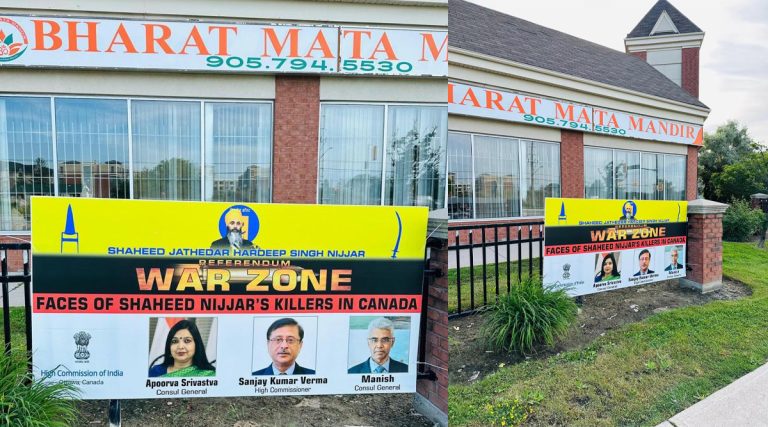
On June 18 (local time), pro-Khalistani Twitter handle Sikh Narrative shared a video of different Hindu religious sites across Toronto, Canada where posters of Khalistani terrorist Talwinder Singh Parmar were placed. Parmar was involved in Air India Flight 182 bombing. Locations, where these posters were placed include outside of Bharat Mata Mandir, on the opposite side of Hindu Sabha Temple, on the opposite side of Krishna Temple, outside BAPS Temple and outside Ram Mandir. Sikh Narrative’s Twitter handle is withheld in India.

Source: Twitter

The poster had a photograph of Khalistani terrorist Talwinder Singh Parmar with information about the Khalistan Car Rally scheduled for June 25, 2024. At the bottom of the poster, it read, “Investigate India’s role in the 1985 Kanishka bombing”, insinuating that India was behind the Air India flight bombing and not Khalistani terrorists.

Retired Canadian Broadcasting Corporation (CBC) correspondent and author of ‘Blood for Blood – Fifty Years of the Global Khalistan Project’ Terry Milewski, who earlier shared information on similar posters, wrote, “More Khalistani posters honouring the Air India bomber popped up, however briefly, outside Toronto’s Hindu temples. It seems it’s not enough to rally at the victims’ memorial, glorify their killer, and pretend he didn’t do it. Gotta be more provocative.”

According to the poster, the car rally will be held on June 25, starting at 12.30 PM at The Great Punjab Business Centre at Malton in Toronto and ending at Air India 182 Memorial at Humber Bay Park West in the same city. It further demands, “Investigate India’s role in 1986 Kanishka bombing,” a terror attack carried out by the Khalistani terror group Babbar Khalsa.

On June 23, 1985, Air India Flight 182, which was travelling from Toronto to London with 329 passengers and crew, was blown in mid-air off the coast of Ireland. All of the lives on board were lost as a result of the blast. Sikh radicals were reportedly charged with the derailment of the flight, and one person was found guilty in 2003.

Canadian officials in Montreal found three suspicious items during a routine stop, which set off a chain of events. Afterwards, the goods were taken off the plane before proceeding to London. However, the aircraft exploded while it was airborne, about 45 minutes short of its intended destination, without any warning or distress calls being attempted.

Emergency rescue teams were dispatched to the spot when the plane vanished from radar screens, but no survivors were discovered. Later, 131 bodies were pulled from the sea by the former.

Officials at the airline initially believed that Sikh extremists had detonated a bomb on the Air India flight. Two months after the fatal occurrence, two accused were eventually arrested. Canadian police accused Talwinder Singh Parmar of orchestrating the attack. He was charged, but the case was later withdrawn. The Indian police killed him.

Inderjit Singh Reyat, the other culprit and a Sikh living in Vancouver, pled guilty to manslaughter in relation to the bombing. He received a five-year prison term in 2003. Notably, he had already been given a 10-year prison sentence for his part in the bombing of two baggage handlers at Japan’s Narita Airport on the same day as the Air India Flight 182 tragedy.

Although Ripudaman Singh Malik and Ajaib Singh Bagri, two further suspects, were apprehended in 2000, they were exonerated in 2005 owing to insufficient evidence. A Canadian commission was constituted in 2006 to look into the instance. The accident was caused by a “cascading series of errors,” according to the commission’s five-volume report published in 2010.

It emphasised precisely how Canadian intelligence and security organisations engaged in “turf wars” and failed to exchange critical information with one another, which resulted in the demise of so many innocents.

33 years after the horrific assault, Canadian Prime Minister Justin Trudeau paid respect to the 329 victims and called the atrocity the “single worst terrorist attack” in his nation’s history.

Hindu man and Muslim woman decide to get married in Temple, invite ire of Kerala police: Girl’s family files complaint, police manhandles groom

On Sunday, June 18, a dramatic scene unfolded when the Kayamkulam police in Kerala stopped an interfaith couple from getting married, misbehaved with the Hindu groom and whisked away the girl from a temple in Kovalam minutes before the duo were set to tie the knot. The video of the incident went viral on social media.

Akhil and Alfia, the couple, had decided to get married to each other of their own volition. According to reports, the duo reached the Sri Madan Tampuran temple in Malavila Panamoot on KS Road, Kovalam at 5 pm on Sunday. The Kayamkulam police, however, reached the site and manhandled the groom and did not allow him to go near the bride. They also forcefully took the bride away.

The action was reportedly taken based on a complaint lodged by the Muslim girl’s family. The girl’s family reportedly knew she intended to marry the Hindu youth of her own free will, but even after that they reportedly filed a missing person report to separate the two and obviously frame the Hindu boy for a crime he had not committed.

As seen in the video, a few lady police officers can be seen physically pulling the bride and shoving her into a car, while the latter resents. A male officer in seen yelling at the bribe when she argues with him and urges them to let her go. The groom is also pushed and prevented from going near the bride. One police officer sits in the front seat of the car and drives away.

According to reports, Alfia, a Kayamkulam native, and Akhil, a Kovalam native from KS Road, fell in love. Alfia came to Kovalam last Friday after deciding to settle down with Akhil. Then, on Friday (June 16) night, Alfia’s family and Akhil’s family met with the assistance of the Ward Member and SI of the Kovalam Police Station, and Alfia was permitted to go with Akhil.

It was decided that the duo would tie the knot as per Hindu customs in the Sri Madan Tampuran temple in Malavila Panamoot on KS Road, Kovalam at 5 pm on Sunday. The couple reached the temple but minutes before they could get married, police officers from the Kayamkulam town, from where the Muslim bride belonged, arrived in two vehicles. They stopped the wedding and forcibly dragged her away.

Narrating what transpired just minutes before they were to marry, Akhil said, ”The police arrived in two vehicles from Kayamkulam. They stopped the wedding from happening and forcibly dragged her away.”

The couple on Monday told the media that the bride was, thereafter, taken to a magisterial court where she gave a statement that she had left with the groom of her own free will and wanted to go with him.

”After recording my statement, I was allowed to leave with Akhil who had also reached there,” she said.

Meanwhile, a senior police officer of Alappuzha district said that there was a missing person complaint lodged in Kayamkulam police station and as part of it they had to produce the woman before a court there.

FIR copy (Source: Twitter)

”The officers were directed to produce the woman before the court. So they were just doing their duty. Not aware of any use of force by them. The girl told the court she wants to leave with the groom and she left with him,” the officer told the media.

Alfia, meanwhile, said that the police took her away despite she has already given a statement a few days back that she was leaving with Akhil, whom she knew for over a year, of her own free will to get married to him.

”The missing person complaint was lodged in Kayamkulam police station after that. It was done by my parents. They do not want me to live with him. They want to take me away,” she lamented.

Rs 2000 notes withdrawal to boost deposits, consumption, among other parameters, argues SBI Research

Though the Reserve Bank of India may have decided to withdraw Rs 2000 banknotes from circulation as a part of its currency management, the move is likely to boost various macroeconomic parameters.

On May 19, 2023, RBI decided to withdraw the Rs 2000 denomination banknotes from circulation but said it will continue to remain as legal tender. However, RBI has advised banks to stop issuing such banknotes with immediate effect. 

The Rs 2000 denomination banknote was introduced in November 2016 under Section 24(1) of the RBI Act, 1934, primarily to meet the currency requirement of the economy in an expeditious manner after the withdrawal of the legal tender status of all Rs 500 and Rs 1000 banknotes in circulation at that time.

The objective of introducing Rs 2000 banknotes was met once banknotes in other denominations became available in adequate quantities. Therefore, the printing of Rs 2000 banknotes was stopped in 2018-19.

SBI Research in a report analysed and argued how the withdrawal of Rs 2000 banknotes could boost bank deposits, repayment of loans, consumption, RBI’s retail digital currency usage, and overall economic growth.

RBI Governor Shaktikanta Das the other day said 50 per cent of the to-be-withdrawn Rs 2,000 notes had already come back to the system after the May 19 announcement, and of those 85 per cent were through bank deposits.

“Totally so far about Rs 180,000 crore of Rs 2000 notes have come back. This is roughly about 50 per cent of the Rs 2000 notes which were in circulation on March 31,” RBI Governor Das said at a post-monetary policy meeting press conference, adding about 85 per cent of those notes, on a provisional basis, have come back as deposits in bank accounts.

On the basis of the RBI governor’s comments, the SBI Research in its latest Ecowrap report, put out on Monday, authored by Group Chief Economic Adviser Soumya Kanti Ghosh, argued that deposits are likely to increase.

“Though some amount would be withdrawn following the deposit, but going by the current trends, CASA deposits are likely to increase (Rs 1.5 lakh crore) due to this measure,” the SBI Research report said.

The report, citing All Scheduled Commercial Bank (ASCB) data, said it shows that there has been an increase in total deposits of Rs 3.3 lakh crore during the fortnight ended Jun 2, 2023.

“The average increase in deposits during the same fortnight in the last two years was around Rs 1.5 lakh crore. Thus, taking that also into account, banks may have received additional deposits of around Rs 1.8 lakh crore during the fortnight this year. It seems Corporates, flush with in-hand liquidity, are parking the additional funds with Banks,” the report added.

Adding to the Rs 2000 banknote deposits, some of the sectors — Refinery, Oil and Gas, Power, and Chemicals — which reported improved cash and bank balance, according to the report, are believed to be more active in parking funds with banks.

On the credit front, as per SBI Research’s assessment, 30 per cent of deposits (or Rs 92,000 crore) might go for loan payment and argued that credit growth continues to remain quite strong despite repayments getting frontloaded.

Further, the Ecowrap report argued that one of the other major benefits of withdrawal of Rs 2000 note might be the immediate uptick in consumption demand. As per estimates, the consumption demand may be frontloaded by Rs 55,000 crore.

“With the banknote remaining a legal tender, unlike demonetization, consumption could see a boost. Though, RBI asked customers to deposit or exchange the Rs 2000 notes, but it is expected that high-value amounts could move to high-value spends such as gold/jewellery, high-end consumer durables like AC, mobile phones etc, and real estate,” the report said.

Cash value transactions at energy stations, cash on delivery for purchases, donations in temples, and various sundry purchases are also likely to rise, it argued.

The total value of these Rs 2000 banknotes in circulation had declined from Rs 6.73 lakh crore at its peak of March 31, 2018 (37.3 per cent of Notes in Circulation) to Rs 3.62 lakh crore constituting only 10.8 per cent of Notes in Circulation on March 31, 2023. It was also observed that this denomination was not commonly used for transactions.

Meanwhile, people can exchange or deposit their Rs 2,000 notes in bank branches and regional branches of RBI. A non-account holder also can exchange Rs 2000 banknotes up to a limit of Rs 20,000 at a time at any bank branch.

As of now, RBI said the exchange facility is available till September 30, 2023, and the notes continue to be legal tender. September 30 has been decided as the last date for the purpose of completing the exercise in a time-bound manner and to provide adequate time to the public. RBI is likely to revisit the September deadline based on the situation going ahead.

The demonetization drive carried out in 2016 and the withdrawal of Rs 2000 now is not similar. Legal tender status for Rs 500 and Rs 1000 notes were withdrawn right from day one in 2016. For Rs 2000 notes, it, however, continues to be legal tender and people can use it for any transactions.

“Good thing is that there has been no rush in any of the banks,” the RBI governor said recently, appealing to people not to rush to banks in panic. He particularly urged people to avoid the last-minute rush at bank branches.

(This news report is published from a syndicated feed. Except for the headline, the content has not been written or edited by OpIndia staff)

Do not interfere with religious affairs of Sikhs: SGPC chief warns AAP after Punjab CM’s free Gurbani telecast decision sparks row. All you need to know

A resolution is scheduled to be presented in the assembly during the special session on June 20 by the incumbent Aam Aadmi Party in Punjab. The state government would alter the Sikh Gurdwara Act, 1925, according to Chief Minister Bhagwant Singh Mann’s statement on Sunday, to ensure free transmission rights of Gurbani from the Golden Temple.

He posted, “With the blessings of God, we are going to make a historic decision tomorrow, as per the demand of all devotes, we are adding a new clause in the Sikh Gurdwara Act 1925 that the transmission of Gurbani from Harminder Sahib will be free for all, no tender required. Tomorrow in the cabinet, on June 20, a vote will be taken in the state assembly.” 

The PTC network, owned by the influential Badal family of the former chief minister of Punjab and union minister Prakash Singh Badal, has been given authorisation to broadcast Gurbani from Harmandir Sahib by the Shiromani Gurdwara Prabhandhak Committee (SGPC), the highest board for Sikhs. The move by the Punjab government will end the network’s monopoly and level the playing field for all television networks.

On a political level, it is expected to lessen the Shiromani Akali Dal’s pantheistic reputation, which is also controlled by the Badal family. The Shiromani Akali Dal, the SGPC, and the Badal family all aggressively rejected the chief minister’s prior proposal to make Gurbani broadcasts free. Notably, the Badal Family have been reported to have a significant impact on SGPC as well.

The fresh announcement has infuriated Harjinder Singh Dhami, president of the Shiromani Gurdwara Parbandhak Committee (SGPC), who stated that the Shiromani Committee, an organisation chosen by the Sikh community, could only recommend amendments to the legislation.

He tagged the chief minister and expressed his disapproval on social media. “Sir, do not try to interfere with the religious affairs of the Sikhs. Sikh affairs are related to the sentiments and concerns of the Sangat (Sikh community) in which governments have no right to interfere directly. You are talking about adding a new section by amending the Sikh Gurdwara Act 1925.”

The Sikh Gurdwaras Act of 1925 was a piece of legislation in British India which legally defined Sikh identity and brought Sikh gurdwaras under the control of an elected body of orthodox Sikhs.

The SGPC chief further remarked, “About which process you do not know. This task can be done by the Government of India only in the Parliament with the recommendations of the Shiromani Committee, an organization elected by the Sikh community. The Punjab Government has no right to amend this Act. Do not confuse the country for your political interests.” He added that Gurbani broadcasting is not like other forms of media and that its holiness and dignity cannot be disregarded.

The opposition in Punjab also reacted sharply to the declaration by the Punjab administration. Shiromani Akali Dal leader and former education minister of the state labelled the decision as unconstitutional and a direct interference in the religious activities of the Sikh community. He wrote, “Hon’ble Chief Minister, this act of yours is unconstitutional and direct interference in the religious activities of the Sikh community. The Sikh Gurdwara Act is under Parliament.”

“The Sikh community has elected the Shiromani Gurdwara Parbandhak Committee through voting to take decisions regarding Guru Ghar under this Act of Parliament. Has the above committee passed any such resolution in this regard,” he asked and warned, “Without that, even the Parliament cannot amend this Act. The Sikh community will never tolerate this anti-Sikh work being done under the orders of Arvind Kejriwal.”

Congress leader, former leader of the opposition in the legislative assembly and serving MLA from Bholath, Sukhpal Singh Khaira argued that the state cannot make any changes to the Sikh Gurdwara Act, 1925, as it is central.

However, Navjot Singh Sidhu lauded Bhagwant Singh Mann-led government and proclaimed, “This was a cherished desire of millions of Sikhs across the globe including me.”

The chief minister has defended his action and opined that it is in line with the sentiments of the “Sikh Sangat around the world.” He pronounced that it will promote the “Sarb Sanji Gurbani” (Everyone’s Gurbani) across the globe in an effort to spread the idea of the “welfare of all.”

PM Modi to address Joint US Congress this week: The past 11 times he addressed foreign legislature and how he surpasses past PMs

Indian Prime Minister Narendra Modi is all set to address a joint session of the US Congress on Thursday (June 22). He will be on a State visit to the United States between June 21 and June 24 this year.

The historic invite was extended to PM Modi by US House Speaker Kevin McCarthy, Senate Majority Leader Chuck Schumer, Senate Republican Leader Mitch McConnell and House Democratic Leader Hakeem Jeffries.

Interestingly, this will be the 12th occasion when Prime Minister Narendra Modi will address the legislature of a foreign nation – a historic feat not achieved by other world leaders. He holds the distinction of addressing the Parliament of 11 countries in the past 9 years, thus surpassing all his predecessors. Follow is the list of foreign parliaments addressed by PM Narendra Modi.

List of Foreign Parliaments addressed by PM Narendra Modi

  • Bhutan – Shortly after becoming the Prime Minister of India, Narendra Modi was invited to address the joint session of the Bhutanese parliament on June 16, 2014. During his speech, he emphasised, “India is committed to good relations with its neighbours. Stability and development in India will help neighbours like Bhutan.” PM Modi was also given a guard of honour.
  • Nepal: Two months later in August, he addressed the Constituent Assembly of Nepal. “Our relations with Nepal are as old as the Himalayas and the Ganga…It’s the land where Lord Buddha was born, this country has rich cultural heritage…India is looking at Nepal with hope,” PM Modi had said.
  • Australia: He also addressed the Joint Session of the Australian Parliament in November 18, 2014. This honour was not accorded to any other Prime Minister before Narendra Modi. “Today, as I stand in this temple of democracy, I consider nations such as ours to be blessed, because democracy offers the best opportunity for the human spirit to flourish, because we have the freedom to choose, the right to speak and the power to remove – and, for us in politics, with no option but to leave with grace,” he had remarked.
  • Fiji: A day after addressing the Parliament in Australia, PM Modi was in Suva to address the Fiji Parliament on November 19, 2014. It was the first time that any world leader was given the opportunity to make a speech at the country’s legislature. In May this year, Narendra Modi was awarded the highest civilian award i.e. Companion of the Order of Fiji (CF) by Prime Minister Sitiveni Rubuka.

Sri Lanka: On March 13, 2015, Prime Minister Modi addressed the Parliament of the island nation, Sri Lanka. It was also the first instance when an Indian PM was accorded the opportunity. “I am convinced that the future of any country is influenced by the state of its neighbourhood. The future that I dream for India is also the future that I wish for our neighbours. We in this region are on the same journey: to transform the lives of our people,” he said during his historic address.

Mongolia: Two months later, he was in Mongolia to address the ‘State Great Khural’ (the country’s unicameral Parliament). Interestingly, it was also the first time that an Indian Prime Minister visited the East Asian nation.

United Kingdom: On November 12, 2015, Prime Minister Narendra Modi delivered his historic address at the Parliament of the United Kingdom. “So much of the modern history of India is linked to this building. So much history looms across our relationship,” he had said on the momentous ocaasion.

Afghanistan: The Indian government aided the construction of the Parliament of the war-torn nation of Afghanistan. While inaugurating the building on December 25, 2015, PM Modi stated, “A country with an abiding faith in the tradition of Jirga has chosen the path of democracy. And, it has done it against challenges that would have defeated a lesser people.”

United States: On June 9, 2016, PM Modi addressed a Joint Session of the US Congress. He said, “In granting me this opportunity, you have honoured the world’s largest democracy and its 1.25 billion people. As a representative of the world’s largest democracy, it is indeed a privilege to speak to the leaders of its oldest.”

Uganda: On July 15, 2018, he addressed the parliament of Uganda, making him the first Indian Prime Minister to be accorded such a privilege. “Today, India and Africa stand on the threshold of a future of great promise…India is proud to be Africa’s partner. Uganda is central to our commitment to the continent,” PM Modi shad said then.

Maldives: Narendra Modi addressed the parliament of Maldives on June 8, 2019. During the speech, the Indian Prime Minister pointed out, “Neighbourhood First is our priority. And in the neighbourhood, Maldives is a priority. And therefore, it is no coincidence that I stand amidst you today.

How do past PMs fare

It must be mentioned that other Indian Prime Ministers do not even come close to the number of times that PM Modi had addressed the legislature of a foreign nation.

For instance, ex-Prime Minister Dr Manmohan Singh addressed foreign Parliaments on a total of 7 occasions during his 10-year tenure. The number is lower for Indira Gandhi, who was accorded the opportunity only 4 times in 15 years

India’s first Prime Minister, Jawaharlal Nehru addressed foreign legislature a total of 3 times in 16 years. PM Rajiv Gandhi and Atal Bihari Vajpayee could do it twice during their 5-year terms. PV Narasimha Rao and Morarji Desai got the opportunity only once.

So far, only 5 Prime Ministers other than Narendra Modi addressed the US Congress. They include Jawaharlal Nehru, Rajiv Gandhi, PV Narasimha Rao, Atal Bihari Vajpayee and Manmohan Singh.

On June 22, 2023, PM Modi will become the first Indian Prime Minister to address a joint session of the US Congress twice.

Khalistani terrorist Hardeep Singh Nijjar shot dead in Canada, four days after terrorist Avtar Khanda’s mysterious death in a UK hospital

On June 18 (local time), Khalistani terrorist Hardeep Singh Nijjar was shot dead in Surrey, Canada. He was a wanted terrorist by the Indian Government. Nijjar was the head of Guru Nanak Sikh Gurdwara Sahib. He was shot dead by two unidentified assailants within the Gurdwara premises. 46-year-old Nijjar hailed from the village Bhar Singhpura of Jalandhar. Four days ago, Khalistani terrorist Avtar Khanda mysteriously died in a UK Hospital.

His name was added to the list of designated terrorists recently by the Indian Government. In 2022, the National Investigation Agency (NIA) declared a Rs 10 lakh reward on Nijjar after his name appeared in a conspiracy to kill a Hindu priest in Jalandhar, Punjab.

Khalistan Tiger Force (KTF) was behind the conspiracy to kill the Hindu priest. Nijaar was the chief of the Khalistani terrorist organization KTF. Apart from his activities in KTF, Nijjar was also linked to the Khalistani terrorist organization Sikhs For Justice. He reportedly went to Australia for a ‘Referendum’ voting recently. NIA also booked him in a conspiracy to commit terrorist activities against India.

In its investigation against Nijjar, NIA found that he had made incriminating remarks, published objectionable content and shared media, including photos and videos on social media, with an aim to create tension in India.

As per NIA’s document on Najjar, “The incriminating evidence thus gathered substantiates that he is involved in exhorting seditionary and insurrectionary imputations and also attempting to create disharmony among different communities in India.”

In 2018, a list of wanted criminals was handed over by then-Chief Minister of Punjab, Captain Amarinder Singh, to Canada PM Justin Trudeau. Nijjar’s name was included in the list.

In 2020, the Punjab Government seized 11 kanal and 13.5 marlas of land belonging to Nijjar in his native village.

Last week in the UK, Khalistani terrorist Avtar Singh Khanda, chief of the banned Khalistan Liberation Force (KLF), died in a hospital on Thursday. It is suspected that the main handler of Khalistani separatist Amritpal Singh was poisoned. However, some media reports say that he was suffering from blood cancer.