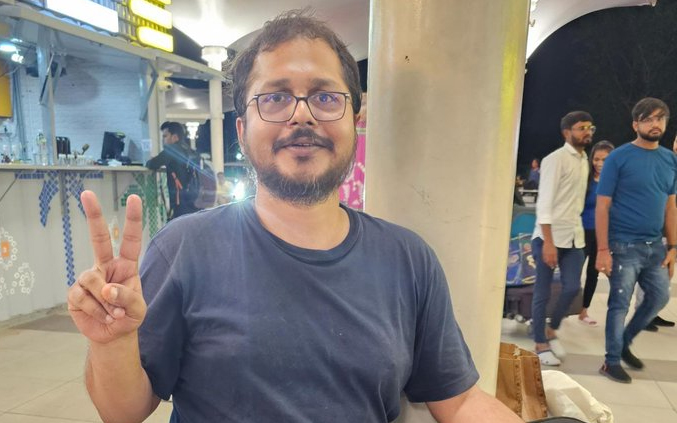
Days after coming out of jail on bail in the crowdfunding case, Trinamool Congress (TMC) spokesperson Saket Gokhale turned to Twitter today (May 12) to rant and rave that the state’s BJP government had engaged in a witch hunt against him. After spending months in jail, the TMC spokesperson was granted bail by a special court on May 6, 2023.
Jailed for misappropriation of funds to the tune of Rs 1.07 crore, the TMC leader claimed in his thread of tweets posted today that the Gujarat Police and the ED arrested him, on the direction of the BJP, in a case of Rs 500.
Statement:
I’m back after spending 4.5 months in Ahmedabad Central Jail.
Why?
Because the Gujarat Police & the ED unleashed on me by the BJP arrested me in a case of Rs. 500. filed by a Gujarat Govt official claiming to be a donor.
“Of the 1700 people that crowdfunded me between 2019-20, a complaint of Rs. 500 by ONE donor (incidentally a Gujarat Govt official) was used to charge me with “money laundering,” he claimed adding that he is confident of his innocence and has immense faith in the judiciary.
It may be recalled that the TMC spokesperson was arrested by the ED under criminal sections of the Prevention of Money Laundering Act (PMLA). While dismissing his bail plea in January this year the court observed that prima facie it appears that Gokhale had utilised the funds raised in crowdfunding for his personal expenses.
He continued his tirade against the BJP by declaring Gujarat to be “BJP’s laboratory for persecution” and accusing Gujarat police of working against him at the party’s orders.
“I’m proud that despite several attempts by the BJP to get me to jump into their “washing machine”, I kept my integrity & chose to suffer prison instead,” Gokhale tweeted.
The TMC leader further claimed that he was attacked in jail on four occasions. Insinuating that the attacks were carried out on him on the instruction of the BJP, Gokhale said, “the main purpose of BJP in jailing me was to try and silence me. I feel sorry for them if they assumed that I’m as weak as their coterie of “washing machine”-returned leaders.”
In his subsequent tweet, he heaped praises at Mamata Banerjee, Abhishek Banerjee and other TMC leaders for standing by him in the hour of need. He thanked his ‘guardian angel’ Derek O’Brien for supporting him and his family throughout.
“Backing down from a righteous battle is not in our DNA,” he claimed, adding that he is “back and ready to fight the good fight.”
Gujarat HC dismisses Gokhale’s bail plea in the crowdfunding case
Notably, in January this year, the Gujarat High Court dismissed the bail application filed by Trinamool Congress (TMC) spokesperson Saket Gokhale observing that prima facie it appears that Gokhale had utilised the funds raised through crowdfunding for his personal expenses.
Noting that the case is of the nature of fraud and cheating and that the investigation is still going on and that the necessary evidence is to be recovered, the court denied bail to the TMC leader.
On December 29, Gokhale was arrested in Delhi by the Ahmedabad Cyber Crime Branch. Gokhale is accused of misappropriating Rs 1.07 crore collected from the public through crowd-funding. Saket Gokhale was charged under sections 420 (cheating), 406 (criminal breach of trust), and 467 (forgery) of the Indian Penal Code.
ED arrests TMC spokesperson Saket Gokhale and his repeated arrests
TMC leader Saket Gokhale was arrested by the Gujarat Police in December last year for siphoning off money in the name of activism. The police had found accounts linked to Gokhale where he was receiving money, which he claimed was being used for legal fees for activism-related cases but were instead being used for personal expenses. Before that, he was arrested by Gujarat police for spreading fake news about PM Modi.
On January 25, the Enforcement Directorate arrested Gokhale under sections of the Prevention of Money Laundering Act in Ahmedabad.
While he was denied bail earlier, a court in Ahmedabad granted him regular bail on Saturday, ensuring his release from Ahmedabad jail where he was lodged since his arrest. On Tuesday, TMC leader Derek O’Brien posted a photograph of Gokhale on Twitter after his release, saying that he is “unbroken and ready to fight the good fight.”
The Lokayukta police in Madhya Pradesh conducted a raid at the house of a woman assistant engineer in Bhopal in connection with a disproportionate assets case. She was found to have items that could not have been procured with her regular salary, which included a Rs 30 lakh TV set, 10 luxury cars and a huge house.
Hema Meena, an assistant engineer in charge (contract) at the state police housing corporation, was discovered to have procured properties 232% disproportionate to her monthly wage of Rs 30,000 by a team from the Madhya Pradesh Lokayukta Special Police Establishment (SPE). To procure the property she has, her salary should have been Rs 18 lakh, according to the officials.
She stays in a 40-room bungalow built on 20,000 square feet of land registered in her father’s name, Ramswaroop Meena in Bilkhiriya near Bhopal. Its cost is estimated to be more than Rs 1 crore.
The anti-corruption agency carried out raids on her bungalow, farm, and office on Thursday, leading to the recovery of assets valued at almost 5 to 7 crore. The vast array of the fortune contained 100 dogs comprising of foreign breeds such as Pitbull and Dobermann, a comprehensive wireless communication system, mobile jammers, and several other valuables.
A roti-making machine worth Rs 2.50 lakh was also located which was used for making rotis to feed the dogs. The Lokayukta sleuths also seized a television priced at 30 lakh from there. Furthermore, 20 vehicles, including expensive four-wheelers like two trucks, one tanker and a Mahindra Thar, were found parked at her luxurious property. Her opulent farmhouse consisted of between 70 and 80 cows.
She used walkie-talkies to speak to her co-workers and seniors present in the sprawling mansion. The devices have also been seized by the Lokayukta team.
The accused also bought 20,000 square feet of property in the village of Bilkhiriya. She has also acquired land in Raisen and Vidisha. The anti-corruption watchdog also noted government property worth lakhs that belonged to the housing board in her farmhouse. Agricultural paraphernalia including harvesters worth lakhs, premium spirits and cigarettes were collected. A dairy was also spotted near it.
A case was filed against her in 2020 for having disproportionate assets, according to Lokayukta Deputy Superintendent of Police, Sanjay Shukla. After receiving the complaint, an investigation was started, and then the action was executed. The raids were conducted in Raisen, Vidisha and Bhopal.
Manu Vyas, Superintendent of Police, disclosed that search operations had been undertaken in three locations and that initial estimations suggested that the possessions had been appraised between 5 and 7 crore.
“We will have to take help from other departments as well in determining the actual value of whatever has been seized so far,” he added.
50 members of the SPE arrived at the upscale bungalow dressed in casual clothing. The security there, however, stopped them. They told the guards that they were from the animal husbandry department and also gained entry under the guise of repairing solar panels.
Preliminary findings indicated that she constructed her abode using materials intended for projects of the Madhya Pradesh Police Housing Corporation.
The engineer is a divorcee who lives in the Raisen district of Chapna village. She got a contractual position in 2011. She is currently employed as the Madhya Pradesh Police Housing And Infrastructure Development Corporation (MPPHC) associate engineer in charge. A case under the Prevention of Corruption Act has been filed against her.
There is a possibility of the involvement of other officers in the matter and further investigation into the matter is underway.
Hinduphobic ‘comedian’ Munawar Faruqui came under the ire of netizens as Star Sports India gave him a stage during the coverage of the Indian Premier League 2023. Munawar Faruqui infamously known for his remarks insulting Hindu deities is featured in this year’s IPL coverage on the Star Sports India TV channel.
Twitter user @coolfunnytshirt posted, “Now, even communal bigots have started doing sports channel shows.”
Munawar Faruqui shared the screen with Anil Kapoor and Aditya Roy Kapoor. Netizens also called them out for not recognizing the Hinduphobic comedian standing with them. Kiran Kasala wrote, “All that matters is money for these people… doesn’t matter if you are sharing the stage with the person who insulted your religion your faith your Gods. If they get money, they will sell themselves.”
All that matters is money for these people… doesn't matter if you are sharing stage with the person who insulted your religion your faith your Gods. Paise mil raha hai tho khud ko bhi bej denge bsdk… https://t.co/Mmdixd8LC4
Another Twitter user Himanshu wrote, “This star is controlled by some leftist guy I guess. Even in star sports kannada, the guy who sits there (kiran srinivas) is a Hindu hater.”
This star is controlled by some leftist guy I guess. Even in star sports kannada, the guy who sits there (kiran srinivas) is a pro hindu hater. https://t.co/MFmmgH7AbD
Dr Jayanti Singh wrote, “I didn’t watch today’s sports pre-talk because of I saw Anil didn’t realise Hindu hater and venom spewing hypocrite coward Munnawar was also called. Disgusting!”
I didn’t watch today’s sports pre talk because of I saw Anil didn’t realise Hindu hater and venom spewing hypocrite coward Munnawar was also called . Disgusting! https://t.co/zxK3ShW1gf
Munawar Faruqui sparked public outrage due to his controversial portrayal and mockery of Hindu deities, as well as his insensitive remarks regarding the victims of the Godhra train burning incident. This tragic event occurred when a Muslim mob allegedly set fire to the Sabarmati Express near Godhra station, resulting in the death of 59 karsevaks from Ayodhya who were onboard.
In January 2021, Faruqui was arrested for allegedly making indecent remarks about Hindu deities during his stand-up performances. Although he was later released, his comments on Hindu genocide and derogatory statements about Hindu Gods led to widespread protests against his shows. Despite issuing an apology, claiming that he never intended to hurt anyone’s sentiments with his jokes, Munawar Faruqui continued to engage in demeaning portrayals of Hindus and their cultural heritage through his ‘comedy’ performances.
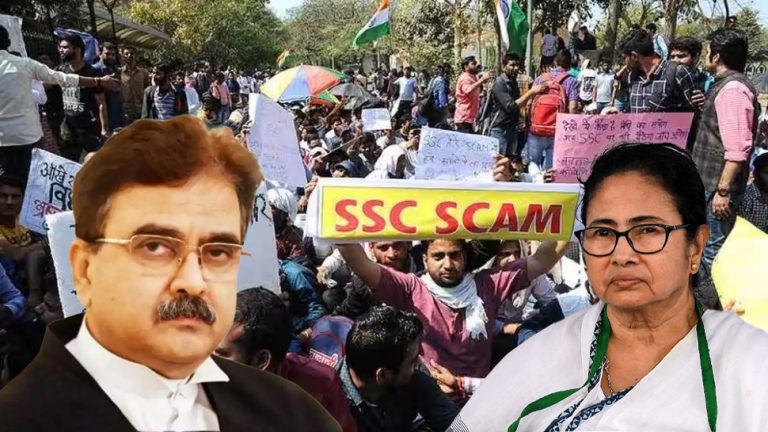
In a major setback to the Mamata Banerjee-led government in West Bengal, the Calcutta High Court on Friday ordered the cancellation of jobs of 36,000 illegally appointed untrained primary school teachers in state-run schools over the SSC recruitment scam.
The court cancelled the jobs saying that they were procured illegally adopting unfair means. A total of 42,500 primary teachers were recruited through the recruitment process in 2016 following the 2014 TET. The court found that many of them didn’t clear the TET exam and didn’t undergo training, and therefore the recruitment of 36,000 teachers has been cancelled by the court.
This is the fourth order of sacking of teachers by Justice Abhijit Gangopadhyay so far. Prior to this, many candidates faced termination of services in the state. However, this is the largest number of job cancellations so far in the teacher recruitment corruption case.
West Bengal | 36,000 recruitments (of primary school teachers) to be cancelled. The Board will arrange for the appointment of newly appointed persons to the vacant posts. This should be completed within three months. Recruitment process to be videographed. Former president of the… pic.twitter.com/msjR9iIUvU
The single-judge bench of Justice Abhijit Gangopadhyay said that all these teachers could return to school for the next four months, however, during that period they will be entitled to the salary of para-teachers instead of regular teachers.
The court further said that the West Bengal Board of Primary Education (WBBPE) should arrange for the appointment of trained teachers on the basis of merit. This should be completed within three months, said Justice Abhijit Gangopadhyay, adding that the entire process of recruitment should be videographed.
If any one of these 36,000 candidates completes the necessary training in the interim, he or she will be qualified to sit for exams during the following recruitment round.
The court further observed that if WBBPE wishes, it could recover the cost for conducting fresh recruitment exams from Trinamool Congress legislator and former President of WBBPE, Manik Bhattacharya, who is currently in judicial custody for his alleged involvement in the SSC recruitment scam.
The court took the testimonies of teachers who passed the TET exam in 2014, and several irregularities were found during the hearing. It was found that aptitude tests were not taken for a large number of candidates. In some cases, appointments were made without following reservation norms. Similarly, candidates having training were rejected and those without training were selected.
What is the Bengal Teacher SSC recruitment scam?
The West Bengal Teacher’s recruitment scam, more commonly referred to as the SSC scam, looks into the recruitment process conducted through the State Level Selection Test (SLT) conducted by SSC from 2014 to 2016.
The West Bengal School Service Commission (SSC) announced in 2014 that teachers would be hired at state-run schools in West Bengal through the State Level Selection Test (SLST), which is when the alleged scam first surfaced. In 2016, the hiring process got underway. At that time, Partha Chatterjee was the Minister-in-Charge of the West Bengal Department of Higher Education and School Education. Nevertheless, a number of complaints were submitted to the Calcutta High Court citing irregularities in the hiring procedure.
The petitioners alleged that many examinees who got lesser marks ranked high on the merit list. Several claims also surfaced regarding the receipt of appointment letters by some applicants who weren’t even on the merit list.
In a separate, but related instance, the Bengal government had in 2016 sent the School Service Commission (SSC) notification for the hiring of 13,000 Group D staff in government-run or aided schools. Interestingly, the tenure of the panel responsible for said recruitment expired in 2019, but several petitioners alleged that recruitment had taken place despite the expiry of the panel’s tenure and as many as 25 persons were allegedly appointed by the WBBSE.
However, when the case came up for hearing, the petitioners alleged that not 25 but over 500 people were appointed after the SSC panel’s expiration and were now receiving salaries from the state government.
Soon a CBI probe was launched in the case following an order by the Calcutta High Court bench of Justice Abhijit Gangopadhyay. The court ordered the agency to interrogate the former chairman of the SSC advisory committee, SP Sinha, and other former members of the panel.
The court had asked the CBI to file a report after interrogating the former members. In April, the CBI also registered an FIR against West Bengal Directorate of School Education former deputy director Alok Kumar Sarkar and unidentified officials of the SSC.
In May this year, the Central Investigation Bureau (CBI) filed an FIR against West Bengal Education Minister Paresh Adhikari and his daughter Ankita Adhikari. The case was registered after the father-daughter duo skipped the CBI summon deadline that was set by the Calcutta High Court. Adhikari was summoned for illegally recruiting teachers in government-aided schools and also for allotting a job to his daughter despite her absence from the merit list.
In the same month, CBI also quizzed Partha Chatterjee as the alleged recruitment scam had taken place when he was the education minister.
Later, the Enforcement Directorate (ED) also joined CBI to jointly investigated the scam. While the CBI is probing the criminal aspect of the recruitment scam, the ED is investigating the money laundering aspects.
As a part of the inquiry into the money laundering aspect of the SSC recruiting scandal, ED, in July last year, raided Partha Chatterjee’s premises and arrested him for swindling money worth crores in the form of bribes taken during his tenure as the state education minister. Several TMC ministers have since then been arrested for their alleged involvement in the multi-crore scam.
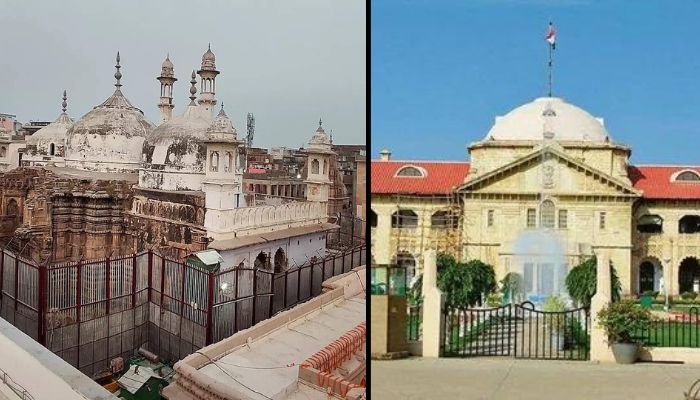
On Friday, May 12, the Allahabad High Court directed the Archaeological Survey of India (ASI) to conduct a scientific survey of the Shivling found inside the Gyanvapi mosque in Varanasi to determine its age.
The order was issued on May 12 by the bench of Justice Arvind Kumar Mishra-I while hearing a revision petition filed by four women Hindu worshippers challenging the Varanasi Court’s October 14 order, which denied their plea for a scientific examination of the ‘Shiva Linga’ to determine its age.
This comes after the ASI submitted its report as sought by the High Court, which rebuked the ASI in April this year for its laxity in submitting its report on the feasibility of carbon dating the Shivling found inside the mosque.
ASI report
The ASI has stated unequivocally in their report that direct dating of the Shivling is not possible, and that the age can only be determined through proxy dating of materials that can directly correlate with the establishment of the Shivling if it is there.
“For an object of religious significance such as Shiv Lingam or for that matter any other object or symbol made of stone etc, we have to get the dates from the surrounding sediments and items,” the ASI report read.
Furthermore, the ASI report states that the radiocarbon dating of rock material is not feasible since it lacks the presence of atmospheric-derived 14C.
The ASI further stated that the top part of the religious symbol has been divided into five sectors, and if this part was later embedded or added (pasted) on the top of Shivling using binders containing plant products or mortar, this binder can be radiocarbon dated and can shed some light on the age of the Shivling.
It is notable that the Hindu side maintains that the structure is a Shivling, while the Anjuman Intezamia Masjid Committee, which manages the Gyanvapi mosque, claims it is a fuwwara (fountain).
Retail inflation in India eased further in April to 4.7 per cent as against 5.7 per cent the previous month.
The sub-index for cereals and products and eggs declined in April, data released by the Ministry of Statistics and Programme Implementation on Friday revealed. The inflation in rural and urban was 4.68 per cent and 4.85 per cent, respectively.
India’s headline consumer price index-based (CPI) inflation (or retail inflation) has gradually declined from its peak of 7.8 per cent in April 2022 to below 6 per cent now, which is below RBI’s upper tolerance band.
India’s retail inflation was above RBI’s 6 per cent target for three consecutive quarters and had managed to fall back to the RBI’s comfort zone only in November 2022.
The RBI’s monetary policy actions over the past year seem to have reaped dividends in managing inflation.
The Reserve Bank of India, in its first monetary policy review meeting this fiscal, decided to keep the key benchmark interest rate — the repo rate (the rate at which it lends to banks) — unchanged at 6.5 per cent with readiness to act should the situation so warrant.
Inflation has been a concern for many countries, including advanced economies, but India has managed to steer its inflation trajectory quite well.
Assuming an annual average crude oil price (Indian basket) of USD 85 per barrel and a normal monsoon, CPI (or retail) inflation is projected to moderate to 5.2 per cent for 2023-24 in India as estimated by RBI in its April monetary policy meeting; with Q1 at 5.1 per cent; Q2 at 5.4 per cent; Q3 at 5. 4 per cent; and Q4 at 5.2 per cent.
A court in Bihar’s Sasaram on Thursday (May 11) awarded a death sentence to a convict Mohammad Shahid in a 2009 rape-cum-murder of a minor. Sasaram’s additional district and sessions judge Manoj Kumar convicted Shahid, a grocery shop owner in the Dhansoin area of Buxar, on the two charges on Thursday and imposed a Rs 76,000 fine.
Notably, Shahid committed the crime in the year 2009. He was arrested on charges of rape and murder. The trial started in the year 2010. The court examined 11 prosecution witnesses in the 14-year-long legal battle before finally delivering justice to the family of the victim.
According to the additional public prosecutor (APP) Vidya Sagar Rai, the lawyer for the victim’s family, the court noted that the girl lost her father at an early age and lived with her mother. the court, while delivering the verdict, explained the rationale behind awarding the death sentence to the accused. It said that Shahid was not entitled to live and move freely in society and would pose a risk to girls even inside their houses. Calling it the rarest of rare cases, the court sentenced Mohammad Shahid to death.
Rai said that the incident had taken place when Shahid, a native of Buxar district, went to Semri village of the adjoining Rohtas district under Kargahar police station to attend a marriage function of his relative on June 16, 2009.
The victim, who was 15 years old then, had just finished pasting cow dung cakes on a wall for drying at their house and went home. Shahid followed her and raped her.
After the rape, the accused killed her and buried the body near the scene of the crime. The local police managed to discover the dead body two days after the incident.
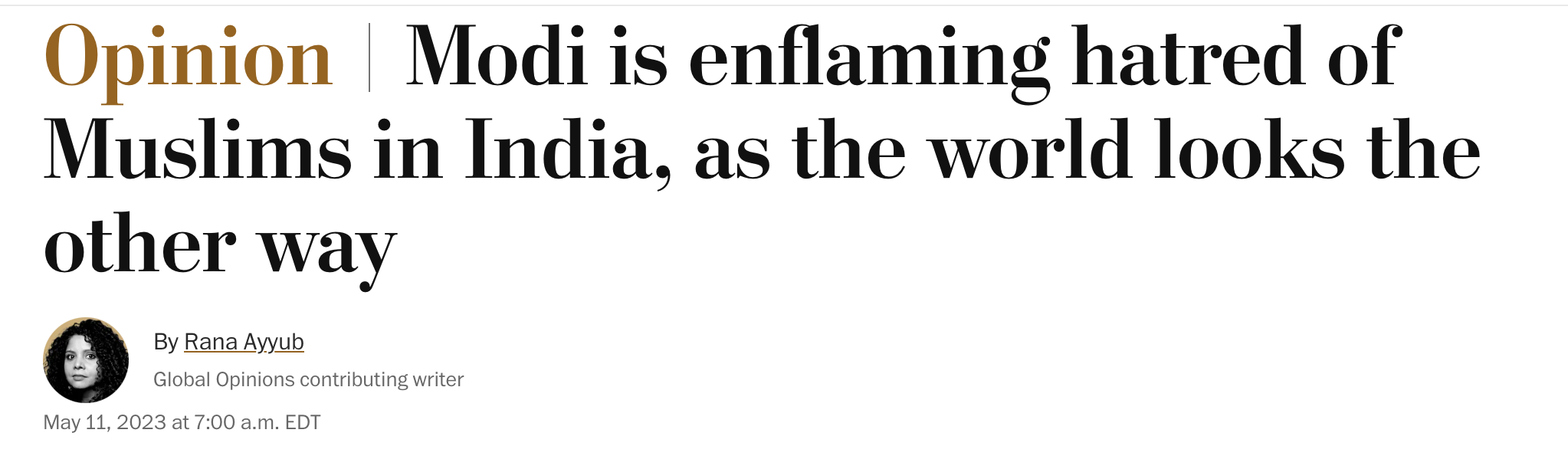
On Friday, Rana Ayyub, a donation fraud accused and a known anti-Modi detractor, received endorsement and support from Press Counsellor at the Embassy of Pakistan in Washington DC over her propaganda article in Washington Post raising questions over India’s democratic credentials.
“Calling upon Int. community not to remain silent, @RanaAyyub warns that “a much darker narrative is starting to define Modi’s India. India is not a healthy democracy. Modi is enflaming hatred of Muslims in India, as the world looks the other way,” Sarfaraz Hussain, a press attaché at the Embassy of Pakistan in Washington DC, tweeted.
While the support from a Pakistani attaché illustrates the kind of fan following Rana Ayyub has garnered with her prejudicial journalism, which often involves relying on fake news and distortions of facts to support her narrative, the Pakistani diplomat’s endorsement of her article sums up why Pakistan is perpetually plagued by economical and political crises.
Pakistan is tottering on the verge of an imminent financial collapse, with its economy facing tremendous pressure from sky-high inflation. The country is struggling to pay its debt and has attracted low foreign investment for its notoriety of being a safe haven for all hues of terrorists and troublemakers.
The country is also afflicted by chronic political crises, most notably with protests sweeping across the length and breadth of the nation following the arrest of former PM Imran Khan. Widespread protests erupted in different parts of the country, with angry protesters attacking military institutions, including the Army GHQ in Rawalpindi, the defacto power centre of Pakistan.
At a time when Pakistani diplomats must assuage international concerns about protests giving way to a potential civil war between the government and Khan’s supporters, the Press Counsellor of the Embassy of Pakistan in Washington DC is busy sharing a propaganda article that vilifies India’s democratic track record and its respect for plurality.
The misplaced priorities of Pakistanis and their fetish to define their existence in opposing India are clearly taking a toll on Pakistan’s internal situation, which remains precarious and ripe for yet another military coup. Even its foreign policy is rooted in its obsession with India and internal matters in India, lecturing New Delhi on the welfare of its minorities, even as religious minorities in the Islamic Republic of Pakistan remain on the verge of extinction.
Half-truths, scaremongering, and polarising rhetorics define Rana Ayyub’s article in Washington Post
Having said that, it is important to objectively scrutinise Rana Ayyub’s vicious article that casts aspersions on the health of democracy in India and insinuates that India is on its inexorable march to fascism.
To begin with, there are no obvious signs that India is sliding towards an authoritarian rule of governance. In fact, in the recently concluded assembly elections in the South Indian state of Karnataka, BJP’s primary rival, INC, seems to be in an advantageous position to form a government in the state, several exit polls predicted.
India continues to be a thriving democracy, with the power of choosing their leader resting securely in the hands of the voters, who decide their political fate by exercising their right to vote for the political party of their choice. Earlier this year, the BJP lost two elections–the MCD polls in Delhi and the assembly elections in Himachal Pradesh. The result saw a peaceful transition of power from the incumbent BJP to the incoming political parties. Yet, the likes of Rana Ayyub continue to resort to stoking fears, scaremongering over the future of democracy in India.
Ms Ayyub highlights many political rallies in Maharashtra in the last few weeks, dubbing them anti-Muslim hate rallies. According to the donation fraud accused, any rally where political leaders, primarily from the BJP, assert their Hindu religious identity and vow to suppress Islamist tendencies that seek to turn India into an Islamic country on the lines of Arab nations becomes an anti-Muslim hate rally.
Ms Ayyub conveniently blurs the distinction between anti-Muslim and anti-Islamist, raising unfounded fears of persecution among the Muslim section of the population and playing to the anti-Modi gallery, which has been yearning to dislodge PM Modi from the highest office in the country ever since he assumed the office in 2014.
The Washington Post article by Rana Ayyub is replete with half-truths, propaganda, and suppositions, which reflects the brand of journalism that the donation fraud accused has been historically associated with. The journalist had long wailed that she had ‘sting tapes’ as authoritative proof of Gujarat Riots conspiracy but has, so far, not managed to upload them online in this age and time of digital and social media. The Supreme Court of India had in 2019 trashed her book ‘Gujarat Files’, which she claims has damning proof of the Gujarat Riots conspiracy, as based on surmises, conjectures, and suppositions with no evidentiary value.
In her Washington Post article, Ms Ayyub expediently mentions the burning of a mosque in Bihar during the Ram Navami celebrations but fails to mention possible causes behind the incident. Since last several decades, Ram Navami celebrations, when Hindus commemorate the birth of Lord Rama, are marred by violence carried out by Islamists who detest idol-worshipping and are opposed to kaafirs celebrating their festivals. Ram Navami processions have increasingly come under attack from Islamists who would pelt stones at the Shobha Yatra, injuring devotees of Lord Ram and touching off a spiralling round of communal strife.
Like every year, this year too, several places across the country, Ram Navami processions came under attack on tenuous pretexts like being carried out through ‘Muslim areas’, meaning Muslim-dominated regions, the use of DJs in the Shobha Yatras, or the chanting of seemingly harmless slogans such as ‘Jai Shri Ram’ in the vicinity of a mosque. Such flimsy excuses are then used by the likes of Ms Rana Ayyub and other ‘intellectuals’ who vilify the victims as aggressors by throwing labels of Islamophobia, hate speech, etc., to project their guilt.
There have been several attacks by Islamists during Ram Navami in different parts of the country. But somehow, not a single one of them merited mention in Rana Ayyub’s diatribe against India’s democratic health in her latest column for the Washington Post.
Though Ms Ayyub accuses the BJP and its leaders of peddling hate, she does not shy away from relying on polarising rhetorics. In her article, Ms Ayyub describes the Babri structure that was levelled by kar sevaks in 1992 as an ‘iconic mosque’, even though the evidence collected by the Archaeological Survey of India, historical accounts, and Hindu beliefs associate it with an erstwhile temple, the birthplace of Lord Ram, which was destroyed during the time of Mughal emperor Babur and a structure was built on its ruins.
The Supreme Court of India ended the centuries-long dispute and handed over the land to Hindus for building a temple to Lord Ram. Ms Ayyub seems to have a problem with that, too, as she took offence at the Modi government for fulfilling its poll promise of consecrating a magnificent Ram Temple at the site where it previously existed before the Mughal invasion of India.
The article also includes observations made by Justice Joseph recently when he criticised state governments for not taking action against instances of hate speech. In March 2023, several media organisations reported that Justice Joseph was smiling when SG Tushar Mehta argued that a DMK leader had called for butchering Brahmins. When SG Mehta pointed out that this (idea of butchering Brahmins) is not a matter that should be laughed at, Justice Nagarathna asked what made him (DMK leader) says so. Justice Joseph then asked if he knows who Periyar is. SG Mehta said that just because it is hate speech, it cannot be pardoned because it is said by someone famous, Bar and Bench reported.
Ms Ayyub also lamented over Uttarakhand CM’s vow to end land jihad, describing it as inflammatory propaganda against Muslims. But several media reports point to an organised attempt by Islamists to usurp land and use it for religious purposes or to effect a demographic change. And not just in Uttarakhand but in several places across the country, the instances of ‘land jihad’ surfaced. In Surat’s Adajan area, permission to construct a building was obtained by one Raihan Heights project, next to a temple by ‘temporarily’ bringing up a Hindu partner in a Muslim-owned enterprise in what appeared to be a bid to hoodwink the law.
Similarly, an incident of ‘land jihad’ was reported from Bharuch as well, where Jains and the Hindu community were forced to leave the neighbourhood over violence, harassment, and other things. In many affected areas by land jihad, the Islamists forced the natives to sell off their lands and properties and effect a demographic change in the neighbourhood, settling their co-religionists and homogenising the once-secular fabric of the region.
In another instance in her article, Ms Ayyub expressed dismay at a statement made by BJP leader Satya Pal Singh Baghel, who said one could count tolerant Muslims on fingers. While she spends a large amount of her time demonising and slandering BJP leaders and supporters as intolerant and bigots, she gets agitated when she gets replied to in the same language and blamed for stoking interfaith tensions.
It bears noting that Ms Ayyub is yet to condemn the death of Kamlesh Tiwari, a Hindu Samaj leader murdered by Islamists in 2019 for his remarks on Prophet Muhammad, made four years ago in 2015 and for which he served jail time. Ms Ayyub is also yet to condemn the vicious death threats directed at former BJP leader Nupur Sharma for defending her faith on a TV news channel, which triggered Sar Tan Se Juda violence after Alt News’ Mohammed Zubair dog whistled Islamists against her for her remarks on Prophet Muhammad. Ms Ayyub has not yet condemned the murders of Kanhaiya Lal, Umesh Kolhe, and other Hindus, who were brutally hacked to death by Islamists for extending their solidarity with the beleaguered former BJP leader.
Yet, Ms Ayyub gets offended when a BJP leader says that tolerant Muslims could be counted on fingers. Rather than considering it provocative, Ms Ayyub should introspect on how extremists have come to represent her community and how polarising rhetorics by ‘Muslim intellectuals’ have contributed to reverse polarisation among Hindus and increased a sense of religious consciousness among them, which hitherto was confined to their private spaces.
The newly released movie named ‘The Kerala Story’ is grabbing international attention while narrating the dreadful cases of Kerala-based women who become the victim of ‘love jihaad’ incidents. The movie which is based on the true events revolves around three Hindu women who are trapped in love affairs, raped, pressured to convert their religion to Islam and then made to join ISIS, ultimately forcing them to serve as sex slaves. While the movie shows devastated lives of women, there are several organizations that work on the ground to rescue such women and make their lives better. One such organization is Arsh Vidya Samajam.
This organization has been working for many years in the direction of rescuing the girls who are tapped in ‘Love Jihad’ and bringing them back to their roots, also giving them respect in society and strengthening them mentally. Arsh Vidya Samajam is an educational institution, which aims at Panch-Kartavya (study, ritual, propagation, teaching and protection of Sanatan Dharma). This institute was born with the inspiration of Rigveda’s mantra ‘Krinvanto Vishwamaryam’, which means – make all the human beings of the world follow best deeds.
Arsh Vidya Samajam established to spread Sanatan Dharma
The organization believes that it was born out of divine inspiration and aims to make the entire world a good place by teaching the values of Sanatan Dharma. The institution believes in the Guru-Shishya tradition. ‘Arsh Vidya Samajam’ believes that the main reason for all the evils that are spreading in the world today is the lack of awareness about religion among the youth. The aim of the organization is to make every individual know about his or her own religon, about the Sanatan Dharma.
‘Arsha Vidya Samajam’ mainly teaches 4 main courses- Adhyatma Shastram, Arsha Yoga Vidya, Indian Culture and Vidyarthi Naipunya Varga. Along with this, the Gurus here also introduce different religions and tell people about the differences between them by comparing them with one another. Yogacharya KR Manoj laid the foundation of the organization in the year 1999. He got inspiration to establish this organization from Sadguru Shankar Gurudev. He is skilled in Sanatan Dharma, Yoga Vidya and Tantra Vidya.
KR Manoj Atreya is proficient in all three traditions – Kriya, Yoga and Tantra. He started his practice at the age of 4. He has also established 5 other institutions associated with ‘Arsh Vidya Samajam’ namely- Shivshakti Yogavidya Kendram, Manisha Sanskarik Vedi, Vigyanbharti Vidya Kendram, Budhikam Books and Sadhana Shakti Kendram. He has also learned Kriya Yoga of Mahavatar Babaji. ‘Yogda Ashram’ is a separate institution which is also run by following the traditions of Mahavatar Babaji.
Apart from all this, KR Manoj is also a devotee of Neelkeshwaranand Paramhans. He has also received education from the Yogda Ashram in Ranchi, established by Paramahansa Yogananda. Further, he has received education from many spiritual centers in the early days of his life. His organization ‘Shivshakti Yogavidya Kendram’ teaches yoga on scientific basis, which is based on ‘Nath Sampradaya’.
Whereas ‘Manisha Sansarik Vedi’ teaches about India’s history and culture, heritage, invasions and freedom struggle. Sanskrit, Vastu Shastra, Astrology etc. are also taught here. On the other hand, the ‘Buddhikam Books and Publications’, targets at creating revolution through study. Books related to Sanatan Dharma are published through this Publication. The books are also made available in digital format. Podcasts, video blogs and magazines are also published. At the same time, through ‘Sadhana Shakti Kendram’, various types of spiritual practices are taught for the betterment of mental and physical health.
The website of ‘Arsh Vidya Samajam’ explains what the organization believes in and how it works. Its main contents are in English and Malayalam languages. The concept and values of Sanatan Dharma have also been explained well in the form of Q&A on the website.
Shruti, one ‘love jihaad’ victim, reveals how Arsh Vidya Samajam helped her
The victim girls have said in the ‘PGurus’ video how ‘Arsh Vidya Samajam’ has helped them get back to life. Vaishali, Anagha and Shruti told about the cruelty meted out to them before coming in contact with the said Samajam. Shruti told that when she converted to Islam, it was a shocking decision for her family members and they could not tolerate it. Their condition had turned pathetic. Although she had reverted to Hinduism, her father was still not sure whether she had given up Islam or not.
During this, Yogacharya Manoj assured her father and other family members that Shruti had returned to Hinduism. Guru told the family that Shruti regrets her actions and is helping other victimized girls like her, to bring them out of the darkness, to bring them back to Hinduism. Yogacharya Manoj assured the family that they should not worry anymore, they should walk with their heads held high as their daughter is doing good work.
After this, the family members of Shruti began re-believing in her. She wrote a book about her experience, made junior girls aware of it and also shared her experience through videos. Arsha Vidya Samajam helped her in her endeavours. After this her father started getting phone calls from people, praising Shruti. Before meeting Yogacharya Manoj, Shruti had not even heard the name of Sanatan Dharma.
Shruti says that Yogacharya KR Manoj has created a course on Sanatan Dharma, in which he explains its values of it in detail. She says that one of the major reasons for conversion is that we do not know about our religion and culture. ‘Arsh Vidya Samajam’ is making efforts in this direction. She told that many ‘love jihad’ victims are living in ‘Arsh Vidya Samajam’. Shruti was also brainwashed by her Muslim colleagues and then forced to convert her religion to Islam.
She was in college when she was brainwashed and forced to convert. Shruti, who hails from Kasargod in Kerala, says that whatever is shown in the trailer of the film ‘The Kerala Story’ is true. Taking advantage of her little knowledge about Hindu religion, her companions asked her to follow Islam and quit Hinduism.
One can also visit the YouTube channel of ‘Arsh Vidya Samajam’ and watch the videos in which the concepts of Islam has been truly explained with facts. Propaganda run through the bollywood films is also explained in the videos. The organization has further explained several other topic which include hijab, halal meat and also about how the leaders of ‘Muslim League’ in Kerala spread hatred and say mallicious things inspired by Quran.
Pakistan Teheek-e-Insaf (PTI) chief and Pakistan’s former prime minister Imran Khan was presented before the Islamabad High Court on Friday, 12th May 2023 as the court heard the Al-Qadir trust case. While speaking to the media at this time, Imran Khan expressed the fear of getting arrested again as soon as he steps out of the court. The court stayed his arrest in all the cases against him till May 17.
"There is a fear that I will be arrested again as soon as I leave the High Court," says PTI chief Imran Khan, reports Pakistan's Samaa News
Imran Khan said, “There is a fear that I will be arrested again as soon as I leave the High Court.” Imran Khan used his counsel’s mobile phone to convey this to the media as he knew about the team of police and rangers reportedly deployed outside the high court to arrest him in four other cases.
#BREAKING | इमरान खान पर फिर लटकी गिरफ्तारी की तलवार
Imran Khan further said, “Now, if I am arrested again, there will be a ruckus. And don’t hold me responsible for that.” On Thursday, the Supreme Court of Pakistan ordered the immediate release of Imran Khan, calling his arrest in the Al Qadir Trust scam illegal. He was asked to seek bail from the Islamabad High Court on Friday. Accordingly, he was granted bail in this case. The high court further ruled that he should not be arrested till May 17.
BIG BREAKING: Islamabad HC stays Imran Khan’s arrest in ALL cases against him till May 17. HC issues orders that Imran must not be arrested until next Wednesday. pic.twitter.com/U6eIeerSki
After staying his arrest till 17 May, the High Court also barred the authorities from arresting him in any new case filed after 9 May. Imran Khan was also granted 15-day protective bail by a two-member special division bench, comprising Justice Miangul Hassan Aurangzeb and Justice Saman Rafat Imtiaz.
The special division bench was formed by Islamabad High Court Chief Justice Aamer Farooq to hear the former prime minister’s bail plea a day after Supreme Court termed Khan’s arrest in the Al-Qadir Trust case “unlawful” as he was arrested inside the court premises, where he had arrived to seek protection.
Reportedly, there were slogans by lawyers inside the court in support of Imran Khan, after which the judges expresses their displeasure. The hearing was also briefly adjourned for a break for Friday prayers.
Imran Khan earlier got relief in another Toshakhana case for the time being. The Islamabad High Court stayed the trial court proceedings for now. The Election Commission of Pakistan had sought permission for a criminal trial in this case. Against this, Imran Khan again filed an application in the High Court. The court stayed the proceedings and said that the sessions court will not hear any case till further orders.
Khan was arrested on Tuesday inside the premises of Islamabad High Court when he appeared before the court in two cases. Ever since Khan’s arrest, Pakistan has been witnessing a situation of unrest. Several protests have broken out across the country as PTI has urged its supporters to come out in support of Imran Khan. On the other hand, the PTI has asked its supporters to stay away from the top court. However, on Friday, some supporters of Imran Khan raised slogans on the premises of the Islamabad High Court.