Taking cognisance of recent violence that broke out between two groups in West Bengal and Bihar during the Ram Navami procession, the Union Ministry of Home Affairs (MHA) has issued an advisory to all states to ensure the maintenance of law and order in preparation of Hanuman Jayanti.
The MHA has also advised through its advisory for peaceful observance of the festival, and monitoring of factors that could disturb communal harmony in society. Hanuman Jayanti would be observed on Thursday, April 6.
“The MHA has issued an advisory to all states in preparation for Hanuman Jayanti. The governments are encouraged to ensure the maintenance of law and order, peaceful observance of the festival, and monitoring of any factors that could disturb communal harmony in society,” tweeted the Union Home Ministry.
The advisory has been sent to the Chief Secretaries and the Director Generals of Police of all States, said sources.
The MHA’s move followed recent clashes reported from West Bengal and Bihar when Ram Navami processions were taken out.
In West Bengal, violence broke out in Howrah last week. Similar clashes were reported in Nalanda’s Biharsharif and Sasaram in Rohtas district in Bihar on March 31.
The Home Ministry has asked the West Bengal government to submit a report at the earliest on the incident of violence in Howrah, where several vehicles were torched and shops vandalized last week.
A total of 10 companies of the Central Armed Police Force (CAPF) have been sent to Bihar after violent clashes erupted there during Ram Navami celebrations.
Tension prevailed in Bihar even a day after Ram Navami as fresh violence was reported in Rohtas and Nalanda districts on Saturday, the police had said.
In Nalanda’s Biharsharif, a person was killed and several others injured after clashes broke out between two groups. Six people were injured in a blast in Sasaram town of Rohtas district.
Nalanda Police on Sunday said more than 75 people were arrested in raids after the clash. Bihar Police imposed prohibitory orders in Nalanda to maintain law and order in the region. Clashes were first reported in the two districts of Bihar on Friday.
(This news report is published from a syndicated feed. Except for the headline, the content has not been written or edited by OpIndia staff)
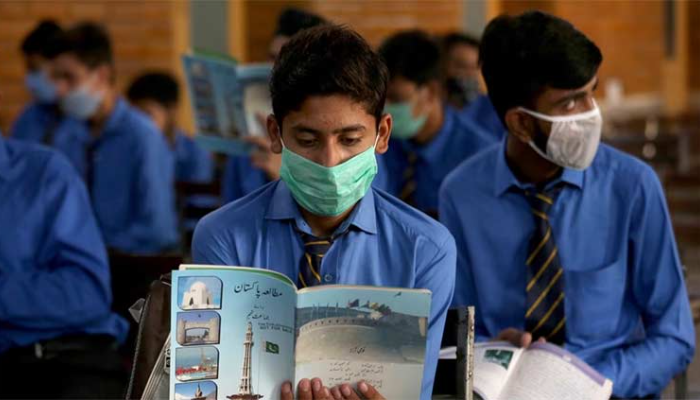
According to a Human Rights Observer 2023 fact sheet in Pakistan, during the year 2022, the amount of anti-minority religious content in curricula and textbooks grew, and several enduring and new issues with the educational system surfaced in the Islamic nation. The Centre for Social Justice (CSJ) issued the annual fact sheet on March 30.
The report addressed five significant issues that have an impact on religious minorities, including prejudice in the educational system, the prevalence of forced conversions to Islam, the misuse of blasphemy laws, the creation of the National Commission for Minorities, and jail remissions for minorities’ prisoners.
‘Blasphemy laws’ claiming dozens of victims
As per the information divulged in the fact sheet, 171 persons have been charged with violating blasphemy laws, with Punjab and Sindh accounting for 65% and 19%, respectively.
Karachi recorded the highest occurrence, which was then followed by Chiniot, Faisalabad, Gujranwala, Dera Ghazi Khan, Nankana Sahib, Lahore, and Sheikhupura. The majority of the victims (88) were Muslims, followed by 75 Ahmadis, four Christians, and two Hindus.
However, the religious identity of the two accused could not be ascertained. Four individuals were executed extrajudicially in 2022, two in Punjab, and one each in Sindh and Khyber Pakhtunkhwa, bringing the total number of such killings from 1987-2022 to 88.
From 1987 and 2022, at least 2,120 people had been charged with blasphemy. In Punjab, the abuse of blasphemy laws has increased by more than 75% overall over the previous 36 years. Despite their modest percentage (3.52%) in Pakistan’s population, 52 per cent of the accused belonged to minority communities.
‘Girls and women from minority communities are being forced to convert to Islam’
The fact sheet examined 124 documented instances of girls and women from minority faiths being forced to change their religious beliefs. Of these, 81 were Hindu, 42 were Christian, and one was Sikh. Merely 12 per cent of the victims were adults, while 28 per cent of the victims’ ages were unknown.
Twenty-three% of the victims were girls under the age of 14 and 36% were females between the ages of 14 and 18. In 2022, 65% of incidents of forced conversion were reported in Sindh, followed by 33% in Punjab and 0.8% in Khyber Pakhtunkhwa and Balochistan, respectively.
Even though this concession has been provided to Muslim convicts since 1978, the fact sheet revealed that no progress had been achieved in giving remission to minority prisoners throughout 2022.
The National Commission for Minorities (NCM), is yet to be established. In March 2023, a poor and imbalanced draught was reportedly presented to parliament, which might lead to more delays and the eventual foundation of the NCM.
Peter Jacob, the executive director at CSJ and editor of the human rights observer, commented that the annual fact sheet contained recommendations to address the problems as well as concrete steps for the realisation and protection of minorities rights. He urged the government to take stock of these problems and uphold the human rights of minorities.
Notably, this is not the first time Pakistan has come under fire for its egregious treatment and appalling condition of religious minorities living in the country. Another similar revelation surfaced earlier this month, exposing the terrible lies Pakistan uses in its textbooks to instil its hate of India and Hindus in the next generation.
According to the report, history textbooks taught in Pakistani schools for grades 8 and 9 are full of material that is anti-India and anti-Hindu, including veiled references to Mahatma Gandhi, accusations, blame, and claims of being ‘Muslim nationalists.’
The textbooks provided to young minds present pupils with an incorrect and antagonistic image of their neighbouring country from the very beginning. They are written and produced by academics of the country in line with its national curriculum.
In 2021, a BBC documentary exposed the blatant anti-Hindu bias in Pakistani textbooks. In the video, several Pakistani Hindus drew attention to the ubiquitous and pervasive anti-Hindu propaganda promoted in the school textbooks and describe the humiliation they suffered at the hands of their friends, coworkers, and classmates just because they were Hindus.
The video additionally demonstrated how anti-Hindu bigotry has become commonplace in Pakistani government-approved school textbooks.
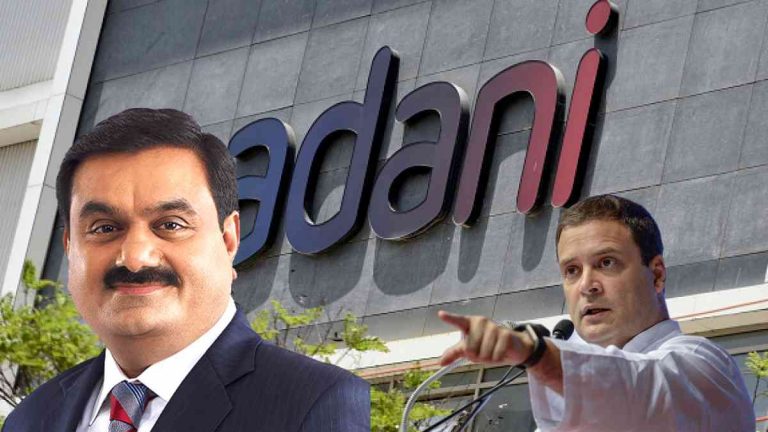
Congress leader and currently disqualified Wayanad MP Rahul Gandhi has been consistently asking one question. “Whose Rs 20,000 money is there in Adani’s shell companies?”
20,000 करोड़ अडानी की शेल कंपनियों में बेनामी पैसे किसके हैं – प्रधानमंत्री चुप, कोई जवाब नहीं!
2000 sq km ज़मीन चीन ने छीन ली, जगहों के नाम भी बदल रहे – प्रधानमंत्री चुप, कोई जवाब नहीं!
When a journalist asked Rahul Gandhi’s comment on taking an entourage of senior Congress leaders for filing an appeal in a Sessions Court in defamation case, Rahul Gandhi got upset and hit back with why was journalist asking what BJP is asking. Which is literally the journalist’s job – to get reactions, comments on allegations.
That apart, Rahul Gandhi questions whose money to the tune of Rs 20,000 crore is lying in the shell companies of Adani? He asserts the money is ‘benami’. As per The Benami Transactions (Prohibition) Act, 1988, “benami transaction means any transaction in which property is transferred to one person for a consideration paid or provided by another person.” The Indian laws specifically prohibit benami transactions and is punishable by law including imprisonment.
So Rahul Gandhi alleged that there is benami money worth Rs 20,000 crore in shell companies of Adani group. Let us break this down and figure out where did he get this exact figure from, since he has not provided any source, and if at all there is this money lying somewhere, where could it have come from.
On March 23, 2023, Rahul Gandhi addressed a press conference after he was convicted in defamation case leading to his disqualification. On March 25, 2023, he shared a snippet of his conference with background music alleging that Gautam Adani is a corrupt man.
मैं सच्चाई बोलता हूं, देश की ख़ातिर बोलता हूं। और आखिरी दम तक सच के रास्ते पर ही चलूंगा।
Rahul Gandhi, in as many words, asserted that PM Modi is ‘saving’ this corrupt man (Adani). He claimed that ‘we have caught Rs 20,000 crore entering Mr Adani’s company. Nobody knows whose money that is. That money cannot be Mr Adani’s money’. He alleged that the defamation case against him for insulting the OBC Modi community over his ‘all Modi surname people are thieves’ is a tactic to distract the panic PM Modi is having over his relationship with Adani being ‘exposed’.
Rahul Gandhi didn’t specify but cast enough aspersions to insinuate that the Rs 20,000 crore money was parked by PM Modi. Congress’ official social media account has also been tweeting wordplays of ‘Modani’ to insinuate that somehow PM Modi is part of some huge financial scam along with Gautam Adani.
So, where did Rahul Gandhi come up with this Rs 20,000 crore figure? You see, while he has been making these allegations, he has not quite given source for this very specific amount. A bit of Google search led us to Leftist propaganda website The Wire which had given an ‘explainer’ of this Rs 20,000 crore figure. Till then, no one knew where this figure came from. As if on cue, The Wire had rushed to explain on behalf of Rahul Gandhi, a task which was earlier carried out by the likes of Rajdeep Sardesai and Ravish Kumar.
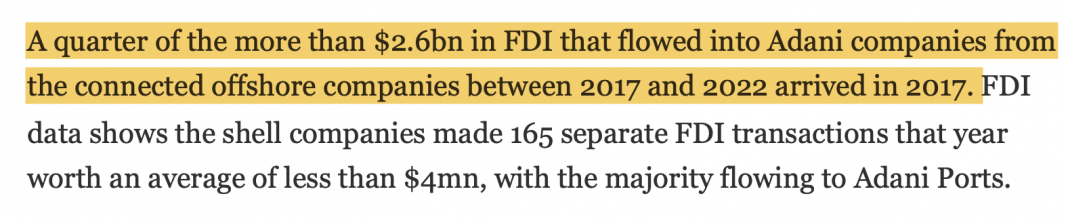
On March 22, 2023, Financial Times (FT) had published a report titled ‘Indian data reveals Adani empire’s reliance on offshore funding’. In the report, FT had claimed offshore companies linked to the Adanis invested at least $2.6 bn in the group between 2017 and 2022.
Snippet from FT report
This, USD 2.6 billion is approximately Rs 21,000/Rs 20,000 crore which Rahul Gandhi is talking about.
Amusingly, FT cites one Harvard Business School associate professor who is upset that Adani has very complex transactions.
HBS associate prof upset at complex transactions
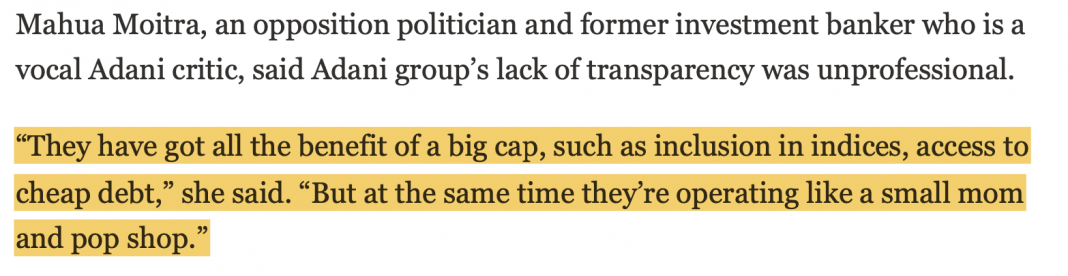
Clearly Prof Heese has not dealt with Indian taxation laws ever. Jokes apart, just because something is complex, it does not mean it is illegal. FT also cites TMC’s Mahua Moitra, who was recently caught lying about State Bank of India (SBI)’s exposure to Adani Group. She deleted her tweet after being called out for blatant lies and misleading citizens.
Mahua’s comment
As long as something is within the purview of the law, I’m quite certain Adani is free to run the business the way he wants.
Now that we know where they mystery figure Rahul Gandhi is citing came from, let us read the rest of FT article to see if they have mentioned source.
Yes, FT mentions that the said USD 2.6 billion came from its offshore companies. FT does not mention where it came up with this figure. FT claims this figure is derived after analysing ‘FDI’ (foreign direct investment) data. But it does not give specifics on which data was used. In its methodology section, FT mentions that it analysed India’s ‘share-based route’ and ‘automatic route for FDI, under which purchases of shares or equity-like debt are reported by Indian entities to India’s Central Bank, which would be the Reserve Bank of India.
Essentially, in absence of specific data used by FT to arrive at the figure, it is difficult to verify the claims by FT on Rs 20,000 crore figure. So, OpIndia cannot verify this figure. We leave it to our readers’ wisdom.
Rahul Gandhi’s next question is whose money is this.
Adani promoter group
Let us assume the Rs 20,000 crore was routed to Adani group companies through offshore companies. The FT report itself claims that this money was routed through companies linked with Adani. As per the FT report, most of these shell companies which are allegedly supplying FDI to Adani Group is disclosed as part of Adani’s ‘promoter group’. Which means, closely tied to Adani or his immediate family. Umm, so if FT is to be believed, this Rs 20,000 crore imaginary figure is Adani’s own money?
So, Rahul Gandhi did not read the article? Did his team not made him aware of facts before he addresses media or tweets things with so much confidence? So, Rs 20,000 crore Rahul Gandhi is claiming to be ‘benami’ is Adani’s own as per FT claims?
Again, to make it clear, OpIndia does not endorse Rahul Gandhi’s allegations of Rs 20,000 crore benami money. Adani Group has not yet reacted to the fresh allegations. Maybe because they did not even think this should be dignified with a response.
Rahul Gandhi and China love-hate relationship
In the same press conference where Rahul Gandhi first raked up the Rs 20,000 crore issue, he had mentioned, “Rs 20,000 crore has suddenly arrived in Adani’s shell companies. Where did the money come from? Whose money is it? Some of these companies are defence companies. Why is the defence ministry not asking the question? Why is nobody asking the question who this Chinese national is?”
I read the FT report at least three times to find out which Chinese national is he talking about. One would assume that the allegations of Chinese national investing in Indian defence sector via Adani Group would be from same source as the Rs 20,000 allegations. Rahul Gandhi has alleged that the Rs 20,000 crore have ‘arrived’ in Adani’s shell companies. He claims no one knows where the money came from and whose is it (FT report mentions it is Adani’s ‘promoter group’ companies, which means Adani’s own money) and then claims that some of these so-called shell companies are ‘defence companies’. He then invokes a Chinese national being involved in all this.
See, the thing is Rahul Gandhi has mixed up two different reports while making allegations. The Rs 20,000 crore shell company bit is from FT, but the ‘Chinese national’ allegation is from Hindenburg report. If you can’t convince them, confuse them seems to be Rahul Gandhi’s mantra.
Rahul Gandhi claims that all this Rs 20,000 crore was routed through shell companies to be invested in Defence sector in India. The Chinese national was seemingly invoked to cast aspersions that through Adani group there is some Chinese investment in Defence sector. This was not said in as many words, but enough to get the tongues of opposition leaders wagging.
You see, after Rahul Gandhi dog-whistled, people like Delhi CM Arvind Kejriwal used their privilege and speaking inside the Delhi Assembly making outlandish allegations against the PM without any proof or backing. Last week, while addressing the Assembly during Budget session, Kejriwal had claimed that PM Modi is the ‘real investor’ and Adani is the front. This came soon after Rahul Gandhi’s Rs 20,000 crore remark. Kejriwal thereby used his privilege as an MLA and within the four walls of the Assembly, which protect him from any legal action, and said what Rahul Gandhi implied.
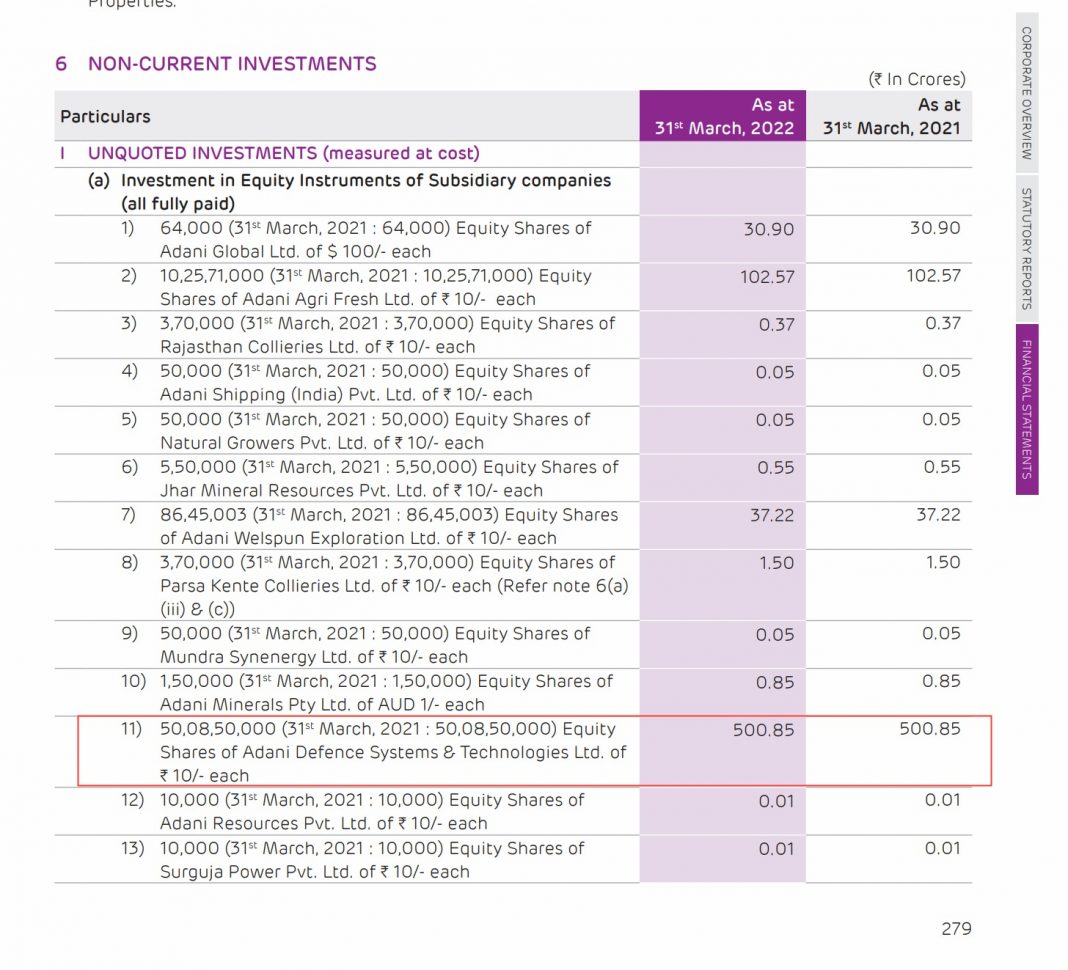
Except, here’s the truth about investment in Defence sector by Adani group. Following is an excerpt of the annual accounts of Adani Enterprise Limited for the year ending March 31, 2022.
Adani group investment in Defence sector
Adani’s investment in its subsidiary Adani Defence Systems & Technologies Ltd is Rs 500.85 crore, about 0.5% of the Rs 20,000 crore Rahul Gandhi keeps talking about.
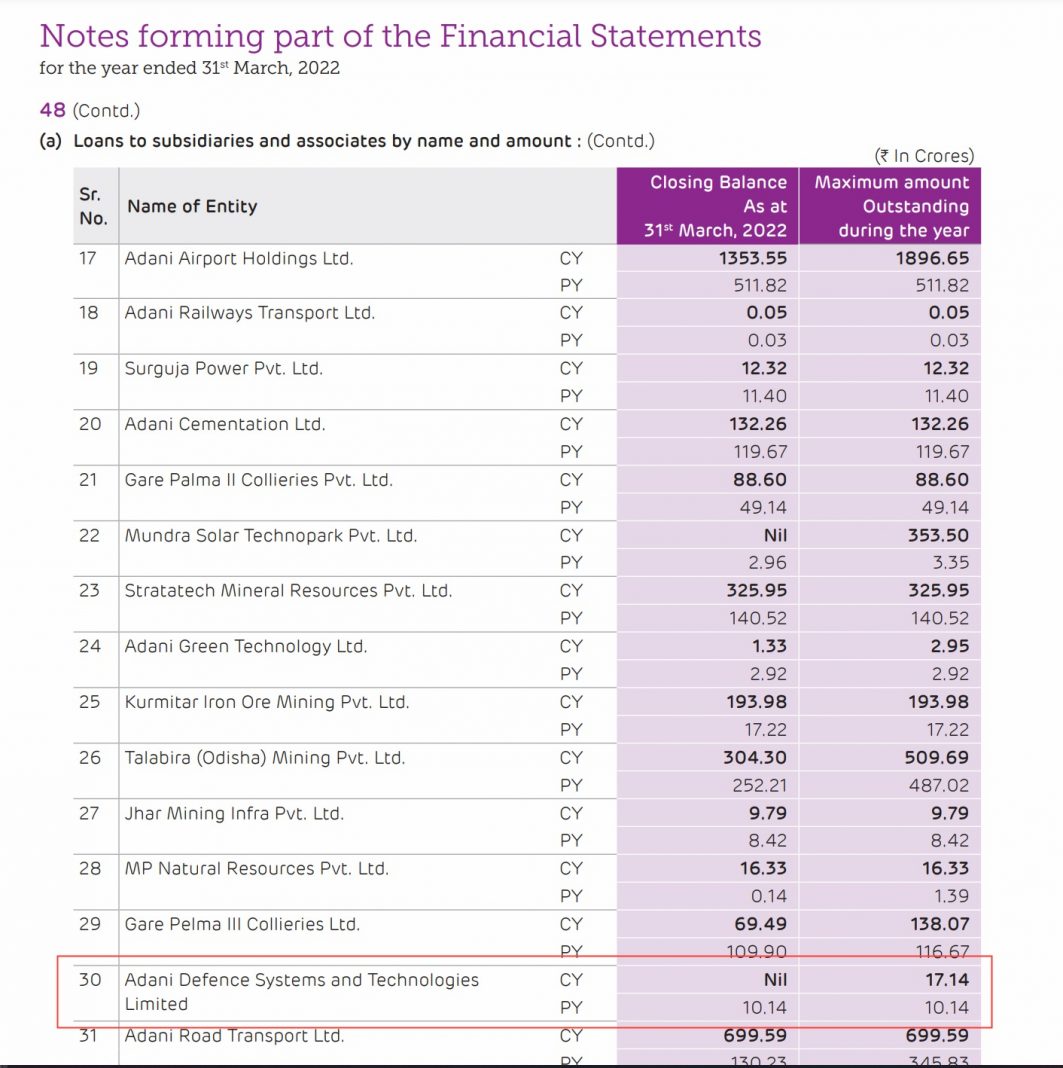
Loans to Adani Defence
Further, the outstanding loans to Adani Defence Systems & Technologies Limited is also nil. So, no money moved from Adani’s parent company to its defence subsidiary.
So what exactly does Rahul Gandhi want Defence Ministry to look into?
To summarise,
1. Rahul Gandhi’s mysterious Rs 20,000 crore is from an FT report.
2. There is no way to verify how FT arrived at this figure.
3. Even if one is to believe the figure to be correct, FT report itself mentions the money from offshore accounts came from Adani promoter group.
4. Complex transaction does not mean illegal transactions.
5. There is no new investment in defence sector subsidiary of Adani group, Chinese or otherwise, as per its annual accounts for the year ending March 31, 2022.
6. Rahul Gandhi took figures from FT and Hindenburg and came up with his own set of conspiracy theories
7. While Adani Group has rejected all allegations by Hindenburg report, it has not considered it worth reacting to FT report. And if for arguments’ sake we consider allegations are correct, which is what Rahul Gandhi believes in, even then, all the money is Adani’s own. Not of ‘Modi’ as Rahul Gandhi seems to insinuate and Kejriwal seems to assert.
8. Rahul Gandhi should consult old guards of Congress, like P Chidambaram and Kapil Sibal before alleging financial irregularities – his socialist lackeys with doctorate in African Studies from JNU are not the brightest bulbs.
Johnson & Johnson offered to pay close to $9 billion to settle the tens of thousands of lawsuits that alleged that its baby powder and other talc-based products cause cancer.
The healthcare behemoth declared it continued to view the allegations as “specious,” but hoped the fresh settlement offer would help put an end to its legal battle. The amount is a significant increase from the $2 billion it originally proposed. Those connected to the case have expressed strong support for the revised offer.
More than 40,000 lawsuits have been filed against the corporation by former customers who claimed that using its talc-based powder caused cancer. Some of the cases also claimed that the product included asbestos, which is known to cause cancer.
Johnson & Johnson has proposed an $8.9 billion settlement to resolve lawsuits that claimed its talcum powder products caused cancer.@eriknjoka tells you more
In 2020, the company discontinued selling its talc-based baby powder in the US, blaming “misinformation” for reducing demand for the item, which was used to reduce diaper rash and for other cosmetic purposes, such as a dry shampoo. It had intentions to halt sales worldwide, the company announced last year.
The company had been selling baby powder for about 130 years before that decision. It continues to market a corn-starch-containing version of the product. Since 2021, when it established a subsidiary to handle the claims, the business has been attempting to settle the litigation in bankruptcy court.
“The company continues to believe that these claims are specious and lack scientific merit,” said Erik Haas, worldwide vice president of litigation for Johnson & Johnson.
But he said, “resolving these cases in the tort system would take decades and impose significant costs on LTL and the system, with most claimants never receiving any compensation.”
“Resolving this matter through the proposed reorganisation plan is both more equitable and more efficient, allows claimants to be compensated promptly, and enables the company to remain focused on our commitment to profoundly and positively impact health for humanity,” Erik further added.
Other the other hand Alicia O’Neill of Watts Guerra, one of the firms representing plaintiffs said “This settlement is a testament to the tens of thousands of women who have battled both cancer and the court system to achieve justice for themselves.” She further added, “These strong women have ensured that no other woman will be exposed to this unnecessary danger, they deserve compensation and closure.”
In the talc litigation it faced, Johnson & Johnson claimed that it had won most of the cases. Yet, it has been saddled with some hefty setbacks, such as one ruling where 22 women received judgements totalling more than $2 billion. According to Johnson & Johnson, around 60,000 current claimants have agreed to approve the revised settlement conditions.
On March 30, the Ram Navami procession (Shobhayatra) was taken out in Una of district Gir Somnath, Gujarat. Following the procession, an event was organised where Hindu activist Kajal Hindusthani was one of the speakers. The local Muslims deemed her speech controversial and took the whole city hostage. There were reports of stone pelting, and the city burnt for two days. Following the incidents of violence, the so-called fact-checker Mohammed Zubair and other Islamists have started targeting Kajal Hindustani.
Notably, reports of violence have come to the fore from Gujarat and other states nationwide. Islamists have started propaganda to blame Hindus for the violence. Amid such attempts, Kajal Hindusthani has become one of their prime targets.
Here is the chronology of events that occurred since violence erupted during the procession detailing how Hindutva Watch and Zubair are making Kajal their scapegoat.
March 30 – Ram Navami Shobhayatra and Dharmsabha
On March 30, Hindus celebrated the birth anniversary of Bhagwan Ram (Ram Navami). As scheduled, a large procession to honour Bhagwan Ram was taken out in Una, district Gir Somnath. Kajal Hindusthani was one of the speakers in the Dharmsabha organised after the procession.
Reports suggest there were around 30,000 Ram devotees in the Shobha Yatra. The Dharmasabha took place at Raavanvadi near Trikon Bagh. During her speech, Kajal raised several issues, including Love Jihad and Land Jihad.
March 31 – Islamists blocked roads and raised ‘sar tan se juda’ slogans
On March 31, thousands of Islamists came to the roads and protested against Kajal Hindusthani’s speech during Dharmsabha. They called it ‘controversial’. Notably, it was Friday when the protests took place. There are videos on social media where Muslims can be seen raising ‘sar tan se juda‘ slogans. They raised ‘gustakh-e-Nabi ki ek saza, sar tan se juda’ slogans before a police station.
Again, Sar tan se juda slogan raised by jihadi radicals in Una, Gujarat Muslim goons raised slogans in front of the police post, @sanghaviharsh now in what language will you answer them? You used to say that you will forget to look at the stone !#HindusUnderAttackpic.twitter.com/uPwCHJ5era
April 1 – Gir Somnath SP attempted to mediate, Islamists pelted stones in the evening
On April 1, keeping the communal tension in mind, Una Police called religious leaders from both communities and tried to pacify the situation. However, both sides started arguing during the meeting. The Muslim leaders left the meeting as the situation got tense. The shopkeepers started shutting down their shops, and the whole city started to shut down.
Later Superintendent of Police (SP) called five-five leaders from both communities and brought them to a compromise. However, the city was under stress amid heavy police presence. Despite the efforts of senior police officials, stone pelting took place in the evening. Miscreants pelted stones in Kumbhwada, Koliwada and Chandrakiran areas. They also threw soda bottles. The police had to intervene to control the situation.
April 2 – 70 rioters arrested, cache of weapons recovered
Following the violence on March 31 and April 1, police started investing in the matter. Around 70 miscreants involved in the riots were arrested by the police. People were allowed to do their daily chores, but the police strictly watched the events. SRP teams have been deployed in the city.
During the investigation, police recovered a large cache of weapons. It is believed that there might be a pre-planned controversy to create a riot-like situation in the city. As per reports, the police recovered swords, axes, knives, razors, iron rods, batons and glass bottles. The police confiscated the weapons.
Kajal Hindusthani came forward to answer the allegations
As there were slogans raised to behead Kajal Hindusthani, people were expecting a strong reply from her. On April 2, Kajal Hindusthani came forward and answered the allegations in an interview with India TV on the show ‘Sawaal to bant-ta hai’. During the interview, she said if Hindu breathing in the country, it is deemed hate speech.
She said, “Muslim women are not getting equal rights and respect in the country. Women have more rights than men in the country, but women are not getting equal rights among Muslims. She said, “I have not said anything against any community, religion or God. What I said was true, and I am not responsible if someone gets offended.”
She added Love Jihad, Land Jihad, and conversions have been happening in the country because of organisations like the Popular Front of India (PFI). She deemed PFI a poisonous organisation that pushes Muslim youth towards extremism, terrorism and separatism.
She said, “I speak against their conspiracies, including Love Jihad and Land Jihad. I do not think I said anything wrong or indulged in giving hate speech.” She added, “When I talk about the benefits of women in the Muslim community and vouch for the Uniform Civil Code, people get offended.”
Notably, Love Jihad is a term used for the incidents when a Muslim or a Christian hides his or her true identity and lures a Hindu man or woman into an affair to get married to convert. Recently, there has been a spike in the cases of Love Jihad.
Similarly, when a Muslim or Christian person hides his or her identity to take control of land, it is called Land Jihad. In many such cases, illegal mosques and dargahs have been built on such lands.
April 3 – complaint against Kajal Hindusthani
During Dharmsabha, Kajal said if Muslim women marry Hindu men, it would benefit them. After her speech, Muslim leaders filed a complaint against her and demanded action. An FIR was registered against Kajal under Section 295A, 153A and 505 of the Indian Penal Code. Amid the controversy, Islamists are gaslighting their followers against Kajal Hindusthani.
April 4 – Ecosystem activated against Kajal, Hindutva Watch and Zubair frontrunners in gaslighting Muslims
As always, Islamists accused Hindus of violence. The conspiracy to blame Hindus and target Hindu leaders started on social media. For some time, low-profile Islamists kept trying to instigate Muslims against Kajal. However, later the infamous players jumped into the game. The controversial Twitter handle Hindutva Watch shared a video of Kakal Hindusthani and wrote, “At Hindu Jagruti Samelan, Kajal Shingla aka Kajal Hindusthani, a repeat offender, delivered hate speech targeting Muslims and called on Hindus to wake up and pick arms to defend themselves.”
Location: New Delhi
At Hindu Jagruti Samelan, Kajal Shingla aka Kajal Hindusthani, a repeat offender, delivered hate speech targeting Muslims and called on Hindus to wake up and pick arms to defend themselves. pic.twitter.com/o8P2aTcvwe
Notably, in the video and as Hindutva Watch wrote, Kajal only talked about self-defence. She never asked Hindus to attack someone. However, her statements were twisted and used for propaganda. The propagandist fact-checker and co-founder of Alt News, Mohammed Zubair, took charge of the conspiracy against Kajal. He shared Hindutva Watch’s video and tagged Delhi Police, saying, “Kajal Singla (Kajal Hindustani) says, “Utho Hinduon shastra apne aap uthao, apni raksha apne aap karo”. Isn’t this provocation to pick up arms? Delhi Police.
Kajal Singla (Kajal Hindustani) says, “Utho Hinduon shastra apne aap uthao, apni raksha apne aap karo”. Isn’t this provocation to pick up arms? @DelhiPolice ? https://t.co/EETZzknITe
Here, Zubair deemed the call of self-defence as a provocation. This is the same person who dog-whistled Islamists against former BJP spokesperson Nupur Sharma on social media leading to ‘sar tan se juda‘ threats against her. Not to forget, Zubair’s dog-whistling led to the murder of several Hindus, including Udaipur resident Kanhaiya Lal and Amravati resident Umesh Kohle, as they supported Nupur Sharma on social media. He employed the same modus operandi to target Hindu activist Kajal Hindusthani and paint a target behind her, triggering violence and riots in several parts of the country.
In the Nupur Sharma case, Zubair had shared an incomplete video of the former BJP spokesperson, alleging that she had blasphemed against Prophet Muhammad. The dog-whistling incited Islamists across the country who went on a rampage, resulting in vandalism, rioting, and arson in many parts of the country. In this case, Zubair twisted a call for self-defence as a “provocation to pick up arms”, painting a target behind Kajal Hindusthani and sending Islamists after her.
Since April 2, Kajal has not posted anything on social media. OpIndia tried to contact her but could not. If you remember, the same format was followed in the case of Nupur Sharma. Only time will tell if Kajal also has to live in hiding amid death threats from Jihadists or if the system will take any steps to safeguard her life and bring to account professional dog whistlers galvanising a bloodthirsty mob by twisting statements.
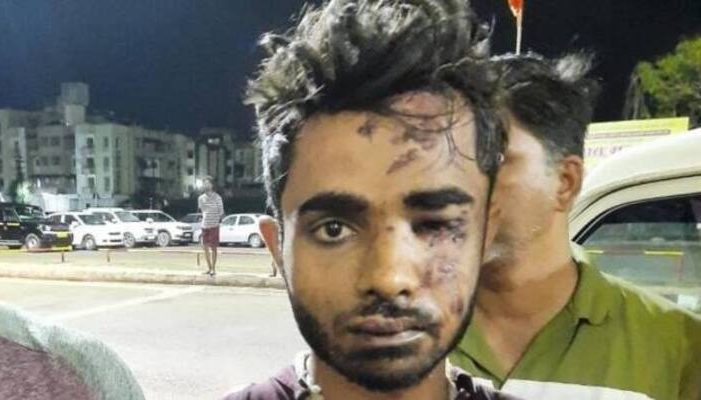
On Wednesday, April 5, Kerala Police arrived at Shaheen Bagh in New Delhi to visit the residence of Shahrukh Saifi, who is accused of setting his co-passengers on fire in a moving train in Kerala. It is notable that earlier today, with the help of Maharashtra ATS, the Kerala police nabbed Shahrukh Saifi from Ratnagiri railway station. The accused will be handed over to the Kerala Police today and brought to Kochi by this evening.
Delhi | A team of Kerala Police arrives at Shaheen Bagh to visit the residence of the Kozhikode train fire incident suspect, Shahrukh Saifi pic.twitter.com/luw2qmxm8i
Earlier, it was reported that the investigation team collected details of the SIM card used by accused Shahrukh Saifi. The police team had recovered a diary from a bag suspected to belong to the accused. In the diary ‘Shahrukh Saifi carpenter’ was written. Upon investigating the accused’s mobile phone it was found that the SIM card was obtained in the name of Shahrukh Mohammad Fakhruddin, C-8, Faisal Enclave, Shaheen Bagh in South Delh’s Jamia Nagar, as reported by Manorama. The SIM was reportedly switched off on March 31 in Haryana. The police so far have not found evidence suggesting that the accused contacted anyone in Kerala using this SIM card.
Reportedly, two weeks ago the accused was also spotted near Irumpanam in Tripunithura. After the sketch of the accused was released the Kerala ATS received some confidential information and started collecting evidence. Amidst allegations that the Brahmapuram waste fire was started by someone, this development may also be crucial in the Brahmapuram fire case, as per reports.
Kerala DGP, Anil Kant confirmed the arrest of accused Shahrukh Saifi and said that a thorough interrogation of the accused will be conducted.
According to the police, Shahrukh Saifi, a Shaheen Bagh native went missing from his house on March 30. Following this, his parents lodged a missing person complaint on Saturday. Saifi’s attempts to flee to Gujarat were thwarted when the burns on his face worsened, forcing him to stop in Maharashtra instead.
During their visit on Wednesday, the Kerala police team questioned the family of the accused, and searches were also conducted, however, nothing contentious was found. Shahrukh’s parents claimed to have no information about the case.
While some media reports say that the accused was arrested at Ratnagiri railway station, others state that Shahrukh Saifi was arrested from a hospital in Ratnagiri where he was receiving medical treatment for his burn injuries during the arson attack on April 2.
According to media reports, 30-year-old Shahrukh Saifi was working in Kerala as a construction worker. Earlier it was reported that a suspect was taken into custody by the UP ATS from Uttar Pradesh’s Bulandshahr. However, UP ATS chief Navin Arora stated that the ATS team only checked his credentials, and the person was neither arrested nor interrogated.
Meanwhile, Union Railways Minister Ashwini Vaishnaw thanked the agencies and the Maharashtra government for prompt action.
#WATCH | Railway Minister Ashwini Vaishnaw on Kozhikode train fire case suspect nabbed by police in Maharashtra pic.twitter.com/FuhPmjvnN9
The perpetrator of this heinous crime has been apprehended in Maharashtra’s Ratnagiri. Minister Vaishnaw stated, “I thank the Maharashtra government, their police, RPF, and NIA who have apprehended him this quickly.
Accused Shahrukh Saifi had reportedly boarded the Alappuzha-Kannur Executive Express train in Kozhikode at around 9.45 pm on Sunday, April 2, to pour an inflammable liquid on fellow passengers in the moving train and set them on fire.
The bodies of a woman, a man, and a child were found on the tracks near the Elathur station after the incident, the police had stated. It is suspected that the 3 persons were trying to get away from the fire and may have fallen or jumped from the train to escape.
While the BJP has called for statewide protests against the arrest of the party’s state unit president Bandi Sanjay Kumar, Telangana police detained BJP MLAs Raghunandan Rao, Eatala Rajender and other leaders on Wednesday.
As a large group of BJP members arrived at the police station to protest against Sanjay Kumar’s arrest, the area outside the station became hostile. To handle the situation, more police officers were dispatched to the location. To disperse the demonstrators, police roadblocks were built roughly two kilometres from the police station.
Telangana | BJP leaders protest outside Bommala Ramaram police station in Yadadri Bhuvanagiri district where state BJP president & MP Bandi Sanjay is detained by police pic.twitter.com/jxLhF4O1un
Raghunandan Rao and his supporters were also stopped by the police. The lawmaker, who intended to meet police officers, was held and driven off in a car. Women were also among the demonstrators who chanted anti-police slogans and attempted to block the automobile. Protesters attempted to breach the police perimeter and go closer to the police station, which resulted in a scuffle. Several protesters were arrested.
#WATCH | BJP workers protest outside Bommala Ramaram police station in Nalgonda district where state BJP president & MP Bandi Sanjay is detained by police#Telanganapic.twitter.com/GZEGE8LxYH
Raghunandan asserted that during Sanjay’s arrest, police breached the rules set down by the Supreme Court. According to him, the ruling Bharat Rashtra Samithi (BRS) administration was bringing ‘Bihar-like disorder’ to Telangana. He was detained near Bommala Ramaram police station in Yadadri Bhuvanagiri district where he was lodged.
బ్రేకింగ్ న్యూస్ :
బిజెపి ఆఫీస్ కి వెళ్తున్న హుజురాబాద్ MLA@Eatala_Rajender గారిని అరెస్టు చేస్తున్న పోలీసులు ?♀️?♀️
— BalaKrishna Reddy Mogili ?? (@Balu4nation) April 5, 2023
At Shameerpet, a neighbourhood outside of Hyderabad, the police apprehended another BJP lawmaker, Eatala Rajender. The MLA was placed under preventative detention. He questioned the police’s decision to hold him when he was on his way to the Party headquarters.
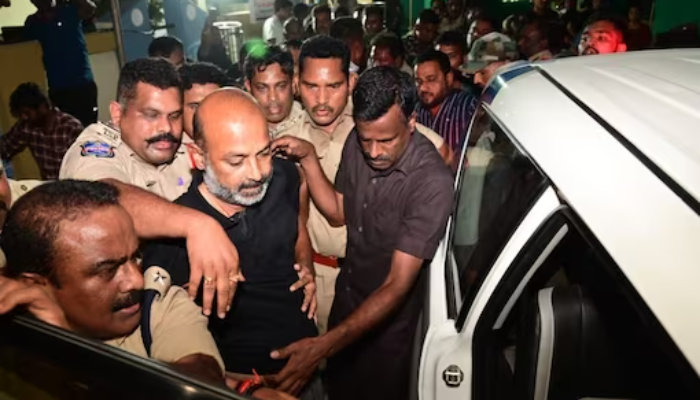
Bandi Sanjay was later transported from the police station. The BJP workers attempted to block the police car that was taking him. The cops took them into custody. He would possibly appear in court in the Nalgonda district. He was arrested from his in-laws’ house in Karimnagar around 12.45 a.m.
#WATCH | Telangana BJP president & MP Bandi Sanjay detained at Bommala Ramaram police station in Yadadri Bhuvanagiri district being shifted to another location by police pic.twitter.com/WV2eyd5Kh3
He was taken to a hospital in Palakurthi for a medical examination where BJP members tried to stop the police convey which led to a lathi-charge on them.
#WATCH | Jangaon, Telangana: Police take Telangana BJP Chief Bandi Sanjay Kumar for medical examination to a hospital in Palakurthi. BJP workers tried to stop the convoy and police lathi-charged protesters. pic.twitter.com/WxRgsFuAdw
They also tried to stage a protest and stop the vechile outside the hospital.
#WATCH | Jangaon, Telangana: BJP supporters tried to stage a protest and stop the vehicle outside the hospital, where Bandi Sanjay was taken for medical examination pic.twitter.com/woA1NBsjbB
The BJP leader is arrested concerning the leak of test papers from the 10th-grade exams. Police claimed that immediately after the exam started in Warangal, someone leaked the Hindi question paper and provided it to Bandi Sanjay over WhatsApp. Prashanth, the accused, is reportedly a BJP worker.
In the meantime, the BJP organised demonstrations around the state to oppose Sanjay’s arrest and raised slogans against the current dispensation.
H. Kishan Reddy, the minister of tourism and culture, has denounced the police action. He called Director General of Police Anjani Kumar to inquire about the case that led to Sanjay’s arrest. The police chief assured that information about the case will be made available soon.
On 30th March 2023, the West Bengal chief minister Mamata Banerjee said that Hindus should not take the Ram Navami processions from what she referred to as the ‘Muslim areas’ and asked Hindu communities to be ‘peaceful’. On the contrary, the Islamists attacked Ram Navami processions in West Bengal and many other states in India, while Hindus were inherently peaceful in carrying out the processions.
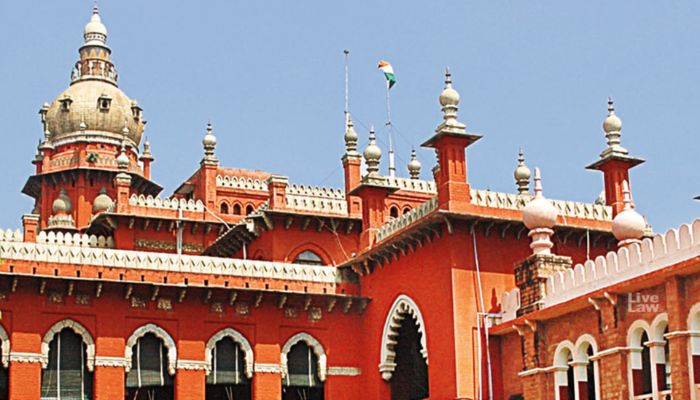
As the term ‘Muslim areas’ caught attention against this background, it becomes necessary to know remarks by the Madras High Court in 2021 on hearing a petition in which Muslims in Tamil Nadu had similarly opposed the Hindu processions passing through the so-called ‘Muslim areas’. Notably, in their petition, the Muslims in Tamil Nadu had called the Hindu processions a sin.
V Kalathur in Tamil Nadu’s Perambalur district is a Muslim-majority area where Hindus are a minority. The majority community here has long opposed the Hindu processions taken from the temples. A petition was filed before the Madras High Court about the conduct of temple processions through a Muslim-dominated locality at V Kalathur in the district of Perambalur in Tamil Nadu.
Some local Muslims in the area have been objecting to the conduct of Hindu processions since 2012. The community had dubbed the Hindu festivals as ‘sins’. The petitioner had therefore approached the police for protecting the conduct of rituals and processions. The same was provided by the law enforcement authorities with restrictions.
When the matter came up for hearing before the Madras High Court, a 2-Judge Bench of N Kirubakarn and P Velmurugan noted that religious intolerance is detrimental to the secular fabric of the country. The Court noted that if such a ‘resistance’ to the conduct of religious festivals is reciprocated by another religious group, it might lead to riots and chaos.
While reading out the affidavit presented by the Deputy Superintendent of Police, the Madras High Court observed that objection to temple processions was raised from 2012 onwards. The Judges observed how no such problem existed before 2012. The Court pointed out how objections were raised by the Muslim community despite the Court granting permission to the Hindus to carry out temple processions (in accordance with Section 180A of the District Municipalities Act 1920).
The court said in its order, “Merely because one religious group is dominating in a particular locality, it cannot be a ground to prohibit celebrating religious festivals or taking processions of other religious groups through those roads. If religious intolerance is going to be allowed, it is not good for a secular country. Intolerance in any form by any religious group has to be curtailed and prohibited.”
The court further said, “In this case, intolerance of a particular religious group is exhibited by objecting to the festivals which have been conducted for decades together and the procession through the streets and roads of the village is sought to be prohibited, stating that the area is dominated by Muslims and therefore, there cannot be any Hindu festival or a procession through the locality.”
In this case, the judges simultaneously reiterated that due to the dominance of one religious group in the area, other religious groups and their processions cannot be removed from the area. The court argued that if such cases are accepted, no minority community will be able to celebrate their festivals in most parts of the country. The Madras High Court said that such protests will lead to religious fights, and riots, in which many people will lose their lives and many properties will be vandalized.
Notably, Mamata Banerjee had said on Ram Navami, “I want to request those who are taking out the Ram Navami procession, please do but do it peacefully. Kindly avoid Muslim areas as Ramzan is going on. Celebrate peacefully but don’t try to create violence. Don’t get provoked.”
She further said, “Some goon has said that ‘on the day of Ram Navami, we will come out with weapons and do a procession.’ I will not stop the procession of Ram Navami, but if weapons come out then action will be taken by the government. The month of Ramzan is also going on and during this time if anyone tries to do any wrong thing, he will not be spared. No one has the right to practice riot.”
Mamata Banerjee cited the occasion of Ram Navami to indicate that Hindus create violence in the so-called “Muslim areas” during Ram Navami processions and attack the community. She extended her support to the Muslim community and stated asked Hindus to be ‘peaceful’.
On Thursday, March 30, stones were pelted on a Ram Navami procession from the terraces of the buildings in the Shibpur area of Howrah. This led to a clash between the Hindu and Muslim groups, leading to violence and arson. Vehicles and shops were also torched during the attack. Several disturbing videos of the incident went viral on social media. A large contingent of police was deployed to maintain the law and order situation in the area. The cops conducted a flag march, fired tear gas shells, and chased away the rioters.
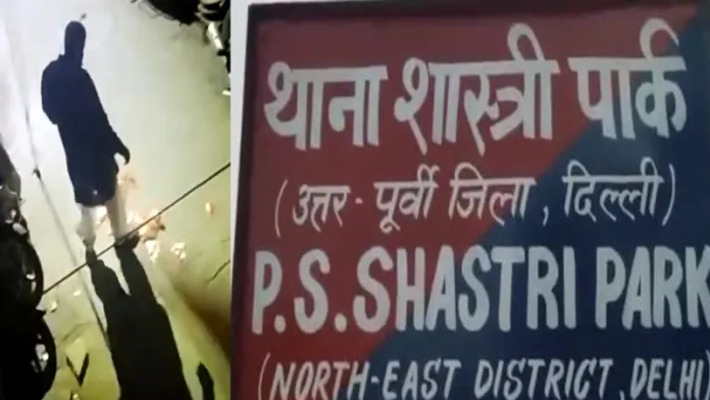
A man in Delhi named Azim has been arrested by Delhi Police for insulting saffron flags placed along a street in the Shastri Park area. He was arrested after a complaint was filed by a Shastri Park resident named Sagar after he saw his neighbour Azim trampling the flags.
On the occasion of Ram Navami, saffron-coloured religious flags were placed along A Block Street at Shastri Nagar. At around 12.30 on Tuesday, Azim tore some of the flags, trampled them and then dumped them in a drain. Sagar, a resident of Lane No. 8 in the area named filed a police complaint against Azim alleging that he has hurt the religious sensibilities of Hindus. The complainant also submitted a video of Azim’s act to the police.
Delhi Police booked Azim under IPC sections (promoting enmity between different groups on grounds of religion, race, place of birth, residence, language, etc) and 295A (deliberate and malicious acts, intended to outrage religious feelings of any class by insulting its religion or religious beliefs). He was arrested after the FIR was registered based on the complaint.
Case registered under sections 153A and 295A IPC at PS Shastri Park against one Azim for allegedly insulting saffron flags that were placed along a street in the Shastri Park area on Ram Navami. The man was arrested and further investigation is underway: Delhi Police
The video of the incident has gone viral, which shows a person wearing a kurta-pajama tearing apart and then trampling saffron flags with his feet in the night. As seen in the 28-second video, after trampling the saffron flags, the accused returns to his home.
शास्त्री पार्क इलाके में राम नवमी मे लगाए गए भगवा झंडे को पैरों से कुचने par अजीम पर FIR darj अजीम ने गली में लगे हिंदू धार्मिक ध्वज का अपमान किया पुलिस ने IPC U/s 153A, 295A के तहत मामला दर्ज किया है। pic.twitter.com/096R0yAJoQ
It is pertinent to mention here that on Ram Navami this year, fanatics carried out acts of violence in various states of the country. The states of Gujarat, Maharashtra, Bihar, Bengal, and Jharkhand have been especially severely impacted by this violence. The administration was hesitant to let the procession this time after the violence on Ram Navami in Delhi’s Jahangirpuri last year. However, Hindu organizations took out a grand procession.
Tiktok has been penalised by the UK’s privacy watchdog with a fine of 12.7 million pounds ($15.9 million) for failing to block users under the age of 13 and exploiting their data without their parent’s permission. The decision comes as several Western governments have started to impose strict regulations on the enormously popular Chinese app.
In a statement released on Tuesday, the Information Commissioner’s Office (ICO) said that, in violation of TikTok’s terms of service, over 1.4 million British children under the age of 13 used the app in 2020. The ICO said many were able to access the site despite TikTok setting 13 as the minimum age to create an account. According to the watchdog, TIkTOk “did not do enough” to delete these minor users, and the company utilised their data without getting permission from their parents.
The ICO said the data breaches occurred between May 2018 and July 2020, as the company didn’t do enough to check who was using the platform and remove the underage children from it.
Information UK Commissioner John Edwards said, “There are laws in place to make sure our children are as safe in the digital world as they are in the physical world. TikTok did not abide by those laws. As a consequence, an estimated one million under-13s were inappropriately granted access to the platform, with TikTok collecting and using their personal data.”
John Edwards further said, “it means that their data may have been used to track them and profile them, potentially presenting dangerous, inappropriate content at their very next scroll.”
“TikTok should have known better. TikTok should have done better. Our £12.7m fine reflects the serious impact their failures may have had,” he added.
TikTok claimed that its 40,000-strong safety team analyses accounts for evidence of underage use and that it invests “heavily to keep under 13s off the site.”
The regulator had initially proposed a fine of £27 million, but it was reduced to £12.7 million. In the ‘notice of intent’ previously issued to TikTok, ICO had said that the potential fine could be £27 million.
Similar penalties have already been imposed on the platform. The app, which was then known as Musical.ly was found to have broken US privacy laws in 2019 by allowing children under 13 to sign up without parental permission. A settlement for $5.7 million was reached between the FTC and Musical.ly.
Since the majority of the largest international tech companies have their EU Headquarters in Dublin, Ireland typically conducts investigations into violations of the EU’s privacy regulations
Ireland’s Data Protection Commission opened a similar inquiry into TikTok’s handling of user data from minors in 2021, according to Irish media, and last November proposed an unnamed “preliminary range of fines” on the company.
In addition to these probes, TikTok has been charged with sharing user data with the Chinese government by numerous Western governments, an accusation both the company and Beijing have refuted. Nonetheless, TikTok has been prohibited from being used on government-issued devices in more than a dozen nations, including the major institutions of the US, UK and EU
According to TikTok, the prohibitions were put in place “without thought or justification” and on the basis of “basic misinformation”.
Other countries which have gone tough on TikTok
New Zealand
In a move to strengthen security protocols, New Zealand’s Parliament has officially decided to ban the use of TikTok on all the devices linked to Parliament or its MPs The decision was made due to concerns over potential security risks posed by the Chinese social media platform. This comes a day after the UK banned TikTok on government-issued phones.
TikTok will be banned on all devices with access to New Zealand’s parliamentary network by the end of March, said Parliamentary Service Chief Executive Rafael Gonzalez-Montero. The announcement comes after a review of security procedures was conducted by the Parliamentary Service. It was found that TikTok’s data collection and privacy policies could potentially compromise sensitive information that is shared and stored on Parliament’s devices
France
France became the most recent country to join the list of countries that have outlawed the Chinese short video app TikTok, which is owned by the Chinese technology company Bytedance, on phones of govt officials over security issues.
India
The government of India permanently banned 59 Chinese apps, including ByteDance’s short video app TikTok, WeChat, Baidu, Alibaba’s UC Browser, Club Factory, BIGO Live and others in 2020. The apps were banned for their failure to comply with the user data handling norms of India.