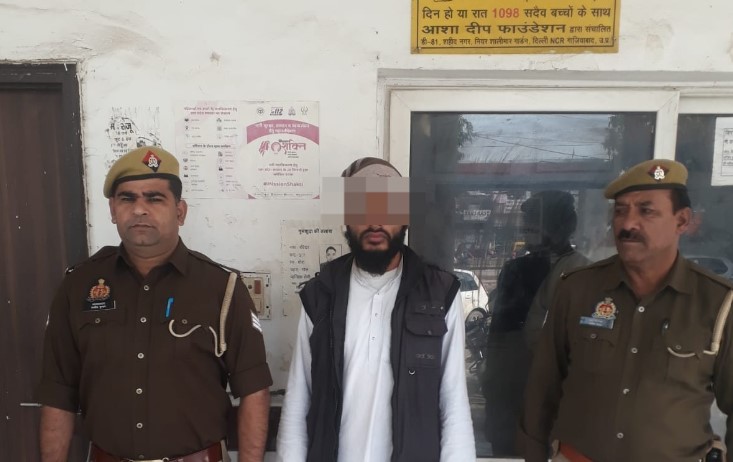
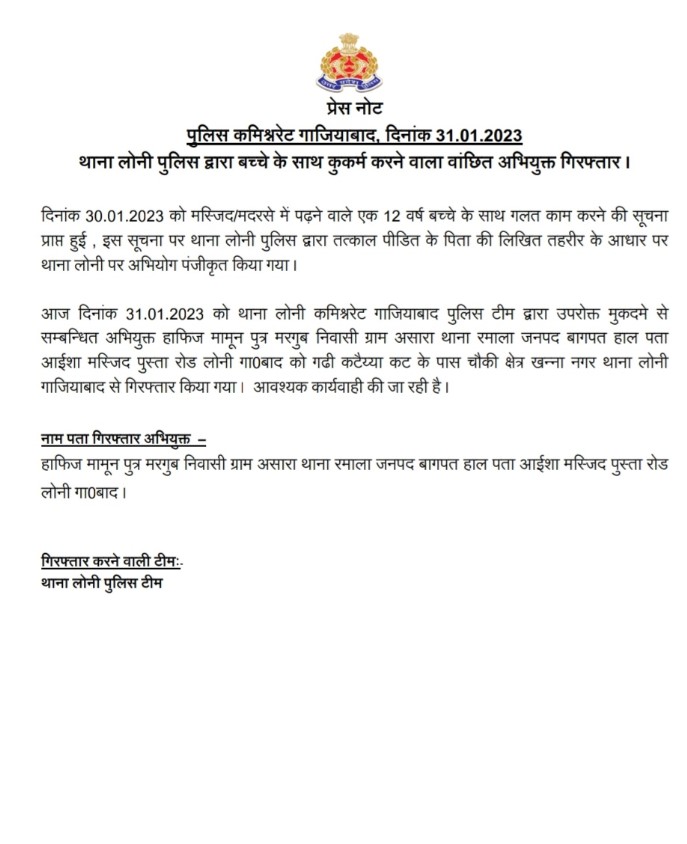
On Monday, January 30, a case of sexual harassment of a 13-year-old minor boy by a cleric at Aisha Madarsa in the Loni area of Uttar Pradesh has come to light. According to the police, Hafiz Mamoon, a native of the Baghpat district raped the minor boy and fled when the incident came to light.
Based on a complaint filed by the boy’s father, the Loni police registered a case against Hafiz under section 377 of the IPC and sections of the POCSO Act and launched a manhunt to trace the accused.
On January 31 (Tuesday), the Ghaziabad police took to Twitter to inform that the accused had been arrested and produced in the court. Further investigation into the matter is underway.
— DCP RURAL COMMISSIONERATE GHAZIABAD (@DCPRuralGZB) January 31, 2023
According to reports, the child had managed to sneak out of the Madarsa on Monday morning. He obtained a mobile phone from a stranger outside the madarsa and called his father. The father reached Loni in the evening and lodged a complaint against Mamoon. The boy in the complaint alleged that the teacher sodomised him.
Source: Twitter handle of DCP Commisionerate Ghaziabad
Divulging details about the case, Assistant Commissioner of Police (Loni) Rajneesh Upadhyay said that the accused teacher had brought the boy to the madarsa five months ago to teach him Quran.
He added that as soon as the police received the complaint, two police teams were formed to apprehend the teacher who fled after committing the crime.
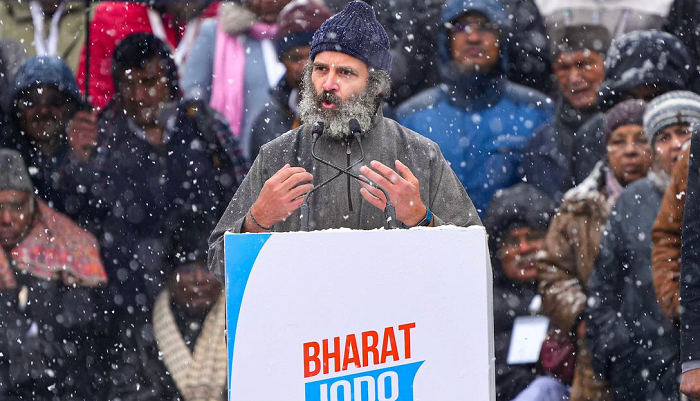
On January 30, 2023, Congress leader Rahul Gandhi completed his Bharat Jodo Yatra that started in September 2022 from Kanyakumari. The Yatra was wrapped up in Jammu and Kashmir. During the Yatra, there were several instances where the journey was more of a ‘Bharat Todo Yatra’ as many people who are known for their divisive politics joined Gandhi.
Simultaneously, the Congress leader made several comments that sparked either controversy or meme-fest. However, one thing is for sure as an event, Yatra was a quite successful PR stunt for the grand old party, especially for its Prime Minister candidate Rahul Gandhi.
In a detailed report, Dainik Bhaskar noted how leaders and workers of the Congress party worked for months to plan every leg of the Yatra in every state. Furthermore, two event companies from Mumbai were also roped in for the arrangements in Maharashtra, the report suggested.
Drawing similarities with MK Gandhi
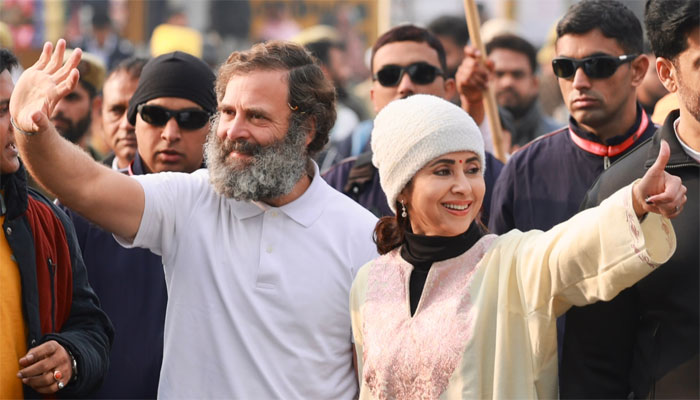
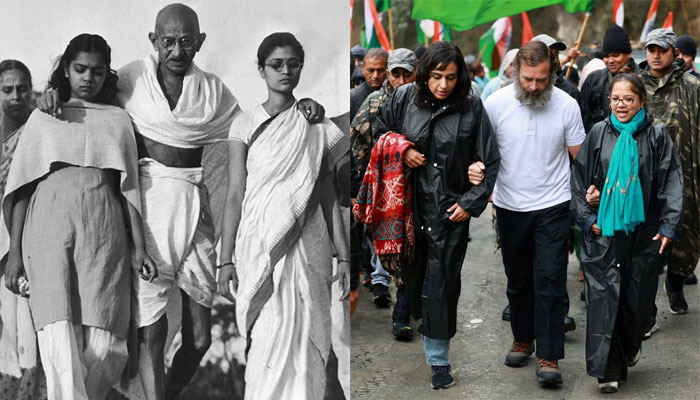
In an interesting PR stunt, a photograph of Rahul Gandhi was made viral on social media platforms where he was seen with two women. The woman on the right was wearing glasses while the woman on the left was without glasses. The photograph has a striking similarity with a famous photograph of Mohandas Karamchand Gandhi where he was walking with his granddaughter Sita and wife of his nephew Kaanu’s wife Abhaben. Factually speaking, Rahul Gandhi has no relationship with MK Gandhi.
MK Gandhi (Left) Rahul Gandhi (Right)
How much of the BJY was planned?
The reporters of Dainik Bhaskar investigated the whole event and traced the steps of the Congress leader to find out how much of the Yatra was spontaneous and how much of it was planned. The reporters met 16 people from seven states who were seen with Rahul Gandhi in photographs. They asked them three questions.
First, how they met Gandhi, Who told them about the Yatra and how well were they prepared?
Was there any security check before Gandhi arrived or it was as spontaneous as shown in the photographs?
When they think about meeting Gandhi, how much life changed?
Kerala
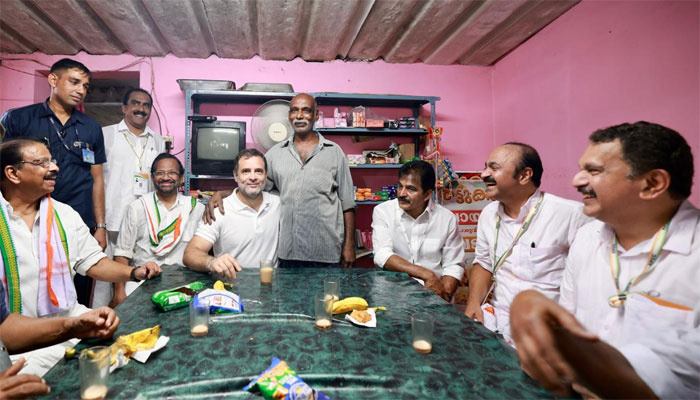
On September 11, 2022, Rahul Gandhi made a stop at a tea shop in Nemum’s Annakkun Church Junction. The tea shop belongs to one Stanley Thattukada. He told Dainik Bhaskar that at around 7 AM, a few people came and told him to make arrangements for a few big leaders. He said, “They came with electronic equipment and checked my shop.” He was informed ten minutes before Gandhi’s arrival that it was the Congress leader who would be drinking tea at his shop. As he did not have much time, Stanley and his wife prepared fritters and banana fingers. Gandhi stayed at his shop for 30 minutes. While leaving, he gave him Rs 2,000.
Source: Bharat Jodo Yatra official website
Interestingly, there is a hardware shop next to Stanley’s, owned by one Bernard, a Congress Booth President. He told Dainik Bhaskar that he was informed about Gandhi’s proposed visit on the same day. He was not allowed to meet Gandhi, Bernard claimed.
Trivandrum
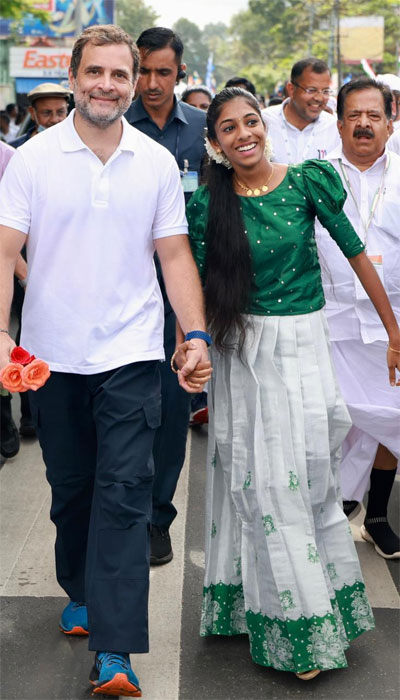
In Neyattinkra, a 12th-class student named Daksha Dilip MD met Gandhi. Her photograph went viral on social media. Upon asking how she met Gandhi, Daksha said, “I came to know about Gandhi’s visit via the newspaper. I asked my father if I wanted to meet him. We were waiting on the roadside for him. When he was crossing, I called him. He saw me and asked the security person to let me come”. No security check took place before allowing her to meet Gandhi. She talked to him for 2-3 minutes.
Source: Bharat Jodo Yatra official website
Pallichal
In Pallichal, Gandhi met one Ratish. He told Bhaskar that around 5 PM in September, some people visited his place and told him that Rahul Gandhi wanted to use their washroom. When he allowed, the team checked the house and 15 minutes later Gandhi came. His wife told Bhaskar’s reporter that the security personnel stayed with her when she was preparing tea. They checked the ingredients as well. Gandhi stayed at their place for 30 minutes, talked to their children and left.
Ratish is a member of the Communist party. He said it was shocking for him that Gandhi visited his place. He alleged the visit might have been planned by Gandhi’s team.
Multiple teams were formed for the arrangements at the national and local level
As per District Congress Committee head Plode Ravi, BJY reached Trivandrum on September 11, 2022. The team was preparing for Gandhi’s visit for a month. There were teams formed at the district and local levels to arrange everything for the Yatra. Six main committees were formed that included Sub Committees, Transport Committee, Steering Committee, Food Committee, Accommodation Committee and Finance Committee. There were five committees at the organisational level. These were District Level Committees, Panchayat Level Committees, Assembly Level Committees, Booth Level Committees and Block Level Committees.
Ravi told Bhaskar’s journalist that the Congress workers collected funds for the arrangements. There are 2740 booths in Trivandrum. Every booth worker was handed over coupons worth Rs 50 thousand each. They went to every house seeking donations and used coupons of Rs 5, Rs 10 and Rs 100 to collect the donations.
He further told Bhaskar that the meetings were preplanned. He said, “In Trivandrum, he met Gandhian leader Ramachandram. Then he met handloom workers. He also went to a temple in Trichy. All these events were preplanned. Ravi’s team had arranged for everything. Congress workers were available at every point to provide the support required including for SPG for security. Only those people were allowed to meet Gandhi who was selected by the Congress leaders beforehand.”
He further told the reporter that a team of Congress members would stay 45 minutes ahead of Gandhi and make arrangements for stops. Where Gandhi would take a break, security arrangements etc were the responsibility of this team.
There were three criteria that were followed to choose the location for breaks:
The house, restaurant or tea shop should have a toilet.
There should be enough space where Gandhi could sit and talk to 2-5 people.
There should be an arrangement for tea and snacks.
Karnataka
In Karnataka’s Mysore, Gandhi stopped at a pickle factory in Nanjangud. Vishvachetan KL, the partner of the factory, told Bhaskar’s reporter that they were aware that Gandhi would pass through the factory’s location. At around 7 AM, a few security personnel came and informed them that at 8:30 AM a prominent leader would visit the factory and asked if they could arrange for snacks. At 8:15 AM, he was informed that Gandhi would be visited. Gandhi came with Randeep Surjewala and 50 others. They had tea and snacks at the factory and talked to the factory’s partner’s son Vishwaroop.
Interestingly, Varun Venugopal, owner of Platinum In Restaurant of Mysore, told Bhaskar’s reporter that when Gandhi stopped at the restaurant, no one was allowed to use the phones. Only camerapersons of the Yatra were allowed to take pictures.
The uninvited were beaten up
There were instances where those who tried to meet Gandhi without prior approval were beaten up. Yogesh Anneyay of Mysore tried to gift Gandhi an old photograph of Rajiv Gandhi. The security personnel did not allow him to meet and instead, beat him up. However, Gandhi spotted what was happening and asked the security personnel to let Yogesh pass.
यात्रा के वो लम्हे, जो थकान-दर्द सब मिटा देते हैं।
On the contrary, another student named Noufil Ahmed was allowed to meet Gandhi without any problem. He even talked to Gandhi about jobs and unemployment. He, along with a group of 70-75 youth met Gandhi and gave him their resumes.
While speaking to the Congress leaders in Karnataka, Bhaskar reporters found out that the arrangements were different in every state. For example, in Karnataka, the arrangements were made at four levels. Here too, the preparations started a month before the Yatra. Around ten meetings were held to form the structure of the arrangements. All the permissions were obtained fifteen days before Gandhi’s visit. The famous places including Sutur Math, Chamundi Hill Temple, Masjid-E-Azam etc were visited by the Congress’s team members multiple times in two months to make the arrangements.
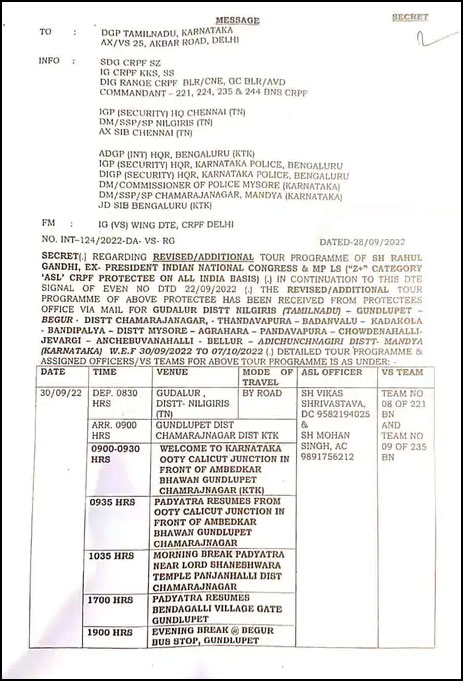
From protests against the Central Government to visits to temples, mosques and churches, everything was pre-planned at least 15 days before the day of the events. For the Mysore visit, an application was submitted to the DM office eight days before the date of the event. In the document accessed by Bhaskar, all details of Gandhi’s visit excluding team breaks and details of temple, mosque and church visits were there.
Source: Dainik Bhaskar
Andhra Pradesh
In Aalur, Gandhi met a man named Rasool who came with his 2-year-old son. He expressed his surprise when he was allowed to meet Gandhi without any check. Interestingly, the little lad was wearing a shiny cap and the photograph went viral on social media.
D Pasha, Congress Incharge of Aalur, told Bhaskar that they were informed about Gandhi’s plan in June. His team was given the task to make all the arrangements. They had put up over 10,000 posters and five auto-rikshaws were hired to promote Yatra.
In Karnul, Congress District Committee Chief M Sudhakar Babu told Bhaskar that Yatra passed via inner roads and not via main roads and it would not have made such an impact on the main roads. Everything was planned 15 days before the day of Gandhi’s visit. All the programs were preplanned by the Congress workers, former MLA Lakshminarayan Reddy told Bhaskar. Wherever, Bhaskar’s team went, everyone, told them that all the events were preplanned and the arrangements were made by the local leaders and workers.
Maharashtra
In Maharashtra, Congress spokesperson Santosh Pandhagle told Bhaskar that they went to Kerala to study how preparations were made so that those can be replicated in the state. He said that they were informed about the Yatra five months prior. Two event management companies were also roped in for the arrangements along with workers from private firms.
Madhya Pradesh
In Madhya Pradesh’s Khandwa, Gandhi stopped at Rahul Naushad’s place. He told Bhaskar that he was informed about the visit two hours prior. The chairs and snacks were brought by Gandhi’s team.
Rajasthan
In Rajasthan as well, special arrangements were made for some famous artists including Langa-Mangniyaar artists, Kalbheliya dancers etc to meet Gandhi. All the arrangements were made by local leaders.
राजस्थान की सांस्कृतिक विरासत को संजोती #BharatJodoYatra में कालबेलिया नृत्य की झलक।
From Bhaskar’s report, it is evident that several incidents where things looked spontaneous were pre-planned at the booth level. Celebrities, articles and groups that met Gandhi were all part of the plan. Only those were allowed to meet Gandhi who was cleared by Congress committees and passed security checks. The committee members in every state started preparing for the visits months before the Yatra started. The party collected funds for the Yatra using coupons.
During Bharat Jodo Yatra, mainstream media was kept at a distance but planned interviews were given to YouTubers. It was all planned by the Congress committees who will be invited to meet Gandhi and what kind of questions would be asked.
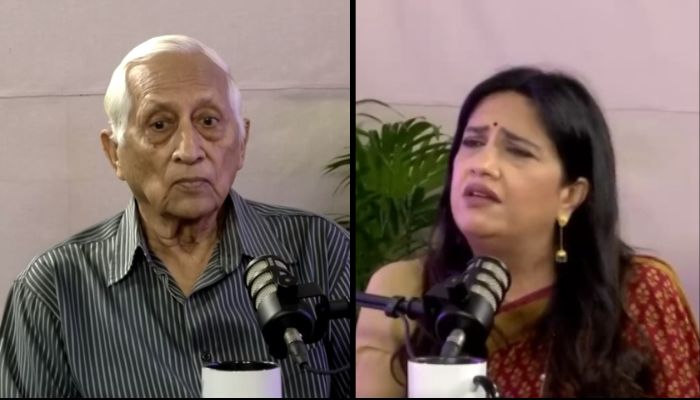
On Monday (January 30), the commander of the infamous ‘Operation Bluestar’ of 1984, Lt. General Kuldip Singh Brar, recounted how Khalistani terrorist Jarnail Singh Bhindranwale had to be eliminated for waging war against the Indian State.
While speaking to ANI Editor-in-Chief Smita Prakash, he narrated how there was a complete breakdown of law and order in the State of Punjab, in the months preceding the military operation at the Golden Temple.
“Feeling of Khalistan was slowly building up. Bhindranwale was fully in control of the State,” Lt. General Brar emphasised. On being asked about the resurgence of the separatist ideology, he lamented how the Khalistani movement, which he helped weed out in the 1980s, had resurfaced on a global scale.
“I feel horrible. I go to South Hall in the United Kingdom. I see Bhindrawale’s pictures everywhere…It is our diaspora who have gone abroad who are more pro-Khalistan and all that than those who are in India. Pakistan is also assisting them, besides the United Kingdom, United States and Canada,” General Brar emphasised.
While recounting Operation Blue Star, he said that the Indian Army was left with no option but to eliminate the Khalistani terrorist who took devottes as hostages at the Golden Temple.
“It was decided that there was no other way except to physically enter the Golden Temple…Machine guns were firing at us from places which we never imagined and couldn’t see. It was like a boxer going into the boxing ring with one hand tied behind his back and allowed to fight with only one hand,” he narrated.
ANI Podcast with Smita Prakash | EP-36 with 1971 War veteran, Operation Blue Star CO Lt Gen Kuldip Singh Brar premieres on Mon at 7 PM IST#KuldipSinghBrar#SmitaPrakash
“Because you do not have all the resources with you. In those 8-10 hours, we must have lost 300-400 soldiers. It was not easy. I know what nightmares I have been having after that event,” the commander of Operation Blue added.
He pointed out how General Krishnaswamy “Sundarji” Sundararajan had instructed the army to execute the operation with minimal damage. “We didn’t want to bring in heavy weapons because of the restrictions imposed by the government – minimum force, no damage to buildings, temples etc,” he said.
“No, we did not fire on the Akal takht. The orders were not to fire on the Akal Takht. But the fact is what do you do? You just allow your men to keep dying. You are to take some action,” General Brar reiterated.
#WATCH | On Op Blue Star, Lt Gen Kuldip Singh Brar,a veteran of 1971 India-Pak War says,”No one wants an op but what do you do?Indira Gandhi allowed him (Bhindranwale) to become Frankenstein. You could see what was happening.But when he reached pinnacle, finish him – too late…” pic.twitter.com/yHIxol5wMl
On being asked whether he had any sense of regret, he remained unabashed about his commitment to the nation without giving a damn about political correctness.
“What shouldn’t have happened? No one wants an operation but what do you do? Indira Gandhi allowed him (Bhindranwale) to become Frankenstein. You could see what was happening with each passing year. But when he reached the pinnacle, now finish/ destroy him. Now, it’s too late…” he highlighted.
“The Congress and the Akalis had their own political problems. (They allowed this cult of Bhindrawnwle) to continue,” he added. On being asked whether the operation could have been executed better in hindsight, Lt. General Kuldeep Singh Brar clarified, “I do not know. How am I to say that? Someone else can say that. I feel whatever we did, it was executed in the best manner that we could.”
Operation Blue Star assassination of ex-army Chief General AS Vaidya
Between the 1st and 10th of June 1984, Prime Minister Indira Gandhi had launched an operation to flush out terrorists from the Golden Temple. Operation Blue Star was the code name for the Indian military action carried out to remove Khalistan terrorist Jarnail Singh Bhindranwale and his armed followers from the Harminder Sahib complex in Amritsar.
Operation Blue Star, however, had far-reaching ramifications well after it was over. While the military had neutralised Bhindranwale, the Army Chief, who had coordinated the operation, was brutally assassinated by Khalistani terrorists only 2 years later.
On August 10, 1986, former army chief General A.S. Vaidya was assassinated in Pune by Sikh militants in Khalistan Commando Force. The assassins, Jinda and Sukha were sentenced to death in 1989 and executed on October 9, 1992. General Vaidya played a vital role in Operation Blue Star which eventually led to the end of the Khalistan movement in Punjab. He was army chief during the operation.
I know I am wading into a topic that has been discussed enough in recent days. The Hindenburg report on the Adani Group has stirred a lot of interest. As Jinit Jain’s article has pointed out, the CONLEFT ecosystem’s attacks on Adani and their embrace of this report to use as a stick to beat Modi has split the right too – should they defend Adani or not? Let me ignore that for now and focus on other aspects.
We must understand and acknowledge that short sellers are very much a part of the overall free market ecosystem. They are often wrong and have their own profit motives – like any other player – but that doesn’t mean they can be condemned wholesale. They play a valuable role in unearthing fraud and bubble stocks. Many, like Jim Chanos, are highly respected even when they are wrong – as they have been with Tesla for a long long time. They may yet be proved right.
There is a special breed of short sellers that are “activists” – they go around actively promoting their theories, perhaps hoping many will buy into it, dump the stock and help turn their doomsday prophecies into reality. At that point it hardly matters if the original allegations are right or wrong. Carson Block, Andrew Left are examples of such activist short sellers.
Such activist short sellers usually target the big guys. Even if they are completely wrong and motivated, one must admire their guts. There are easier ways to make money, believe me.
Adani is not the first or will be the last to be targeted by such people – they go for stocks with high PE, steep run-up in price and are led by visible and controversial people. After all, this is where they can find traction for their allegations and maximum profit potential – again this is not wrong. If posting crazily optimistic projections on Tesla (to name but one stock) while being long on the stock is kosher, so is posting doomsday on the same stock, hoping to profit on its decline. As long as there is proper disclosure, intelligent research or insights and the allegations survive the usual laws of defamation.
The shorts pay a heavy price for their positions if they are wrong or if the market doesn’t believe them, whether they are activists or not. Many lost their shirts on “meme stocks” like AMC and folded up. Of course, they also made killings, as George Soros did with the Pound sterling.
It is not just the right wing that attacks short sellers – everyone does, if it suits them. In fact, in woke liberal paradise of the USA, DOJ (which is supposedly independent) has opened a criminal investigation into short sellers and the FBI sent search warrants to many of them. Imagine Modi doing this! American politicians of various hues have harangued about the alleged damage “shorts” cause the economy while often playing the market themselves, including taking short positions!
I personally think it is more harmful to ban shorts. Yes, they ‘distort’ as the famous academic Prof Mitts report alleges. They spend huge amounts of time and money to research and uncover frauds, not to speak of personal and financial risks for uncertain rewards. If you ban them, the incentive goes. Who will be the loser? The small investor who bought into tulip-style bubbles won’t have access to such analysis.
If all this sounds like a defence of short sellers, you are right! It very much is.
Now let us turn our attention to the specific case – Adani Group and Hindenburg. Again a few points are relevant:
Just as a disclosure, I don’t personally short any stock, I own them mostly for the long term. I do not own any Adani Group stock. I also have no investments in any hedge or other funds that are short-focused.
Adani Group has been selected for the exact same reasons I mentioned earlier – its stock has run up quite a bit, deservedly or otherwise. But then the whole market is frothy not just in India, but in the USA too. And Adani is, to say the least, controversial perhaps next only to Musk.
I am not trying to defend Gautam Adani – he is perfectly capable of doing it himself. I am more concerned about Indian infrastructure which needs more such investments given the pathetic state it was left to us when dynastic loot ended in Delhi.
Having said that I have some comments on the report:
In the very first paragraph, it says the accounting frauds and other manipulations are “decades” old. In that case, the CONLEFT ecosystem may find they have scored yet another self-goal. Pidis may well be careful, your lifafas and table scrap are at risk if this starts biting the hands that feed!
India has signed special treaties that encourage routing investments through Mauritius etc. Obviously, Modi or Adani did not invent this loophole. In fact, in recent years the NDA government has with lots of effort, amended some treaties, tightened them – and in the process got attacked as anti-business.
Having overseas subsidiaries and holding companies, especially in tax-attractive domains like Singapore, UAE etc., is not wrong in of itself – many do it. Not just Indian conglomerates. The challenges this presents to Income tax and other authorities is a separate problem that needs serious discussion but not one that focuses on any one entity.
It is also common for companies that fund infra such as solar or other power plants to insist on separate legal entities and related ownership structures for each project. This is to avoid the problem from one affecting the other.
It is hilarious to see the report pointing out close family control of the Group – this is how Corporate India (or for that matter Political India) runs! So-called key person risk etc. is well known and is hardly an Adani-specific problem. You don’t need a short seller to educate us on that!
Adani is into infra–transmission, green energy, power, airports, ports etc. All of these have considerable time horizons, long gestation periods and huge capital expenditures. But that is also a blessing as it is not easy to get into. It is not a group that’s into dot-com, crypto, chain marketing etc that are scams or bubble almost at birth.
All these businesses require funding from deep-pocketed institutional investors with a long-term view. These investors don’t read sell-side or hedge fund analyst reports to do due diligence. They have access to data, information and insights that we simply don’t. And they don’t recall loans or investments at short notice. Adani is not likely their first or only infra investment. The report’s prediction (or prayer?) of “one liquidity event” creating a cascading collapse seems farfetched.
What the report doesn’t talk about is equally important – loans that are NOT from related parties. Are these fickle investors? Too much short-term loans used to fund long-term projects? No idea. Related party loans, over which the report spends a huge amount of time, are resilient to short-term mood changes even if they are routed through a complex web of entities for tax or other reasons.
Even the attack over the current ratio, an odd metric to pick for a long-term infra group, seems half-hearted – “let’s throw this and see if it sticks”. There is no mention of what the ratio was a year ago or two years ago! Has it gotten worse or better? I guess if worse it would have found mention!
A lot of the Adani group assets and entities are in advanced markets like Singapore, Australia which are regulated independent of SEBI, Modi or India.
The entire market cap of Adani Group – even before the decline is US$218 billions. To see this in perspective, BSE market cap total is well over $3 trillions.
The report itself argues that Adani controls far more of the group than he has declared – well over 75%. And it also says funds have largely avoided investing in it! If so, who exactly is the victim? Clearly, Adani has more skin in the game than most Indian lalas. In fact, many of them control their companies with far less holding and hence are not left holding the bag when things collapse.
Even if the entire Adani Group collapses, it will leave India with infrastructure assets like ports that will have value in a booming economy. Buyers can be found. It is not an arms brokerage or land-flipping outfit that dynasties and their damaads are more familiar with.
Much has been said about the “400-page” response by Adani as if that is a crime. In fact, only 50 pages are the real response – the rest are annexures mostly of public documents. Note that the Hindenburg report is quite long as well and repetitive.
I do not agree that these attacks by Hindenburg constitute an “attack on India”. This line of defence will only hurt. It will be used to gloss over all the other deficiencies in the original analysis and the points made in the response. The corrupt media ecosystem has already picked on this as if that’s the only thing in the report.
This is not market advise and I am no expert, but my gut feel is Adani Group will survive this saga.
But if the report leads to inventor education, curiosity about activist short sellers, better disclosure practices, stronger regulatory oversight and general cleansing of the system, it would have done far more good than harm.
In a horrific case of forced conversion that has come to the fore from Kanpur in Uttar Pradesh, an 18-year-old Dalit girl has accused one Mohammad Shahnawaz of holding her hostage for 25 days, during which he tortured her and pressurised her to convert to Islam. When she did not accede to his demands, he beat her up with a belt and wire. The accused also tried to burn her to death by sprinkling kerosene on her and setting her on fire.
The incident came to light when the victim’s family approached the Kanpur police on Tuesday, January 24, with a complaint against Shahnawaz. Subsequently, the police reached the hospital where the victim was admitted and initiated an investigation into the matter.
According to reports, the girl suffered severe burns to her face and upper body. When she was admitted, her condition was described as critical.
Giving details of the case in a video byte on January 25, ADCP, South, Ankita Sharma said that the accused was booked under sections 326 and 323 of the IPC and relevant sections of the SC/ST Act.
She added, “The 18-year-old girl had gone to Lucknow in search of a job, where she became friends with one Shahnawaz. They stayed together for a few days. However, as per the girl, following a dispute Shahnawaz thrashed her and even tried to burn her by pouring kerosene oil on her. The girl was brought to Kanpur by her family members and admitted to a private nursing home in Juhi, from where she was shifted to Ursala hospital. Two teams of police have been dispatched to Lucknow to arrest the accused. The charge of conversion will be verified only after his arrest.”
कानपुर गुजैनी थाना क्षेत्र की रहने वाली एक किशोरी जो लखनऊ में एक पार्लर में काम करती थी, जिसके साथ बीते दिनों एक युवक द्वारा मारपीट और मिट्टी का तेल डालकर जलाने एवं कानपुर पुलिस कमिश्ररेट द्वारा की गई विधिक कार्यवाही के सम्बन्ध में एडीसीपी साउथ महोदया द्वारा दी गई बाइट। @Uppolicepic.twitter.com/ENgH4qNlC2
— POLICE COMMISSIONERATE KANPUR NAGAR (@kanpurnagarpol) January 25, 2023
According to reports, the victim lived in a rented house in Ambedkar Nagar in Gujaini, Kanpur, with her elderly grandmother after the death of her parents. She was working in a parlour in Yashoda Nagar and just three months back a friend introduced her to Mohammad Shahnawaz.
In December 2022, Shahnawaz invited the victim to his house in Alambagh, Lucknow under the pretext of getting her a job. When the victim reached Alambagh, Shahnazaw held her hostage and kept threatening and pressurising her to convert to Islam.
On January 3, 2023, the girl tried to escape but Shahnawaz caught her. Infuriated by her attempt to flee, Shahnawaz reportedly beat up the victim with a belt and a wire. Shahnawaz then sprinkled kerosene on the 18-year-old girl and set her on fire.
The people in the neighbourhood rushed to Shahnawaz’s house after hearing the victim’s scream. Seeing the crowd assimilate outside his house, Shahnawaz quickly doused the fire and took the girl to the district hospital. He threatened her against informing her family about what occurred.
The victim, however, called her aunt, when Shahnawaz was asleep and shared her ordeal. She urged her to come to the hospital where the accused had admitted her.
On getting the information, the victim’s family members reached Lucknow and brought her to Kanpur where she was admitted to a private nursing home in Juhi. The girl was later shifted to Ursala hospital in the city.
The family also alerted the police about the incident. Subsequently, the police reached the hospital and initiated an inquiry by recording the victim’s statement.
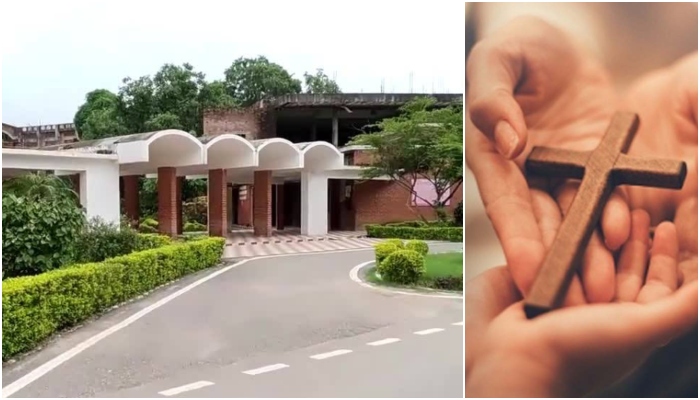
On January 27, Uttar Pradesh Police filed an FIR against eight officials of the Sam Higginbottom University of Agriculture, Technology, and Sciences (SHUATS) and several unidentified persons in Prayagraj, Uttar Pradesh for allegedly luring Hindus and forcing them to convert their religion to Christianity. The case has been filed against the vice-chancellor, two pro-vice-chancellors, and 5 others under the UP Prohibition of Unlawful Conversion of Religion Ordinance 2020.
According to the reports, the FIR was filed based on the complaint registered by a University’s former student named Savendra Vikram Singh on January 20. The complainant stated that he was told that in exchange for converting to Christianity, he can have a job, Rs 15 thousand in cash, and ‘marriage to a beautiful girl’ in Fatehpur.
Savendra Vikram Singh is a resident of Bahauddinpur village in the Gosainganj area of Sultanpur district and visited Fatehpur in December 2021. There he met Ram Chandra Paswan, a resident of Sujarahi village who asked him to convert his religion to Christianity. “He told me we and our organisation will give you cash and your family will get free medical treatment. I was told that I would be given a job in SHUATS, Prayagraj, and I would get married to a beautiful girl. I got trapped and Ram Chandra took me to the Indian Presbyterian Church in Deviganj where I was made to meet the pastor. Both (pastor and Ram Chandra) then promised me gifts and money and took me to SHUATS,” Singh said.
According to Singh, he then met university Vice Chancellor Rajendra B. Lal, director (administration) Vinod B. Lal, director (internal quality assurance and assessment cell) Ajai Lawrence, public relations officer Ramakant Dubey, Pro Vice-Chancellor (academics) Jonathan Lal, Pro Vice-Chancellor (Administration) S.B. Lal, dean (film and mass communication) Stephen Das, senior professor Derrick Denis, and around 40-50 other people who promised him cash, a job at SHUATS and a beautiful wife.
“Ajai Lawrence gave me Rs 15,000 in cash and Rajendra B. Lal told me that their organization has a lot of money and they would give me more if required. Then, I returned to Deviganj church with Ram Chandra and the pastor and converted to Christianity,” Singh was quoted by the Print.
Notably, Paswan who asked Singh to convert his religion in Fatehpur was arrested by the cops in July last year for running ‘changayi sabha’ and falsely promising ‘healing from illness’ to locals if they convert to Christianity. He also offered to get rid of bad spirits through prayers to Jesus and offered painkillers mixed ‘special water’ to visitors.
University officials already booked in another conversion case
The FIR comes almost a month after the Uttar Pradesh Police had sent notices to the chancellor, vice-chancellor, and an administrative official of a Prayagraj-based agriculture university in connection with a case of illegal conversion. An FIR was lodged against 56 people for practising religious conversion. Reports mention that while 53 out of 56 are out on bail, three of the accused are absconding at present.
The notices back then were issued to Chancellor Dr Jetti Oliver, Vice-Chancellor Bishop Rajendra B Lal and administrative official Vinod B Lal of Sam Higginbottom University of Agriculture Technology and Science (SHUATS), an agriculture university in Uttar Pradesh that was set up more than a century ago.
Police have seized 70 bank accounts of University and NGO founded by V-C
Vice-Chancellor Bishop Rajendra B Lal is the founder of an NGO named Yeshu Darbar Trust which holds religious congregations in around 12 of its centers in Prayagraj and other cities of Uttar Pradesh, Gujarat, and Jharkhand. According to SHO Amit Mishra of Kotwali Police station in Fatehpur, 70 accounts of the university and the trust founded by Lal are seized and are being probed.
“Of the 70 bank accounts, four belong to the trust and the rest are that of the university. The Trust has 12 centres across three states, UP, Jharkhand and Gujarat. An FIR was earlier lodged against people associated with the Gujarat centre years ago,” he said.
The University on the other hand has denied the allegations saying that complainant Singh was a University student but he never cleared his exams. “He was former B. Tech (dairy technology) student but he did not pay the fees and also failed to appear for the exams. He later came to the university and asked for his degree, saying he wasn’t getting a job anywhere, but the request was denied. Now, when an issue is being raised in Fatehpur, he has lodged an FIR. He has alleged that he arrived at the university on 25 December 2021, but it was during the Covid pandemic. Both the university and Yeshu Darbar were closed. He has alleged Lawrence gave him Rs 15,000 but the latter was out of the station that day,” SHUATS PRO Ramakant Dubey justified.
Two old cases against SHAUTS reopened
Reports mention that while the Police are probing into the religious angle of the case, it has also reopened earlier two police cases filed against the University. One case filed by Rakesh Dwivedi in 2012, accuses the university’s top brass getting arm licenses illegally by submitting fake information about names and addresses. The other one says that the University has not been granted minority status by the government but it claims so.
In 2012, a case was filed against University Vice Chancellor Rajendra B. Lal, director (administration) Vinod B. Lal, current registrar Robin L. Prasad and then registrar Ajai Lawrence under IPC sections 420 (cheating), 467 (forgery of valuable security, will, etc), 468 (forgery for purpose of cheating), and 471 (using as genuine a forged document or electronic record).
The FIR stated that the accused provided fake names and fake signatures despite holding government posts and took licenses for arms, revolver, rifle and double barreled gun from DM Pratapgarh. It stated that, despite having lived in Prayagraj since 1980, the defendants had shown their addresses to be in Sadar Bazar, Pratapgarh, while holding government positions.
The incident was investigated, and the investigating officer produced a final report (FR, a predecessor to the closure report) in March 2012 after concluding that the accused were not deficient under the sections implicated. Furthermore, the STF is investigating charges that the university did not get minority institution designation from the National Commission for Minority Education Institutions (NCMEI), the authority authorized to provide minority status to educational institutions.
Also on November 8, 2019, the UGC stated in an RTI response to Prayagraj-based Suvrat Kumar Singh, who had written to the UGC inquiring if SHUATS had minority institution status, that minority status is not awarded by it to an educational institution. Since the NCMEI grants minority status, the UGC submitted the inquiry to the commission, which responded on December 11, 2019, that it has not bestowed minority status certificates to SHUATS.
In the current given case, FIR has been lodged against eight university officials and 40-50 other unidentified persons executing illegal religious conversion of a man. The complaint has been filed under Indian Penal Code (IPC) section 120B (criminal conspiracy) and sections 3 and 5 (1) of the UP Prohibition of Unlawful Conversion of Religion Ordinance 2020.
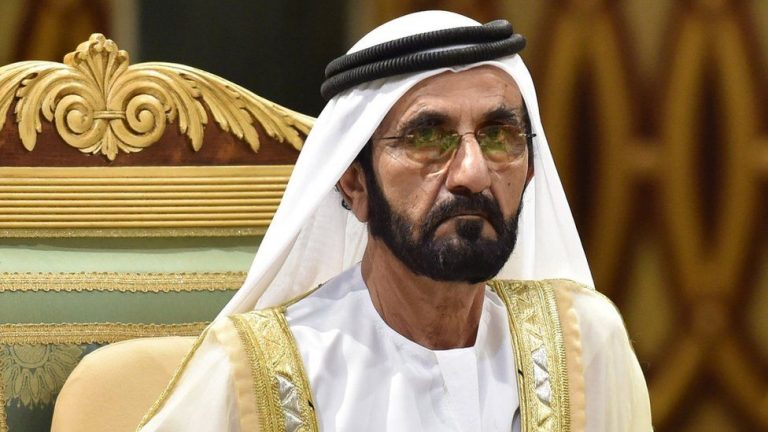
Dubai’s ruler and Vice President and Prime Minister of UAE, Sheikh Mohammed bin Rashid Al Maktoum issued instructions on Sunday, January 29, to rename Al Minhad area to ‘Hind City’. The city, which has 4 zones, from Hind 1 to Hind 4, is spread over an area of 83.9 square kilometers.
Once the news reached India, quite a few people online made the claim that the Dubai district has been renamed to acknowledge the contribution of Indians. While no official reason has been given for the name change, it may not be the actual reason behind the renaming of the area.
Ruler of Dubai and PM of UAE, Sheikh Mohammed bin Rashid Al Maktoum has ordered that a district in the emirate be renamed.
Al Minhad and its surrounding 84 Square KM areas will now be known as “Hind City” to honour the contribution of India and Hindus towards humanity. pic.twitter.com/3o5y45FLSU
“Hind” can mean quite a few things in Arabic, and is an old Arabic name as well. In fact, Sheikh Mohammed’s first wife is also named Hind. Hind bint Maktoum Al Maktoum, the senior wife of Sheikh Mohammed, married him on 26 April 1979 in a grand ceremony. The couple had 12 children, including the crown prince and next in line for Dubai’s crown, Sheikh Hamdan bin Mohammed Al Maktoum. So the district may well be named after her.
Hind can also refer to a large group of camels in Arabic. 100 or more camels are referred to as Hind. Actually, naming your daughters Hind in Arabic meant praying that may she get 100 camels or more.
Then, Hind may refer to India as well. Indians are called Hindi by Arabs.
However, as mentioned, no official reason has been given for the renaming of the district. OpIndia has requested UAE Prime Minister’s office for a comment. This report will be updated if we get the official reason from them for the renaming.
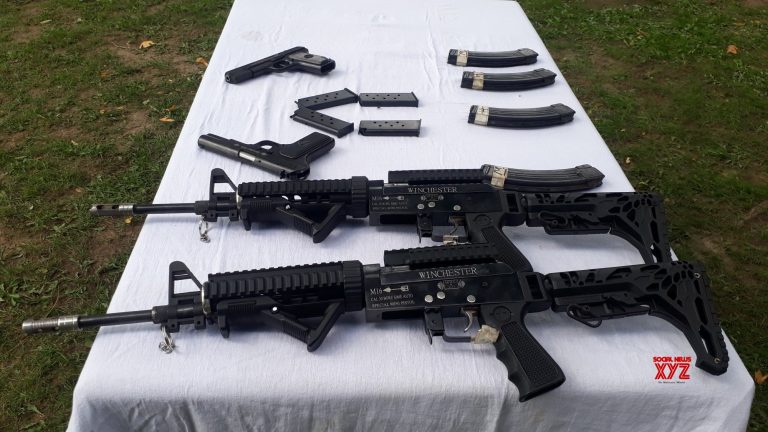
A large cache of weapons that fell into the hands of the Taliban when US-led NATO forces withdrew from Afghanistan in 2021, has now made its way to Kashmir in India. Pakistan-backed terrorists operating in the region have been observed to be using M4 carbine assault rifles, M16 rifles, and other US-made arms and ammunition, reports American broadcaster NBC News.
According to the report, the majority of such weapons seized thus far have come from Pakistan-backed terror organisations Jaish-e-Mohammad (JeM) and Lashkar-e-Taiba (LeT) operating in the Kashmir valley.
Experts are concerned that the enormous flow of US-made weaponry to such terror groups in the Kashmir valley may be the beginning of the weapons’ global journey.
According to Lt. Col. Emron Musavi, an Indian army spokesperson in Srinagar, terrorists from both organisations were sent to Afghanistan to fight alongside or train the Taliban. After the US-led NATO forces withdrew, “it can be safely assumed that they have access to the weapons left behind.”
However, when NBC News attempted to contact government authorities in Afghanistan and Pakistan for a comment, they reportedly did not respond.
It may be recalled that last year in July, Kashmir police had said that they have seized an M4 carbine assault rifle after two JeM terrorists were neutralised in an encounter.
— Kashmir Zone Police (@KashmirPolice) July 11, 2022
Questions about the US-made weapons being used in Kashmir were again raised in January 2022, when a video of terrorists brandishing American-made guns was shared widely on social media platforms.
Major General Ajay Chandpuria, General Officer Commanding (GOC) 19 Infantry Division stationed in Baramulla of North Kashmir also said in an interview with the news agency ANI last year that high-tech weapons left behind by Americans have found their way to Jammu & Kashmir.
Lt. Gov. Manoj Sinha of Jammu and Kashmir stated the government was aware of the issue and that measures were in place to resist the infiltration of US weaponry into Kashmir. “We are monitoring the situation closely and have taken steps accordingly. Our police and army are on the job,” Sinha said on the sidelines of a news conference last year at his official residence in Srinagar.
Weighing in on the issue, Ajai Sahni, executive director of the Institute for Conflict Management, a think tank in New Delhi, had said that the Pak-backed terrorist groups JeM and LeT are purchasing US weapons from the Taliban in Afghanistan, where both groups are reported to have bases, or through smugglers in Pakistan.
US left behind $7 billion of military equipment in Afghanistan during the 2021 withdrawal
Notably, a Defense Department report, published in August 2022, said that roughly $7 billion in military equipment supplied to the Afghan government was left behind in Afghanistan after the US completed its hasty withdrawal in August 2021.
A report by Forbes suggested that America has provided $83 billion worth of training and equipment to Afghan security forces since 2001. That year alone, the U.S. military aid to Afghan forces was $3 billion.
US-made weapons and equipment captured by Taliban were always likely to be sent to Pakistan, to be used against India
Soon after the withdrawal of the NATO forces, many in India raised concerns that these weapons may soon find a way into Pakistan, and then, through Pakistan-sponsored terrorists, to India, especially Jammu and Kashmir. A report by ANI quoted top military experts as saying that these weapons will first be used in Pakistan by the ISI-backed terrorist groups, and will then make their way into India.
“There are a lot of inputs suggesting that American-origin weapons, especially small arms are being sent to Pakistan. But the way terror groups have been emboldened there by the Taliban victory, there is a possibility of these weapons being used for violence in Pakistan itself,” senior military officers told ANI while discussing the Afghanistan war’s outcome.
On Monday, Congress’ so-called unity march named ‘Bharat Jodo Yatra’ led by its leader Rahul Gandhi ended in Kashmir but resulted in a huge disappointment for the party as leaders of only 8 out of 23 political parties attended the final event. Congress President Mallikarjun Kharge had invited heads of 23 political parties and had asked them to join the Bharat Jodo Yatra’s concluding event. However, only a handful of members managed to make it to the event.
According to the reports, DMK’s Tiruchi Siva, CPI general secretary D Raja, the National Conference’s Omar Abdullah, the PDP’s Mehbooba Mufti, the RSP’s NK Premachandran, BSP MP Shyam Singh Yadav and the IUML’s K Navas Kani attended the event at Sher-I-Kashmir Stadium on January 30. Also present were representatives of the JMM and the VCK.
The Congress expected all parties requested to send members to the celebration at Srinagar’s Sher-e-Kashmir cricket stadium. Congress communication head Jairam Ramesh had said in a press conference at the AICC headquarters earlier this month that there would be meeting and discussions among the heads of political parties ahead of the 2024 elections. “You will see the meeting in Srinagar on the 30th… the aim (of the meeting) is that the Bharat Jodo Yatra is over… what is the next step to be taken in the context of the 2024 elections… there will be some discussions on that,” he had said.
While HD Deve Gowda of the JD(S) and Rajiv Ranjan ‘Lalan’ Singh of the JD(U) had written to Congress head Mallikarjun Kharge expressing their inability to attend the occasion, leaders of the Trinamool Congress, RJD, Samajwadi Party, and CPI(M) failed to attend too. Shiv Sena (Thackeray), NCP, TDP, BSP, RLSP, HAM, MDMK, and Kerala Congress also skipped the meeting.
However, the majority of its partners including the NCP, Shiv Sena, JMM, and DMK, participated in the Yatra at various locations. When the Yatra entered Maharashtra, Aditya Thackeray (Shiv Sena) and Supriya Sule (NCP) walked alongside Rahul, while Sanjay Raut also recently joined him in Jammu.
Notably, BSP MP Shyam Singh Yadav, who walked beside Rahul when the Yatra passed through Delhi, also attended the ceremony. According to reports, Singh, the MP from Uttar Pradesh’s Jaunpur seat, did not attend the event as a BSP delegate.
“We all fought together for the independence of the country and liberated it from the British Raj. All secular parties must come together to liberate the country from the BJP Raj,” CPI leader Raja said. While Omar requested Rahul to take up another yatra from the west to the east of the country and promised to walk with him. Mufti meanwhile stated that the public saw a glimmer of hope in Rahul Gandhi.
“A historic movement was undertaken. Rahul Gandhi has proved that he is the right leader to fight against these divisive forces,” RSP’s Premchandran extended support to the Congress Party.
The five-month march began in Kanyakumari, Tamil Nadu’s southernmost town, and ended in Srinagar, the state capital of Jammu and Kashmir. Though the march attracted large crowds around the country and received support from several celebrities, it is difficult to say if this attempt of Rahul Gandhi would help him get votes in the upcoming 2024 Lok Sabha elections.
Last week it was reported that India’s citizens appear to be content with the performance of the Narendra Modi-led NDA administration. According to the India Today-CVoter Mood of the Nation survey, if the Lok Sabha elections were conducted today, the Bharatiya Janata Party would win 284 seats and the Congress party would win 191 seats only.
On Monday, the Uttar Pradesh Police registered an official complaint against a person named Aarif for abducting a Hindu minor girl in the Kasganj district of the state. The case has been registered based on the complaint filed by family members of the victim. Brothers of Aarif identified as Tahir, Moti and Abid have also been booked in the case.
According to the report published by Amar Ujala, the incident is said to have happened on January 23 when the family members of the victim had gone to the fields for their job and the girl was alone at home. Aarif who stays in the same village arrived at the girl’s home and took her forcefully with him.
The family members reached home to see their minor girl missing and they began searching for her. During their search, they discovered that Aarif had taken the girl away with him. They then went to Aarif’s home in search of their daughter. But his brothers Tahir, Moti and Abid happened to verbally assault them.
Aarif’s family members and his brothers also physically assaulted the victim’s family as they constantly kept on inquiring about their minor daughter. They also were issued death threats by the accused’s brothers.
The victim’s family members then immediately reached the Police station and registered a police complaint against the accused and his brothers. They mentioned in the complaint that Aarif had abducted their daughter and his brorthers, Tahir, Moti and Abid had issued death threats to them.
The police has registered an FIR based on the complaint filed by the family members of the victim and have launched an investigation in the case. The accused has been booked under the relevant sections of the law.