Home Blog Page 3144

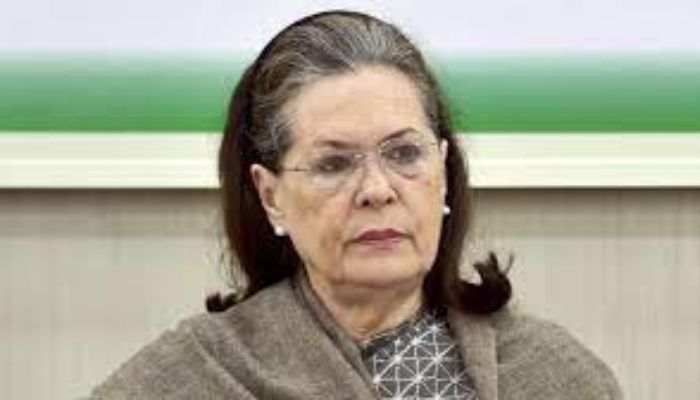
Sonia Gandhi in hospital for fungal infection in the lower respiratory tract, also facing other post-Covid symptoms: Congress

Congress president Sonia Gandi has reportedly been diagnosed with a lower respiratory tract infection after being admitted to the Ganga Ram Hospital in New Delhi. She is still being monitored and treated, according to the Congress party.

According to AICC general secretary Jairam Ramesh, Sonia Gandhi was hospitalized on June 12 after bleeding from her nose due to a recent Covid infection. In a statement, Jairam Ramesh said, “She was immediately put under treatment and underwent a related follow-up procedure yesterday morning.”

Jairam Ramesh, the party’s new general secretary in charge of communications, stated that a fungal infection in her lower respiratory tract was diagnosed during her hospitalization. He further said, “She is currently being treated for it along with other post-Covid symptoms. She continues to be under close observation and treatment.”

The Enforcement Directorate has summoned Sonia Gandhi on June 23 in a money-laundering investigation. The summons is issued in the National Herald case. Her son, former Congress President Rahul Gandhi, is already being questioned by the investigation agency, with his next deposition expected on Monday. After the agency issued the summons, the Congress leaders accused the central government of misusing the government agencies.

On the other hand, as Sonia Gandhi and Rahul Gandhi were summoned by ED, the Congress party launched violent protests in various cities across the country. Congress workers protested in front of the central government’s various offices in the states. In one such protest in Hyderabad of Telangana, Congress leader and former minister Renuka Chowdhury lost her cool and grabbed a police sub-inspector by his collar. Many leaders of the Telangana Pradesh Congress Committee were detained by the Hyderabad police in this case.

The Enforcement Directorate case had sent a notice to Sonia Gandhi to appear before it on June 8 for interrogation in the National Herald case. But due to the Covid-19 infection, she is now scheduled to appear before the ED on June 23.

Pune: Young woman raped by one Rehan Syed while his friend Arbaz made a video, 6 booked for blackmailing

A case of rape and blackmail has come to light in Pune on 17th June 2022. The accused youth Rehan Syed reportedly shot a video of the victim girl with the help of his friends and threatened her that the clip will soon be viral on social media.

A case is registered against the accused, his friends, and his family members in the Kondhwa police station of Pune. As the accused are absconding, the police are on the lookout.

According to a report by Loksatta, the victim girl and the accused Rehan Syed were known to each other. Rehan Syed proclaimed his love to the girl and reportedly coerced her into a physical relationship. Arbaz Shaikh, a friend of the accused Rehan Syed secretly shot a video of Rehan making sexual relations with the girl. After this, accused Rehan Syed shared the video clip with his friends Shahrukh and Sohail. Both Shahrukh and Sohail started threatening and blackmailing the girl saying that they will make the clip viral on social media.

Fed up with this trouble, the victim girl informed Rehan Syed’s mother about the issue and sought her help. However, Rehan’s mother and his sister beat the victim girl and abused her. Both the mother and sister too joined in to blackmail the victim girl saying they would make the clip viral on social media. The victim girl filed a complaint in the Kondhwa police station against Rehan Syed, his mother, his sister, Shahrukh Shaikh, Arbaz Shaikh, and Sohail Pathan. The police have registered the case and all the accused are absconding. A team of police personnel led by police sub-inspector Samadhan Machale is doing further investigation into this case, Loksatta reported.

IIIT Basara students have been protesting for 3 days, but Agnipath noise drowns their voice: Read why students in Telangana are out on streets

We are all aware that protests by thousands of so-called ’aspirants’ of the Indian Armed Forces opposing the centre’s latest Agniveer scheme is among the hot topics discussed at length by media organisations. However, there is another burning issue that has prompted the students of IIIT Basara in Telangana to take to the streets in protest against the incumbent TRS government. Surprisingly, there is no widespread coverage of the issue since the mainstream media has deliberately neglected it, with just one or two short reports in the public domain.

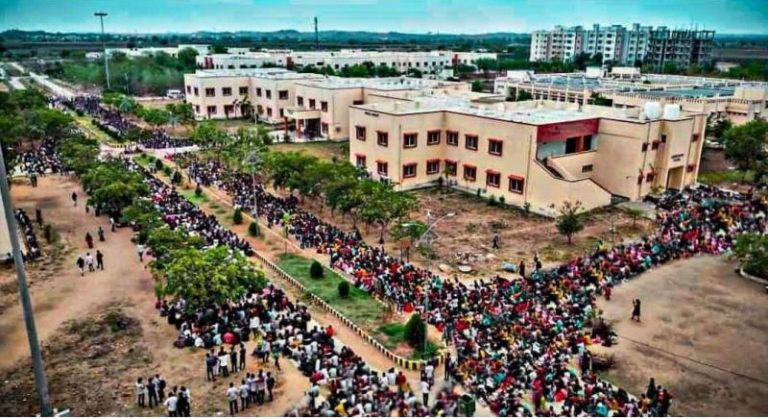
Thousands of students at the International Institute of Information Technology (IIIT) in Basara are on strike for the third day in a row over issues linked to the administration of services in the institution, but they have gotten virtually minimal attention up to this point. Here are the details as to why these students are protesting against the state government of Telangana.

Protests at the Rajiv Gandhi University of Knowledge Technology also known as IIIT Basara

For the third day in a straight, hundreds of students at Telangana’s the Rajiv Gandhi University of Knowledge Technology, widely known as IIIT Basara, are on strike, demanding decent meals, labs, and other academic facilities. They are criticising the poor food quality and requesting that other basic amenities, as well as the appointment of a permanent vice-chancellor, be addressed.

The students also requested that K. Chandrasekhar Rao, the Chief Minister, and K. T. Rama Rao, the Minister of Information Technology, come to RGUKT to witness the problems firsthand. Students have expressed dissatisfaction with the quality of food offered at hostel meals. In many instances, they claimed to have spotted little insects and frogs in the hostel meals.

Students indicated that they are not being given the essential laptops and uniforms and that numerous hostels and college buildings are in disarray, without sufficient mattresses, fans, and other amenities. Hundreds of stressed-out students began boycotting classes and protesting on Tuesday, sitting on a protest at the administrative office and subsequently marching to the campus’ main gate.

The students issued a manifesto of 12 demands, including the recruitment of professors, the appointment of a full-time VC who can swiftly address their issues, the supply of internet, projectors, and other classroom equipment, and, most significantly, healthy meals.

Engineering and pre-engineering students have taken to the road due to the university’s dreadful status in every domain, from lectures to meals to other areas such as unclean housing and poor sports facilities. Despite apparent intimidation by authorities and police, students are asking that either Chief Minister K Chandrasekhar Rao or his son, IT-Industries and Municipal Administration Minister KT Rama Rao, visit their campus to put an end to their miseries.

The heightened police presence, according to a student leader, is intended to terrify students, but they will not back down until their concerns are addressed. Bandi Sanjay Kumar, the head of the Telangana BJP, has accused the administration of attempting to frighten the protesting students.

The Rajiv Gandhi University of Knowledge Technology

The RGUKT, or IIIT Basara, is one of three IIITs established in unified AP in 2008 during the YS Rajasekhara Reddy regime and is presently Telangana’s sole one. It lies in the Nirmal district of north Telangana, in Basara, a town known for the Goddess Saraswati temple on the banks of the Godavari. It houses around 8000 individuals. Meritorious children are accepted, with preference given to those who attend public schools.

“Army must be young and fit at all times”: Kargil Review Committee had recommended measures implemented in the Agnipath scheme

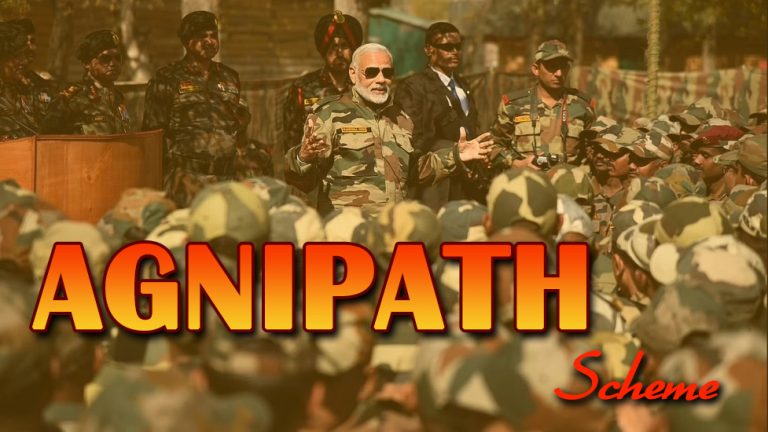
Ever since the Defence Ministry announced the Agnipath scheme for recruitment into armed forces, the scheme has met with resistance from a large number of so-called army aspirants and opposition political parties. As usual, Rahul Gandhi has criticised the scheme, instigating more protests against it.

Under this new scheme of recruitment into armed forces, soldiers will be recruited for four years. After the end of the term, they will be able to apply for permanent jobs in the armed forces, and around 25% of them will be inducted. After the four-year service period, Agniveers who are not absorbed in regular commission will be paid a one-time ‘SevaNidhi’ package amounting to ₹11.71 Lakh. They will also get preference in PSUs, and State Governments’ jobs, and state and central police forces.

This has been called a radical change in the recruitment process, and some youths aspiring to be soldiers are burning trains against it, demanding the continuation of existing recruitment process. While the opposition parties and even some army veterans have criticised the scheme, the fact is that such short service for soldiers was suggested two decades ago, in the Kargil Review Committee report.

The committee formed to study the sequence of events that led to the Kargil war and make recommendations had made several suggestions to improve the defence of the country. Some of them have been already implemented.

One of the key recommendations of the committee was to reduce the average age of soldiers, as the report said that the army must be young and fit all the times. The committee had also recommended an integrated manpower policy for Armed forces, para-military forces and the Central police forces.

The committee had said, “in the light of the new situation of proxy war and large scale terrorism that the country faces, the role and the tasks of the para-military forces have to be restructured particularly with reference to command and control and leadership functions. They need to be trained to much higher standards of performance and better equipped to deal with terrorist threats. The possibility of adopting an integrated manpower policy for the Armed Forces, para-military forces and the Central police forces merits examination.”

The report had further said, “The Army must be young and fit at all times. Therefore, instead of the present practice of having 17 years of colour service (as has been the policy since 1976), it would be advisable to reduce the colour service to a period of seven to ten years and, thereafter, release these officers and men for service in the country’s para-military formations.”

The committee formed after the Kargil war had suggested that after the end of the service period, they can be absorbed in regular police forces or in a “National Service Corps (or a National Conservation Corps), as provided for under Article 5 lA(d) of the Constitution, to spearhead a range ofland and water conservation and physical and social infrastructure development.”

The committee had observed that this will reduce the age profile of the Army and the para-military forces, and also reduce pension costs and other entitlements such as married quarters and educational facilities.

The committee had noted that the army pension bill of ₹6,932 crore in 1999-2000 was almost two-thirds of the salary bill, and it was rising sharply every year. In this year’s budget, ₹5.25 lakh has been allocated for defence, out of which ₹1,19,696 crore is allocated for pensions alone, which means almost 25% of defence budget is spent for paying pensions only. The army pension have gone up sharply after the implementation of the One Rank One Pension (OROP) scheme.

Such large amount spent on pension means that nothing much is left for much needed modernisation of the armed forces, including procurement of modern arms and equipment systems. The defence sector already gets a large portion of budget allocation, and the possibility of increasing its share is very less. While some experts suggest increasing the budget allocation for defence, the Kargil Committee had suggested against it.

While noting that budgetary constrains have affected the process of modernisation and created certain operational voids, the committee had said that the share of allocation for defence should not be increased, instead, the govt should find another way to increase spending on modernisation. The report had said, “The Committee would not like to advocate any percentage share of GDP that should be assigned to defence. This must be left to the Government to determine in consultation with the concerned departments and the Defence Services.”

The Agnipath scheme implements these recommendations.

Under this scheme, candidates between the age of 17½ years and 21 years will be recruited as Angiveers, and as they will serve for only 4 years, the maximum age of an Angiveer will be 25 years. Thus, the soldiers will remain young and fit in their entire term of service.

While 25% of the Agniveers recruited under Agnipath scheme will be absorbed into regular commission, who will be promoted to higher ranks, the rest 75% will be given preference in govt and PSU jobs. This includes recruitment into state police forces and central armed police forces. Youths trained in army working in police forces will definitely enhance the operational efficiency of the police and para-military forces.

Apart from state and central police forces, the retired Agniveers will also be valuable manpower in central and state disaster response forces, and similar jobs requiring physical fitness. Therefore, while 75% of the youths will no longer be with the army after 4 years of service, they will certainly find gainful employment in govt and private sector.

The Agnipath scheme will help in keep a check on the rising army pension bill, as the Agniveers will not be paid pension after their service is over. Around 45000 to 50000 Agniveers will recruited every year, which means a substantial savings in pensions under the under Agnipath scheme.

And all these were recommended by the Kargil Review Committee more than two decades ago, which was not implemented by the previous govts.

Army had proposed three-year recruitment scheme

Not just the Kargil committee, the Indian Army had also proposed a recruitment scheme similar to the Agnipath scheme to save on manpower cost. In 2020, the army had proposed “tour of duty” scheme to recruit youths for 3 years. The current scheme has several similarities with this proposal, while the service term has fixed at 4 years instead of 3 years.

The army had calculated substantial monetary savings by employing soldiers for three years instead of 17 years currently, saying that the saved money can be used for the much needed modernisation of the armed forces.


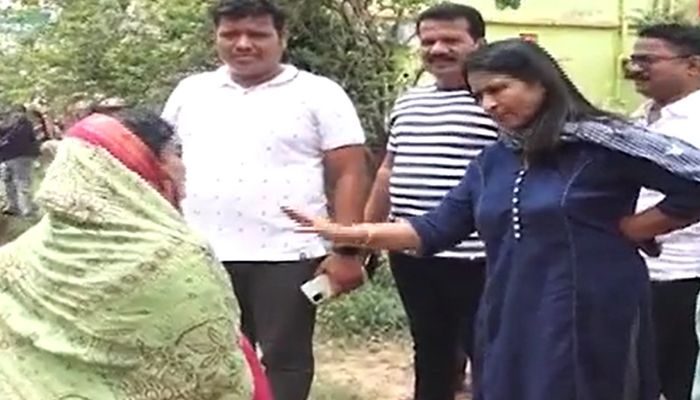
‘If your toilet water comes to the road, I will put a truckload of municipal garbage inside your house’: Bhubaneswar mayor tells residents

Sulochana Das, the first woman Mayor of Bhubaneswar has told some residents of the city that they can no longer let their toilet water flow on the roads. In a video by Odisha’s Kanak News, she is seen scolding the citizens who release the dirty toilet water from their houses on the roads.

Sulochana Das reprimanded them saying, “If one drop of toilet water comes to the road, I will put a truckload of municipal waste inside your house.”

The newly elected mayor Sulochana Das was seen in a strict mode while visiting areas where residents were discarding toilet water onto roads. In the video, a local woman is seen telling the mayor that most people in the locality do it so they do it too (letting toilet water flow onto the road near the houses). Some other local residents are also seen trying to give excuses to the mayor.

“I don’t know what you did till now, I don’t know who all are doing it. But from today, if one drop of wastewater comes to the road, I will park the municipality garbage truck near your house and start putting the garbage in. BMC (Bhubaneswar Municipal Corporation) has no shortage of garbage,” the Mayor was seen telling the residents.

Sulochana Das is from the Biju Janata Dal. She assumed the charge as the first woman mayor of the capital city of Odisha on 10th April 2022. Another BJD corporator Manjulata Kanhar is the Deputy Mayor of the city. For the first time, BMC is having two women in the top two positions of the local body. Water logging and drainage are among the main problems faced by the residents in Bhubaneswar city.

Violence across India overshadows the public discourse on the Agnipath recruitment scheme: Here are some visuals from across India

On Tuesday (June 14), the Indian government, along with the chiefs of the three armed forces, launched the Agnipath scheme for the recruitment of youth in the armed forces. The new recruits under the scheme will henceforth be known as ‘Agniveer’.

As per reports, the enrollment will be open for both men and women for a four-year period, including the training. Following the completion of their service, Agniveers will get preference in PSUs, and State Governments’ jobs. The Modi government had also announced the recruitment of 46,000 Agniveers this year.

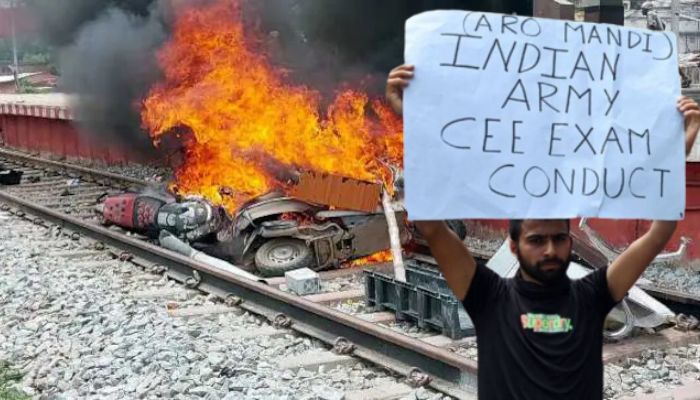
Soon after, scores of armed forces aspirants took to the streets and destroyed public property under the pretext of ‘peaceful protests’ and demonstrations. While demanding a rollback of the government scheme, they vandalised public property, burnt trains and brought life to a standstill across various Indian States.

Students unleash mayhem in the name of protest

In the Southern State of Telangana, students dissatisfied with the Agnipath recruitment scheme vandalised the Secunderabad railway station and set a train on fire.

Visuals shared by news agency ANI showed an abandoned station, with smoke gushing out of a stationary train. The frenzied mob also damaged shops belonging to small business owners, which were located at the station.

The armed force aspirants also blocked the railway tracks in the Narwana town in the Jind district of Haryana. They were seen disrupting railway service and standing on railway tracks with a tricolour in hand.

In Palwal, the police had to fire aerial shots to disrupt the mob which was pelting stones at them. During the scuffle, several police vehicles were damaged and police personnel were injured.

Similar scenes were observed in Gwalior in Madhya Pradesh. Violent protestors, with their faces covered, were seen vandalising a railway station and throwing objects on the railway tracks.

They also burnt tyres in Gole ka Mandir area, prompting the State government to deploy a large contingent of police personnel to pacify the situation.

In Uttar Pradesh, the violent mob of aspirants vandalised the windscreen of roadway buses on the Agra-Lucknow Expressway. They also set a train ablaze in Balia during the protest.

The fury of the ‘students’ reached its zenith in the state of Bihar. On Friday (June 17), they attempted to vandalise the Hajipur railway station but their plans were thwarted by the police.

While speaking about the development, SP (Hajipur) Maneesh remarked, “Situation at the moment is alright. Hooligans have been chased away. Some of them have been detained for questioning.”

The mob had earlier pelted stones at the residence of Deputy Chief Minister of Bihar, Renu Devi.

In a tweet, journalist Smita Prakash said, “Agnipath vandals have reached your homes, your gated neighbourhoods. No one is safe anymore. Will you react now dear politicians? Mobs you unleash will consume you. These visuals from outside Bihar’s deputy Chief Minister Renu Devi’s home, they threw stones at her balcony.”

In Nevada, the aspirants blocked roads, burnt tyres and trains and caused public inconvenience under the guise of peaceful protests.

In the hill state of Himachal Pradesh, the students held protests in Kangra, Mandi, Hamirpur, Nagrota and Gaggal on June 16. They tore down PM Narendra Modi’s hoardings in Kangra and burnt the flags of the BJP.

They also blocked highways and raised slogans against the Modi government. The mob clashed with the cops, prompting the police to use force. The grim law and order situation, created by the armed forces aspirants, forced former Army General VK Singh to rule that they are unfit to become part of the Indian army.

Why do students want the rollback of the Agnipath scheme?

One of the grievances of the armed force aspirants is that only 25% of the Agniveers, recruited under the new scheme, will get the opportunity to continue for a full term. Many have also cried foul over the lack of pensionary benefits.

Some of the students have also complained that the recruitment in the Indian army was halted for a period of 2 years due to the outbreak of the Coronavirus. They claim that their future will be shrouded in obscurity with the implementation of the new scheme.

“It takes us 3 years to prepare for Indian army exams. We prepare for 3 years and get to serve only 4. What is there for us after we retire? The government is saying that we will get to join the IT sector. What will I do? Become a security guard. Is that what I am preparing for?” said a protestor on News 24.

The misplaced protests and benefits of the Agniveer scheme

Having said that, the early exit option for Agniveers will leave them with a SevaNidhi fund of ₹11.71 lakh and the ability to start a new career, get priority selection in police services, government agencies, and PSUs.

Apart from that, Agniveers will also get a non-contributory Life Insurance Cover of Rs 48 lakh for the duration of their engagement period in the Indian Armed Forces. During the period of service, the recruits will learn various military skills, including discipline, physical fitness, leadership qualities, courage and patriotism.

Although around 25% of the recruited Agniveers will be enrolled in Armed Forces as regular cadres post the four-year service, all candidates can apply on a volunteer basis to enrol in the regular cadre. 

In association with IGNOU, the Armed Forces will provide graduation degrees to Agniveers that will help them if they want to go for higher studies after completion of four years of service.

Outcomes of 12th WTO Ministerial Conference favourable to India: Commerce and Industry Minister Piyush Goyal

After five days of arduous discussions at the World Trade Organization (WTO), sources indicate that India made a significant influence, with its point of view expressed in all sectors, and that the country’s interests were not put at risk whatsoever.

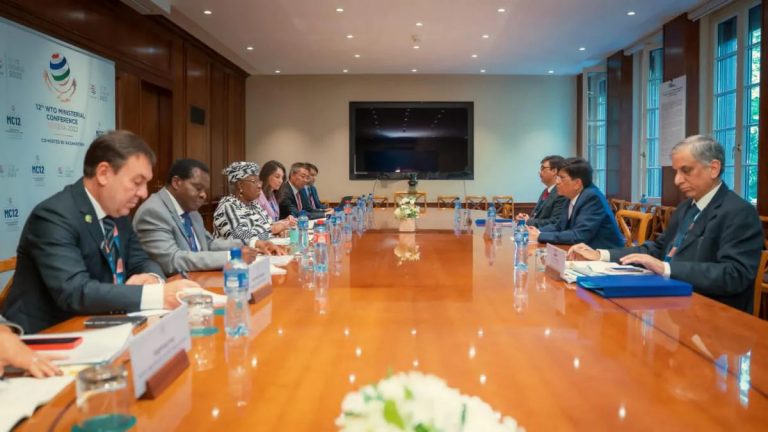
On June 17, Commerce and Industry Minister Piyush Goyal also stated that India had a fantastic triumph at the World Trade Organization’s 12th ministerial conference (MC12) in Geneva, Switzerland. Goyal headed India’s team to the four-day global summit, which was prolonged for two more days due to disagreements among signatory countries on critical subjects.

Speaking to reporters after the once-every-two-year mega-conference of trade ministers from all 162 WTO member countries ended in the early hours of Friday, Piyush Goyal said, “India is 100% satisfied with the outcome of WTO’s MC12 conference. India was successful in ensuring the livelihood of its farmers and fishermen.”

Despite several foreign news accounts specifying India as a serious obstacle at the WTO, Goyal stated that India played a very constructive role in this ministerial. MC12 concluded with agreements on a global IPR waiver for Covid vaccinations and fishing subsidies to conserve ocean resources. The deal is in accordance with India’s desire to encourage sustainable fishing and to press for the abolition of “irrational subsidies” and overfishing by numerous nations that harmed Indian fishers.

“The agreement on fisheries is currently limited to illegal, unreported, unregulated fishing. The discussion on extending this to all government subsidies will take place going forward. Currently, there are no restrictions on government subsidies,” Goyal said at the press briefing.

Goyal also stated that there will be no negative consequences for India’s agricultural sector. He also said that India’s public stockholding programme for foodgrains will continue unabated. Goyal stated that negotiations on food security had proceeded to some extent.

MC12 also authorised a temporary suspension of some provisions of the World Trade Organization Agreement on Trade-Related Aspects of Intellectual Property Rights (TRIPS). Suspension of portions of the TRIPS agreement would enable governments to overcome the legal hurdles faced by patents in order to ensure timely distribution of economical medical supplies.

At the 12th ministerial meeting, which began on Sunday, negotiators from 162 nations sought agreement on a number of themes, including the WTO’s response to future pandemics and an IP waiver for vaccines, fisheries subsidies, WTO reforms, agriculture, food and nutrition security, and e-commerce solutions.

Rajasthan: CBI raids CM Ashok Gehlot’s brother Agrasen’s properties in 2007 fertilizer scam case, earlier ED had conducted similar raids

The Central Bureau of Investigation (CBI) on Friday conducted raids at the residence and shop of Rajasthan CM Ashok Gehlot’s brother Agrasen Gehlot in Jodhpur. Gehlot is a fertilizer trader and is accused of exporting subsidized fertilizer between the years 2007 and 2009 when the UPA government was in power.

According to the reports, Gehlot was questioned by the Enforcement Directorate in the case in the year 2020 as well. The ED had also raided ‘Anupam Krishi’, a business that is run by Agrasen Gehlot.

Criticising the event, Congress leader Jairam Ramesh called the CBI action ‘vendetta politics’. “This is vendetta politics beyond all bounds. Ashok Gehlot was at the forefront of the protests in Delhi over the past three days, and this is Modi government’s brazen response. We will not be silenced,” Ramesh tweeted referring to Congress’ protest against ED in the National Herald case.

The 2007 Fertilizer Scam

The fertilizer scam of the year 2007 refers to the illegal export of Muriate of Potash (MoP), which is imported by Indian Potash Limited (IPL) and distributed to the Indian farmers. It is alleged that Gehlot during 2007-2009 exported 35,000 tonnes of MoP to foreign countries that was meant for Indian farmers at a subsidized rate.

“MoP was meant for poor farmers of the country. Agrasen Gehlot, through his company Anupam Krishi, bought the MoP at a subsidised rate and later sold it at a high rate to countries like Malaysia and Vietnam,” the ED had said in 2020 after conducting searches. The ED also had said that the MoP was exported majorly to Malaysia and Singapore in the guise of industrial salt.

According to the reports, the scam is stated to be worth Rs 150 crores. Gehlot and his company in the past have also been slapped with a Customs penalty of about Rs 7 crore in this case.

Pakistan: Two minor Hindu sisters raped at gunpoint; police delayed filing an FIR due to the accused’s influential background

The atrocities on minority Hindus continue unabated in Pakistan. On June 16, Thursday, it has been reported that two minor Hindu sisters were raped at gunpoint in the Islamic country’s Punjab province. One of the accused belongs to an influential family in Pakistan.

BJP leader Manjinder Singh Sirsa took to Twitter Thursday to share a report by DNA on the crime. He Tweeted, “Minorities continue to suffer in Pak: 2 Hindu teenage sisters raped at gunpoint in Punjab province of Pakistan. Pak Police registered a case after a 3-day delay as some influential people of the area reportedly wanted to settle the matter with the victims’ family.”

On the morning of June 5, two sisters, ages 16 and 17, left their home in Bahawalnagar, Fort Abbas, some 300 kilometres from Lahore, to attend a nature call in a nearby field when two men allegedly held them at gunpoint, area police official Irshad Yaqoob was quoted by PTI as saying. The accused, identified as Umair Ashfaq and Kashif Ali, then raped them and fled the scene, the official said.

The girls were taken for a medical test, which confirmed that they were raped, said Yaqoob.

According to reports, the police did not take cognisance of the incident immediately and registered a case only after a delay of three days. The clout and influence of one of the accused, Kashif Ali, are believed to be the reason for the police’s callousness in handling the case.

As per reports, Kashif belongs to an influential family in the area and his family wanted to privately settle the matter with the victims’ family and not take it to court. This is why the police initially delayed in filing the FIR against the accused. However, after three days, an FIR was filed based on the complaint of the girls’ father.

The police arrested one of the accused Umair Ashfaq while the other Kashif Ali used his connections to secure a pre-arrest bail from the court.

As US condemns the statements by Nupur Sharma, here is what a Pakistani Maulana said about its hand in the global outcry

0

On Thursday, the United States issued a statement condemning the remarks made by ex-BJP spokesperson Nupur Sharma and Naveen Kumar Jindal. The US also backed the Bharatiya Janata Party (BJP) for distancing itself from Sharma’s comments on Prophet Muhammad.

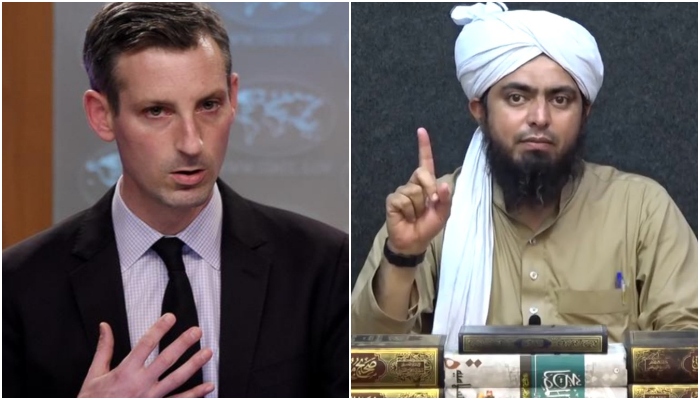
“We condemn the offensive comments made by two BJP functionaries, and we were glad to see that the party publicly condemned their statements,” State Department spokesperson Ned Price said in a daily news conference on June 16. He added that India should promote respect for human rights.

Nupur Sharma in a TV debate had made some comments as per the Hadiths on Prophet Muhammad that irked the Islamists. She argued that since people are mocking the Hindu faith repeatedly, the Hindus can also mock other religions by referring to Islamic beliefs and the life of Prophet Muhammad. Her statement was taken out of context by Alt News co-founder and alleged fact-checker Mohammed Zubair, whose tweet unleashed an army of trolls and Islamists after Sharma.

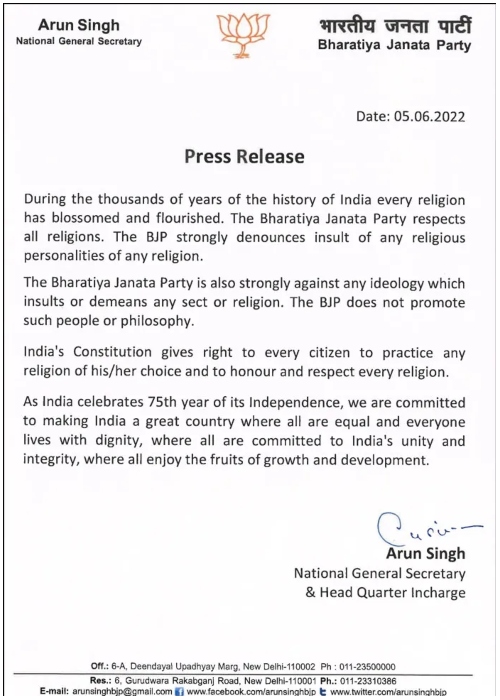
Later the BJP also distanced itself from her statement and suspended her from the party. In its suspension letter, the BJP told Sharma that she had expressed views contrary to the party’s on various matters which violate the party’s constitution. “The BJP respects all religions. It strongly denounces insults of any religion. personalities of any religion. The Bharatiya Janata Party is also strongly against any ideology which insults or demeans any sect or religion. The BJP does not promote such people or philosophy”, the letter read.

Press note issued by BJP on June 5

Reportedly, multiple FIRs have been registered against Sharma and open calls for her death have also been made. She also received threats from extremist organizations across the border. The Tehreek-e-Labbaik Pakistan (TLP) supporters from Pakistan announced a cash reward of Pakistani Rupees 5 million (Around 19.5 lakhs INR) to anyone who would behead Nupur for allegedly committing ‘blasphemy’. Further, terrorist organizations like Al Qaeda have threatened to conduct suicide attacks in India over Sharma’s remarks.

Interestingly, while several other Islamists are taking to the streets to protest against the ex-BJP spokesperson, Maulana Engineer Mohammad Ali Mirza of Pakistan has come out in support of Nupur Sharma. In one of the videos that is going viral on social media, he stated that a Muslim panelist first provoked Nupur Sharma and in response to this the suspended spokesperson of BJP commented about the Prophet.

He also slammed the US for grabbing the opportunity to criticize India over the Prophet Mohammed row. He said, “Arab countries are slaves of those countries who oppose Russia. When they saw India trapped in controversy, they told the US to issue official statements against India over the Prophet Mohammed row”. He stated the need to understand the atmosphere around the entire controversy. “From the style and tone of Nupur Sharma’s statement, we can see that she was retaliating. The first accused is the Muslim who mocked another person’s religion in a live TV program”, he added.

He further questioned the interference of the Arab countries in the matter. He said that the recent Nupur Sharma incident was just a 5-second distorted clip, but why didn’t Arab nations raise their voices in the past when real, major incidents of ‘blasphemy’ occurred. “Sharma has officially apologized for her statement. Her statement was not at all planned and organized. It was accidental”, he added.

To note, before the United States, more than 15 countries including Qatar, Kuwait, Iran, Pakistan, Saudi Arabia, Bahrain, Jordan, Oman, Turkey, Maldives, Indonesia, Libya, Iraq, Malaysia, and even the Taliban regime in Afghanistan have condemned the alleged ‘blasphemous’ remarks by Sharma.

In India, the issue is still burning with Islamists coming out violently on the streets last week after the Friday prayers. Staging protests in various parts of the country, Islamists are either demanding the immediate arrest of Nupur Sharma or are demanding her death. Severe Islamist protests against Sharma have so far been seen in Indian cities of Kanpur, Prayagraj, Hyderabad, Mumbai, Solapur (Maharashtra), Ludhiana (Punjab), Belagavi (Karnataka), and also in the states of West Bengal and Jharkhand.